Section5.5The Fundamental Theorem of Calculus, Part II
In this section, we will learn the Fundamental Theorem of Calculus (FTC), part II, which states that integration and differentiation are inverse process (so they cancel each other).
Using our knowledge of function notation, we know that the name of the accumulation function is \(A\text{,}\) with the input of \(x\) and the output of \(A(x)\text{.}\)
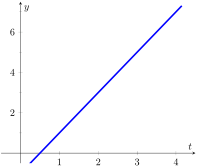
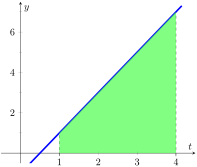
Find the value of \(A(1)\text{,}\)\(A(2)\text{,}\)\(A(3)\text{,}\) and \(A(4)\text{.}\) Then graph the function \(y = f(t)\) and indicate what these values represent on the graph.
Recall definite integral represents some sort of signed area of the region under the curve. Can we find the (signed) area of the region under the curve geometrically?
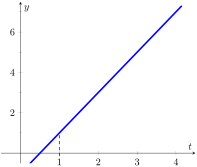
\(A(1)\) represents the area under the line \(y = f(t)\) from \(t = 1\) to \(t = 1\text{.}\) Graphically speaking, the area is 0, shown in the diagram below.
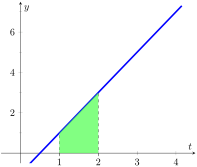
\(A(2)\) represents the area under the line \(y = f(t)\) from \(t = 1\) to \(t = 2\text{.}\) Graphically speaking, the enclosed region is a trapezoid, with the area of
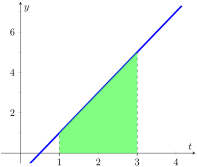
\(A(3)\) represents the area under the line \(y = f(t)\) from \(t = 1\) to \(t = 3\text{.}\) Graphically speaking, the enclosed region is a trapezoid, with the area of
\(A(4)\) represents the area under the line \(y = f(t)\) from \(t = 1\) to \(t = 4\text{.}\) Graphically speaking, the enclosed region is a trapezoid, with the area of
Notice that the variable \(x\) appears to be in the place of the upper limit of integration in the integral. This implies that the input of the accumulation function, \(x\text{,}\) represents the upper limit of integration. It tells us how "far" we are integrating from the starting point of \(t = a\text{.}\)
The outout of the accumulation function, \(A(x)\text{,}\) represents the signed area under the curve of \(y = f(t)\) from \(t = a\) to \(t = x\text{.}\)
We call \(A\) the accumulation function because it accumulates the signed area under the curve as we move from the starting point of \(t = a\) to some later point \(t = x\text{.}\) Your textbook actually call it the area function but this idea of area can be generalized. The accumulation function accumulates some quantity (and it doesn’t have to be some area) between two points.
Note5.5.8.Why are there two variables in the function....
Notice that there are two variables in the accumulation function, \(x\) and \(t\text{.}\) Why do we need both the \(x\) and the \(t\) to define the accumulation function...
Then the next natural question to ask here is why wouldn’t it make sense to use ONLY one variable to do both jobs (like only using \(x\) as the variable)? Wouldn’t it make the function easier?
Well we can do a quick experiment to see if it works to use only \(x\) as the variable in the accumulation function. Let’s define the accumulation function like this:
Wel... \(f(2)\) is a constant (the output of the function with an input of \(2\)), so we are really integrating a number here (boring). Also, what is \(d2\text{...}\) Well we know that the symbol \(d\) here represents the infinitesimally small amount of change. But \(2\) is a constant and the value of \(2\) will never change... So \(d2\) doesn’t really make sense mathematically...
Now that we know what the accumulation function is, we can investigate the Fundamental Theorem of Calculus in the next section! As the name of the theorem suggested, this theorem is really fundamental in the study of calculus.
It turns out that THE fundamental theorem of calculus says the integration and differentiation are inverse processes. That is, they will cancel each other. This relation (at least half of it) is captured in the Fundamental Theorem of Calculus, Part II, in your textbook page 326. I also included it below:
Let \(f\) be a continuous function on an open interval \(I\) and let \(a\) be in \(I\text{.}\) Then the definite integral of \(f\) from \(a\) to \(x\text{,}\) aka the accumulation function, is an antiderivative of \(f\) on \(I\text{.}\) That is,
You may be wondering why differentiation will cancel the integration. Well your textbook provided a technical proof in this section using the fancy Squeeze Theorem. We will come up with the (same-ish) argument but in a more intuitive sense.
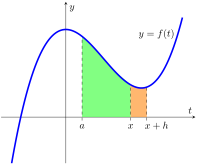
Hmm let’s simplify the average rate of change of the accumulation function from \(x\) to \(x + h\) first (the fraction without the limit). I made a pretty picture below to help you visualize the situation.
This implies that \(A(x + h) - A(x)\) should give us the area on \([x,x + h]\text{,}\) which is the area of the orange region. Hence, we know that the average rate of change is the area of the orange region over \(h\text{.}\)
To obtain the derivative, aka the instantaneous rate of change, we want \(h\) to be a super very really small number, so the orange region should be a super skinny region whose area can be approximated using one skinny rectangle strip.
We learned about approximating the area using rectangles in Section 5.1! The two easier approximation methods are the left-endpoint approximation and the right endpoint approximation. Then which method should we use to approximate the area of the orange region?
It turns out that it doesn’t matter (because of the Squeeze theorem... if you want a more rigorous argument, ask Richard or read the proof in the textbook). For demonstration purposes, let’s use the right-endpoint approximation to approximate the area of the orange region. Then the height of the skinny rectangle strip is \(f(x + h)\text{.}\) So we know
To apply the Fundamental Theorem of Calculus, make sure the format of the question will match the left-hand side of the equation in the theorem. Let’s start with the easy ones where we can simply apply the Fundamental Theorem of Calculus without any slick tricks!
Does the expression match up with the left-hand side of the equation (5.5.3) in the Fundamental Theorem of Calculus? If so, then what does the Fundamental Theorem of Calculus tell us?
Observe that format matches up perfectly! So we are taking the derivative of the accumulation function with \(f(t) = t^5 - 9t^3\text{.}\) By the Fundamental Theorem of Calculus, we obtain
Does the expression match up with the left-hand side of the equation (5.5.3) in the Fundamental Theorem of Calculus? If not, how can we manipulate the definite integral to make it match up with the equation?
Observe that the expression doesn’t quite match up... We want the variable of the accumulation function to be on the upper limit and the number to be on the lower limit. It would be so nice if there is a way for us to reverse the upper and the lower limits...
Well we are not really tasked to take the derivative of \(A(x)\text{,}\) but more like \(A\left(x^2\right)\text{...}\) This is a composite function with the outside function of \(A\) and inside function of \(f\text{.}\) Do we know how to take the derivative of a composite function?
The last question to resolve here is about the derivative of the accumulation function. By the Fundamental Theorem of Calculus, \(A'(x) = f(x)\text{.}\)
Now we know how to deal with the case where one of the limits of integration contains a variable. What about the case where both the limits of integration contain a variable? Let’s look at an example of this.
Dealing with non-constant upper and lower limits are kind of a lot at once... It would be so nice if there is a property of definite integral that allows us to split the integral into two pieces, so we can deal with one of the non-constant limit of integration at a time...
We investigated the accumulation function earlier in this section. Recall the accumulation function takes the input of the upper limit of the definite integral and spits out the output of the area under the curve. We are now investigating the graph of the accumulation function.
One characteristics of a graph, as you learned back in calculus 1, are the local extrema (peaks and valleys on the graph). Can we predict where the peaks and valleys of the accumulation function are at given a graph of a function?
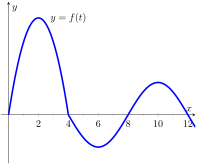
Recall that the accumulation function accumulates the signed area under the curve starting from \(x = 0\text{.}\) The region above the \(x\)-axis should have a positive signed area and the region below the \(x\)-axis should have a negative signed area.
So do we know at which point(s) we starts accumulating positive area (which makes the overall area greater) and negative area (which makes the overall area smaller)?
Observe that the enclosed region is above the \(x\)-axis on \((0,4)\) and \((8,12)\text{.}\) This implies that we are accumulating positive area in these two regions, making the value of the accumulation function \(A\) increasing.
Similarly, the region on \((4,8)\) is below the \(x\)-axis, so we are accumulating negative area in this region, making the value of the accumulation function \(A\) decreasing.
Now let’s think about the peaks and valleys. At the point of \(x = 4\text{,}\) we start to accumulate negative area, which makes the overall area smaller. This implies that there is a peak at \(x = 4\text{.}\)
Similarly, at the point of \(x = 8\text{,}\) we start to accumulate positive area, which makes the overall area greater. This implies that there is a valley at \(x = 8\text{.}\)
If you want to be fancier, recall the accumulation function, \(A\text{,}\) is an antiderivative of the function \(f\text{,}\) guaranteed by FTC. We can reverse-engineer the first derivative test you learned back in calculus 1. That is, the critical points (in this problem, peaks and valley) of the accumulation function will occur at the point where the derivative of the accumulation function, aka \(f\) is \(0\text{.}\) The accumulation function is increasing if its derivative, aka \(f\text{,}\) is positive, and decreasing if its derivative, \(f\text{,}\) is negative.
I included some practice problems that cover some main concepts in this section. You don’t need to turn it in, but I highly encourage you to work on this with your classmates. I may take problems here to be your in-class practice problems, homework problems, and/or exam problems. Reach out to Richard for help if you get stuck or have any questions.
I will only include the final answer to some of the problems for you to check your result. If you want to check your work, talk to Richard and he is happy to discuss the process with you.
Note: By saying "prove", Richard means to justify this formula informally. The goal here is to make sure you know how the formula is derived and why each component is necessary. Richard will never look for a technical mathematical proof in this class, but you are certainly more than welcome to try coming up with a proof-y proof and Richard is always happy to chat about it.