
Section A.3 Written Homework #3

You are encouraged to work on this assignment collaboratively with your peers in class. You can also ask Richard for hints if you are stuck. Yet, you should write up your own work and submit it on Canvas in one single PDF file. Show all of your work for full credits, and your work should be clearly written and organized.
The written homework #3 is due on October 30, 2025.
You can find a printable PDF copy of the homework here: Written Homework 3
This homework assignment cover some important concepts in section 5.8, 6.1, 6.3, and 6.4.

Worksheet

1.

Evaluate the following indefinite integrals using substitution method. Make sure you state what your choice of \(u\) is for each integral.
  1. \(\displaystyle \displaystyle \int \frac{dx}{25x^2 + 36}\)
  2. \(\displaystyle \displaystyle \int \frac{x\, dx}{25x^2 + 36}\)

2.

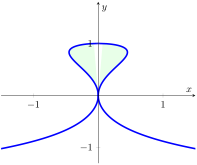
Find the area of the shaded region bounded by the curve
\begin{equation*} x^2 = y^4\left(1 - y^3\right) \end{equation*}
See the figure below for the shaded region.
Figure A.3.1. The graph of \(x^2 = y^4(1 - y^3)\)
Hint.
Rather than integrating along the \(x\)-axis (which I believe is insanely difficult), try integrating along the \(y\)-axis to find the area of the shaded region.
To do so, you will need a function \(x = g(y)\text{...}\) How do we isolate \(x\) in the equation? You may want to confirm you have the right function by graphing it to see if it matches up with the graph in the figure.

3.

Let \(\mathcal{R}\) be the region enclosed between \(y = \sec(x)\text{,}\) \(y = \csc(x)\text{,}\) \(y = 0\text{,}\) \(x = 0\text{,}\) and \(x = \frac{\pi}{2}\text{.}\) Let \(\mathcal{S}\) be the solid obtained by rotating \(\mathcal{R}\) about the \(x\)-axis.
Find the volume of \(\mathcal{S}\text{.}\)
Hint.
What does the region look like? Graph out the functions and shade the region.
Which method, disk or shell, is easier to work with in this problem? Try sketching out a typical disk (or a typical shell) and make a choice.

4.

Let \(f(x) = x^2 - 1\) and \(g(x) = 2x - 1\text{,}\) and let \(\mathcal{R}\) represent the region enclosed between \(y = f(x)\) and \(y = g(x)\text{.}\)
Find the volume of the solid obtained by rotating \(\mathcal{R}\) about the line \(x = -2\text{.}\)
Hint.
What does the region look like? Graph out the functions and shade the region.
Which method, disk/washer or shell, is easier to work with in this problem?
  • If you pick the disk/washer method, sketch a typical disk/washer and mark its radius/radii. This will help you determine the radius/radii.
  • If you pick the shell method, sketch a typical cylindrical shell and mark its radius and height. This will help you determine the radius and height.
