Let’s first figure out the
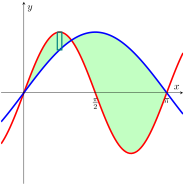
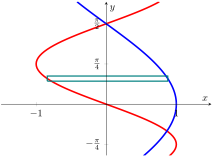
width of the rectangle!
Recall the reason why we can determine the height of the rectangle by
\(y_\text{top} - y_\text{bot}\) is because we know the higher the point, the larger the
\(y\)-value, so by doing the subtraction this way, we don’t end up obtainning a negative height.
Similarly, we know the
\(x\)-value of a point is greater if the point is located more towards the right (so the "right-er" the point, the larger the
\(x\)-value). To make sure the width is not negative, we want to determine the width of the rectangle by doing
\(x_\text{right} - x_\text{left}\text{.}\)
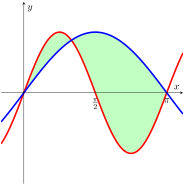
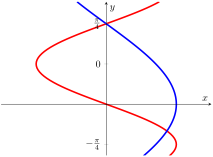
Observe that the blue curve is "right-er" than the red curve, so \(x_\text{right} = \cos(y)\) and \(x_\text{left} = -\sin(2y)\text{.}\) Then we can find the area of the enclosed region by
\begin{equation*}
\int_{\underline{\quad}}^{\underline{\quad}} \left(\cos(y) - (-\sin(2y))\right)\, dy = \int_{\underline{\quad}}^{\underline{\quad}} \left(\cos(y) + \sin(2y)\right)\, dy
\end{equation*}
The next thing to determine here is the
limits of integration. Since the variable is
\(y\) in the integral now, we want to determine the region of the
\(y\)-values. Graphically, we observe that the
\(y\) value can go as high as
\(y = \frac{\pi}{4}\) in the enclosed region. So the upper limit is
\(\frac{\pi}{4}\text{.}\)
To determine the lower limit, we can do the same trick by equating \(-\sin(2y)\) and \(\cos(y)\) and solve for \(y\) within the region \((-\frac{\pi}{4},0)\text{.}\)
\begin{align*}
-\sin(2y) \amp= \cos(y) \qquad\qquad \\
\implies \qquad\qquad y \amp= -\frac{\pi}{6}
\end{align*}
Hence, the lower limit is \(-\frac{\pi}{6}\text{.}\)
Now putting everything together! We can find the area of the enclosed region.
\begin{align*}
\text{Area} \amp= \int_{-\frac{\pi}{4}}^\frac{\pi}{4} \left(\cos(y) - \sin(2y)\right)\, dy \\
\amp= \left(\sin(y) + \frac{1}{2}\cos(2y)\right)\bigg|_{-\frac{\pi}{6}}^\frac{\pi}{4} \\
\amp= \left(\sin\left(\frac{\pi}{4}\right) - \frac{1}{2}\cos\left(\frac{\pi}{2}\right)\right) - \left(\sin\left(-\frac{\pi}{6}\right) - \frac{1}{2}\cos\left(-\frac{\pi}{3}\right)\right) \\
\amp= \frac{\sqrt{2}}{2} + \frac{1}{2} + \frac{1}{4} \\
\amp= \frac{2\sqrt{2} + 3}{4} \approx 1.4571 \qquad \text{unit}^2
\end{align*}