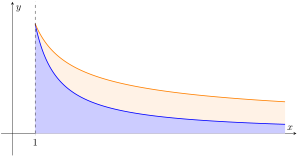
Find the volume of the solid obtained by rotating \(y = \frac{1}{x}\) on the interval \([1,b]\) across the \(x\)-axis, where \(b\) is a constant greater than \(1\text{.}\)
Find the volume of the solid obtained by rotating \(y = \frac{1}{x}\) on the interval \([1,\infty)\) by taking the limit of the volume you obtained in part (a) as \(b\to \infty\text{.}\) Does it match up with your expectation in part (b)? Why or why not?
The reason why we call a definite integral improper is because we can’t evaluate it using the Fundamental Theorem of Calculus directly (hence, improper). Recall the Fundamental theorem of calculus only holds if we are integrating a continuous function on some closed.
SubsectionImproper Integrals over Infinite Intervals
The first case of improper integrals is when we integrate a function over an infinite interval, which means the interval has at least one endpoint to be infinity (or negative infinity). Since the interval is not closed, we can’t apply the Fundamental Theorem of Calculus directly...
But... there is a workaround here. Instead of treating infinity as a number and proceed with the FTC anyways (which leads to plugging \(\infty\) into some antiderivatives... this is bad), we can define a number to replace \(\infty\) and take the limit of the answer as the number approaches \(\infty\text{.}\)
Fix a number \(a\) and assume \(f\) is integrable over \([a,b]\) for all \(b \gt a\text{.}\) The improper integral of \(f\) over \([a,\infty)\) is defined as the following limit.
The ideas of convergence and divergence really come from sequences and series, which is what MTH 253Z is all about. Richard will not elaborate much on these two concepts, since this isn’t really MTH 253Z. For the purpose of this section, remember that an improper integral converges if the final answer is a number, and diverges if the final answer is not a number (like \(\pm \infty\) or DNE). If you really want to know more about these concepts now, talk to Richard and he is happy to investigate these concepts together with you.
We cannot apply FTC right off the bat since the interval \([1,\infty)\) is not closed. We can go around this issue by defining \(b\) to be the upper limit and take the limit of the answer as \(b\to \infty\text{.}\)
We cannot apply FTC right off the bat since the interval \([1,\infty)\) is not closed. We can go around this issue by defining \(b\) to be the upper limit and take the limit of the answer as \(b\to \infty\text{.}\)
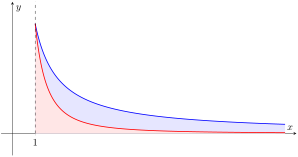
Based on the math, we know that the area under the curve of \(y = \frac{1}{x^2}\) (in red), is \(1\) and the area under the curve of \(y = \frac{1}{x}\) (in blue) is \(\infty\text{.}\) We can do some fun math using the graphs.
Does the improper integral \(\displaystyle \int_1^\infty \frac{1}{x^4}\, dx\) converges or diverges? Can we determine it using the graphs without formally evaluating the integral?
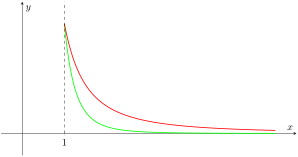
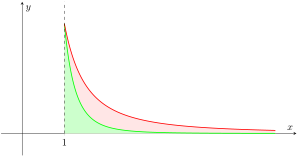
Graphically, lower curves should have smaller area. That is, the area under \(y = \frac{1}{x^4}\) (in green) is less than the area under \(y = \frac{1}{x^2}\) (in red).
Then we know that \(\displaystyle \int_1^\infty \frac{1}{x^4}\, dx \lt \int_1^\infty \frac{1}{x^2}\, dx\text{.}\) We found out that \(\displaystyle \int_1^\infty \frac{1}{x^2}\, dx = 1\text{,}\) so
Does the improper integral \(\displaystyle \int_1^\infty \frac{1}{\sqrt{x}}\, dx\) converges or diverges? Can we determine it using the graphs without formally evaluating the integral?
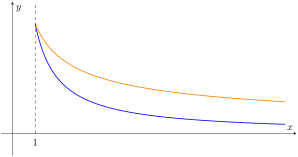
Graphically, higher curves should have larger area. That is, the area under \(y = \frac{1}{\sqrt{x}}\) (in orange) is greater than the area under \(y = \frac{1}{x}\) (in blue).
Then we know that \(\displaystyle \int_1^\infty \frac{1}{\sqrt{x}}\, dx \gt \int_1^\infty \frac{1}{x}\, dx\text{.}\) We found out that \(\displaystyle \int_1^\infty \frac{1}{x}\, dx = \infty\text{,}\) so
What the comparison test says is essentially (1) anything less than a finite number cannot be \(\infty\text{,}\) and (2) anything greater than \(\infty\) cannot be a finite number. We can use the comparison test to identify whether an improper integral converges or diverges.
We don’t need to evaluate the integral, but just to identify whether it converges (the final answer is a number) or diverges (the final answer is not a number). We can figure it out using the comparison test.
To use the comparison text, we need to pick a function to compare with \(y = \frac{1}{x^2 + x}\text{.}\) Usually, we want to pick a similar function for comparison.
Observe that this function looks like \(y = \frac{1}{x}\) and \(y = \frac{1}{x^2}\text{.}\) Richard can let you know that only one of these two choices will work. Let’s try them both and see which one will work. For the one that doesn’t work, why not?
But this is inconclusive, since both a finite number AND infinity can be less than infinity. We cannot say for sure whether the integral converges or diverges.
This is a common trap for the comparison test, especially in MTH 253Z: (1) both a finite number AND infinity can be less than infinity, and (2) both a finite number AND infinity can be greater than a number. So make sure you read the comparison test carefully!!
The last thing in this subsection, before we move on to the second case of improper integrals, is the idea of a \(p\)-integral. Richard will not elaborate too much on this idea since the whole purpose of this idea is to prepare you for a MTH 253Z concept called the \(p\)-series. If you want to know more about it, feel free to reach out to Richard to discuss further.
We can quickly determine whether a \(p\)-integral converges or diverges by looking at the value of \(p\text{.}\) The \(p\)-integral converges if \(p \gt 1\text{;}\) otherwise the \(p\)-integral diverges.
While the idea of \(p\)-integrals seems to be out of nowhere in this class, you will need this quick little concept to define \(p\)-series and whether a \(p\)-series converges in MTH 253Z. Richard will not elaborate further about this and let you learn all the fun things about sequences and series in MTH 253Z.
Now we are in Section 7.7 so let’s think about what’s wrong with this line of work. Observe that FTC was applied directly right off the bat, so the assumption is that \(y = \frac{1}{x^2}\) is continuous on \([-1,3]\) (we can only apply FTC to integrate a continuous function on a closed interval). Yet, \(y = \frac{1}{x^2}\) is for sure NOT continuous on \([-1,3]\text{,}\) as the function is not continuous at \(x = 0\text{.}\) There is a vertical asymptote at \(x = 0\text{.}\)
Of course, there is also a workaround here. We know \(y = \frac{1}{x^2}\) is continuous on \([-1,0)\) and \((0,3]\text{.}\) Then we can split up the integral into two pieces and do the same limit trick in order to apply the FTC.
The workaround here is to split up the integral at \(x = 0\) since this is the point of discontinuity and do the same limit trick in order to apply the FTC.
We cannot apply FTC right off the bat since the integrand \(y = \frac{1}{2\sqrt{x}}\) is not continuous at \(x = 0\text{.}\) We can go around this issue by defining \(a\) to be the lower limit and take the limit of the answer as \(a\to 0^+\text{.}\)
I included some practice problems that cover some main concepts in this section. You don’t need to turn it in, but I highly encourage you to work on this with your classmates. I may take problems here to be your in-class practice problems, homework problems, and/or exam problems. Reach out to Richard for help if you get stuck or have any questions.
I will only include the final answer to some of the problems for you to check your result. If you want to check your work, talk to Richard and he is happy to discuss the process with you.