1.
Approximate the area of the region under the curve of
\begin{equation*}
y = \frac{4 - x}{1 + x^2}
\end{equation*}
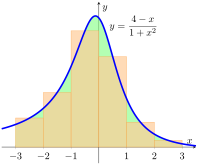
by calculating the area the area of the shaded rectangles shown in the diagram below. Which approximation method do these rectangles represent?
Solution.
Let \(f(x) = \frac{4-x}{1+x^2}\text{.}\) Each rectangle in the diagram has a width of 1 and the height is taken as the function value at the midpoint of each subinterval. Thus, the area of the shaded rectangles can be approximated by
\begin{align*}
\text{Area} \amp\approx 1\cdot\left( f\left(\frac{-3-2}{2}\right) + f\left(\frac{-2-1}{2}\right) + f\left(\frac{-1+0}{2}\right) + f\left(\frac{0+1}{2}\right) + f\left(\frac{1+2}{2}\right) + f\left(\frac{2+3}{2}\right)\right) \\
\amp= 1\cdot\left( f(-2.5) + f(-1.5) + f(-0.5) + f(0.5) + f(1.5) + f(2.5)\right)\\
\amp= 1\cdot\left( \frac{26}{29} + \frac{22}{13} + \frac{18}{5} + \frac{14}{5} + \frac{10}{13} + \frac{6}{29} \right) \\
\amp= \frac{18784}{1885} \approx 9.965
\end{align*}
Note A.1.2.
Graphically, it is clear to see that the heights of each rectangle, using the midpoint rule, are the function values of midpoints of each subinterval, not the midpoint of function values. In fact, if you took the midpoints of the function values, i.e., you did something like
\begin{align*}
\text{Area} \approx \frac{f(-3) + f(-2)}{2} + \frac{f(-2) + f(-1)}{2} \amp+ \frac{f(-1) + f(0)}{2} \\
\amp+ \frac{f(0) + f(1)}{2} + \frac{f(1) + f(2)}{2} + \frac{f(2) + f(3)}{2}
\end{align*}
You actually used the trapezoidal rule instead of the midpoint rule. We will learn this new rule in Chapter 7.

