Skip to main content
Contents Dark Mode Prev Up Next \(\newcommand{\N}{\mathbb N} \newcommand{\Z}{\mathbb Z} \newcommand{\Q}{\mathbb Q} \newcommand{\R}{\mathbb R}
\newcommand{\lt}{<}
\newcommand{\gt}{>}
\newcommand{\amp}{&}
\definecolor{fillinmathshade}{gray}{0.9}
\newcommand{\fillinmath}[1]{\mathchoice{\colorbox{fillinmathshade}{$\displaystyle \phantom{\,#1\,}$}}{\colorbox{fillinmathshade}{$\textstyle \phantom{\,#1\,}$}}{\colorbox{fillinmathshade}{$\scriptstyle \phantom{\,#1\,}$}}{\colorbox{fillinmathshade}{$\scriptscriptstyle\phantom{\,#1\,}$}}}
\)
Worksheet Some Exercises for this section
I included some practice problems that cover some main concepts in this section. You don’t need to turn it in, but I highly encourage you to work on this with your classmates. I may take problems here to be your in-class practice problems, homework problems, and/or exam problems. Reach out to Richard for help if you get stuck or have any questions.
I will only include the final answer to some of the problems for you to check your result. If you want to check your work, talk to Richard and he is happy to discuss the process with you.
1.
Consider the function \(f(x) = \cos(x)\) on the interval \(\left[0,\frac{\pi}{2}\right]\text{.}\)
Graph the function
\(y = f(x)\) and highlight the region of interest.
Approximate the area of the region using
\(R_3\text{.}\) Do we know if this is an under-estimate or over-estimate?
Approximate the area of the region using
\(L_3\text{.}\) Do we know if this is an under-estimate or over-estimate?
2. Approximate the area under the graph of the function
\(f(x) = x - 2\ln(x)\) from
\(x = 1\) to
\(x = 5\) using
\(M_4\text{.}\)
3. Let
\(f(x) = \sqrt{x}\text{.}\) Find
\(R_4\text{,}\) \(L_4\text{,}\) and
\(M_4\) on the interval
\([3,5]\text{.}\)
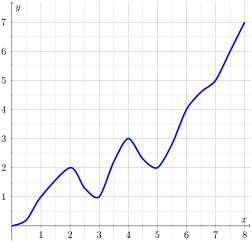
4. Approximate the
area under the curve on
\([0,8]\) using
four subintervals. The graph of the curve is given below.
Figure 5.1.24. The graph of the curve
What is the
\(N\) and
\(\Delta x\) in this problem?
Approximate the area using the right-endpoint approximation.
Approximate the area using the left-endpoint approximation.
Approximate the area using the midpoint approximation.
5.
Explain graphically that if \(f\) is linear on the interval \([a,b]\text{,}\) then the area under the graph \(y = f(x)\) on \([a,b]\) is
\begin{equation*}
A = \frac{1}{2}\left(R_N + L_N\right)
\end{equation*}
for all \(N\text{.}\) Don’t forget to explain in words what your diagram tells us.