Section 14.4 Differentiability, Tangent Planes, and Linear Approximation

In single-variable calculus, we learned that if a function is differentiable at a point, its graph can be approximated by a tangent line near that point. This geometric property is known as local linearity. In this section, we extend this concept to functions of two variables. Instead of a tangent line, we will see that a differentiable function of two variables has a tangent plane that approximates the surface locally.

Subsection Tangent Planes

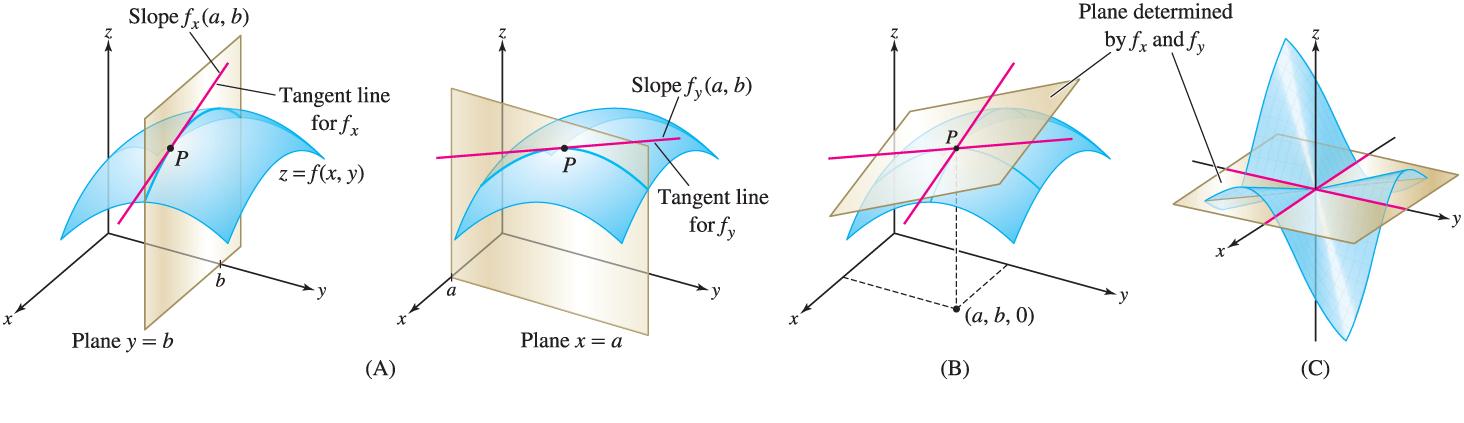
Recall from the last section that the partial derivative tells us the slope of the tangent line at the point on the curve obtained by intersecting the surface with a plane parallel to the \(xz\)-plane or \(yz\)-plane. Then we can construct the tangent line for each curve.
Yet, we need to take into consideration of both tangent lines since each one only gives us the rate of change with respect to one variable. If we combine both tangent lines, we can construct a plane, called the plane determined by \(f_x\) and \(f_y\).
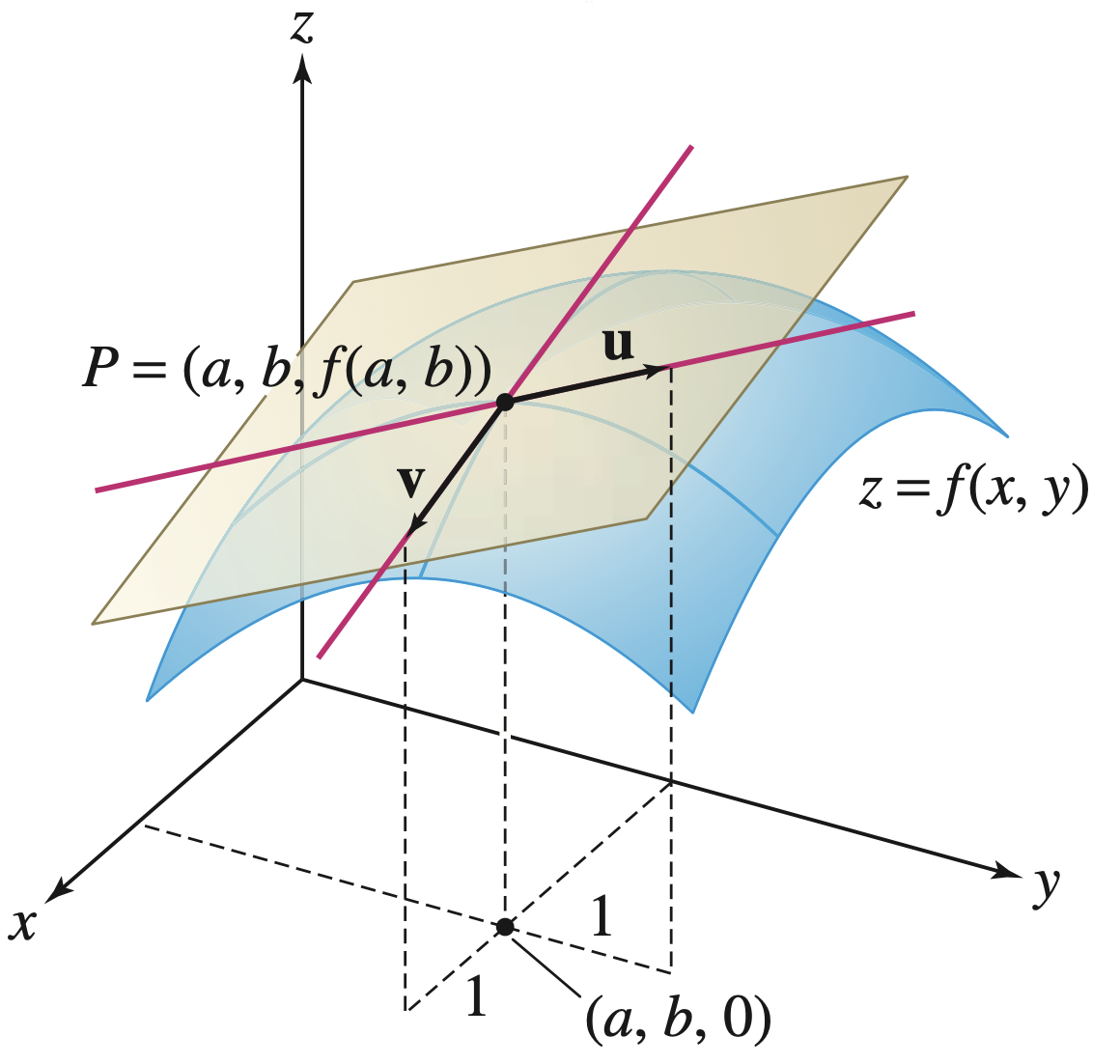
Figure 14.4.1. The Plane Determined by \(f_x\) and \(f_y\text{.}\)
Observe that the plane determined by \(f_x\) and \(f_y\) may NOT be tangent to the surface at the point (see part C in the above diagram). Let’s first assume that the plane determined by \(f_x\) and \(f_y\) is tangent to the surface at the point and see what equation we can get for the tangent plane. Then we will discuss the weird case where the plane determined by \(f_x\) and \(f_y\) is not tangent to the surface at the point using differentiability.
Let’s assume that the plane determined by \(f_x\lp a,b \rp\) and \(f_y\lp a,b \rp\) is tangent to the surface at the point \((a,b,f(a,b))\text{.}\) Then we can determine two vectors \(\v{v}\) and \(\v{w}\) whose tails are at the point of intersection of the two tangent lines, \(\v{v}\) is parallel to the first tangent line with the slope of \(f_x\text{,}\) and \(\v{w}\) is parallel to the second tangent line with the slope of \(f_y\text{.}\) The figure below illustrates this idea.
Figure 14.4.2. The Plane Determined by \(f_x\) and \(f_y\text{.}\)
We actually know the components of the two vectors \(\v{v}\) and \(\v{w}\text{.}\) For the vector \(\v{v}\text{,}\) which is parallel to the first tangent line whose slope is \(f_x\text{,}\) there is no change in the \(y\)-component. Also, with every unit change in the \(x\)-component, the \(z\)-component changes by \(f_x(a,b)\text{.}\) That is,
\begin{equation*} \v{v} = \la 1,0,f_x(a,b) \ra \end{equation*}
A similar argument can be made for the components of the vector \(\v{w}\text{,}\) which is parallel to the second tangent line whose slope is \(f_y\text{.}\) We have
\begin{equation*} \v{w} = \la 0,1,f_y(a,b) \ra \end{equation*}
The cross product of these two vectors will give us a normal vector to determine the equation of the plane.
\begin{align*} \v{w} \times \v{v} \amp= \begin{vmatrix} \v{i} \amp \v{j} \amp \v{k} \\ 0 \amp 1 \amp f_y(a,b) \\ 1 \amp 0 \amp f_x(a,b) \end{vmatrix} \\ \amp= f_x(a,b) \v{i} + f_y(a,b) \v{j} - \v{k} \\ \amp= \la f_x(a,b), f_y(a,b), -1 \ra \end{align*}
The point \(P = \lp a,b,f(a,b) \rp\) is on the plane. Hence, the tangent plane to the surface at the point \((a,b,f(a,b))\) has the equation
\begin{equation*} f_x(a,b) (x - a) + f_y(a,b) (y - b) - 1 (z - f(a,b)) = 0 \end{equation*}
Let’s make it into a fancy theorem!

Example 14.4.4.

Find the tangent plane to the elliptic paraboloid \(z = 2x^2 + y^2\) at the point \((1,1,3)\text{.}\)
Solution.
Let \(f(x,y) = 2x^2 + y^2\text{.}\) Then we have
\begin{align*} f_x(x,y) = 4x \qquad \amp \qquad f_y(x,y) = 2y \\ f(1,1) = 4 \qquad \amp \qquad f_y(1,1) = 2 \end{align*}
Using the equation of the tangent plane, we have
\begin{equation*} z = 3 + 4(x - 1) + 2(y - 1) = 4x + 2y - 3 \end{equation*}
Recall that we made the assumption that the plane determined by \(f_x\lp a,b \rp\) and \(f_y\lp a,b \rp\) is tangent to the surface at the point \((a,b,f(a,b))\) to come up with the formula. Also, the theorem states that this formula is valid if \(f\) is locally linear at \((a,b)\text{.}\) You may heard of this term in MTH 251Z (or MTH 251) before. This term basically describes what a differentiable function looks like graphically.

Subsection Differentiability

Recall back in MTH 251Z (or MTH 251) that a function of a single variable is differentiable at a point if the limit of the difference quotient exists at that point. This idea can also extend to functions of two variables. But we can only take the partial derivatives with respect to each variable for functions of two variables...
Well the partial derivatives are the derivatives of the function with respect to each variable. For a function of two variables to be differentiable at a point, the function must be differentiable with respect to each variable at that point. That is, the partial derivatives must all exist at that point.

Example 14.4.6.

Show that \(f(x,y) = y^8 + 2x^6 + 2xy\) is differentiable on its domain \(\R^2\text{.}\)
Hint.
Based on the above theorem, the function is differentiable at a point if the partial derivatives exist and are continuous at that point. Can we check off these two conditions for this function?
Solution.
Let’s start by finding the partial derivatives of \(f(x,y)\text{.}\) Let \((x,y)\in \R^2\text{.}\) Then we have
\begin{align*} f_x(x,y) \amp= \frac{\partial}{\partial x} \lp y^8 + 2x^6 + 2xy \rp = 12x^5 + 2y\\ f_y(x,y) \amp= \frac{\partial}{\partial y} \lp y^8 + 2x^6 + 2xy \rp = 8y^7 + 2x \end{align*}
Observe that both \(f_x(x,y)\) and \(f_y(x,y)\) are polynomials, and therefore continuous on \(\R^2\text{.}\) Hence, \(f\) is differentiable on \(\R^2\text{.}\)
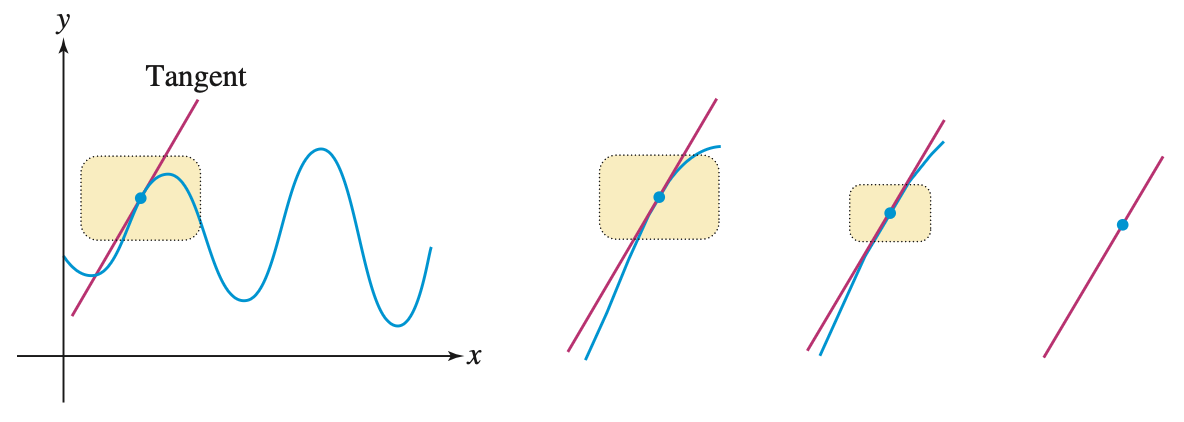
Geometrically speaking, a function is differentiable at a point if it is locally linear at that point. This term actually comes from the fact that if a single-variable function is differentiable at a point, then the graph of the function looks like a line near that point. The diagram below is taken from MTH 251Z (or MTH 251) notes to illustrate this idea.
Figure 14.4.7. Local Linearity: The graph looks more and more like the tangent line as we zoom in on a point.
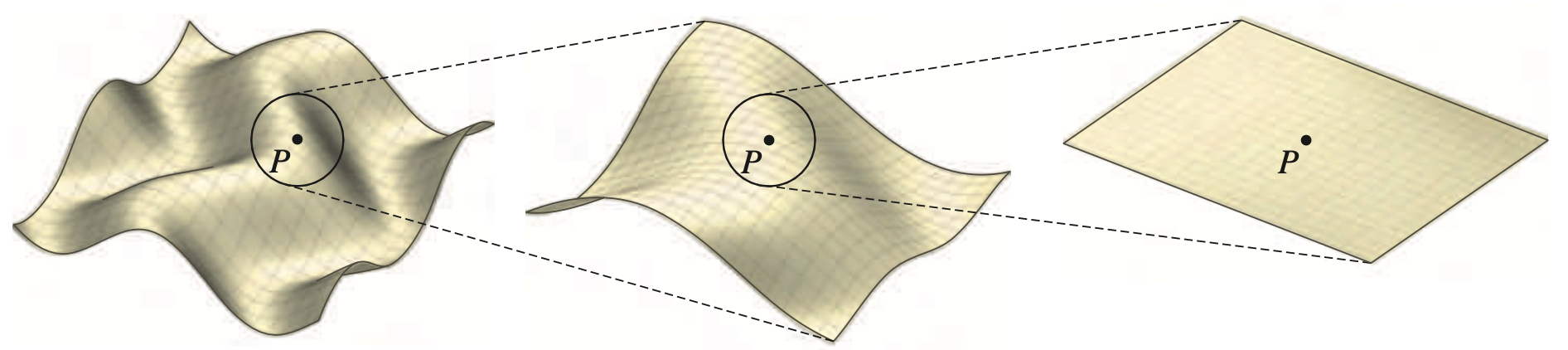
Imagine we extend this idea to functions of two variables. If a function of two variables is differentiable at a point (aka locally linear at the point graphically), then the surface should look more and more like the tangent plane as we zoom in on a point. The diagram below illustrates this idea.
Figure 14.4.8. Local Linearity: The graph looks more and more like the tangent plane as we zoom in on a point.
If a function is differentiable at a point, then we can estimate the function value at a point near the point using the tangent plane. This is called the linear approximation of the function at the point.

Subsection Linearization

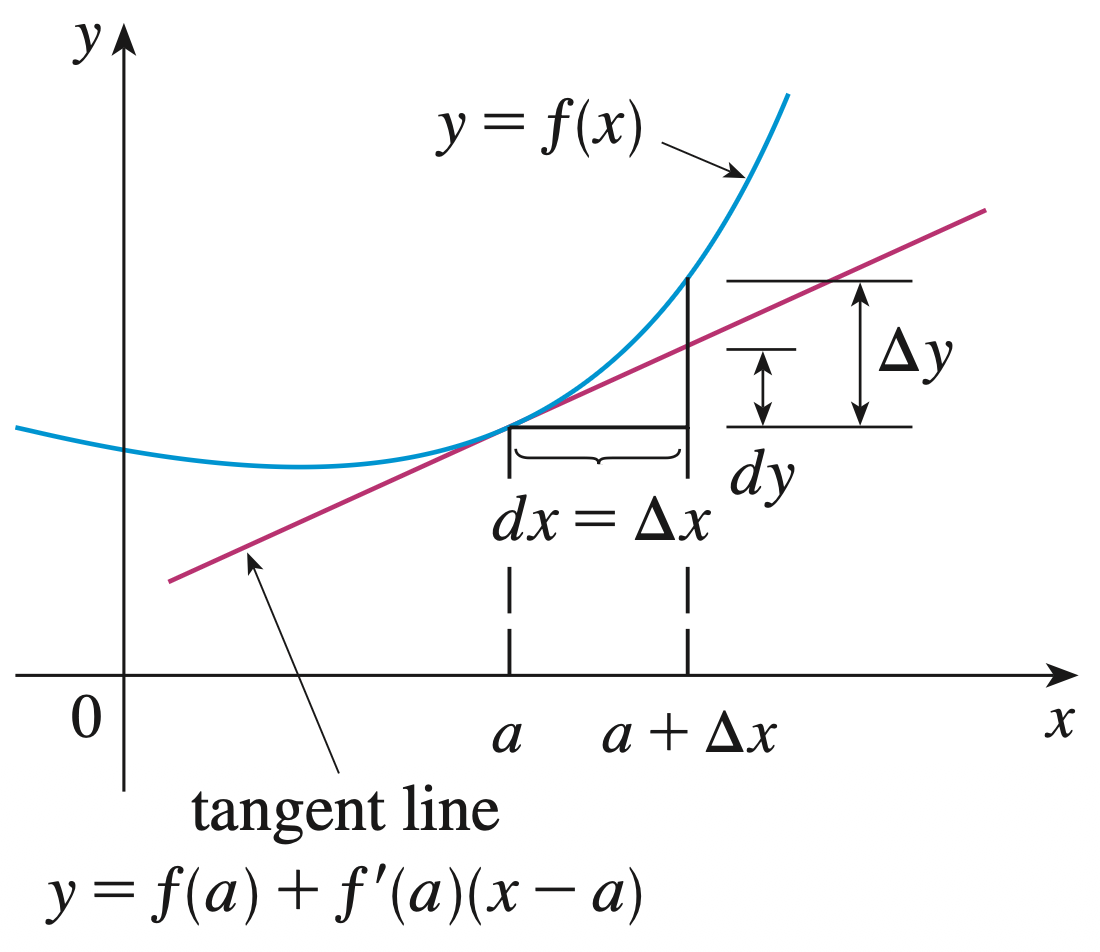
Let’s first revisit the idea of linearization in MTH 251Z (or MTH 251) for functions of a single variable. If a function is differentiable, then the graph of the function looks like a line near the point. Hence, we can use the tangent line to estimate the function value at a point near the point. The diagram below illustrates this idea.
Figure 14.4.9.
Observe that \(dy\text{,}\) the change of the \(y\) value of the tangent line, is really close to \(\Delta y\text{,}\) the change of the \(y\) value of the function, if \(\Delta x\) is small. Then we can approximate the \(y\) value of the function at a point near the point using the \(y\) value of the tangent line at that point. Since they are not necessarily equal, we use another symbol \(L(x)\) to denote the estimated \(y\) values to distinguish it from the actual \(y\) values of the function. Then we ontain the following formula
\begin{align*} f(x) \amp\approx L(x) = f(a) + f'(a)(x - a) \end{align*}
where the \(L(x)\) is called the linearization centered at \(x = a\).
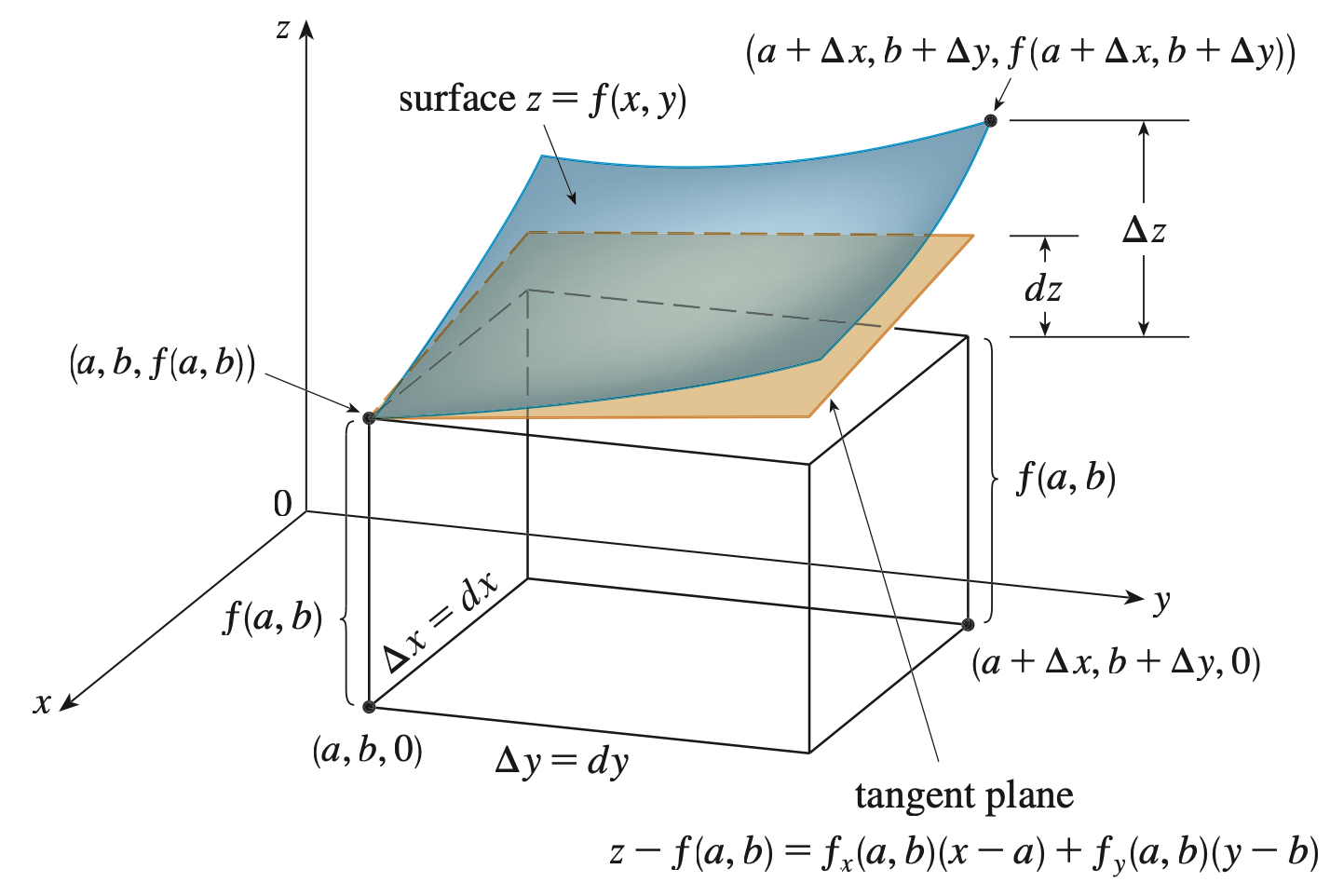
Now we extend this idea to functions of two variables. Let’s say \(z = f(x,y)\) is differentiable at \((a,b)\text{.}\) Then we can construct a tangent plane at the point \((a,b,f(a,b))\text{.}\) It is a lot easier to find the \(z\) value of a point on the tangent plane than to find the \(z\) value of a point on the surface. If the point is close to \((a,b,f(a,b))\text{,}\) then the \(z\) value of the tangent plane at that point should be close to the \(z\) value of the surface at that point. The diagram below illustrates this idea.
Figure 14.4.10.
If we call the estimated \(z\) value using the tangent plane \(L(x,y)\text{,}\) then we have the following formula for the linearization of a function of two variables at a point.
\begin{align*} z = f(x,y) \approx L(x,y) \amp= f(a,b) + f_x(a,b)(x - a) + f_y(a,b)(y - b) \end{align*}
Let’s make it into a fancy theorem!

Example 14.4.12.

Let \(f(x,y) = \dfrac{x^2}{y^2 + 1}\text{.}\) Use the linear approximation at an appropriate point \((a,b)\) to estimate the value of \(f(4.01, 0.98)\text{.}\)
Hint.
For the linear approximation to be accurate and easy to work with, the point \((a,b)\) must (1) be close to the point \((4.01, 0.98)\) and (2) make the calculations of \(f(a,b)\text{,}\) \(f_x(a,b)\text{,}\) and \(f_y(a,b)\) easy. Usually, decimals are not easy to work with, so what is a good choice for \((a,b)\text{,}\) where \(a\) and \(b\) are close to \(4.01\) and \(0.98\text{,}\) respectively, and they are integers?
Solution.
We use the linear approximation at the point \((a,b) = (4,1)\text{,}\) which is the closest point with integer coordinates. That is,
\begin{align*} f(x,y) \approx L(x,y) \amp= f(4,1) + f_x(4,1) dx + f_y(4,1) dy \end{align*}
where \((x,y)\) is a point near \((4,1)\text{,}\) and \(dx\) and \(dy\) are the changes in the \(x\) and \(y\) values from \((4,1)\text{,}\) respectively.
We need to find the values of \(f(4,1)\text{,}\) \(f_x(4,1)\text{,}\) and \(f_y(4,1)\text{.}\)
\begin{align*} f(x,y) = \frac{x^2}{y^2 + 1} \qquad \amp \qquad f(4,1) = 8 \\ f_x(x,y) = \frac{2x}{y^2 + 1} \qquad \amp \qquad f_x(4,1) = 4 \\ f_y(x,y) = -\frac{2x^2 y}{(y^2 + 1)^2} \qquad \amp \qquad f_y(4,1) = -8 \end{align*}
Also, observe that \(dx = 0.01\) and \(dy = -0.02\text{.}\) Substituting these values into the linear approximation formula, we have
\begin{align*} f(4.01, 0.98) \approx L(4.01, 0.98) \amp= 8 + 4(0.01) - 8(-0.02) = 8.2 \end{align*}
To give us an idea of how good our estimate is, the actual value of \(f(4.01, 0.98)\) is
\begin{equation*} f(4.01, 0.98) = \frac{4.01^2}{0.98^2 + 1} = 8.202 \end{equation*}
The percentage error of our estimate is
\begin{equation*} \frac{|8.202 - 8.2|}{8.202} \times 100\% \approx 0.24\% \end{equation*}
This is a pretty good estimate!
Other than using the formula to find the linearization of a known formula, we can also use the formula to find the linearization of an expression in general (ish). It turns out that the idea of linear approximation (and linearization) can extend to any dimension. But this can be tricky since we basically need to find a function that models the expression...

Example 14.4.13.

Estimate the value of \(\dfrac{8.01}{\sqrt{(1.99)(2.01)}}\) using linear approximation.
Hint.
In order to use the linear approximation formula, we need a function first. The expression can be modeled using the function
\begin{equation*} f(x,y,z) = \frac{x}{\sqrt{yz}} \end{equation*}
at the point \((8,2,2)\text{.}\)
We can extend the idea of linear approximation in \(\R^3\) to \(\R^4\) by adding one more component to take the change in the third component into consideration. As you can imagine, the formula can be asjusted as follows:
\begin{equation*} f(x,y,z) \approx L(x,y,z) = f(a,b,c) + f_x(a,b,c) dx + f_y(a,b,c) dy + f_z(a,b,c) dz \end{equation*}
where \((x,y,z)\) is a point near \((a,b,c) = (8,2,2)\text{,}\) and \(dx\text{,}\) \(dy\text{,}\) and \(dz\) are the changes in the \(x\text{,}\) \(y\text{,}\) and \(z\) values from \((8,2,2)\text{,}\) respectively.
Solution.
We use the linear approximation of the function \(f(x,y,z) = \dfrac{x}{\sqrt{yz}}\) at the point \((a,b,c) = (8,2,2)\text{,}\) which is
\begin{equation*} f(x,y,z) \approx L(x,y,z) = f(a,b,c) + f_x(a,b,c) dx + f_y(a,b,c) dy + f_z(a,b,c) dz \end{equation*}
We need to find the values of \(f(8,2,2)\text{,}\) \(f_x(8,2,2)\text{,}\) \(f_y(8,2,2)\text{,}\) and \(f_z(8,2,2)\text{.}\)
\begin{align*} f(x,y,z) = \frac{x}{\sqrt{yz}} \qquad \amp \qquad f(8,2,2) = 4 \\ f_x(x,y,z) = \frac{1}{\sqrt{yz}} \qquad \amp \qquad f_x(8,2,2) = \frac{1}{2} \\ f_y(x,y,z) = - \frac{1}{2}xy^{-\frac{3}{2}}z^{-\frac{1}{2}} \qquad \amp \qquad f_y(8,2,2) = -1 \\ f_z(x,y,z) = -\frac{1}{2}xy^{-\frac{1}{2}}z^{-\frac{3}{2}} \qquad \amp \qquad f_z(8,2,2) = -1 \end{align*}
Also, observe that \(dx = 0.01\text{,}\) \(dy = -0.01\text{,}\) and \(dz = 0.01\text{.}\) Substituting these values into the linear approximation formula, we have
\begin{align*} f(8.01, 1.99, 2.01) amp\approx L(8.01, 1.99, 2.01) \\ \amp= 4 + \frac{1}{2}(0.01) - 1\cdot (-0.01) - 1 \cdot 0.01 \\ \amp= 4.005 \end{align*}
Using a calculator, the actual value of \(f(8.01, 1.99, 2.01)\) is \(4.00505\text{.}\) The percentage error of our estimate is
\begin{equation*} \frac{|4.00505 - 4.005|}{4.00505} \times 100\% \approx 0.00125\% \end{equation*}
This is a super good estimate!
Worksheet Assigned Problems for Section 14.4

The problems listed below are assigned to be included in your problem set portfolio. Note that a specific selection of these problems will also form the written homework assignments. I recommend working through all of them to ensure a solid grasp of the material. Reach out to Richard for help if you get stuck or have any questions.
The solutions will be posted after the written homework due dates. If you have any questions about your work, talk to Richard and he is happy to discuss the process with you.

14.4.7.

Find an equation of the tangent plane to \(F(r,s) = r^2 s^{-\frac{1}{2}} + s^{-3}\) at the point \((2,1)\text{.}\)
Solution.
First, we compute the function value at the point \((2,1)\text{:}\)
\begin{align*} F(2,1) \amp = (2)^2 (1)^{-1/2} + (1)^{-3} = 4 + 1 = 5 \end{align*}
Next, we find the partial derivatives:
\begin{align*} F_r(r,s) \amp = 2rs^{-1/2} \\ F_s(r,s) \amp = -\frac{1}{2}r^2s^{-3/2} - 3s^{-4} \end{align*}
Evaluate the derivatives at \((2,1)\text{:}\)
\begin{align*} F_r(2,1) \amp = 2(2)(1) = 4 \\ F_s(2,1) \amp = -\frac{1}{2}(4)(1) - 3(1) = -2 - 3 = -5 \end{align*}
The equation of the tangent plane is:
\begin{align*} z - z_0 \amp = F_r(2,1)(r - 2) + F_s(2,1)(s - 1) \\ z - 5 \amp = 4(r - 2) - 5(s - 1) \\ z \amp = 4r - 5s - 8 + 5 + 5 \\ z \amp = 4r - 5s + 2 \end{align*}

14.4.11.

Find the points on the graph of \(z = 3x^2 - 4y^2\) at which the vector \(\v{n} = \la 3,2,2 \ra\) is normal to the tangent plane.
Solution.
Let \(f(x,y) = 3x^2 - 4y^2\text{.}\) We know that the tangent plane is determined by the vectors \(\v{v} = \la 1, 0, f_x \ra\) and \(\v{w} = \la 0, 1, f_y \ra\text{.}\) The normal vector to the tangent plane is given by their cross product:
\begin{align*} \v{n}\amp = \v{w} \times \v{v} = \la f_x, f_y, -1 \ra \end{align*}
First, we compute the partial derivatives:
\begin{align*} f_x(x,y) \amp = 6x \\ f_y(x,y) \amp = -8y \end{align*}
So, the normal vector to the tangent plane at any point \((x,y)\) is \(\la 6x, -8y, -1 \ra\text{.}\) We are given that \(\v{n} = \la 3,2,2 \ra\) is normal to the tangent plane, so our computed vector must be parallel to \(\v{n}\text{.}\) This means there exists a constant \(k\) such that:
\begin{align*} \la 6x, -8y, -1 \ra \amp = k \la 3,2,2 \ra \end{align*}
Equating the components:
\begin{align*} -1 \amp = 2k \implies k = -\frac{1}{2} \\ 6x \amp = 3k = 3\lp -\frac{1}{2} \rp = -\frac{3}{2} \implies x = -\frac{1}{4} \\ -8y \amp = 2k = 2\lp -\frac{1}{2} \rp = -1 \implies y = \frac{1}{8} \end{align*}
Finally, we find the \(z\)-coordinate:
\begin{align*} z \amp = 3\lp -\frac{1}{4} \rp^2 - 4\lp \frac{1}{8} \rp^2 \\ \amp = \frac{3}{16} - \frac{4}{64} = \frac{12}{64} - \frac{4}{64} = \frac{8}{64} = \frac{1}{8} \end{align*}
The point is \(\lp -\frac{1}{4}, \frac{1}{8}, \frac{1}{8} \rp\text{.}\)

14.4.13.

Find the points on the graph of \(f(x,y) = 3x^2 - xy - y^2\) at which the tangent plane is horizontal.
Solution.
A horizontal tangent plane occurs where the partial derivatives are both zero.
\begin{align*} f_x(x,y) \amp = 6x - y = 0 \\ f_y(x,y) \amp = -x - 2y = 0 \end{align*}
From the first equation, \(y = 6x\text{.}\) Substituting this into the second equation:
\begin{align*} -x - 2(6x) \amp = 0 \\ -13x \amp = 0 \implies x = 0 \end{align*}
If \(x=0\text{,}\) then \(y=0\text{.}\) The point on the graph is \((0,0, f(0,0)) = (0,0,0)\text{.}\)

14.4.15.

Find the linearization \(L(x,y)\) of \(f(x,y) = x^2y^3\) at \((a,b) = (1,2)\text{.}\) Use it to estimate \(f(2.01, 1.02)\) and \(f(1.97, 1.01)\text{,}\) and compare with values obtained using a calculator.
Solution.
We compute the function value and derivatives at \((2,1)\text{:}\)
\begin{align*} f(2,1) \amp = 2^2(1)^3 = 4 \\ f_x(x,y) \amp = 2xy^3 \implies f_x(2,1) = 2(2)(1) = 4 \\ f_y(x,y) \amp = 3x^2y^2 \implies f_y(2,1) = 3(4)(1) = 12 \end{align*}
The linearization is:
\begin{align*} L(x,y) \amp = f(2,1) + f_x(2,1)(x-2) + f_y(2,1)(y-1) \\ \amp = 4 + 4(x-2) + 12(y-1) \end{align*}
Using \(L(x,y)\) for estimation:
\begin{align*} f(2.01, 1.02) \amp \approx 4 + 4(0.01) + 12(0.02) = 4 + 0.04 + 0.24 = 4.28 \\ \text{Calculator: } \amp 2.01^2 \cdot 1.02^3 \approx 4.286 \end{align*}
\begin{align*} f(1.97, 1.01) \amp \approx 4 + 4(-0.03) + 12(0.01) = 4 - 0.12 + 0.12 = 4 \\ \text{Calculator: } \amp 1.97^2 \cdot 1.01^3 \approx 3.998 \end{align*}

14.4.17.

Let \(f(x,y) = x^3 y^{-4}\text{.}\) Use the formula for linear approximation using differentials to estimate the change
\begin{equation*} \Delta f = f(2.03, 0.9) - f(2,1) \end{equation*}
Solution.
The differential is \(df = f_x \, dx + f_y \, dy\text{.}\)
\begin{align*} f_x \amp = 3x^2y^{-4} \\ f_y \amp = -4x^3y^{-5} \end{align*}
At \((2,1)\) with \(dx = 0.03\) and \(dy = -0.1\text{:}\)
\begin{align*} f_x(2,1) \amp = 3(4)(1) = 12 \\ f_y(2,1) \amp = -4(8)(1) = -32 \end{align*}
\begin{align*} \Delta f \approx df \amp = 12(0.03) + (-32)(-0.1) \\ \amp = 0.36 + 3.2 = 3.56 \end{align*}

14.4.23.

Estimate \(f(2.1, 3.8)\) assuming that \(f(2,4) = 5\text{,}\) \(f_x(2,4) = 0.3\text{,}\) and \(f_y(2,4) = -0.2\text{.}\)
Solution.
We use the linearization centered at \((2,4)\text{.}\) Here \(\Delta x = 0.1\) and \(\Delta y = -0.2\text{.}\)
\begin{align*} f(2.1, 3.8) \amp \approx f(2,4) + f_x(2,4)\Delta x + f_y(2,4)\Delta y \\ \amp = 5 + (0.3)(0.1) + (-0.2)(-0.2) \\ \amp = 5 + 0.03 + 0.04 \\ \amp = 5.07 \end{align*}

14.4.29.

Use the Linear Approximation to estimate the value of \(\sqrt{(1.9)(2.02)(4.05)}\text{.}\) Compare with the value given by a calculator.
Solution.
Let \(f(x,y,z) = \sqrt{xyz}\text{.}\) We approximate near \((2,2,4)\) where \(f(2,2,4) = \sqrt{16} = 4\text{.}\) The differentials are \(dx = -0.1\text{,}\) \(dy = 0.02\text{,}\) and \(dz = 0.05\text{.}\)
\begin{align*} f_x \amp = \frac{yz}{2\sqrt{xyz}} \implies f_x(2,2,4) = \frac{8}{8} = 1 \\ f_y \amp = \frac{xz}{2\sqrt{xyz}} \implies f_y(2,2,4) = \frac{8}{8} = 1 \\ f_z \amp = \frac{xy}{2\sqrt{xyz}} \implies f_z(2,2,4) = \frac{4}{8} = 0.5 \end{align*}
\begin{align*} L(1.9, 2.02, 4.05) \amp = 4 + 1(-0.1) + 1(0.02) + 0.5(0.05) \\ \amp = 4 - 0.1 + 0.02 + 0.025 \\ \amp = 3.945 \end{align*}
Using a calculator: \(\sqrt{15.5439} \approx 3.9426\text{.}\)

14.4.31.

Suppose that the plane tangent to \(z = f(x,y)\) at \((-2,3,4)\) has equation \(4x + 2y + z = 2\text{.}\) Estimate \(f(-2.1, 3.1)\text{.}\)
Solution.
The tangent plane \(z = L(x,y)\) provides the linear approximation for \(f\text{.}\) We rewrite the plane equation to solve for \(z\text{:}\)
\begin{align*} z \amp = 2 - 4x - 2y \end{align*}
Substituting the point \((-2.1, 3.1)\text{:}\)
\begin{align*} f(-2.1, 3.1) \amp \approx 2 - 4(-2.1) - 2(3.1) \\ \amp = 2 + 8.4 - 6.2 \\ \amp = 4.2 \end{align*}

14.4.37.

A cylinder of radius \(r\) and height \(h\) has volume \(V(r,h) = \pi r^2 h\text{.}\)
  1. Use the Linear Approximation to show that
    \begin{equation*} \frac{\Delta V}{V} \approx \frac{2\Delta r}{r} + \frac{\Delta h}{h} \end{equation*}
  2. Estimate the percentage increase in \(V\) if \(r\) and \(h\) are each increased by 2%.
  3. The volume of a certain cylinder \(V\) is determined by measuring \(r\) and \(h\text{.}\) Which will lead to a greater error in \(V\text{:}\) a 1% error in \(r\) or a 1% error in \(h\text{?}\)
Solution.
  1. The total differential of \(V\) is:
    \begin{align*} dV \amp = \frac{\partial V}{\partial r}dr + \frac{\partial V}{\partial h}dh \\ \amp = 2\pi rh \, dr + \pi r^2 \, dh \end{align*}
    Approximating \(\Delta V \approx dV\) and dividing by \(V = \pi r^2 h\text{:}\)
    \begin{align*} \frac{\Delta V}{V} \amp \approx \frac{2\pi rh \Delta r + \pi r^2 \Delta h}{\pi r^2 h} \\ \amp \approx \frac{2\pi rh \Delta r}{\pi r^2 h} + \frac{\pi r^2 \Delta h}{\pi r^2 h} \\ \amp \approx \frac{2\Delta r}{r} + \frac{\Delta h}{h} \end{align*}
  2. Given \(\dfrac{\Delta r}{r} = 0.02\) and \(\dfrac{\Delta h}{h} = 0.02\text{:}\)
    \begin{align*} \frac{\Delta V}{V} \amp \approx 2(0.02) + 0.02 = 0.04 + 0.02 = 0.06 \end{align*}
    The percentage increase is approximately 6%.
  3. Looking at the formula \(\frac{\Delta V}{V} \approx 2\frac{\Delta r}{r} + \frac{\Delta h}{h}\text{,}\) A 1% error in \(r\) contributes \(2(1\%) = 2\%\) to the error in \(V\text{.}\) A 1% error in \(h\) contributes \(1(1\%) = 1\%\) to the error in \(V\text{.}\) Therefore, a 1% error in \(r\) leads to a greater error in \(V\text{.}\)