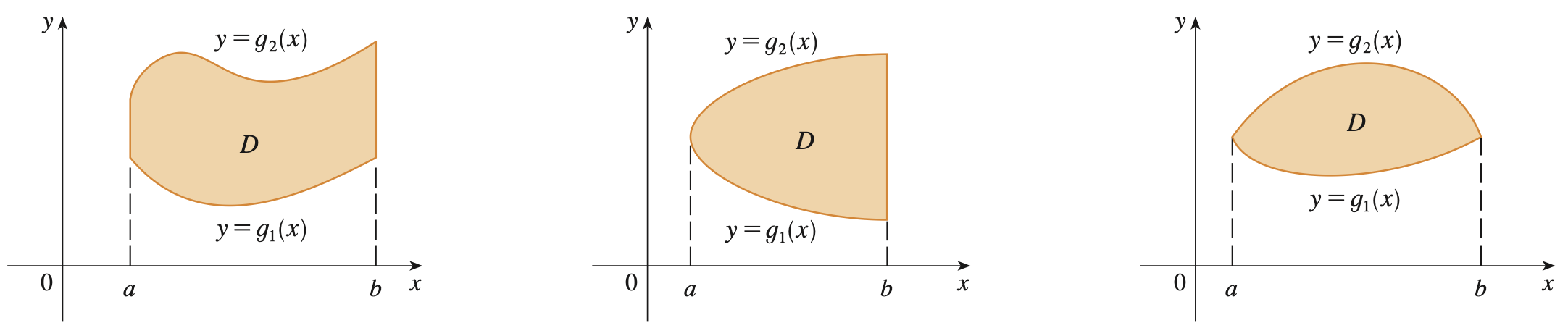
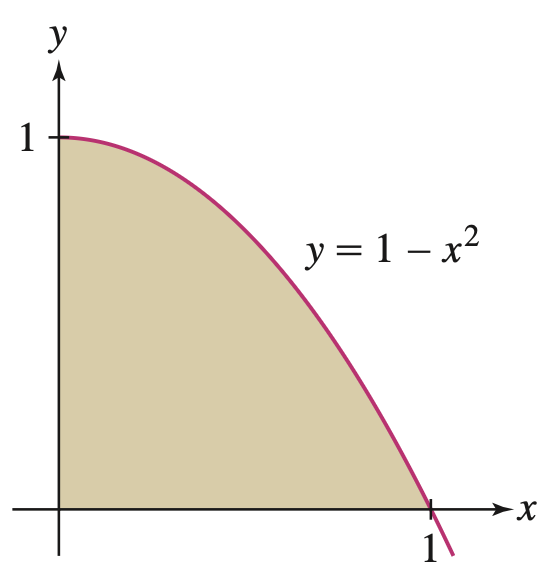
Vertically Simple: To express the domain as a vertically simple region, we bound \(x\) between two constants, and \(y\) between two functions of \(x\text{.}\) Looking at the figure, \(x\) ranges from \(0\) to \(1\text{.}\) For a given \(x\) in this interval, \(y\) goes from the \(x\)-axis (\(y = 0\)) up to the curve \(y = 1 - x^2\text{.}\)
\begin{align*}
\iint_\c{D} xy \, dA \amp = \int_0^1 \int_0^{1-x^2} xy \, dy \, dx
\end{align*}
Evaluating the inner integral with respect to \(y\text{:}\)
\begin{align*}
\int_0^{1-x^2} xy \, dy \amp = \left[ \frac{1}{2}xy^2 \right]_{y=0}^{y=1-x^2} \\
\amp = \frac{1}{2}x(1 - x^2)^2 = \frac{1}{2}x(1 - 2x^2 + x^4) = \frac{1}{2}x - x^3 + \frac{1}{2}x^5
\end{align*}
Evaluating the outer integral with respect to \(x\text{:}\)
\begin{align*}
\int_0^1 \left( \frac{1}{2}x - x^3 + \frac{1}{2}x^5 \right) \, dx \amp = \left[ \frac{1}{4}x^2 - \frac{1}{4}x^4 + \frac{1}{12}x^6 \right]_0^1 \\
\amp = \frac{1}{4} - \frac{1}{4} + \frac{1}{12} = \frac{1}{12}
\end{align*}
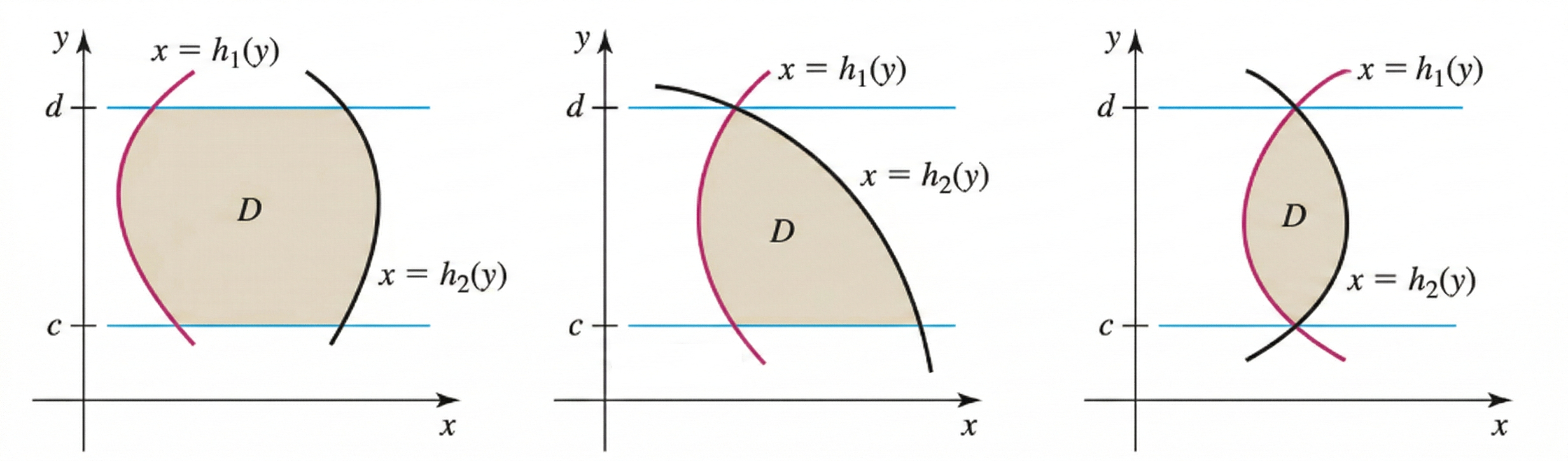
Horizontally Simple: To express it as a horizontally simple region, we bound \(y\) between two constants, and \(x\) between two functions of \(y\text{.}\) First, we solve the curve equation for \(x\text{:}\) \(y = 1 - x^2 \implies x^2 = 1 - y\text{.}\) Since we are in the first quadrant, \(x = \sqrt{1 - y}\text{.}\) \(y\) ranges from \(0\) to \(1\text{.}\) For a given \(y\text{,}\) \(x\) goes from the \(y\)-axis (\(x = 0\)) out to the curve \(x = \sqrt{1 - y}\text{.}\)
\begin{align*}
\iint_\c{D} xy \, dA \amp = \int_0^1 \int_0^{\sqrt{1-y}} xy \, dx \, dy
\end{align*}
Evaluating the inner integral with respect to \(x\text{:}\)
\begin{align*}
\int_0^{\sqrt{1-y}} xy \, dx \amp = \left[ \frac{1}{2}x^2y \right]_{x=0}^{x=\sqrt{1-y}} \\
\amp = \frac{1}{2}(\sqrt{1-y})^2 y = \frac{1}{2}(1 - y)y = \frac{1}{2}y - \frac{1}{2}y^2
\end{align*}
Evaluating the outer integral with respect to \(y\text{:}\)
\begin{align*}
\int_0^1 \left( \frac{1}{2}y - \frac{1}{2}y^2 \right) \, dy \amp = \left[ \frac{1}{4}y^2 - \frac{1}{6}y^3 \right]_0^1 \\
\amp = \frac{1}{4} - \frac{1}{6} = \frac{3}{12} - \frac{2}{12} = \frac{1}{12}
\end{align*}
As expected by Fubini’s Theorem, both orders of integration yield the exact same result:
\(\frac{1}{12}\text{.}\)