Section 12.5 Planes in 3-Spaces

In this section, we extend our knowledge of linear geometry from 2-dimensions to 3-dimensions. While lines were the fundamental linear object in the plane, in 3-space, the fundamental linear object is a surface: the plane. We will learn how to describe these flat surfaces using vectors and how to analyze their interactions with one another.
Recall we briefly introduced planes in \(\R^3\) back in SectionΒ 12.2. In that section, we defined a plane by setting one of the coordinates to a constant value and obtain what we called the coordinate planes. But as you can imagine, these are just a small subset of all possible planes in \(\R^3\text{.}\)
How do we define an arbitrary plane in \(\R^3\text{?}\)

Subsection Defining a Plane

When we defined a line, we used a point and a direction vector \(\v{v}\text{.}\) You might wondering whether we can do the same for a plane?
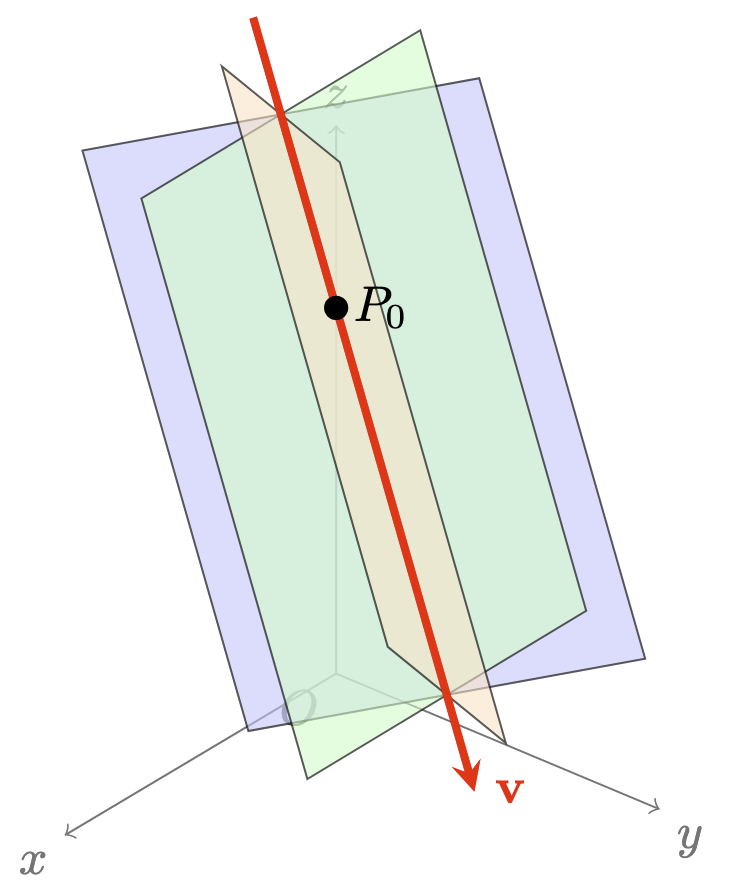
The short answer is no and we have a quick counterexample. The vector \(\v{i} = (1,0,0)\) is parallel to the \(xy\)-plane and the \(xz\)-plane. And both the planes go through the point \((0,0,0)\text{.}\) So a point and a direction vector parallel to the plane cannot uniquely determine a plane.
Figure 12.5.1. Infinite planes through a fixed point and parallel to a fixed vector
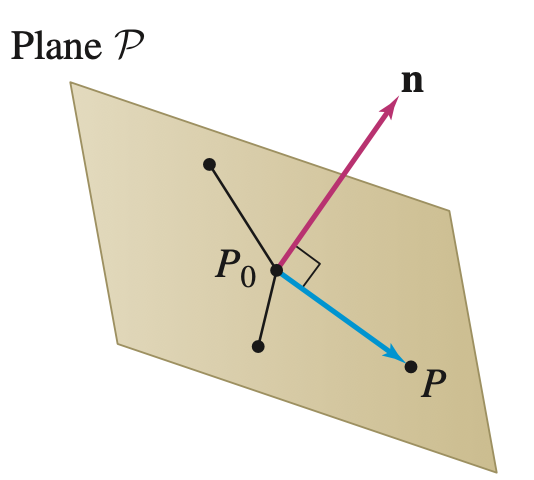
So, to define a plane, we really need a point and a vector that is NOT parallel to the plane. For simplicity, we will choose a vector orthogonal to the plane. That is, this orthogonal vector is orthogonal to every vector that lies in the plane. Visually, this vector "sticks out" of the plane at a right angle.
Figure 12.5.2. A point \(P\) lies on \(\c{P}\) and \(\overrightarrow{P_0P} \perp \v{n}\)
Summing up, to determine a plane in \(\R^3\text{,}\) we need a point and a normal vector, which is a vector orthogonal to the plane.

Definition 12.5.3. Equation of a Plane.

Plane through \(P_0 = (x_0, y_0, z_0)\) with normal vector \(\v{n} = \la a,b,c \ra\text{:}\)
\begin{align*} \textbf{vector form:} \qquad \qquad \qquad \qquad \qquad \qquad \v{n} \cdot \la x,y,z \ra \amp= d \\ \textbf{scalar form:} \qquad \, \, \, \, a(x - x_0) + b(y - y_0) + c(z - z_0) \amp= 0 \\ ax + by + cz \amp= d \end{align*}
where \(d = ax_0 + by_0 + cz_0\text{.}\)

Note 12.5.4. But Richard... Why is the equation appears this way?

This equation may seem a bit mysterious at first glance, but it actually follows directly from the definition of the dot product (and orthogonality).
Let’s say we have a point \(P_0 = (x_0, y_0, z_0)\text{.}\) Furthermore, let \(P = (x,y,z)\) be an arbitrary point on the plane. Then we can define a vector
\begin{equation*} \overrightarrow{P_0P} = \la x - x_0, y - y_0, z - z_0 \ra\text{.} \end{equation*}
Also, we have a normal vector \(\v{n} = \la a,b,c \ra\text{.}\) This vector is orthogonal to ANY vector that lies in the plane, including \(\overrightarrow{P_0P}\text{.}\) Two vectors are orthogonal if and only if their dot product is zero. Therefore, we obtain
\begin{align*} \la a,b,c \ra \cdot \la x - x_0, y - y_0, z - z_0 \ra \amp= 0 \\ a(x - x_0) + b(y - y_0) + c(z - z_0) \amp= 0 \end{align*}
Hey! This is the scalar form of the equation of a plane!
You can simplify this equation further! That is, the scalar form can be simplied to
\begin{align*} ax + by + cz \amp= ax_0 + by_0 + cz_0 \end{align*}
Observe that the right-hand side is just a number, so let’s call it \(d\) for simplicity. Hence, we obtain
\begin{equation*} ax + by + cz = d \end{equation*}
where \(d = ax_0 + by_0 + cz_0\)
What about the vector form? We can observe quickly that \(ax + by + cz\) is just the dot product \(\v{n} \cdot \la x,y,z \ra\text{.}\) Hence, we can rewrite the equation as
\begin{equation*} \v{n} \cdot \la x,y,z \ra = d \end{equation*}
Hey! The vector form!

Example 12.5.5.

Find an equation of the plane with normal vector \(\v{n} = \la -1,2,1 \ra\) passing through the point \((3,1,9)\text{.}\)
Solution.
We are given \(\v{n} = \la -1,2,1 \ra\) and \(P_0 = (3,1,9)\text{.}\)
We can write an equation using the vector form:
\begin{align*} \la -1,2,1 \ra \cdot \la x,y,z \ra \amp= -1 \cdot 3 + 2 \cdot 1 + 1\cdot 9\\ -x + 2y + z \amp= 8 \end{align*}
Alternatively, we can write an equation using the scalar form:
\begin{align*} -1(x-3) + 2(y-1) + 1(z-9) \amp= 0 \\ -x + 3 + 2y - 2 + z - 9 \amp= 0 \\ -x + 2y + z \amp= 8 \end{align*}
Sometimes we are given the equation \(ax + by + cz = d\) and we need to work backwards to find the geometric properties. Specifically, we may want to find a normal vector and a point on the plane.
Finding a point is a bit boring... We just need to find a point \((x,y,z)\) that satisfies the equation. The easiest way to do so is to set the two other variables to zero (or other numbers) and solve for the third.
What about finding a normal vector? If you stare at the equation long enough, you may notice that the coefficients of \(x\text{,}\) \(y\text{,}\) and \(z\) correspond to the components of the normal vector. That is, the normal vector is simply \(\v{n} = \la a, b, c \ra\text{.}\)
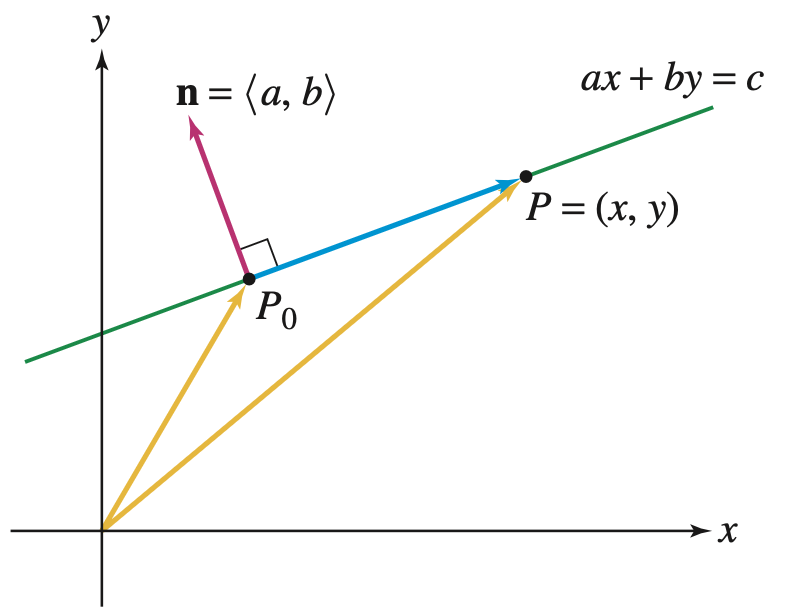
Surprisingly, this pattern also works for lines in \(\R^2\text{.}\) An equation of the line in \(\R^2\) is \(ax + by = c\text{.}\) You for sure know that the slope of this line is \(-\frac{a}{b}\text{.}\) But what you may not know there is that the vector \(\v{n} = \la 1,b \ra\) a normal vector to this line!
Figure 12.5.6. A line with normal vector \(\v{n}\)

Example 12.5.7.

Consider the plane defined by \(3x - 2y + z = 12\text{.}\) Identify the normal vector and find a point on the plane.
Solution.
To find a normal vector, we read the coefficients directly.
\begin{equation*} \v{n} = \la 3, -2, 1 \ra\text{.} \end{equation*}
To find a point on the plane, we can set two of the variables to be constants and solve for the third. For example, we set \(x=0\) and \(y=0\text{,}\) and we can solve for \(z\text{.}\)
\begin{align*} 3(0) - 2(0) + z \amp= 12\\ z \amp= 12 \end{align*}
So, the point \((0,0,12)\) is on the plane.
Note that the equation \(ax + by + cz = d\) of a plane in \(\R^3\) is a generalization of the equation \(ax + by = c\) of a line in \(\R^2\text{.}\) Back in \(\R^2\text{,}\) we can determine and equation of a line using two points. If we generalize this idea to \(\R^3\text{,}\) we can determine an equation of a plane using three points. It turns out that this plane is unique as long as the three points are not collinear (i.e., they do not all lie on the same line).

Example 12.5.8.

Find an equation of the plane passing through the three points \(P = (5,1,1)\text{,}\) \(Q = (1,1,2)\text{,}\) and \(R = (2,1,1)\text{.}\)
Hint.
Recall that we need a point and a normal vector to determine an equation of a plane. Well we are given three points, so we can use one of them as our point.
What about a normal vector... Can we find a normal vector using the three points?
Yes we can! Recall we can find a normal vector orthogonal to two vectors using the cross product!
Solution.
First, we can find two vectors lying on the plane.
\begin{align*} \overrightarrow{PQ} \amp = \la 1-5, 1-1, 2-1 \ra = \la -4, 0, 1 \ra\\ \overrightarrow{PR} \amp = \la 2-5, 1-1, 1-1 \ra = \la -3, 0, 0 \ra \end{align*}
Since both \(\overrightarrow{PQ}\) and \(\overrightarrow{PR}\) lie on the plane, their cross product will be orthogonal to the plane. This can be our normal vector!
\begin{align*} \v{n} = \overrightarrow{PQ} \times \overrightarrow{PR} \amp = \begin{vmatrix} \v{i} \amp \v{j} \amp \v{k} \\ -4 \amp 0 \amp 1 \\ -3 \amp 0 \amp 0 \end{vmatrix}\\ \amp = \v{i}(0-0) - \v{j}(0 - (-3)) + \v{k}(0-0) \\ \amp = -3\v{j} \\ \amp = \la 0, -3, 0 \ra \end{align*}
Below is a visualization of what we just did. We plotted \(P, Q, R\) to create the plane (shown in blue). We constructed the vectors \(\overrightarrow{PQ}\) and \(\overrightarrow{PR}\) (green) that lie on the plane. Finally, we crossed them to get the normal vector \(\v{n}\) (red), which you can see stands orthogonal to the surface.
Figure 12.5.9. Visualizing the plane through P, Q, R
We can use any scalar multiple of this vector, so let’s use \(\v{n} = \la 0, 1, 0 \ra\) for simplicity. Using point \(P(5,1,1)\text{:}\)
\begin{equation*} 0(x-5) + 1(y-1) + 0(z-1) = 0 \implies y - 1 = 0 \implies y = 1 \end{equation*}
This makes sense, as all three given points had a y-coordinate of 1!

Subsection Intersection of a Line and a Plane

We often want to know where a specific line punctures a plane. Unless the line is parallel to the plane (or lying inside it), they will intersect at exactly one point.
To find the intersection point of a line and a plane, we need to find the point \((x,y,z)\) that lies on both the line and the plane. But how do we solve THREE variables simulateneously?
A good news here is that the line in \(\R^3\) is defined parametrically using a single parameter \(t\text{!}\) Since the coordinate of the point needs to satisfy both the equation of the plane and the parametric equation of the line, we can use substitution to find the point of intersection.
That is, to find this point, we
  1. write the parametric equations for \(x(t)\text{,}\) \(y(t)\text{,}\) and \(z(t)\) from the line.
  2. plug these expressions into the equation of the plane.
  3. solve for \(t\text{.}\)
  4. plug \(t\) back into the line equation to get the point \((x,y,z)\text{.}\)

Example 12.5.10.

Find the point where the line \(\v{r}(t) = \la 1, 0, 0 \ra + t\la 2, 1, -1 \ra\) intersects the plane \(x + y + z = 10\text{.}\)
Solution.
First, let’s break the line into its components: \(x = 1+2t\text{,}\) \(y = t\text{,}\) \(z = -t\text{.}\)
Now, plug these into the plane equation \(x + y + z = 10\text{:}\)
\begin{equation*} (1+2t) + (t) + (-t) = 10 \end{equation*}
Simplify the algebra:
\begin{equation*} 1 + 2t = 10 \implies 2t = 9 \implies t = 4.5 \end{equation*}
We aren’t done yet! We need the point. Plug \(t=4.5\) back into our line components:
\begin{align*} x \amp= 1 + 2(4.5) = 10\\ y \amp= 4.5\\ z \amp= -4.5 \end{align*}
The intersection point is \((10, 4.5, -4.5)\text{.}\)
Here is a visual confirmation of our algebra. The yellow dot is exactly where the red line punctures the blue plane.
Figure 12.5.11. Visualizing the intersection point

Subsection Traces

Drawing planes in 3D on a 2D sheet of paper is tricky. A great tool to help us visualize the position of a plane is finding its traces.
A trace is a slice of a surface by a coordinate plane. We are working with planes now, so the trace here is the line of intersection between the plane and one of the coordinate planes (\(xy\)-plane, \(xz\)-plane, or \(yz\)-plane).
  • \(xy\)-trace: Set \(z=0\text{.}\) This shows where the plane cuts through the floor.
  • \(xz\)-trace: Set \(y=0\text{.}\) This shows where the plane cuts through the side wall.
  • \(yz\)-trace: Set \(x=0\text{.}\) This shows where the plane cuts through the back wall.
By finding the intercepts on the axes and connecting them, we can draw a triangle that represents a portion of the plane.

Example 12.5.12.

Sketch the plane \(2x + 3y + 4z = 12\) by finding its traces.
Solution.
Let’s find the intercepts to help us draw the lines.
  • x-intercept: Set \(y=0, z=0\text{.}\) \(2x = 12 \implies x=6\text{.}\) Point: \((6,0,0)\text{.}\)
  • y-intercept: Set \(x=0, z=0\text{.}\) \(3y = 12 \implies y=4\text{.}\) Point: \((0,4,0)\text{.}\)
  • z-intercept: Set \(x=0, y=0\text{.}\) \(4z = 12 \implies z=3\text{.}\) Point: \((0,0,3)\text{.}\)
Now, look at the diagram below. The red lines are the traces. The xy-trace connects the x and y intercepts. The yz-trace connects the y and z intercepts. The xz-trace connects the x and z intercepts. Connecting these three points forms a triangle in the first octant that helps us visualize the slant of the plane.
Figure 12.5.13. Traces of the plane \(2x + 3y + 4z = 12\)

Subsection Parallel and Intersecting Planes

Two planes in \(\R^3\) can either be parallel or intersecting, providing they are not the same plane.
To determine whether two planes are parallel, we can compare their normal vectors. Recall two lines are parallel if their direction vectors are parallel (i.e., scalar multiples of each other). In the similar sense, two planes are parallel if their normal vectors are parallel (i.e., scalar multiples of each other).

Example 12.5.14.

Show that the two planes \(x + 2y - 3z = 4\) and \(2x + 4y - 6z = 3\) are parallel.
Solution.
The normal vector of the first plane is \(\v{n}_1 = \la 1,2,-3 \ra\) and the normal vector of the second plane is \(\v{n}_2 = \la 2,4,-6 \ra\text{.}\) Note that \(\v{n}_2 = 2 \v{n}_1\text{,}\) so the normal vectors are parallel. Therefore, the two planes are parallel.
In the diagram below, you can see these "floating" surfaces. They have the same tilt, they are just shifted relative to each other.
Figure 12.5.15. Parallel Planes \(x + 2y - 3z = 4\) (Blue) and \(2x + 4y - 6z = 3\) (Red)
What about the intersection of two planes? Imagine two non-parallel planes in \(\R^3\) is intersecting, then they will intersect along a line.

Example 12.5.16.

Find an equation of the line of intersection of the planes \(x + 2y + z = 5\) and \(2x + y - z = 7\text{.}\)
Hint.
To define the line of intersection, we need two things:
  1. A direction vector \(\v{v}\) for the line.
  2. A point \(P\) on the line.
Since the line lies on both planes, it must be perpendicular to both normal vectors. Does that ring a bell? (Think cross product!)
Figure 12.5.17. Intersection of \(x + 2y + z = 5\) (Blue) and \(2x + y - z = 7\) (Red)
Solution.
Step 1: Find the direction vector. The normal vectors are \(\v{n}_1 = \la 1, 2, 1 \ra\) and \(\v{n}_2 = \la 2, 1, -1 \ra\text{.}\) The direction of the intersection line, \(\v{v}\text{,}\) is orthogonal to both normals:
\begin{align*} \v{v} = \v{n}_1 \times \v{n}_2 \amp = \begin{vmatrix} \v{i} \amp \v{j} \amp \v{k} \\ 1 \amp 2 \amp 1 \\ 2 \amp 1 \amp -1 \end{vmatrix}\\ \amp = \la -2-1, -( -1-2), 1-4 \ra \\ \amp = \la -3, 3, -3 \ra \end{align*}
For simplicity, we can divide by -3 to get a parallel vector: \(\v{v} = \la 1, -1, 1 \ra\text{.}\)
Step 2: Find a point on the line. We need a point \((x,y,z)\) that satisfies both plane equations. We have 2 equations and 3 unknowns, so we can pick a value for one variable. Let’s try \(z = 0\) (so we are really finding the intersection between this line and the \(xy\)-plane, and this point of intersection will be on this line for sure! ). The system becomes:
\begin{align*} x + 2y \amp= 5\\ 2x + y \amp= 7 \end{align*}
From the second eq, \(y = 7 - 2x\text{.}\) Substitute into the first:
\begin{equation*} x + 2(7 - 2x) = 5 \implies x + 14 - 4x = 5 \implies -3x = -9 \implies x = 3 \end{equation*}
Then \(y = 7 - 2(3) = 1\text{.}\) So a point on the line is \((3, 1, 0)\text{.}\)
Step 3: Write the equation. The vector equation of the line is:
\begin{equation*} \v{r}(t) = \la 3, 1, 0 \ra + t \la 1, -1, 1 \ra \end{equation*}

Worksheet Assigned Problems for Section 12.5

The problems listed below are assigned to be included in your problem set portfolio. Note that a specific selection of these problems will also form the written homework assignments. I recommend working through all of them to ensure a solid grasp of the material. Reach out to Richard for help if you get stuck or have any questions.
The solutions will be posted after the written homework due dates. If you have any questions about your work, talk to Richard and he is happy to discuss the process with you.

12.5.3.

Write the equation of the plane with normal vector \(\v{n} = \la -1,2,1 \ra\) passing through the point \(\lp 4,1,5 \rp\) in the scalar form \(ax + by + cz = d\text{.}\)
Solution.
The vector equation is
\begin{equation*} \la-1,2,1\ra\cdot\la x_0,y_0,z_0\ra=\la-1,2,1\ra\cdot\la 4,1,5\ra=-4+2+5=3 \end{equation*}
To obtain the scalar form we compute the dot product on the left-hand side above.
\begin{equation*} -x+2y+z=3 \end{equation*}
or in the other scalar form.
\begin{equation*} -(x-4)+2(y-1)+(z-5)=0 \end{equation*}

12.5.15.

Find a vector normal to the plane \(3(x - 4) - 8(y - 1) + 11z = 0\text{.}\)
Solution.
Using the scalar form of the equation of the plane, \(3x-8y+11z=4\text{,}\) a vector normal to the plane is the coefficients vector
\begin{equation*} \v{n}=\la3,-8,11\ra \end{equation*}

12.5.23.

Find an equation of the plane passing through the three points \(P = (1,0,0)\text{,}\) \(Q = (0,1,1)\text{,}\) and \(R = (2,0,1)\text{.}\)
Solution.
We use the vector form of the equation of the plane.
\begin{equation*} \v{n}\cdot\la x,y,z\ra=d \end{equation*}
To find the normal vector to the plane, \(\v{n}\text{,}\) we first compute the vectors \(\overrightarrow{PQ}\) and \(\overrightarrow{PR}\) that lie in the plane, and then find the cross product of these vectors. This gives
\begin{align*} \overrightarrow{PQ} \amp =\la0,1,1\ra-\la1,0,0\ra=\la-1,1,1\ra\\ \overrightarrow{PR} \amp =\la2,0,1\ra-\la1,0,0\ra=\la1,0,1\ra \end{align*}
\begin{align*} \v{n}=\overrightarrow{PQ}\times\overrightarrow{PR} \amp= \begin{vmatrix}\v{i}\amp \v{j}\amp \v{k}\\ -1\amp 1\amp 1\\ 1\amp 0\amp 1\end{vmatrix} \\ \amp=\begin{vmatrix}1\amp 1\\ 0\amp 1\end{vmatrix}\v{i}-\begin{vmatrix}-1\amp 1\\ 1\amp 1\end{vmatrix}\v{j}+\begin{vmatrix}-1\amp 1\\ 1\amp 0\end{vmatrix}\v{k} \\ \amp=\v{i}+2\v{j}-\v{k} \\ \amp=\la1,2,-1\ra \end{align*}
We now choose any one of the three points in the plane, say \(P=(1,0,0),\) and compute \(d\text{.}\)
\begin{equation*} d=\v{n}\cdot\overrightarrow{OP}=\la1,2,-1\ra\cdot\la1,0,0\ra=1\cdot1+2\cdot0+(-1)\cdot0=1 \end{equation*}
Putting it all together, the equation of the plane is
\begin{align*} \la1,2,-1\ra\cdot\la x,y,z\ra \amp= 1\\ x+2y-z \amp= 1 \end{align*}
12.5.27.

In each case, determine whether or not the lines have a single point of intersection. If they do, give an equation of a plane containing them.
  1. \(\v{r}_1(t) = \la t, 2t-1, t-3 \ra\) and \(\v{r}_2(t) = \la 4, 2t-1, -1 \ra\)
  2. \(\v{r}_1(t) = \la 3t, 2t+1, t-5 \ra\) and \(\v{r}_2(t) = \la 4t, 4t-3, -1 \ra\)
Solution.
  1. We look for an intersection point by setting the components equal. Be careful to use different parameters for the two lines, say \(t\) for \(\v{r}_1\) and \(s\) for \(\v{r}_2\text{.}\)
    \begin{align*} x: \quad t \amp= 4 \\ y: \quad 2t - 1 \amp= 2s - 1 \\ z: \quad t - 3 \amp= -1 \end{align*}
    From the first equation, \(t=4\text{.}\) However, from the third equation, \(t - 3 = -1 \implies t = 2\text{.}\) Since \(t\) cannot be both 4 and 2, there is no solution. The lines do not intersect (and their direction vectors \(\la 1,2,1 \ra\) and \(\la 0,2,0 \ra\) are not parallel). Thus, they are skew lines and there is no single plane containing both.
  2. Again, we set the components equal using parameters \(t\) and \(s\text{.}\)
    \begin{align*} x: \quad 3t \amp= 4s \\ y: \quad 2t + 1 \amp= 4s - 3 \\ z: \quad t - 5 \amp= -1 \end{align*}
    From the third equation, \(t = 4\text{.}\) Plugging \(t=4\) into the first equation: \(3(4) = 4s \implies 12 = 4s \implies s = 3\text{.}\) Now we check if these values satisfy the second equation (the y-coordinate):
    \begin{gather*} \text{LHS: } 2(4) + 1 = 9 \\ \text{RHS: } 4(3) - 3 = 9 \end{gather*}
    They match! The lines intersect at the point derived from \(t=4\text{:}\)
    \begin{equation*} P = (3(4), 2(4)+1, 4-5) = (12, 9, -1) \end{equation*}
    Since the lines intersect, they define a plane. The normal vector \(\v{n}\) is the cross product of the direction vectors \(\v{v}_1 = \la 3, 2, 1 \ra\) and \(\v{v}_2 = \la 4, 4, 0 \ra\text{.}\)
    \begin{align*} \v{n} = \v{v}_1 \times \v{v}_2 \amp = \begin{vmatrix} \v{i} \amp \v{j} \amp \v{k} \\ 3 \amp 2 \amp 1 \\ 4 \amp 4 \amp 0 \end{vmatrix}\\ \amp = \v{i}(0-4) - \v{j}(0-4) + \v{k}(12-8) \\ \amp = \la -4, 4, 4 \ra \end{align*}
    We can simplify this normal vector by dividing by -4 to get \(\v{n} = \la 1, -1, -1 \ra\text{.}\) Using the intersection point \((12, 9, -1)\text{,}\) the equation of the plane is:
    \begin{align*} 1(x - 12) - 1(y - 9) - 1(z - (-1)) \amp= 0 \\ x - 12 - y + 9 - z - 1 \amp= 0 \\ x - y - z \amp= 4 \end{align*}

12.5.33.

Draw the plane given by the equation \(x + y + z = 4\text{.}\)
Solution.
To draw the plane, we find the intercepts where the plane crosses the coordinate axes.
  • x-intercept: Set \(y=0, z=0\text{.}\) \(x = 4\text{.}\) Point \((4,0,0)\text{.}\)
  • y-intercept: Set \(x=0, z=0\text{.}\) \(y = 4\text{.}\) Point \((0,4,0)\text{.}\)
  • z-intercept: Set \(x=0, y=0\text{.}\) \(z = 4\text{.}\) Point \((0,0,4)\text{.}\)
The traces form a triangle connecting these three points.
Figure 12.5.18. Plane \(x + y + z = 4\) with traces

12.5.41.

Find the intersection of the line \(\v{r}(t) = \la 1,1,0 \ra + t \la 0,2,4 \ra\) and the plane \(x + y + z = 14\text{.}\)
Solution.
The line has parametric equations
\begin{equation*} x(t)=1, \qquad y(t)=1+2t, \qquad z(t)=4t \end{equation*}
To find a value of \(t\) for which \((x,y,z)\) lies on the plane, we substitute the parametric equations in the equation of the plane and solve for \(t\text{.}\)
\begin{align*} x+y+z \amp = 14\\ 1+(1+2t)+4t \amp = 14\\ 6t \amp = 12 \qquad \implies \qquad t=2 \end{align*}
The point \(P\) of intersection has coordinates
\begin{equation*} x(2)=1, \qquad y(2)=1+2\cdot2=5, \qquad z(2)=4\cdot2=8 \end{equation*}
That is, \(P=(1,5,8)\text{.}\)

12.5.59.

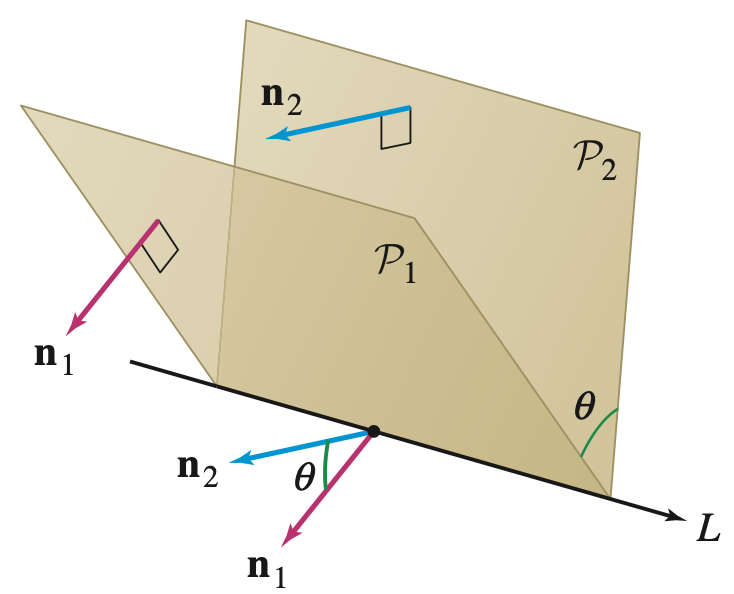
By definition, the angle between two planes is the angle between their normal vectors.
Figure 12.5.19. Angle between Two Planes
Compute the angle between the two planes \(2x + 3y + 7z = 2\) and \(4x - 2y + 2z = 4\text{.}\)
Solution.
The planes \(2x+3y+7z=2\) and \(4x-2y+2z=4\) have the normal vectors of \(\v{n}_1=\la2,3,7\ra\) and \(\v{n}_2=\la4,-2,2\ra\) respectively. The cosine of the angle between \(\v{n}_1\) and \(\v{n}_2\) is
\begin{align*} \cos \theta \amp= \frac{\v{n}_1\cdot \v{n}_2}{\|\v{n}_1\|\|\v{n}_2\|} \\ \amp=\frac{\la2,3,7\ra\cdot\la4,-2,2\ra}{\|\la2,3,7\ra\|\|\la4,-2,2\ra\|} \\ \amp=\frac{8-6+14}{\sqrt{2^2+3^2+7^2}\sqrt{4^2+(-2)^2+2^2}} \\ \amp=\frac{16}{\sqrt{62}\sqrt{24}} \\ \amp\approx 0.415 \end{align*}
The solution for \(0\le\theta\lt\pi\) is \(\theta=1.143\) rad or \(\theta=65.49^{\circ}\text{.}\)

12.5.65.

Find a plane that is perpendicular to the two planes \(x + y = 3\) and \(x + 2y - z = 4\text{.}\)
Solution.
The vector forms of the equations of the planes are \(\la 1,1,0 \ra \cdot \la x,y,z \ra = 3\) and \(\la 1,2,-1 \ra \cdot \la x,y,z \ra = 4\text{,}\) hence the vectors \(\v{n}_1=\la1,1,0\ra\) and \(\v{n}_2=\la1,2,-1\ra\) are normal to the planes. We denote the equation of the planes which are perpendicular to the two planes by
\begin{equation*} ax + by + cz = d \end{equation*}
Then, the normal \(\v{n}=\la a,b,c\ra\) to the planes is orthogonal to the normals \(\v{n}_1\) and \(\v{n}_2\) of the given planes. Therefore, \(\v{n}\cdot \v{n}_1=0\) and \(\v{n}\cdot \v{n}_2=0\) which gives us
\begin{align*} \la a,b,c \ra \cdot \la 1,1,0 \ra \amp = 0\\ \la a,b,c \ra \cdot \la 1,2,-1 \ra \amp = 0 \end{align*}
We obtain the following equations.
\begin{equation*} \begin{cases} a+b=0 \\ a+2b-c=0 \end{cases} \end{equation*}
The first equation implies that \(b=-a\text{.}\) Substituting in the second equation we get \(a-2a-c=0\text{,}\) and hence \(c=-a\text{.}\) Substituting them back to the equation of the perpendicular planes, we get
\begin{equation*} ax-ay-az=d \qquad \implies \qquad x-y-z=\frac{d}{a} \end{equation*}
\(\frac{d}{a}\) is an arbitrary constant which we denote by \(f\text{.}\) Therefore, the planes which are perpendicular to the given planes are
\begin{equation*} x-y-z=f \end{equation*}

12.5.67.

Let \(\c{L}\) denote the line of intersection of the planes \(x - y - z = 1\) and \(2x + 3y + z = 2\text{.}\) Find parametric equations for the line \(\c{L}\text{.}\)
Hint.
To find a point on \(\c{L}\text{,}\) substitute an arbitrary value for \(z\) (say, \(z = 2\)) and then solve the resulting pair of equations for \(x\) and \(y\text{.}\)
Solution.
A direction vector for \(L\) is the cross product \(\v{v}=\v{n}_1\times \v{n}_2\text{.}\)
\begin{equation*} \v{v}=\v{n}_1\times \v{n}_2=\begin{vmatrix}\v{i}\amp \v{j}\amp \v{k}\\ 1\amp -1\amp -1\\ 2\amp 3\amp 1\end{vmatrix}=2\v{i}-3\v{j}+5\v{k}=\la2,-3,5\ra \end{equation*}
We now need to find a point on \(L\text{.}\) We choose \(z=2\) substitute in the equations of the planes and solve the resulting equations for \(x\) and \(y\text{.}\) This gives
\begin{align*} x-y-2=1 \amp \qquad \implies \qquad x-y=3\\ 2x+3y+2=2 \amp \qquad \implies \qquad 2x+3y=0 \end{align*}
The 1st equation implies that \(y=x-3\text{.}\) Substituting in the 2nd equation and solving for \(x\) gives
\begin{equation*} 2x+3(x-3)=0 \end{equation*}
\begin{equation*} 5x=9 \qquad \implies \qquad x=\frac{9}{5} \end{equation*}
This also implies that \(y=\dfrac{9}{5}-3=-\dfrac{6}{5}\text{.}\)
We conclude that the point \((\frac{9}{5},-\frac{6}{5},2)\) is on \(L\text{.}\) We now use the vector parametrization of a line to obtain the following parametrization for \(L\text{:}\)
\begin{equation*} \v{r}(t)=\la\frac{9}{5},-\frac{6}{5},2\ra+t\la2,-3,5\ra \end{equation*}
This yields the parametric equations
\begin{equation*} x(t) = \frac{9}{5}+2t, \qquad y(t) = -\frac{6}{5}-3t, \qquad z(t)=2+5t \end{equation*}