Section 12.4 The Cross Product

In the previous section, we learned about the Dot Product, a way to multiply two vectors to get a scalar (a single number). You might be wondering whether there is another way to multiply two vectors?
The answer is yes! We can multiply two vectors in a special way to get a third vector. This is called the Cross Product. However, unlike the dot product which works in any dimension, the cross product is special. It only works meaningfully in \(\R^3\text{.}\) This operation is incredibly useful for finding orthogonal directions, calculating areas, and understanding rotation in physics.
Let’s dive right into the definition. The formula can look a bit intimidating at first, but we will use a tool called a determinant to help us remember it.

Definition 12.4.1. The Cross Product.

Given two vectors \(\v{v} = \la v_1, v_2, v_3 \ra\) and \(\v{w} = \la w_1, w_2, w_3 \ra\) in \(\R^3\text{,}\) the cross product \(\v{v} \times \v{w}\) is the vector defined by:
\begin{equation*} \v{v} \times \v{w} = \la v_2 w_3 - v_3 w_2, -(v_1 w_3 - v_3 w_1), v_1 w_2 - v_2 w_1 \ra \end{equation*}
Wow this definition looks crazy! No one should memorize this long of a formula! If you know a bit linear algebra, the cross product can be computed using the determinant.
Given the two vectors \(\v{v} = \la v_1, v_2, v_3 \ra\) and \(\v{w} = \la w_1, w_2, w_3 \ra\text{,}\) we can construct a matrix as follows:
\begin{equation*} \begin{pmatrix} \v{i} \amp \v{j} \amp \v{k} \\ v_1 \amp v_2 \amp v_3 \\ w_1 \amp w_2 \amp w_3 \end{pmatrix} \end{equation*}
where the \(\v{i}\text{,}\) \(\v{j}\text{,}\) and \(\v{k}\) are the standard basis vectors in \(\R^3\text{.}\)
It turns out that the cross product \(\v{v} \times \v{w}\) is the determinant of this matrix. That is,
\begin{align*} \v{v} \times \v{w} \amp= \begin{vmatrix} \v{i} \amp \v{j} \amp \v{k} \\ v_1 \amp v_2 \amp v_3 \\ w_1 \amp w_2 \amp w_3 \end{vmatrix}\\ \amp= \begin{vmatrix} v_2 \amp v_3 \\ w_2 \amp w_3 \end{vmatrix} \v{i} - \begin{vmatrix} v_1 \amp v_3 \\ w_1 \amp w_3 \end{vmatrix} \v{j} + \begin{vmatrix} v_1 \amp v_2 \\ w_1 \amp w_2 \end{vmatrix} \v{k}\\ \amp= (v_2 w_3 - v_3 w_2)\v{i} - (v_1 w_3 - v_3 w_1)\v{j} + (v_1 w_2 - v_2 w_1)\v{k}\\ \amp= \la v_2 w_3 - v_3 w_2, -(v_1 w_3 - v_3 w_1), v_1 w_2 - v_2 w_1 \ra \end{align*}
P.S.: Yes Richard did a cofactor expansion on the first row in his work above. Remember that this isn’t really a linear algebra class so he will not go in depth on the cofactor expansion. If linear algebra isn’t your thing and you don’t want to memorize the formula (no one should), you can find the determine of a 3x3 matrix using the lattice method. Below is a quick video tutorial on how to do that:
Figure 12.4.2. Quick Tutorial on Computing the Determinant of a 3x3 Matrix

Note 12.4.3. If you prefer to have a list of steps for the lattice method....

Richard understands that not everyone learn how to compute the determinant of a square matrix. And we are only working with the determinant of a 3x3 matrix here, so lattice method is a quick and easy way to compute it.
P.S.: The lattice method here will ONLY work to find the determinant of a 3x3 matrix! This is NOT generalizable to larger matrices!
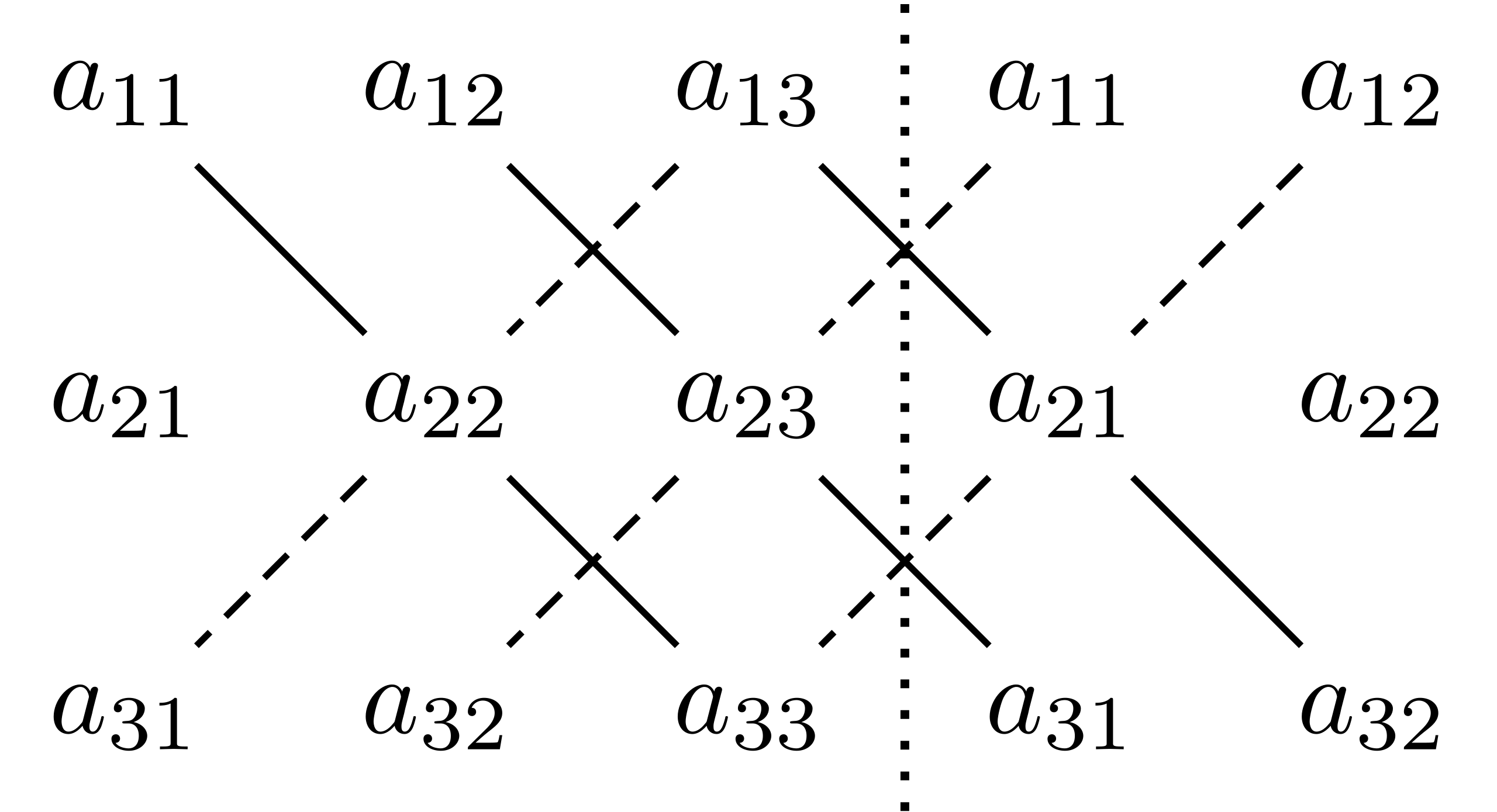
Here are the steps to compute the determinant of a 3x3 matrix using the lattice method:
  1. Write down the 3x3 matrix and then duplicate the first two columns to the right of the matrix.
  2. Draw diagonals from the top left to bottom right and multiply the three numbers on each diagonal. Then add these products together.
  3. Next, draw diagonals from the top right to bottom left and multiply the three numbers on each diagonal. Then add these products together.
  4. Finally, subtract the sum from step 3 from the sum from step 2 to get the determinant.
Below is a more visual representation of the steps above:
Figure 12.4.4. Lattice Method to calculate the determinant of a 3x3 matrix
Then the determinant is calculated as
\begin{equation*} \lp a_{11} a_{22} a_{33} + a_{12} a_{23} a_{31} + a_{13} a_{21} a_{32}\rp - \lp a_{13} a_{22} a_{31} + a_{11} a_{23} a_{32} + a_{12} a_{21} a_{33}\rp \end{equation*}
In practice with the cross product, the first row will be the standard basis vectors in \(\R^3\text{,}\) the second row will be the components of the first vector, and the third row will be the components of the second vector.

Example 12.4.5.

Compute \(\v{v} \times \v{w}\) for \(\v{v} = \la 1, 2, -1 \ra\) and \(\v{w} = \la 3, 0, 1 \ra\text{.}\)
Solution.
\begin{align*} \v{v} \times \v{w} \amp= \begin{vmatrix} \v{i} \amp \v{j} \amp \v{k} \\ 1 \amp 2 \amp -1 \\ 3 \amp 0 \amp 1 \end{vmatrix} \\ \amp= \begin{vmatrix} 2 \amp -1 \\ 0 \amp 1 \end{vmatrix} \v{i} - \begin{vmatrix} 1 \amp -1 \\ 3 \amp 1 \end{vmatrix} \v{j} + \begin{vmatrix} 1 \amp 2 \\ 3 \amp 0 \end{vmatrix} \v{k} \\ \amp= (2 \cdot 1 - (-1) \cdot 0)\v{i} - (1 \cdot 1 - (-1) \cdot 3)\v{j} + (1 \cdot 0 - 2 \cdot 3)\v{k} \\ \amp= (2 - 0)\v{i} - (1 + 3)\v{j} + (0 - 6)\v{k} \\ \amp= 2\v{i} - 4\v{j} - 6\v{k} \\ \amp= \la 2, -4, -6 \ra \end{align*}
Below is a quick sketch to visualize the two vectors and their cross product.
Figure 12.4.6. Visualizing \(\v{v} \times \v{w}\) for \(\v{v}=\la 1,2,-1 \ra\) and \(\v{w}=\la 3,0,1 \ra\)
Now that we know how the cross product works, let’s explore some of its important properties!

Subsection Properties of the Cross Product

Let’s start off by observing the behavior of the cross product in the FigureΒ 12.4.6. The most obvious observation here is that \(\v{v} \times \v{w}\) is also a vector!
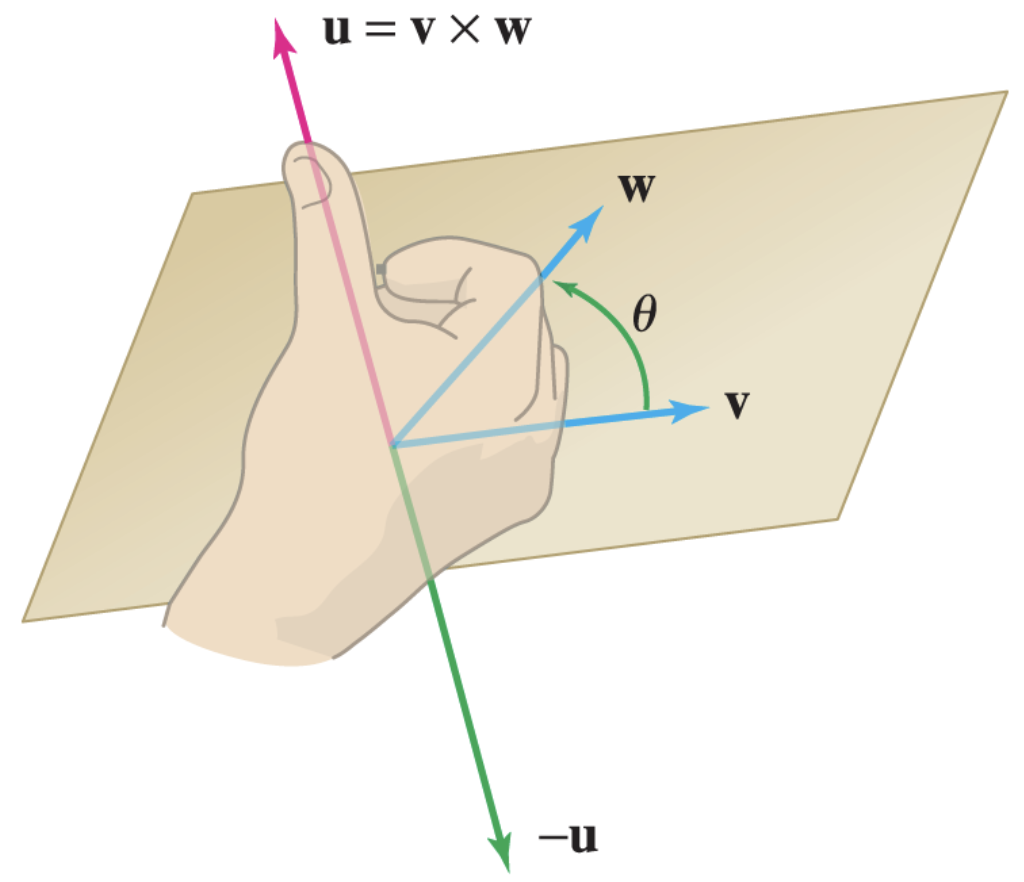
We can also see that \(\v{v} \times \v{w}\) is orthogonal to both \(\v{v}\) and \(\v{w}\text{.}\) It turns out that the cross product always produces a vector that is perpendicular to both input vectors, following the right-hand rule, which states that when the fingers of your right hand curl from \(\v{v}\) to \(\v{w}\text{,}\) your thumb points to the same side of the plane spanned by \(\v{v}\) and \(\v{w}\) as their cross product.
Figure 12.4.7. Right-Hand Rule for Cross Product
Other than these geometric properties, the cross product also has several algebraic properties that are useful in computations.
Some of the results can be justified directly from the right-hand rule and geometric intuition. For example, the anticommutative property makes sense because switching the order of the vectors reverses the direction of the resulting vector. As a mathematician, we should also verify these properties using the definition of the cross product (the one with the determinant).

Some Proofs of Cross Product Properties.

Richard will prove some of these properties using the determinant definition of the cross product. Some will be left as exercises for the reader.
  1. Let \(\v{v} = \la v_1, v_2, v_3 \ra\) and \(\v{w} = \la w_1, w_2, w_3 \ra\text{.}\) Then we obtain
    \begin{align*} \v{w} \times \v{v} \amp= \begin{vmatrix} \v{i} \amp \v{j} \amp \v{k} \\ w_1 \amp w_2 \amp w_3 \\ v_1 \amp v_2 \amp v_3 \end{vmatrix}\\ \amp= (w_2 v_3 - w_3 v_2)\v{i} - (w_1 v_3 - w_3 v_1)\v{j} + (w_1 v_2 - w_2 v_1)\v{k}\\ \amp= -(v_2 w_3 - v_3 w_2)\v{i} + (v_1 w_3 - v_3 w_1)\v{j} - (v_1 w_2 - v_2 w_1)\v{k}\\ \amp= - \left[ (v_2 w_3 - v_3 w_2)\v{i} - (v_1 w_3 - v_3 w_1)\v{j} + (v_1 w_2 - v_2 w_1)\v{k} \right]\\ \amp= - (\v{v} \times \v{w}) \end{align*}
    Thus, the cross product is anticommutative.
  2. Let \(\v{v} = \la v_1, v_2, v_3 \ra\text{.}\) Then we have
    \begin{align*} \v{v} \times \v{v} \amp= \begin{vmatrix} \v{i} \amp \v{j} \amp \v{k} \\ v_1 \amp v_2 \amp v_3 \\ v_1 \amp v_2 \amp v_3 \end{vmatrix}\\ \amp= \la v_2 v_3 - v_3 v_2, -(v_1 v_3 - v_3 v_1), v_1 v_2 - v_2 v_1 \ra\\ \amp= \la 0, -0, 0 \ra\\ \amp= \v{0} \end{align*}
  3. Left as an exercise to the reader.
  4. Let \(\v{v} = \la v_1, v_2, v_3 \ra\) and \(\v{w} = \la w_1, w_2, w_3 \ra\text{.}\) Then for the first part of the equality, we obtain
    \begin{align*} (\lambda\v{v}) \times \v{w} \amp= \begin{vmatrix} \v{i} \amp \v{j} \amp \v{k} \\ \lambda v_1 \amp \lambda v_2 \amp \lambda v_3 \\ w_1 \amp w_2 \amp w_3 \end{vmatrix}\\ \amp= (\lambda v_2 w_3 - \lambda v_3 w_2)\v{i} - (\lambda v_1 w_3 - \lambda v_3 w_1)\v{j} + (\lambda v_1 w_2 - \lambda v_2 w_1)\v{k}\\ \amp= \lambda(v_2 w_3 - v_3 w_2)\v{i} - \lambda(v_1 w_3 - v_3 w_1)\v{j} + \lambda(v_1 w_2 - v_2 w_1)\v{k}\\ \amp= \lambda \left[ (v_2 w_3 - v_3 w_2)\v{i} - (v_1 w_3 - v_3 w_1)\v{j} + (v_1 w_2 - v_2 w_1)\v{k} \right]\\ \amp= \lambda (\v{v} \times \v{w}) \end{align*}
    The proof that \(\v{v} \times (\lambda\v{w}) = \lambda(\v{v} \times \v{w})\) follows a similar calculation by placing the scalars \(\lambda w_i\) in the second row of the determinant. Thus, \((\lambda\v{v}) \times \v{w} = \v{v} \times (\lambda\v{w}) = \lambda(\v{v} \times \v{w})\text{.}\)
  5. Left as an exercise to the reader.
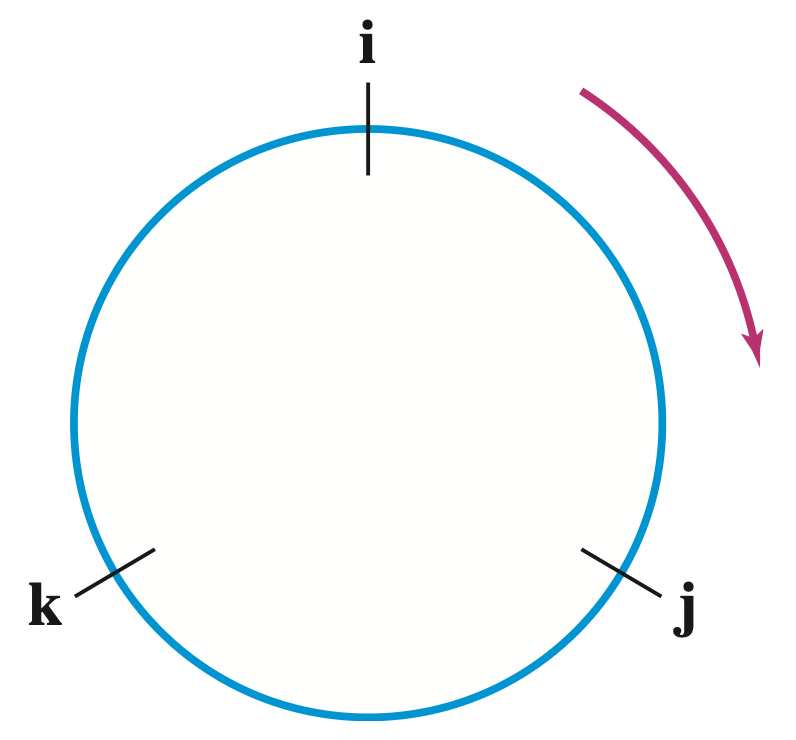
The most fun thing about the cross product is how it interacts with the standard basis vectors in \(\R^3\text{.}\) Recall the standard basis vectors are \(\v{i} = \la 1,0,0 \ra\text{,}\) \(\v{j} = \la 0,1,0 \ra\text{,}\) and \(\v{k} = \la 0,0,1 \ra\text{.}\) Because these are orthogonal unit vectors, following the right-hand rule, we have a cyclic pattern:
\begin{align*} \v{i} \times \v{j} \amp = \v{k}\\ \v{j} \times \v{k} \amp = \v{i}\\ \v{k} \times \v{i} \amp = \v{j} \end{align*}
If you reverse the order, you get the negative (anticommutative):
\begin{align*} \v{j} \times \v{i} \amp = -\v{k}\\ \v{k} \times \v{j} \amp = -\v{i}\\ \v{i} \times \v{k} \amp = -\v{j} \end{align*}
The following circle summarizes these properties:
Figure 12.4.9. Circle for Computing the Cross Product of Standard Basis Vectors
If you don’t mind some FOIL-ing and combining like terms, you can actually use this circle to compute the cross product instead of the determinant!

Example 12.4.10.

Calculate the cross product \(\lp 3\v{i} - \v{j} - 2\v{k}\rp \times \lp 3\v{j} - 2\v{k} \rp\text{.}\)
Solution.
\begin{align*} \lp 3\v{i} - \v{j} - 2\v{k}\rp \times \lp 3\v{j} - 2\v{k} \rp\amp= 9\v{i} \times \v{j} - 6\v{i} \times \v{k} - 3\v{j} \times \v{j} + 2\v{j} \times \v{k} - 6\v{k} \times \v{j} + 4\v{k} \times \v{k}\\ \amp= 9\v{k} - 6(-\v{j}) - 3(\v{0}) + 2\v{i} - 6(-\v{i}) + 4(\v{0})\\ \amp= 9\v{k} + 8\v{j} + 6\v{i} \end{align*}
This is actually how the determinant formula is derived! If we write \(\v{v} = v_1\v{i} + v_2\v{j} + v_3\v{k}\) and \(\v{w} = w_1\v{i} + w_2\v{j} + w_3\v{k}\) and expand \(\v{v} \times \v{w}\) like a polynomial, we can use the rules above to simplify the terms.

Note 12.4.11. If you want to see a bunch of letters here to derive the formula....

To be a due diligent mathematician, Richard will show you how to derive the determinant formula from the standard basis properties (and there are a lot of the typing here...).
Let \(\v{v} = v_1\v{i} + v_2\v{j} + v_3\v{k}\) and \(\v{w} = w_1\v{i} + w_2\v{j} + w_3\v{k}\text{.}\) Then we have
\begin{align*} \v{v} \times \v{w} \amp= \lp v_1\v{i} + v_2\v{j} + v_3\v{k} \rp \times \lp w_1\v{i} + w_2\v{j} + w_3\v{k} \rp\\ \amp= v_1w_1 \underbrace{\lp \v{i} \times \v{i} \rp}_{\v{0}} + v_1w_2 \underbrace{\lp \v{i} \times \v{j} \rp}_{\v{k}} + v_1w_3 \underbrace{\lp \v{i} \times \v{k} \rp}_{-\v{j}}\\ \amp \qquad + v_2w_1 \underbrace{\lp \v{j} \times \v{i} \rp}_{-\v{k}} + v_2w_2 \underbrace{\lp \v{j} \times \v{j} \rp}_{\v{0}} + v_2w_3 \underbrace{\lp \v{j} \times \v{k} \rp}_{\v{i}}\\ \amp \qquad + v_3w_1 \underbrace{\lp \v{k} \times \v{i} \rp}_{\v{j}} + v_3w_2 \underbrace{\lp \v{k} \times \v{j} \rp}_{-\v{i}} + v_3w_3 \underbrace{\lp \v{k} \times \v{k} \rp}_{\v{0}}\\ \amp= (v_2w_3 - v_3w_2)\v{i} - (v_1w_3 - v_3w_1)\v{j} + (v_1w_2 - v_2w_1)\v{k} \end{align*}

Subsection Geometry: Area of a Parallelogram

We know the direction of \(\v{u} \times \v{v}\) is orthogonal to the inputs (given by the Right Hand Rule). But what about its magnitude?
It turns out that the magnitude of the cross product is very similar to the dot product, but with a small twist. Rather than using the cosine of the angle between the vectors, we use the sine of the angle.
The proof of this theorem is at the end of the section in your textbook, so Richard will not repeat it here. It requires an identity that links the dot product and cross product together. Feel free to read through it later if you are interested!

Note 12.4.13. And Richard will include the proof here for the completeness of his notes.

The proof of the magnitude of the cross product really relies on a key identity called the Lagrange Identity in vector notation
\begin{equation*} \|\v{w} \times \v{w}\|^2 = \|\v{v}\|^2 \|\v{w}\|^2 - \lp \v{v}\cdot \v{w} \rp^2 \end{equation*}
Let’s prove this identity first.
We can prove this identity using the "meet in the middle" approach. That is, we want to manipulate both sides of the equation separately to arrive at the same expression.
Let \(\v{v} = \la v_1, v_2, v_3 \ra\) and \(\v{w} = \la w_1, w_2, w_3 \ra\text{.}\) Then we have
\begin{equation*} \v{v} \times \v{w} = \la v_2w_3 - v_3w_2, v_3w_1 - v_1w_3, v_1w_2 - v_2w_1 \ra \end{equation*}
Then we obtain
\begin{align*} \text{LHS} \amp= \|\v{v} \times \v{w}\|^2 \\ \amp= (v_2w_3 - v_3w_2)^2 + (v_3w_1 - v_1w_3)^2 + (v_1w_2 - v_2w_1)^2 \\ \amp = v_2^2w_3^2 - 2v_2w_3v_3w_2 + v_3^2w_2^2 + v_3^2w_1^2 - 2v_3w_1v_1w_3 + v_1^2w_3^2 \\ \amp \qquad + v_1^2w_2^2 - 2v_1w_2v_2w_1 + v_2^2w_1^2 \end{align*}
On the other hand, we have
\begin{align*} \text{RHS} \amp= \|\v{v}\|^2 \|\v{w}\|^2 - \lp \v{v}\cdot \v{w} \rp^2 \\ \amp= (v_1^2 + v_2^2 + v_3^2)(w_1^2 + w_2^2 + w_3^2) - (v_1w_1 + v_2w_2 + v_3w_3)^2 \\ \amp = (v_1^2w_1^2 + v_1^2w_2^2 + v_1^2w_3^2 + v_2^2w_1^2 + v_2^2w_2^2 + v_2^2w_3^2 + v_3^2w_1^2 + v_3^2w_2^2 + v_3^2w_3^2) \\ \amp \qquad - (v_1^2w_1^2 + v_2^2w_2^2 + v_3^2w_3^2 + 2v_1w_1v_2w_2 + 2v_1w_1v_3w_3 + 2v_2w_2v_3w_3) \\ \amp = v_1^2w_2^2 + v_1^2w_3^2 + v_2^2w_1^2 + v_2^2w_3^2 + v_3^2w_1^2 + v_3^2w_2^2 \\ \amp \qquad - 2v_1w_1v_2w_2 - 2v_1w_1v_3w_3 - 2v_2w_2v_3w_3 \end{align*}
Observe that the last steps in each expression are identical (you may want to do some reordering of terms to make it clear), so the Lagrange Identity holds.
Now that we know the Lagrange Identity holds, we can use it to prove the magnitude of the cross product theorem. We can start with the Lagrange Identity and substitute in the formula for the dot product in terms of the angle between the vectors.
\begin{align*} \|\v{v} \times \v{w}\|^2 \amp= \|\v{v}\|^2 \|\v{w}\|^2 - \lp \v{v}\cdot \v{w} \rp^2 \\ \amp= \|\v{v}\|^2 \|\v{w}\|^2 - \|\v{v}\|^2\|\v{w}\|^2\cos^2(\theta) \\ \amp= \|\v{v}\|^2\|\v{w}\|^2 \lp 1 - \cos^2(\theta) \rp \\ \amp= \|\v{v}\|^2\|\v{w}\|^2\sin^2(\theta) \end{align*}
Taking the square root of both sides gives us the desired result.
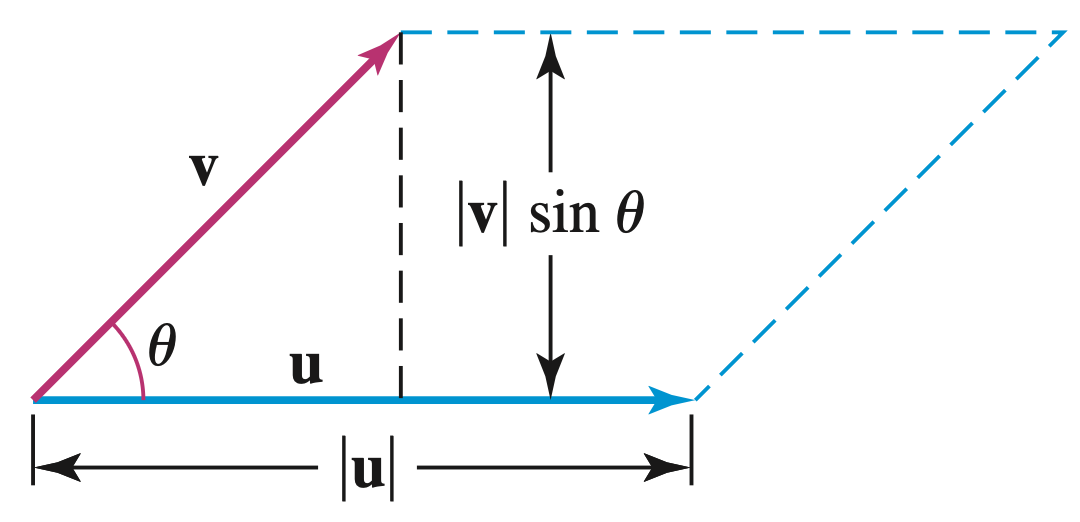
Geometrically, this value represents the Area of the Parallelogram spanned by the two vectors (that is, the parallelogram formed by \(\v{u}\) and \(\v{v}\) where the two adjacent sides are \(\v{u}\) and \(\v{v}\)). The following diagram illustrates this idea:
Figure 12.4.14. Area of the parallelogram spanned by vectors \(\v{u}\) and \(\v{v}\text{.}\)
Observe that the area of the parallelogram is the base times the height, where the base is \(\|\v{u}\|\) and the height is \(\|\v{v}\|\sin(\theta)\) (by basic trig). Hence, the area of this parallelogram is
\begin{equation*} \|\v{u}\| \cdot \|\v{v}\| \sin(\theta)\text{,} \end{equation*}
which is exactly the magnitude of the cross product, \(\|\v{u} \times \v{v}\|\text{!}\)

Example 12.4.15.

Find the area of the parallelogram with vertices \(P(1,0,0)\text{,}\) \(Q(3,0,1)\text{,}\) \(R(2,2,0)\text{,}\) and \(S(4,2,1)\text{.}\)
Hint.
To help you visualize things, Richard coded the parallelogram below.
Figure 12.4.16. The parallelogram spanned by vectors \(\overrightarrow{PQ}\) and \(\overrightarrow{PR}\) with axes.
Solution.
We choose \(P\) as our "anchor" point. The two vectors originating from \(P\) to its neighbors \(Q\) and \(R\) are:
\begin{align*} \overrightarrow{PQ} \amp = \langle 3-1, 0-0, 1-0 \rangle = \langle 2, 0, 1 \rangle\\ \overrightarrow{PR} \amp = \langle 2-1, 2-0, 0-0 \rangle = \langle 1, 2, 0 \rangle \end{align*}
(Note: We do not need to use vertex \(S\) for the calculation, as \(P\text{,}\) \(Q\text{,}\) and \(R\) are sufficient to define the dimensions of the parallelogram.)
Now, we compute the cross product \(\overrightarrow{PQ} \times \overrightarrow{PR}\text{:}\)
\begin{align*} \overrightarrow{PQ} \times \overrightarrow{PR} \amp = \begin{vmatrix} \mathbf{i} \amp \mathbf{j} \amp \mathbf{k} \\ 2 \amp 0 \amp 1 \\ 1 \amp 2 \amp 0 \end{vmatrix}\\ \amp = (0 - 2)\mathbf{i} - (0 - 1)\mathbf{j} + (4 - 0)\mathbf{k}\\ \amp = \langle -2, 1, 4 \rangle \end{align*}
Finally, the area is the magnitude of this normal vector:
\begin{align*} \text{Area} \amp = \|\langle -2, 1, 4 \rangle\|\\ \amp = \sqrt{(-2)^2 + (1)^2 + (4)^2}\\ \amp = \sqrt{21} \end{align*}
Observe that we really need three points to find the area of the parallelogram. Recall three points can also form a triangle, so we can also find the area of a triangle using the cross product. The area of a triangle is just half of the parallelogram formed by the same two vectors.

Example 12.4.17.

Find the area of the triangle with vertices \(A(1, 1, 1)\text{,}\) \(B(3, 2, 1)\text{,}\) and \(C(2, 3, 2)\text{.}\)
Hint.
Richard coded the triangle and its vectors below to help you visualize the problem.
Figure 12.4.18. Visualization of the triangle vertices and vectors.
The area of a triangle is half the area of the parallelogram spanned by two vectors originating from the same vertex.
Solution.
First, we find the vectors representing two sides of the triangle originating from \(A\text{:}\)
\begin{align*} \overrightarrow{AB} \amp = \langle 3-1, 2-1, 1-1 \rangle = \langle 2, 1, 0 \rangle\\ \overrightarrow{AC} \amp = \langle 2-1, 3-1, 2-1 \rangle = \langle 1, 2, 1 \rangle \end{align*}
Next, we calculate the cross product \(\overrightarrow{AB} \times \overrightarrow{AC}\) using the determinant:
\begin{align*} \overrightarrow{AB} \times \overrightarrow{AC} \amp = \begin{vmatrix} \mathbf{i} \amp \mathbf{j} \amp \mathbf{k} \\ 2 \amp 1 \amp 0 \\ 1 \amp 2 \amp 1 \end{vmatrix}\\ \amp = \mathbf{i}(1(1) - 0(2)) - \mathbf{j}(2(1) - 0(1)) + \mathbf{k}(2(2) - 1(1))\\ \amp = 1\mathbf{i} - 2\mathbf{j} + 3\mathbf{k}\\ \amp = \langle 1, -2, 3 \rangle \end{align*}
Now, we find the magnitude of this normal vector:
\begin{align*} \|\overrightarrow{AB} \times \overrightarrow{AC}\| \amp = \sqrt{(1)^2 + (-2)^2 + (3)^2}\\ \amp = \sqrt{1 + 4 + 9}\\ \amp = \sqrt{14} \end{align*}
Finally, the area of the triangle is half the magnitude of the cross product:
\begin{equation*} \text{Area} = \frac{1}{2}\sqrt{14} \approx 1.87 \end{equation*}
We can summarize this result in the following theorem:

Subsection Geometry: Volume of a Parallelepiped

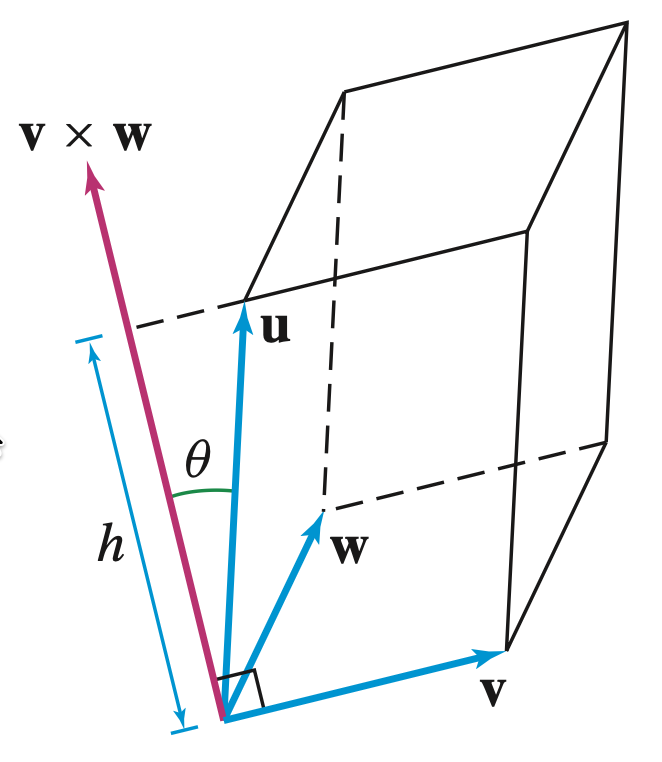
If we add a third vector \(\v{w}\text{,}\) we lift the 2D parallelogram into a 3D slanted box called a Parallelepiped.
Figure 12.4.20. A parallelepiped spanned by three vectors
We can actually find the volume of the parallelepiped using the cross product (and dot product) together! Generally speaking, the volume of a pallelepiped is the area of the base times the height.
Figure 12.4.21. Volume of a parallelepiped
Observe that the base is the parallelogram spanned by \(\v{v}\) and \(\v{w}\text{,}\) so its area is \(\|\v{v} \times \v{w}\|\text{.}\) Also, a little trigonometry can tell us that the height of the parallelepiped is \(\|\v{u}\| \cos(\theta)\text{,}\) where \(\theta\) is the angle between \(\v{v} \times \v{w}\) and \(\v{u}\text{.}\) Hence, the volume of the parallelepiped is
\begin{align*} V \amp= \|\v{v} \times \v{w}\| \cdot \|\v{u}\| \cos(\theta) \end{align*}
Observe that this is exactly the dot product of \(\v{v}\times \v{w}\) and \(\v{u}\text{!}\) Hence, the volume of the parallelepiped is the absolute value of the dot product of some cross product and a vector, to ensure the volume is always nonnegative. The dot product of a cross product and a vector is called the Vector Triple Product.

Definition 12.4.22. Volume of a Parallelepiped.

Let \(\v{u}, \v{v}, \v{w}\) be nonzero vectors in \(\R^3\text{.}\) Then the parallelepiped spanned by \(\v{u}\text{,}\) \(\v{v}\text{,}\) and \(\v{w}\) has volume
\begin{equation*} V = |\v{u} \cdot (\v{v} \times \v{w})| \end{equation*}
where \(\v{u} \cdot (\v{v} \times \v{w})\) is the vector triple product.
We can actually come up witl a cool formula to find the vector triple product using determinants! Let’s say \(\v{u} = \la u_1, u_2, u_3 \ra\text{,}\) \(\v{v} = \la v_1, v_2, v_3 \ra\text{,}\) and \(\v{w} = \la w_1, w_2, w_3 \ra\text{.}\) Then we have
\begin{align*} \v{u}\cdot (\v{v}\times \v{w}) \amp= u\cdot \lp \begin{vmatrix} v_2 \amp v_3 \\ w_2 \amp w_3 \end{vmatrix} \v{i} - \begin{vmatrix} v_1 \amp v_3 \\ w_1 \amp w_3 \end{vmatrix} \v{j} + \begin{vmatrix} v_1 \amp v_2 \\ w_1 \amp w_2 \end{vmatrix} \v{k}\rp \\ \amp= u_1 \begin{vmatrix} v_2 \amp v_3 \\ w_2 \amp w_3 \end{vmatrix} - u_2 \begin{vmatrix} v_1 \amp v_3 \\ w_1 \amp w_3 \end{vmatrix} + u_3 \begin{vmatrix} v_1 \amp v_2 \\ w_1 \amp w_2 \end{vmatrix} \\ \amp= \begin{vmatrix} u_1 \amp u_2 \amp u_3 \\ v_1 \amp v_2 \amp v_3 \\ w_1 \amp w_2 \amp w_3 \end{vmatrix} \end{align*}
Hence, we can find the vector triple product, which will determine the volume of the parallelepiped, using a 3x3 determinant!
P.S.: the last step in the above derivation can be justified by the cofactor expansion along the first row of the 3x3 matrix. If this step doesn’t seem convinving to you, feel free to actually find the determinant of the last two steps and verify they are the same!
Sometimes, rather than listing out all the components of the vectors, we can represent the 3x3 determinant using the vectors themselves like this:
\begin{equation*} \v{u} \cdot (\v{v} \times \v{w}) = \det \begin{pmatrix} \v{u} \\ \v{v} \\ \v{w} \end{pmatrix} \end{equation*}

Example 12.4.23.

Consider the parallelepiped determined by the vectors \(\v{u} = \langle 0, 1, 4 \rangle\text{,}\) \(\v{v} = \langle 3, 0, 1 \rangle\text{,}\) and \(\v{w} = \langle 1, 2, 0 \rangle\) originating from the point \(P(2, 0, 1)\text{.}\)
  1. Find the area of the base parallelogram spanned by vectors \(\v{v}\) and \(\v{w}\text{.}\)
  2. Find the volume of the parallelepiped.
Hint.
As always, Richard coded a pretty diagram below to help you visualize what the parallelogram and the parallelepiped look like!
Figure 12.4.24. Visualization of the parallelepiped with base defined by \(\v{v}\) and \(\v{w}\text{.}\)
Solution.
  1. The area of the base is the magnitude of the cross product \(\v{v} \times \v{w}\text{.}\)
    \begin{align*} \v{v} \times \v{w} \amp = \begin{vmatrix} \mathbf{i} \amp \mathbf{j} \amp \mathbf{k} \\ 3 \amp 0 \amp 1 \\ 1 \amp 2 \amp 0 \end{vmatrix}\\ \amp = (0 - 2)\mathbf{i} - (0 - 1)\mathbf{j} + (6 - 0)\mathbf{k}\\ \amp = \langle -2, 1, 6 \rangle \end{align*}
    Now, we compute the magnitude:
    \begin{align*} \text{Area} \amp = \|\langle -2, 1, 6 \rangle\| = \sqrt{(-2)^2 + 1^2 + 6^2}\\ \amp = \sqrt{4 + 1 + 36} = \sqrt{41} \end{align*}
  2. The volume is the absolute value of the dot product of \(\v{u}\) with the normal vector found in part (a).
    \begin{align*} \text{Volume} \amp = |\v{u} \cdot (\v{v} \times \v{w})|\\ \amp = |\langle 0, 1, 4 \rangle \cdot \langle -2, 1, 6 \rangle|\\ \amp = |(0)(-2) + (1)(1) + (4)(6)|\\ \amp = |0 + 1 + 24|\\ \amp = 25 \end{align*}

Subsection Application: Torque

Cross products appear in a variety of applications in physics and engineering. The most common application is in calculating torque.
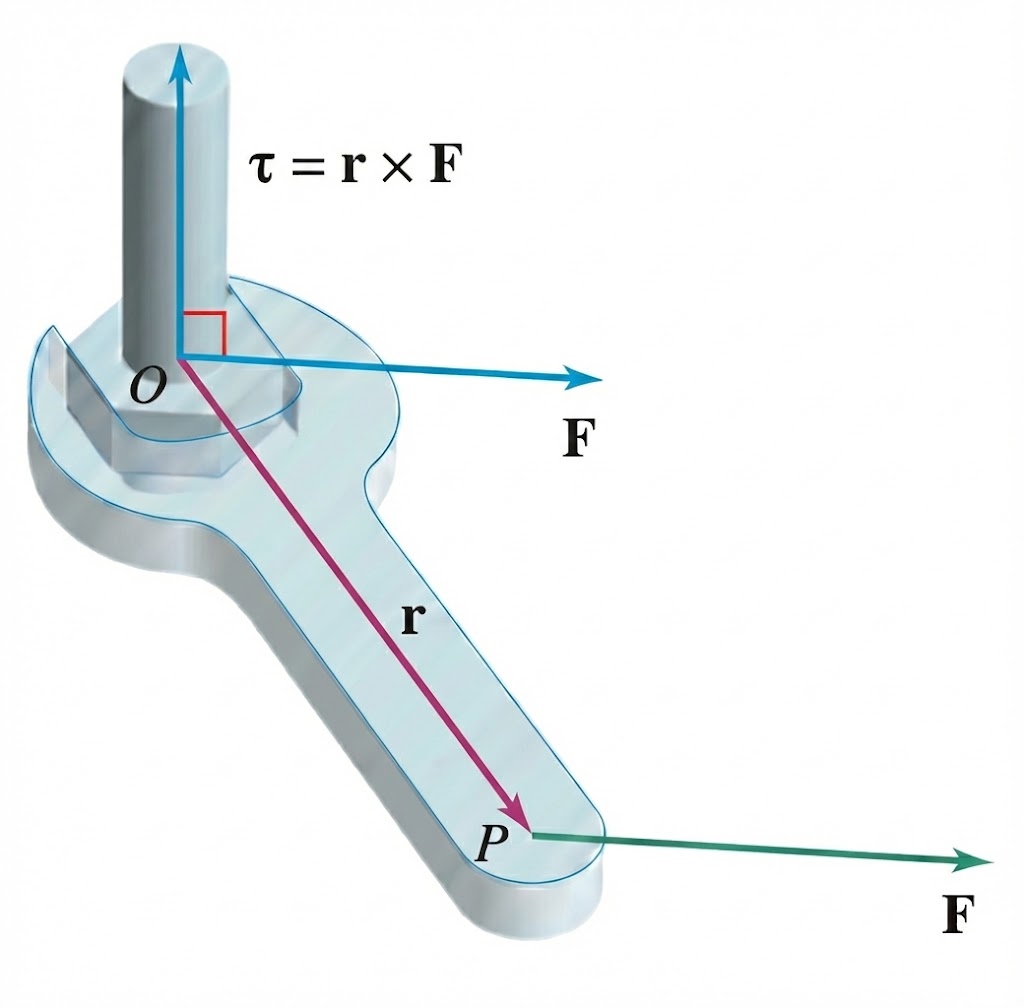
Suppose you want to loosen a bolt using a wrench. You will apply a force \(\v{F}\) at a distance \(\v{r}\) from the bolt, perpendicular to the bolt. The "twiting power" you apply to the bolt is called the torque, denoted \(\boldsymbol{\tau}\text{.}\)
Figure 12.4.25. Tightening a bolt using a wrench
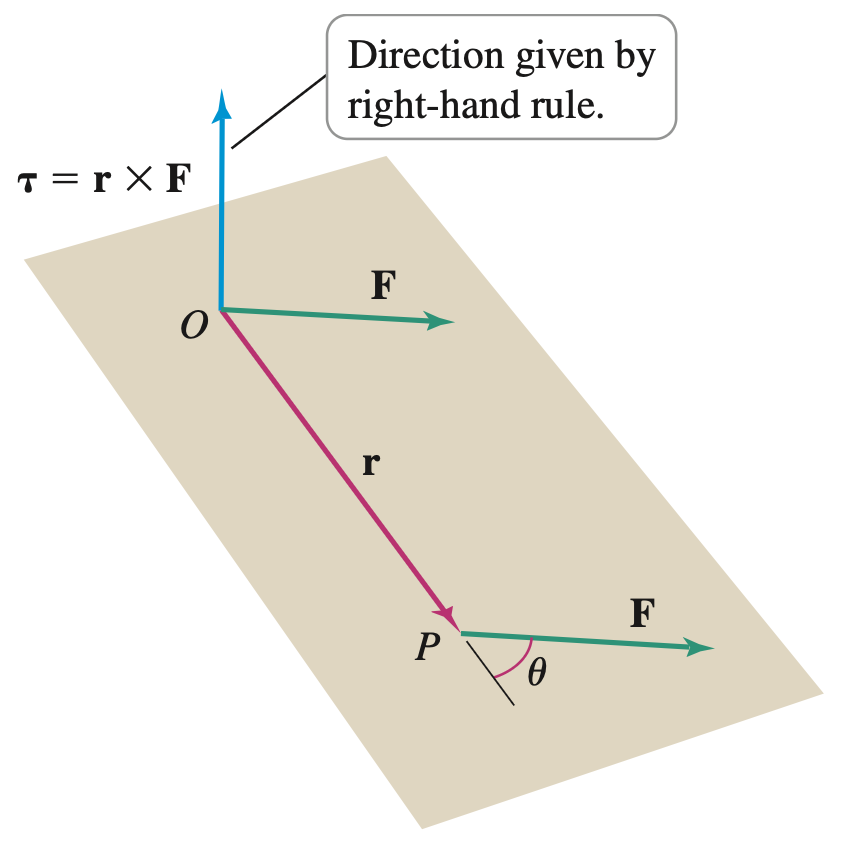
The torque here is a vector, as this twisting force has both a magnitude and a direction. This torque vector is given by the cross product of the position vector \(\v{r}\) and the force vector \(\v{F}\text{.}\) The magnitude of the torque is given by
\begin{equation*} \|\boldsymbol{\tau}\| = \|\v{r} \times \v{F}\| = \|\v{r}\|\|\v{F}\|\sin(\theta) \end{equation*}
where \(\theta\) is the angle between \(\v{r}\) and \(\v{F}\text{,}\) and the direction of \(\boldsymbol{\tau}\) is given by the right-hand rule. The following diagram demonstrates the abstract notion of torque as a cross product without the wrench and the bolt.
Figure 12.4.26. Torque is the cross product of \(\v{r}\) and \(\v{F}\)

Example 12.4.27.

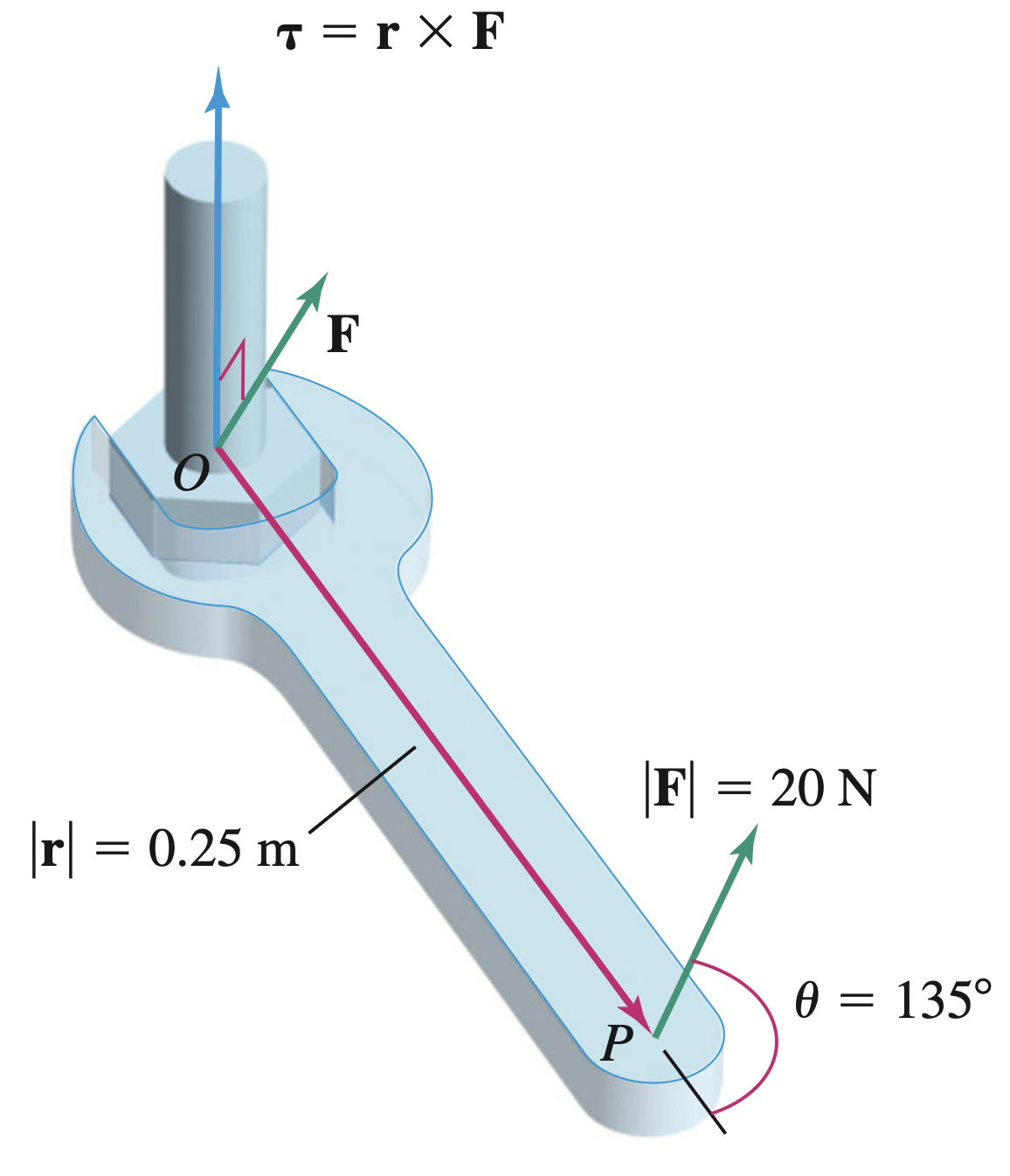
A force of \(20 \text{ N}\) is applied to a wrench attached to a bolt in a direction perpendicular to the bolt. The length of the wrench is \(0.25 \text{ m}\) and the force is applied at the end of the wrench at an agle of \(135^\circ\) to the wrench. What is the torque applied to the bolt?
Figure 12.4.28.
Solution.
The magnitude of the torque can be calculated by
\begin{align*} \|\boldsymbol{\tau}\| \amp = \|\v{r}\|\|\v{F}\|\sin \lp 135^\circ \rp\\ \amp= (0.25)(20)\sin \lp 135^\circ \rp\\ \amp= 5 \cdot \frac{\sqrt{2}}{2}\\ \amp= \frac{5\sqrt{2}}{2}\\ \amp\approx 3.54 \end{align*}
We can also derive the unit by multiplying the units of \(\|\v{r}\|\) and \(\|\v{F}\|\) together. Hence, the unit of the torque is \(\text{N} \cdot \text{m}\text{,}\) and therefore, the torque applied to the bolt is approximately \(3.54 \text{ N} \cdot \text{m}\text{.}\)
Also, the right-hand rule tells us that the direction of \(\boldsymbol{\tau}\) is orthogonal to \(\v{r}\) and \(\v{F}\text{,}\) parallel to the shaft of the bolt.

Worksheet Assigned Problems for Section 12.4

The problems listed below are assigned to be included in your problem set portfolio. Note that a specific selection of these problems will also form the written homework assignments. I recommend working through all of them to ensure a solid grasp of the material. Reach out to Richard for help if you get stuck or have any questions.
The solutions will be posted after the written homework due dates. If you have any questions about your work, talk to Richard and he is happy to discuss the process with you.

12.4.11.

Calculate \(\v{v} \times \v{w}\text{,}\) where \(\v{v} = \la \frac{2}{3}, 1, \frac{1}{2} \ra\) and \(\v{w} = \la 4, -6, 3 \ra\text{.}\)
Solution.
We have
\begin{align*} \v{v} \times \v{w} \amp= \begin{vmatrix} \v{i} \amp \v{j} \amp \v{k} \\ \frac{2}{3} \amp 1 \amp \frac{1}{2} \\ 4 \amp -6 \amp 3 \end{vmatrix}\\ \amp= \v{i}\begin{vmatrix} 1 \amp \frac{1}{2} \\ -6 \amp 3 \end{vmatrix} - \v{j}\begin{vmatrix} \frac{2}{3} \amp \frac{1}{2} \\ 4 \amp 3 \end{vmatrix} + \v{k}\begin{vmatrix} \frac{2}{3} \amp 1 \\ 4 \amp -6 \end{vmatrix}\\ \amp= (3 + 3)\v{i} - (2 - 2)\v{j} + (-4 - 4)\v{k}\\ \amp= 6\v{i} + 0\v{j} -8\v{k}\\ \amp= \la 6,0,-8 \ra \end{align*}

12.4.17.

Calculate the cross product \(\lp \v{i} - 3\v{j} + 2\v{k} \rp \times \lp \v{j} - \v{k} \rp\)
Solution.
Using the distributive law, we obtain
\begin{align*} \lp \v{i} - 3\v{j} + 2\v{k} \rp \times \lp \v{j} - \v{k} \rp \amp= \v{i} \times \v{j} + 2\v{k} \times \v{j} - \v{i} \times \v{k} - (-3\v{j} \times \v{k}) \\ \amp= \v{k} + 2(-\v{i}) - (-\v{j}) - (-3\v{i}) \\ \amp= \v{k} - 2\v{i} + \v{j} + 3\v{i} \\ \amp= \v{i} + \v{j} + \v{k} \end{align*}

12.4.21.

Calculate the cross product \(\v{w} \times \lp \v{u} + \v{v} \rp\text{,}\) assuming that
\begin{equation*} \v{u} \times \v{v} = \la 1,1,0 \ra, \qquad \v{u} \times \v{w} = \la 0,3,1 \ra, \qquad \v{v} \times \v{w} = \la 2,-1,1 \ra \end{equation*}
Solution.
Using the properties of the cross product, we obtain
\begin{align*} \v{w} \times \lp \v{u} + \v{v} \rp \amp= \v{w} \times \v{u} + \v{w} \times \v{v} \\ \amp= -\v{u} \times \v{w} - \v{v} \times \v{w} \\ \amp= -\la 0,3,1 \ra - \la 2,-1,1 \ra \\ \amp= \la 0,-3,-1 \ra - \la 2,-1,1 \ra \\ \amp= \la -2,-2,-2 \ra \end{align*}

12.4.37.

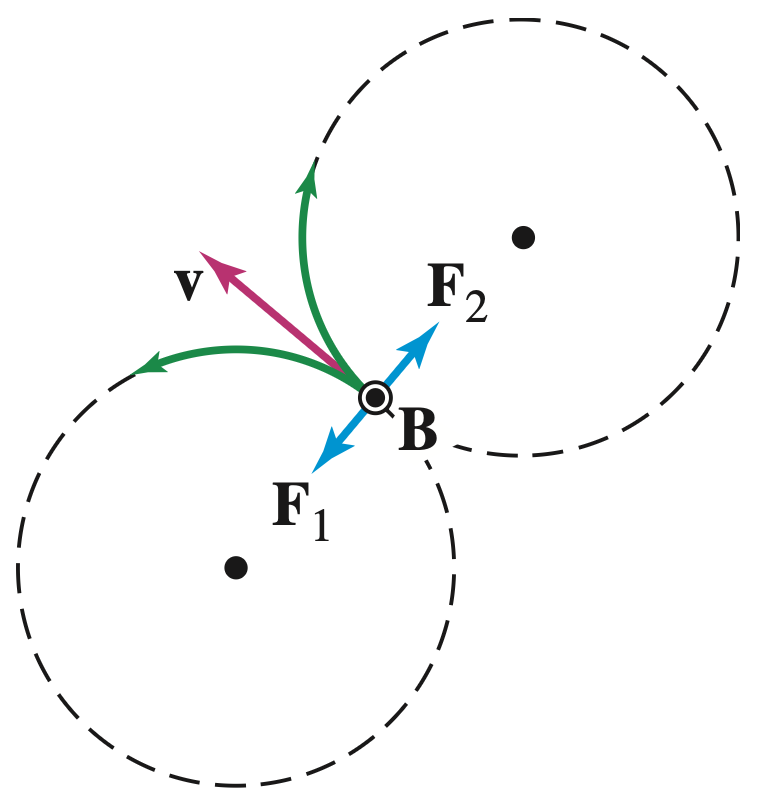
A force \(\v{F}\) (in newtons) on an electron moving at velocity \(\v{v}\) meters per second in a uniform magnetic field \(\v{B}\) (in teslas) is given by \(\v{F} = q\lp \v{v} \times \v{B} \rp\text{,}\) where \(q = -1.6 \times 10^{-19}\) coulombs is the charge on the electron. Assume an electron moves with velocity \(\v{v}\) in the plane and \(\v{B}\) is a uniform magnetic field pointing directly out of the page. Which of the two vectors, \(\v{F}_1\) or \(\v{F}_2\text{,}\) in the following figure represents the force on the electron? Remember that \(q\) is negative.
Figure 12.4.29. The magnetic field vector \(\v{B}\) points directly out of the page.
Solution.
Since the magnetic field \(\v{B}\) points directly out the page (toward us), the right-hand rule implies that the cross product \(\v{v} \times \v{B}\) is in the direction of \(\v{F}_2\text{.}\)

12.4.41.

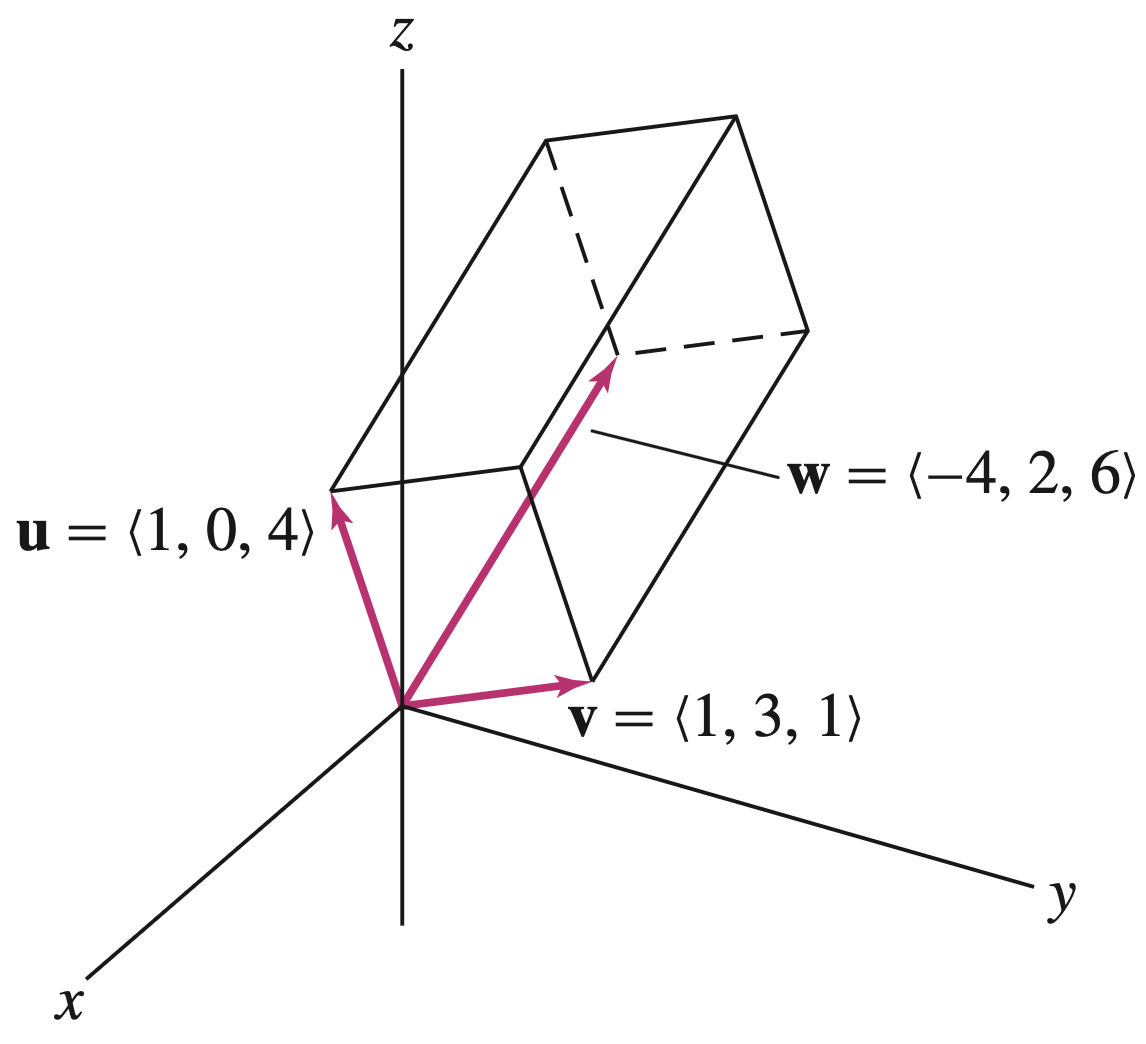
Find the area of the parallelogram spanned by \(\v{v}\) and \(\v{w}\) in the following figure.
Figure 12.4.30.
Solution.
The area of the parallelogram equals the length of the cross product of the two vectors \(\v{v} = \la 1,3,1 \ra\) and \(\v{w} = \la -4,2,6 \ra\text{.}\) We calculate the cross product as follows:
\begin{align*} \v{v} \times \v{w} \amp= \begin{vmatrix} \v{i} \amp \v{j} \amp \v{k} \\ 1 \amp 3 \amp 1 \\ -4 \amp 2 \amp 6 \end{vmatrix} \\ \amp= (18 - 2)\v{i} - (6 + 4)\v{j} + (2 + 12)\v{k} \\ \amp= 16\v{i} - 10\v{j} + 14\v{k} \end{align*}
The length of this vector \(16\v{i} - 10\v{j} + 14\v{k}\) is
\begin{equation*} \sqrt{16^2 + (-10)^2 + 14^2} = 2\sqrt{138} \approx 23.49 \text{ units}^2 \end{equation*}
Hence, the area of the parallelogram is approximately \(23.49 \text{ units}^2\text{.}\)

12.4.47.

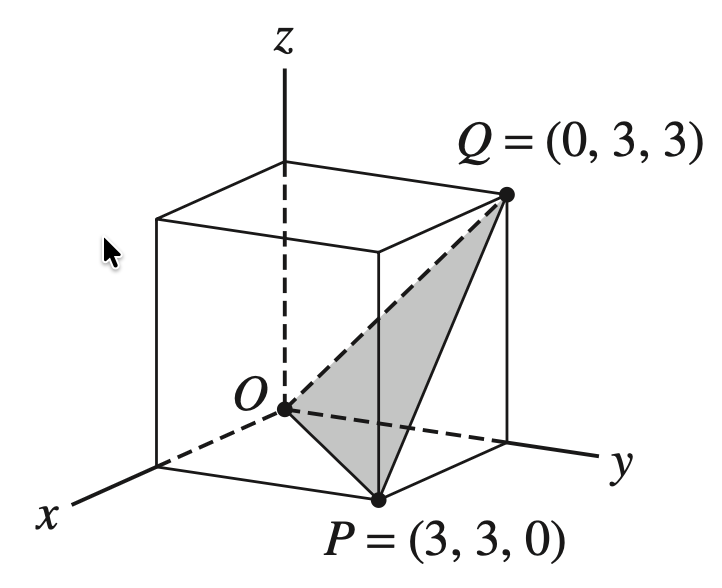
Sketch the triangle with vertices at the origin \(O\text{,}\) \(P = (3,3,0)\text{,}\) and \(Q = (0,3,3)\text{,}\) and compute its area using cross product.
Solution.
The triangle \(OPQ\) is shown in the following figure.
Figure 12.4.31.
The area \(S\) of the triangle is half of the area of the parallelogram spanned by the vectors \(\overrightarrow{OP} = \la 3,3,0 \ra\) and \(\overrightarrow{OQ} = \la 0,3,3 \ra\text{.}\) Thus,
\begin{equation*} S = \frac{1}{2} \|\overrightarrow{OP} \times \overrightarrow{OQ}\| \end{equation*}
We compute the cross product:
\begin{align*} \overrightarrow{OP} \times \overrightarrow{OQ} \amp= \begin{vmatrix} \v{i} \amp \v{j} \amp \v{k} \\ 3 \amp 3 \amp 0 \\ 0 \amp 3 \amp 3 \end{vmatrix} \\ \amp= \begin{vmatrix} 3 \amp 0 \\ 3 \amp 3 \end{vmatrix} \v{i} - \begin{vmatrix} 3 \amp 0 \\ 0 \amp 3 \end{vmatrix} \v{j} + \begin{vmatrix} 3 \amp 3 \\ 0 \amp 3 \end{vmatrix} \v{k} \\ \amp= 9\v{i} - 9\v{j} + 9\v{k}\\ \amp= 9\la 1, -1, 1 \ra \end{align*}
Substituting into the area formula, we obtain
\begin{align*} S \amp= \frac{1}{2} \|9 \la 1,-1,1 \ra \| \\ \amp= \frac{9}{2} \|\la 1,-1,1 \ra \| \\ \amp= \frac{9}{2} \sqrt{1^2 + (-1)^2 + 1^2} \\ \amp= \frac{9\sqrt{3}}{2} \\ \amp\approx 7.8 \end{align*}
The area of the triangle is \(S = \dfrac{9\sqrt{3}}{2} \approx 7.8\text{.}\)

12.4.51.

Check that the four points \(P = (2,4,4)\text{,}\) \(Q = (3,1,6)\text{,}\) \(R = (2,8,0)\text{,}\) and \(S = (7,2,1)\) all lie in a plane. Then use vectors to find the area of the quadrilateral they define.
Solution.
The points \(P\text{,}\) \(Q\text{,}\) and \(R\) determine a plane with normal vector \(\v{n}\text{.}\) \(S\) lies in that plane if \(\overrightarrow{PS}\) is perpendicular to \(\v{n}\text{.}\) To find \(\v{n}\text{,}\) we compute
\begin{align*} \overrightarrow{PQ} \times \overrightarrow{PR} \amp \la 1,-3,2 \ra \times \la 0,4,-4 \ra \\ \amp= \begin{vmatrix} \v{i} \amp \v{j} \amp \v{k} \\ 1 \amp -3 \amp 2 \\ 0 \amp 4 \amp -4 \end{vmatrix} \\ \amp= \begin{vmatrix} -3 \amp 2 \\ 4 \amp -4 \end{vmatrix} \v{i} - \begin{vmatrix} 1 \amp 2 \\ 0 \amp -4 \end{vmatrix} \v{j} + \begin{vmatrix} 1 \amp -3 \\ 0 \amp 4 \end{vmatrix} \v{k}\\ \amp= 4\v{i} + 4\v{j} + 4\v{k} \end{align*}
Since
\begin{equation*} \la 4,4,4 \ra \cdot \overrightarrow{PS} = \la 4,4,4 \ra \cdot \la 5,-2,-3 \ra = 0 \end{equation*}
the normal vector is also orthogonal to \(\overrightarrow{PS}\text{,}\) so that the vector \(\overrightarrow{PS}\text{,}\) and therefore the point \(S\text{,}\) also lies in the plane. So all four points lie in a plane.
To find the area of the quadrilateral of which they are the vectices, divide the quadrilateral into the two triangles \(\triangle PQR\) and \(\triangle SQR\text{.}\) The area of each of these triangles is given by half the magnitude of the cross product of two of its sides. First, we must compute various vectors:
\begin{align*} \overrightarrow{PQ} \amp= \la 3-2, 1-4, 6-4 \ra = \la 1,-3,2 \ra\\ \overrightarrow{PR} \amp= \la 2-2, 8-4, 0-4 \ra = \la 0,4,-4 \ra\\ \overrightarrow{SQ} \amp= \la 3-7, 1-2, 6-1 \ra = \la -4,-1,5 \ra\\ \overrightarrow{SR} \amp= \la 2-7, 8-2, 0-1 \ra = \la -5,6,-1 \ra \end{align*}
To find the area of \(\triangle PQR\text{,}\) we must compute \(\overrightarrow{PQ} \times \overrightarrow{PR}\text{;}\) to find the area of \(\triangle SQR\text{,}\) we must compute \(\overrightarrow{SQ} \times \overrightarrow{SR}\text{.}\)
\begin{align*} \overrightarrow{PQ} \times \overrightarrow{PR} \amp= \begin{vmatrix} \v{i} \amp \v{j} \amp \v{k} \\ 1 \amp -3 \amp 2 \\ 0 \amp 4 \amp -4 \end{vmatrix} = 4\v{i} + 4\v{j} + 4\v{k}\\ \overrightarrow{SQ} \times \overrightarrow{SR} \amp= \begin{vmatrix} \v{i} \amp \v{j} \amp \v{k} \\ -4 \amp -1 \amp 5 \\ -5 \amp 6 \amp -1 \end{vmatrix} = -29\v{i} - 29\v{j} - 29\v{k} \end{align*}
The area of the quadrilateral, \(\c{S}\text{,}\) is given by
\begin{align*} \c{S} \amp= \frac{1}{2} \| 4\v{i} + 4\v{j} + 4\v{k} \| + \frac{1}{2} \| -29\v{i} - 29\v{j} - 29\v{k} \| \\ \amp= \frac{1}{2} \lp 4\sqrt{3} + 29 \sqrt{3} \rp \\ \amp= \frac{33\sqrt{3}}{2} \\ \amp\approx 28.58 \end{align*}
12.4.55.

Prove the identity using the formula for the cross product.
\begin{equation*} (\v{u} + \v{v}) \times \v{w} = \v{u} \times \v{w} + \v{v} \times \v{w} \end{equation*}
Solution.
We let \(\mathbf{u} = \la a_1, a_2, a_3 \ra\text{,}\) \(\mathbf{v} = \la b_1, b_2, b_3 \ra\) and \(\mathbf{w} = \la c_1, c_2, c_3 \ra\text{.}\) Computing the left-hand side gives
\begin{align*} (\mathbf{u} + \mathbf{v}) \times \mathbf{w} \amp = \la a_1 + b_1, a_2 + b_2, a_3 + b_3 \ra \times \la c_1, c_2, c_3 \ra\\ \amp = \begin{vmatrix} \mathbf{i} \amp \mathbf{j} \amp \mathbf{k} \\ a_1 + b_1 \amp a_2 + b_2 \amp a_3 + b_3 \\ c_1 \amp c_2 \amp c_3 \end{vmatrix}\\ \amp = \begin{vmatrix} a_2 + b_2 \amp a_3 + b_3 \\ c_2 \amp c_3 \end{vmatrix} \mathbf{i} - \begin{vmatrix} a_1 + b_1 \amp a_3 + b_3 \\ c_1 \amp c_3 \end{vmatrix} \mathbf{j} + \begin{vmatrix} a_1 + b_1 \amp a_2 + b_2 \\ c_1 \amp c_2 \end{vmatrix} \mathbf{k}\\ \amp = (c_3(a_2 + b_2) - c_2(a_3 + b_3)) \mathbf{i} - (c_3 (a_1 + b_1) - c_1 (a_3 + b_3)) \mathbf{j} + (c_2(a_1 + b_1) - c_1(a_2 + b_2)) \mathbf{k} \end{align*}
We now compute the right-hand-side of the equality:
\begin{align*} \mathbf{u} \times \mathbf{w} + \mathbf{v} \times \mathbf{w} \amp = \begin{vmatrix} \mathbf{i} \amp \mathbf{j} \amp \mathbf{k} \\ a_1 \amp a_2 \amp a_3 \\ c_1 \amp c_2 \amp c_3 \end{vmatrix} + \begin{vmatrix} \mathbf{i} \amp \mathbf{j} \amp \mathbf{k} \\ b_1 \amp b_2 \amp b_3 \\ c_1 \amp c_2 \amp c_3 \end{vmatrix}\\ \amp = \left| \begin{matrix} a_2 \amp a_3 \\ c_2 \amp c_3 \end{matrix} \right| \mathbf{i} - \left| \begin{matrix} a_1 \amp a_3 \\ c_1 \amp c_3 \end{matrix} \right| \mathbf{j} + \left| \begin{matrix} a_1 \amp a_2 \\ c_1 \amp c_2 \end{matrix} \right| \mathbf{k} + \left| \begin{matrix} b_2 \amp b_3 \\ c_2 \amp c_3 \end{matrix} \right| \mathbf{i} - \left| \begin{matrix} b_1 \amp b_3 \\ c_1 \amp c_3 \end{matrix} \right| \mathbf{j} + \left| \begin{matrix} b_1 \amp b_2 \\ c_1 \amp c_2 \end{matrix} \right| \mathbf{k}\\ \amp = (a_2c_3 - a_3c_2)\mathbf{i} - (a_1c_3 - a_3c_1)\mathbf{j} + (a_1c_2 - a_2c_1)\mathbf{k}\\ \amp \qquad + (b_2c_3 - b_3c_2)\mathbf{i} - (b_1c_3 - b_3c_1)\mathbf{j} + (b_1c_2 - b_2c_1)\mathbf{k}\\ \amp = (a_2c_3 - a_3c_2 + b_2c_3 - b_3c_2)\mathbf{i} - (a_1c_3 - a_3c_1 + b_1c_3 - b_3c_1)\mathbf{j} + (a_1c_2 - a_2c_1 + b_1c_2 - b_2c_1)\mathbf{k}\\ \amp = (c_3(a_2 + b_2) - c_2(a_3 + b_3)) \mathbf{i} - (c_3(a_1 + b_1) - c_1(a_3 + b_3)) \mathbf{j} + (c_2(a_1 + b_1) - c_1(a_2 + b_2)) \mathbf{k} \end{align*}
The results are the same. Hence,
\begin{equation*} (\mathbf{u} + \mathbf{v}) \times \mathbf{w} = \mathbf{u} \times \mathbf{w} + \mathbf{v} \times \mathbf{w}. \end{equation*}

12.4.67.

The torque about the origin \(O\) due to a force \(\v{F}\) acting on an object with position vector \(\v{r}\) is the vector quantity \(\boldsymbol{\tau} = \v{r} \times \v{F}\text{.}\) If several forces \(\v{F}_j\) act at psitions \(\v{r}_j\text{,}\) then the net torque (units: N-m or lb-ft) is the sum
\begin{equation*} \boldsymbol{\tau} = \sum \v{r}_j \times \v{F}_j \end{equation*}
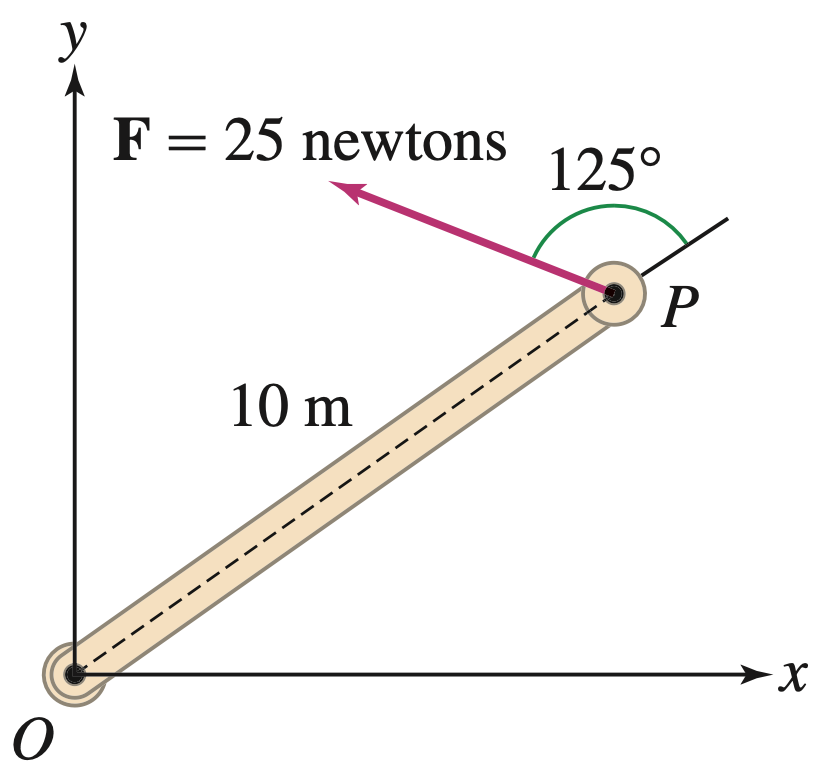
Calculate the net torque \(\boldsymbol{\tau}\) about \(O\) acting at the point \(P\) on the mechanical arm in the following figure, assuming that a 25-newton force acts as indicated.
Figure 12.4.32.
Solution.
We denote by \(O\) and \(P\) the points shown in the figure and compute the position vector \(\v{r} = \overrightarrow{OP}\) and the force vector \(\v{F}\text{.}\)
Denoting by \(\theta\) the angle between the arm and the \(x\)-axis we have
\begin{equation*} \v{r} = \overrightarrow{OP} = 10 (\cos \theta \v{i} + \sin \theta \v{j}) \end{equation*}
The angle between the force vector \(\v{F}\) and the \(x\)-axis is \((\theta + 125^\circ)\text{,}\) hence,
\begin{equation*} \v{F} = 25 (\cos (\theta + 125^\circ) \v{i} + \sin (\theta + 125^\circ) \v{j}) \end{equation*}
The torque \(\boldsymbol{\tau}\) about \(O\) acting at the point \(P\) is the cross product \(\boldsymbol{\tau} = \v{r} \times \v{F}\text{.}\) We compute it using the cross products of the unit vectors \(\v{i}\) and \(\v{j}\text{:}\)
\begin{align*} \boldsymbol{\tau} = \v{r} \times \v{F} \amp = 10 (\cos \theta \v{i} + \sin \theta \v{j}) \times 25 (\cos (\theta + 125^\circ) \v{i} + \sin (\theta + 125^\circ) \v{j})\\ \amp = 250 (\cos \theta \v{i} + \sin \theta \v{j}) \times (\cos (\theta + 125^\circ) \v{i} + \sin (\theta + 125^\circ) \v{j})\\ \amp = 250 (\cos \theta \sin (\theta + 125^\circ) \v{k} + \sin \theta \cos (\theta + 125^\circ) (-\v{k}))\\ \amp = 250 (\sin (\theta + 125^\circ) \cos \theta - \sin \theta \cos (\theta + 125^\circ)) \v{k} \end{align*}
We now use the identity \(\sin \alpha \cos \beta - \sin \beta \cos \alpha = \sin(\alpha - \beta)\) to obtain
\begin{equation*} \boldsymbol{\tau} = 250 \sin (\theta + 125^\circ - \theta) \v{k} = 250 \sin 125^\circ \v{k} \approx 204.79 \v{k} \end{equation*}