Section 13.2 Calculus of Vector-Valued Functions

In the previous section, we established that a vector-valued function \(\v{r}(t)\) traces out a curve in space as the parameter \(t\) varies. Now, we turn our attention to the calculus of these functions.
Just as we used limits, derivatives, and integrals in single-variable calculus to analyze the behavior of functions (such as their rate of change and accumulation), we will define these operations for vector-valued functions.
Long story short, all the fun calculus stuff you learned (and love) about functions of a single variable extends naturally to vector-valued functions. The only difference is that we have to do everything component-wise, since a vector-valued function is just a collection of component functions bundled together, and each component function is a single variable function.

Subsection Limit of a Vector-Valued Function

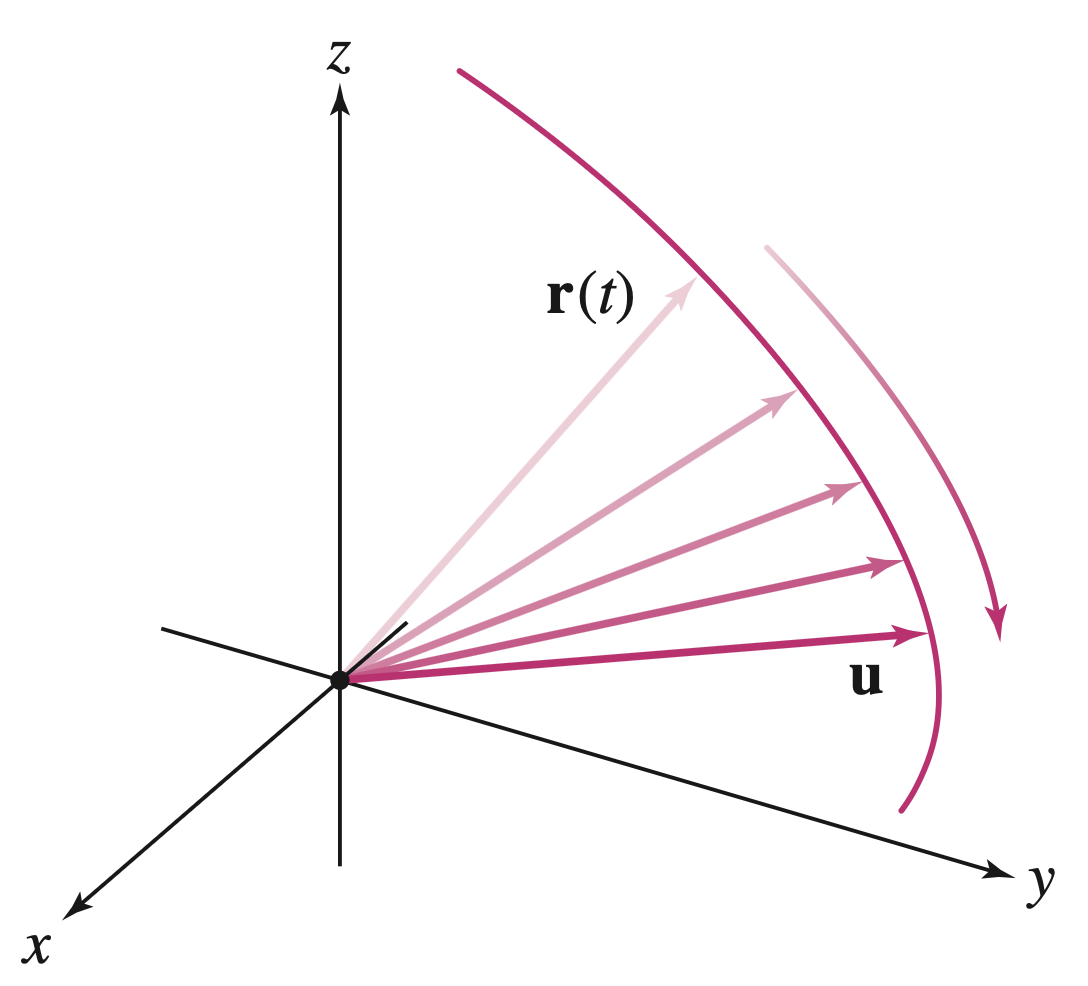
Recall back in MTH 251 (or MTH 251Z), we defined limit as the function value getting arbitrarily close to some point as the input approaches some value. In the case of vector-valued functions, the input is some parameter \(t\text{,}\) and the output is a vector in space. That is, we say that a vector-valued function \(\v{r}(t)\) approaches a limit \(\v{u}\) (a vector) as \(t\) approaches \(t_0\) if the distance between \(\v{r}(t)\) and \(\v{u}\) approaches \(0\) as \(t\) approaches \(t_0\text{.}\)

Definition 13.2.1. Limit of a Vector-Valued Function.

A vector-valued function \(\v{r}(t)\) approaches the limit \(\v{u}\) (a vector) as \(t\) approaches \(t_0\) if \(\displaystyle \lim_{t\to t_0} \|\v{r}(t) - \v{u}\| = 0\text{.}\) In this case, we write
\begin{equation*} \lim_{t\to t_0} \v{r}(t) = \v{u} \end{equation*}
Figure 13.2.2. The vector-valued function \(\v{r}(t)\) approaches the vector \(\v{u}\) as \(t\to t_0\)
It turns out that we can compute limits of vector-valued functions by examining the behavior of each component function individually. Observe that each component function is a single-variable function, so we can apply all the limit laws we learned in MTH 251 (or MTH 251Z) to each component function. That is, the limit of a vector-valued function can be computed componentwise.

Example 13.2.4.

Evaluate \(\displaystyle \lim_{t\to 0}\la \frac{1}{t + 1}, \frac{e^t - 1}{t}, 4t \ra\)
Hint.
Remember the limit can be computed componentwise. So what is the limit of each of the components as \(t\) approaches \(0\text{?}\)
Also, back from Calculus I (or differential calculus), what is the very first step you should do when evaluating a limit?
Solution.
We will evaluate the limit componentwise:
  • \(\displaystyle \displaystyle \lim_{t\to 0} \frac{1}{t + 1} = \frac{1}{0 + 1} = 1\)
  • \(\displaystyle \lim_{t\to 0} \frac{e^t - 1}{t} = \lim_{t\to 0} \frac{e^t}{1} = e^0 = 1\) (using L’HΓ΄pital’s Rule)
  • \(\displaystyle \displaystyle \lim_{t\to 0} 4t = 4(0) = 0\)
Therefore,
\begin{align*} \lim_{t\to 0} \la \frac{1}{t + 1}, \frac{e^t - 1}{t}, 4t \ra \amp= \la \lim_{t\to 0} \frac{1}{t + 1}, \lim_{t\to 0} \frac{e^t - 1}{t}, \lim_{t\to 0} 4t \ra \\ \amp= \la 1, 1, 0 \ra \end{align*}
If we can evaluate the limit, then we can find the limit of the difference quotient, which leads us to the derivative of a vector-valued function.

Subsection Derivative of a Vector-Valued Function

Recall from MTH 251 (or MTH 251Z) that the derivative of a single-variable function is defined as the limit of the difference quotient. We extend this definition to vector-valued functions in the same way. That is, given a vector-valued function \(\v{r}(t)\text{,}\) we define the difference quotient on \([t,t + h]\) as follows
\begin{equation*} \text{d.q.} = \frac{\v{r}(t + h) - \v{r}(t)}{h} \end{equation*}
The derivative of \(\v{r}(t)\) is the limit of the difference quotient as \(h\to 0\text{.}\)

Definition 13.2.5. Derivative of a Vector-Valued Function.

The derivative of a vector-valued function \(\v{r}(t)\) is defined as the limit of the difference quotient
\begin{equation*} \v{r}'(t) = \frac{d}{dt} \v{r}(t) = \lim_{h\to 0} \frac{\v{r}(t+h) - \v{r}(t)}{h} \end{equation*}
In Leibniz notation, the derivative is written as \(\dfrac{d\v{r}}{dt}\text{.}\)
We say that \(\v{r}(t)\) is differentiable at \(t\) if the derivative \(\v{r}'(t)\) exists.
Similar to limits, we can compute the derivative of a vector-valued function by examining the behavior of each component function individually. That is, if \(\v{r}(t) = \la x(t), y(t), z(t) \ra\text{,}\) then
\begin{align*} \lim_{h\to 0} \frac{\v{r}(t+h) - \v{r}(t)}{h} \amp= \lim_{h\to 0} \frac{\la x(t+h), y(t+h), z(t+h) \ra - \la x(t), y(t), z(t) \ra}{h} \\ \amp= \lim_{h\to 0} \la \frac{x(t+h) - x(t)}{h}, \frac{y(t+h) - y(t)}{h}, \frac{z(t+h) - z(t)}{h} \ra \\ \amp = \la \lim_{h\to 0} \frac{x(t+h) - x(t)}{h}, \lim_{h\to 0} \frac{y(t+h) - y(t)}{h}, \lim_{h\to 0} \frac{z(t+h) - z(t)}{h} \ra \\ \amp= \la x'(t), y'(t), z'(t) \ra \end{align*}
Let’s make it into a cool theorem!

Example 13.2.7.

Compute the derivative of \(\v{r}(t) = \la e^{3t-4}, e^{6-t}, (t+1)^{-1} \ra\)
Hint.
Remember the derivative can be computed componentwise. So what is the derivative of each of the components?
You probably want to dig out the formula sheet you made back in Calculus I (or differential calculus) to remind yourself of the derivative formulas if needed.
Solution.
We will compute the derivative componentwise:
Therefore,
\begin{align*} \v{r}'(t) \amp= \la \frac{d}{dt} e^{3t-4}, \frac{d}{dt} e^{6-t}, \frac{d}{dt} (t+1)^{-1} \ra \\ \amp= \la 3e^{3t-4}, -e^{6-t}, - (t+1)^{-2} \ra \end{align*}
We also learned many derivative rules back in MTH 251 (or MTH 251Z). They also extend naturally to vector-valued functions as well since vector operations are also defined componentwise.
The only weird rule here is the Scalar Product Rule, since we are multiplying two different types of functions together. Richard included a brief proof below to convince you why this works.

Note 13.2.9. Proof of the Scalar Product Rule.

Let \(\v{r}(t) = \la x(t), y(t), z(t) \ra\text{.}\) Then
\begin{align*} \frac{d}{dt}\lp f(t)\v{r}(t) \rp \amp= \frac{d}{dt} \la f(t)x(t), f(t)y(t), f(t)z(t) \ra \\ \amp= \la \frac{d}{dt} \lp f(t)x(t) \rp, \frac{d}{dt} \lp f(t)y(t) \rp, \frac{d}{dt} \lp f(t)z(t) \rp \ra \end{align*}
Using the product rule from MTH 251 (or MTH 251Z) on each component, we have
\begin{align*} \frac{d}{dt}\lp f(t)\v{r}(t) \rp \amp= \la f'(t)x(t) + f(t)x'(t), f'(t)y(t) + f(t)y'(t), f'(t)z(t) + f(t)z'(t) \ra \\ \amp= f'(t) \la x(t), y(t), z(t) \ra + f(t) \la x'(t), y'(t), z'(t) \ra \\ \amp= f'(t)\v{r}(t) + f(t)\v{r}'(t) \end{align*}
as desired.
You are more than welcome to prove the other rules on your own as an exercise! The proofs are very similar to the one above, in the sense that we will need to break everything down componentwise and then apply the corresponding single-variable calculus rule to each component.

Example 13.2.10.

Evaluate \(\dfrac{d}{dt} \v{r}\lp g(t) \rp\) using the Chain Rule, where
\begin{equation*} \v{r}(t) = \la t^2, \sin(t), e^t \ra \quad \text{and} \quad g(t) = \ln(t) \end{equation*}
Hint.
Recall the chain rule formula says
\begin{equation*} \frac{d}{dt}\v{r}\lp g(t) \rp = \v{r}'\lp g(t) \rp \, g'(t) \end{equation*}
So we need to compute \(\v{r}'(t)\) and \(g'(t)\) first.
Solution.
First, we compute \(\v{r}'(t)\text{.}\)
\begin{equation*} \v{r}'(t) = \frac{d}{dt} \la t^2, \sin(t), e^t \ra = \la 2t, \cos(t), e^t \ra \end{equation*}
Next, we compute \(g'(t)\text{.}\)
\begin{equation*} g'(t) = \frac{d}{dt} \ln(t) = \frac{1}{t} \end{equation*}
Putting them together, by the Chain Rule, we have
\begin{align*} \frac{d}{dt} \v{r}\lp g(t) \rp \amp= \v{r}'\lp g(t) \rp \, g'(t) \\ \amp= \v{r}'\lp \ln(t) \rp \cdot \frac{1}{t} \\ \amp= \la 2\ln(t), \cos(\ln(t)), e^{\ln(t)} \ra \cdot \frac{1}{t} \\ \amp= \la \frac{2\ln(t)}{t}, \frac{\cos(\ln(t))}{t}, \frac{e^{\ln(t)}}{t} \ra \\ \amp= \la \frac{2\ln(t)}{t}, \frac{\cos(\ln(t))}{t}, 1 \ra \end{align*}
But what about multiplying two vector-valued functions? We learned back in the previous chapter that we can multiply two vectors using the dot product or the cross product. It turns out that we have product rules for both of these operations as well.

Note 13.2.12. Proof of the Product Rules.

The proofs of both rules are very similar to the proof of the Scalar Product Rule. We break down the dot product and cross product componentwise, and then apply the corresponding single-variable calculus product rule to each component.
For the dot product, recall that
\begin{equation*} \v{r}_1(t) \cdot \v{r}_2(t) = x_1(t)x_2(t) + y_1(t)y_2(t) + z_1(t)z_2(t) \end{equation*}
So we can apply the product rule from MTH 251 (or MTH 251Z) to each of the three terms individually.
Let \(\v{r}_1(t) = \la x_1(t), y_1(t), z_1(t) \ra\) and \(\v{r}_2(t) = \la x_2(t), y_2(t), z_2(t) \ra\text{.}\) Then
\begin{align*} \frac{d}{dt}\lp \v{r}_1(t) \cdot \v{r}_2(t) \rp \amp= \frac{d}{dt} \lp x_1(t)x_2(t) + y_1(t)y_2(t) + z_1(t)z_2(t) \rp \\ \amp= x_1'(t)x_2(t) + x_1(t)x_2'(t) + y_1'(t)y_2(t) + y_1(t)y_2'(t) \\ \amp \qquad + z_1'(t)z_2(t) + z_1(t)z_2'(t) \\ \amp= \lp x_1'(t)x_2(t) + y_1'(t)y_2(t) + z_1'(t)z_2(t) \rp \\ \amp \qquad + \lp x_1(t)x_2'(t) + y_1(t)y_2'(t) + z_1(t)z_2'(t) \rp \\ \amp= \v{r}_1'(t) \cdot \v{r}_2(t) + \v{r}_1(t) \cdot \v{r}_2'(t) \end{align*}
as desired.
For the cross product, recall that
\begin{equation*} \v{r}_1(t) \times \v{r}_2(t) = \la y_1(t)z_2(t) - z_1(t)y_2(t), z_1(t)x_2(t) - x_1(t)z_2(t), x_1(t)y_2(t) - y_1(t)x_2(t) \ra \end{equation*}
So we can apply the product rule from MTH 251 (or MTH 251Z) to each of the three components individually.
Let \(\v{r}_1(t) = \la x_1(t), y_1(t), z_1(t) \ra\) and \(\v{r}_2(t) = \la x_2(t), y_2(t), z_2(t) \ra\text{.}\) Then
\begin{align*} \frac{d}{dt}\lp \v{r}_1(t) \times \v{r}_2(t) \rp \amp= \frac{d}{dt} \la y_1(t)z_2(t) - z_1(t)y_2(t), z_1(t)x_2(t) - x_1(t)z_2(t), x_1(t)y_2(t) - y_1(t)x_2(t) \ra \\ \amp= \la \frac{d}{dt} \lp y_1(t)z_2(t) - z_1(t)y_2(t) \rp, \frac{d}{dt} \lp z_1(t)x_2(t) - x_1(t)z_2(t) \rp, \frac{d}{dt} \lp x_1(t)y_2(t) - y_1(t)x_2(t) \rp \ra \end{align*}
Using the product rule from MTH 251 (or MTH 251Z) on each component, we have
\begin{align*} \frac{d}{dt}\lp \v{r}_1(t) \times \v{r}_2(t) \rp \amp= \bigg\langle y_1'(t)z_2(t) + y_1(t)z_2'(t) - z_1'(t)y_2(t) - z_1(t)y_2'(t), \\ \amp \qquad \quad z_1'(t)x_2(t) + z_1(t)x_2'(t) - x_1'(t)z_2(t) - x_1(t)z_2'(t), \\ \amp \qquad \quad x_1'(t)y_2(t) + x_1(t)y_2'(t) - y_1'(t)x_2(t) - y_1(t)x_2'(t) \bigg\rangle \\ \amp= \v{r}_1'(t) \times \v{r}_2(t) + \v{r}_1(t) \times \v{r}_2'(t) \end{align*}
P.S.: Recall the cross product is NOT commutative, so be sure to keep the order of the vectors the same when applying the cross product rule!

Example 13.2.13.

Let
\begin{equation*} \v{r}_1(t) = \la t^2,1,2t \ra \quad \text{ and } \quad \v{r}_2(t) = \la 1,2,e^t \ra \end{equation*}
Find \(\dfrac{d}{dt} \lp \v{r}_1(t) \cdot \v{r}_2(t) \rp\) and \(\dfrac{d}{dt} \lp \v{r}_1(t) \times \v{r}_2(t) \rp\text{.}\)
Solution.
First, we compute the derivatives of \(\v{r}_1(t)\) and \(\v{r}_2(t)\text{:}\)
\begin{align*} \v{r}_1'(t) \amp= \frac{d}{dt} \la t^2,1,2t \ra = \la 2t,0,2 \ra \\ \v{r}_2'(t) \amp= \frac{d}{dt} \la 1,2,e^t \ra = \la 0,0,e^t \ra \end{align*}
Now, using the Dot Product Rule, we have
\begin{align*} \frac{d}{dt} \lp \v{r}_1(t) \cdot \v{r}_2(t) \rp \amp= \v{r}_1'(t) \cdot \v{r}_2(t) + \v{r}_1(t) \cdot \v{r}_2'(t) \\ \amp= \la 2t,0,2 \ra \cdot \la 1,2,e^t \ra + \la t^2,1,2t \ra \cdot \la 0,0,e^t \ra \\ \amp= 2t(1) + 0(2) + 2(e^t) + t^2(0) + 1(0) + 2t(e^t) \\ \amp= 2t + 2e^t + 2te^t \end{align*}
Next, using the Cross Product Rule, we have
\begin{align*} \frac{d}{dt} \lp \v{r}_1(t) \times \v{r}_2(t) \rp \amp= \v{r}_1'(t) \times \v{r}_2(t) + \v{r}_1(t) \times \v{r}_2'(t) \\ \amp= \la 2t,0,2 \ra \times \la 1,2,e^t \ra + \la t^2,1,2t \ra \times \la 0,0,e^t \ra \\ \amp= \la 0( e^t ) - 2( 2 ), 2(1) - 2t( e^t ), 2t( 2 ) - 0(1) \ra \\ \amp \qquad + \la 1( e^t ) - 2t( 0 ), 2t(0) - t^2( e^t ), t^2( 0 ) - 1(0) \ra \\ \amp= \la -4, 2 - 2te^t, 4t \ra + \la e^t, -t^2e^t, 0 \ra \\ \amp= \la -4 + e^t, 2 - e^t(2t + t^2), 4t \ra \end{align*}
One of the reasons we learned about the derivative in the first place is to find the tangent line to a curve at a given point. We can do the same thing for vector-valued functions as well.

Subsection Derivative as a Tangent Vector

Recall back in MTH 251 (or MTH 251Z), we learned that the derivative of a single-variable function at a point gives us the slope of the tangent line to the curve at that point. But there is no slope in \(\R^3\text{...}\) so what gives?
Back in SectionΒ 12.2, we learned that a line in \(\R^3\) can be represented using a point and a direction vector. It turns out that the derivative of a vector-valued function at a point gives us a direction vector for the tangent line to the curve at that point. That is, the derivative of the vector-valued function at a point gives us the direction of the tangent line to the curve at that point.

Definition 13.2.14. Tangent Vector and Tangent Line.

The derivative of a vector-valued function \(\v{r}(t)\) at a point \(t = t_0\text{,}\) denoted \(\v{r}'(t_0)\text{,}\) is a tangent vector (if it exists and is nonzero). The tangent vector is a direction vector for the tangent line to the curve. The tangent line then is the line with vector parameterization
\begin{equation*} \v{L}(t) = \v{r}(t_0) + t \v{r}'(t_0) \end{equation*}

Example 13.2.15.

Find an equation of the tangent line to the curve defined by \(\v{r}(t) = \la 2\cos(t), \sin(t), t \ra\) at the point \(\lp 0,1,\dfrac{\pi}{2} \rp\text{.}\)
Hint.
Recall back in MTH 251 (or MTH 251Z) that to find the equation of the tangent line, we need a point on the line and the slope of the tangent line. Since we are in \(\R^3\text{,}\) we trade the slope for a direction vector instead.
So what is a point on the line and a direction vector for the tangent line at the given point?
Solution.
First, we need to find the value of \(t\) that corresponds to the given point \(\lp 0,1,\dfrac{\pi}{2} \rp\text{.}\) From the third component, we see that \(t = \dfrac{\pi}{2}\text{.}\) Next, we compute the derivative of \(\v{r}(t)\text{:}\)
\begin{equation*} \v{r}'(t) = \frac{d}{dt} \la 2\cos(t), \sin(t), t \ra = \la -2\sin(t), \cos(t), 1 \ra \end{equation*}
Evaluating at \(t = \dfrac{\pi}{2}\text{,}\) we have
\begin{equation*} \v{r}'\lp \frac{\pi}{2} \rp = \la -2\sin\lp \frac{\pi}{2} \rp, \cos\lp \frac{\pi}{2} \rp, 1 \ra = \la -2(1), 0, 1 \ra = \la -2, 0, 1 \ra \end{equation*}
Therefore, a vector parameterization of the tangent line is
\begin{align*} \v{L}(t) \amp= \v{r}\lp \frac{\pi}{2} \rp + t\v{r}'\lp \frac{\pi}{2} \rp \\ \amp= \la 0, 1, \frac{\pi}{2} \ra + t \la -2, 0, 1 \ra \\ \amp= \la -2t, 1, \frac{\pi}{2} + t \ra \end{align*}

Subsection Vector-valued Integration

Last but not least, we turn our attention to integration of vector-valued functions. Recall back in MTH 252 (or MTH 252Z) that integration and differentiation are inverse operations (guaranteed by the Fundamental Theorem of Calculus). This implies that if things work out for differentiation, it will also work out for integration as well.
Since the derivative of a vector-valued function is computed componentwise, it follows that the integral of a vector-valued function is also computed componentwise.
The indefinite integral (antiderivative) is easier to understand first. We are looking for some antiderivative of each of the component functions, and then we just combine them back into a vector. But what about the definite integral?
Recall back in MTH 252 (or MTH 252Z) that the definite integral defines the signed area under the curve of the function. But this result doesn’t make sense in this case... The definite integral of a vector-valued function is also a vector, but area should be a scalar... What???
It turns out that the definite integral gives us the net change in position as we move along the curve from \(t = a\) to \(t = b\) on each component of the vector. So interpreting the definite integral as the accumulation function is still valid here!

Example 13.2.17.

Evaluate the indefinite integral \(\displaystyle \int \la \frac{1}{t^2}, \frac{1}{t^4}, \frac{1}{t^5} \ra \, dt\)
Hint.
Remember the integral can be computed componentwise. So what is the antiderivative of each of the components?
Also, don’t forget the arbitrary constant at the end, either as a vector or componentwise.
Solution.
We will compute the integral componentwise:
  • \(\displaystyle \int \frac{1}{t^2}\, dt = \int t^{-2}\, dt = -t^{-1} + C_1 = -\frac{1}{t} + C_1\)
  • \(\displaystyle \int \frac{1}{t^4}\, dt = \int t^{-4}\, dt = -\frac{1}{3}t^{-3} + C_2 = -\frac{1}{3t^3} + C_2\)
  • \(\displaystyle \int \frac{1}{t^5}\, dt = \int t^{-5}\, dt = -\frac{1}{4}t^{-4} + C_3 = -\frac{1}{4t^4} + C_3\)
Therefore,
\begin{align*} \int \la \frac{1}{t^2}, \frac{1}{t^4}, \frac{1}{t^5} \ra \, dt \amp= \la \int \frac{1}{t^2}\, dt, \int \frac{1}{t^4}\, dt, \int \frac{1}{t^5}\, dt \ra \\ \amp= \la -\frac{1}{t} + C_1, -\frac{1}{3t^3} + C_2, -\frac{1}{4t^4} + C_3 \ra \end{align*}
or equivalently,
\begin{align*} \int \la \frac{1}{t^2}, \frac{1}{t^4}, \frac{1}{t^5} \ra \, dt \amp= \la -\frac{1}{t}, -\frac{1}{3t^3}, -\frac{1}{4t^4} \ra + \la C_1, C_2, C_3 \ra \\ \amp= \la -\frac{1}{t}, -\frac{1}{3t^3}, -\frac{1}{4t^4} \ra + \v{c} \end{align*}
where \(\v{c} = \la C_1, C_2, C_3 \ra\) is a constant vector.
But how do we evaluate definite integrals of vector-valued functions? The tool we had back in MTH 252 (or MTH 252Z) is the Fundamental Theorem of Calculus (FTC). It turns out that the FTC also holds for vector-valued functions as well!

Example 13.2.19.

Evaluate the definite integral \(\displaystyle \int_1^4 \la t^{-1}, 4\sqrt{t}, -8t^{3/2} \ra \, dt\)
Hint.
Remember that the FTC also holds for vector-valued functions. So how does the process work again?
Solution.
We will evaluate the integral componentwise using the FTC.
  • \(\displaystyle \displaystyle \int_1^4 t^{-1}\, dt = \ln|t|\bigg|_1^4 = \ln(4) - \ln(1) = \ln(4)\)
  • \(\displaystyle \displaystyle \int_1^4 4\sqrt{t}\, dt = \int_1^4 4t^{1/2}\, dt = \frac{8}{3}t^{3/2}\bigg|_1^4 = \frac{8}{3}(8-1) = \frac{56}{3}\)
  • \(\displaystyle \displaystyle \int_1^4 -8t^{3/2}\, dt = -\frac{16}{5}t^{5/2}\bigg|_1^4 = -\frac{16}{5}(32-1) = -\frac{512}{5} + \frac{16}{5} = -\frac{496}{5}\)
Therefore,
\begin{align*} \int_1^4 \la t^{-1}, 4\sqrt{t}, -8t^{3/2} \ra \, dt \amp= \la \int_1^4 t^{-1}\, dt, \int_1^4 4\sqrt{t}\, dt, \int_1^4 -8t^{3/2}\, dt \ra \\ \amp= \la \ln(4), \frac{56}{3}, -\frac{496}{5} \ra \end{align*}
To sum up, since the vector-valued functions are built from single-variable functions componentwise, most of the rules and properties we learned back in MTH 251 (or MTH 251Z) and MTH 252 (or MTH 252Z) extend naturally to vector-valued functions as well! But you have triple the work to do since you have to deal with three components instead of just one...

Worksheet Assigned Problems for Section 13.2

The problems listed below are assigned to be included in your problem set portfolio. Note that a specific selection of these problems will also form the written homework assignments. I recommend working through all of them to ensure a solid grasp of the material. Reach out to Richard for help if you get stuck or have any questions.
The solutions will be posted after the written homework due dates. If you have any questions about your work, talk to Richard and he is happy to discuss the process with you.

13.2.3.

Evaluate the limit \(\displaystyle \lim_{t\to 0} e^{2t}\v{i} + \ln(t+1)\v{j} + 4\v{k}\)
Solution.
Computing the limit of each component, we obtain
\begin{align*} \lim_{t\to 0} \lp e^{2t}\v{i} + \ln(t+1)\v{j} + 4\v{k} \rp \amp= \lp \lim_{t\to 0} e^{2t} \rp \v{i} + \lp \lim_{t\to 0} \ln(t+1) \rp \v{j} + \lp \lim_{t\to 0} 4 \rp \v{k} \\ \amp= e^0\v{i} + \ln(1)\v{j} + 4\v{k} \\ \amp= \v{i} + 4\v{k} \end{align*}

13.2.9.

Compute the derivative of \(\v{r}(s) = \la e^{1-s}, 1-s, \ln(1-s) \ra\text{.}\)
Solution.
Using componentwise differentiation, we have
\begin{align*} \frac{d\v{r}}{ds} \amp= \la \frac{d}{ds}e^{1-s}, \frac{d}{ds}(1-s), \frac{d}{ds}\ln(1-s) \ra \\ \amp= \la -e^{1-s}, -1, -\frac{1}{1-s} \ra \end{align*}

13.2.15.

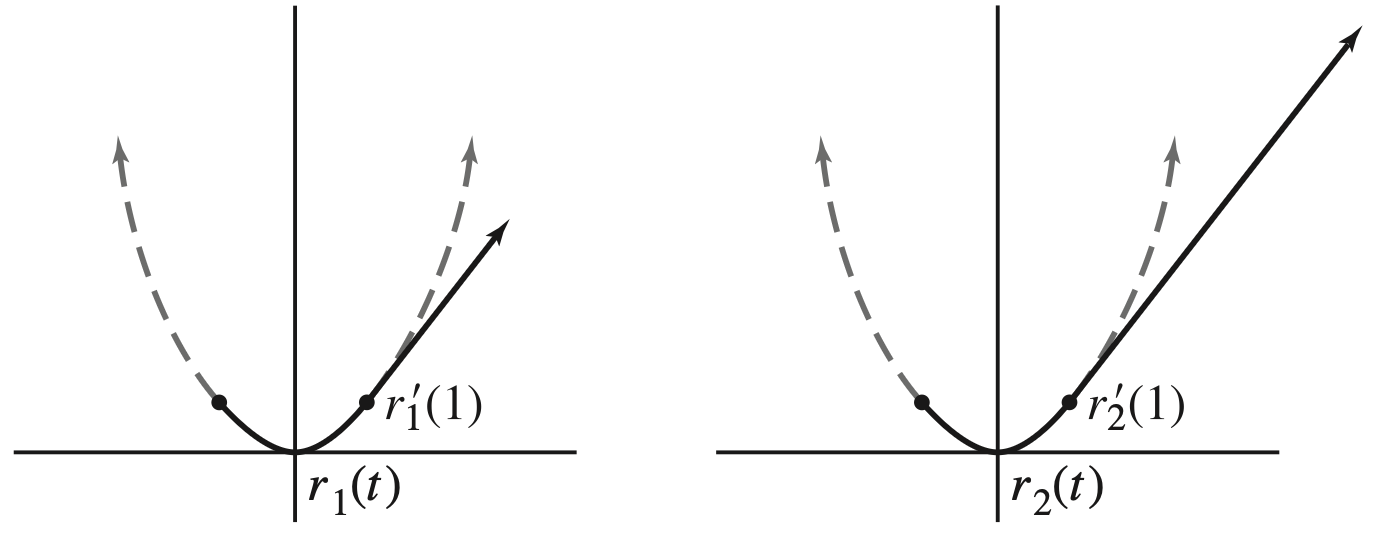
Sketch the curve parametrized by \(\v{r}_1(t) = \la t,t^2 \ra\) together with its tangent vector at \(t = 1\text{.}\) Then do the same for \(\v{r}_2(t) = \la t^3, t^6 \ra\)
Solution.
Note that \(\v{r}'(t) = \la 1,2t \ra\) and so \(\v{r}'(1) = \la 1,2 \ra\text{.}\) The graph of \(\v{r}_1(t)\) satisfies \(y = x^2\text{.}\)
Likewise, \(\v{r}_2'(t) = \la 3t^2,6t^5 \ra\) and so \(\v{r}_2'(1) = \la 3,6 \ra\text{.}\) The graph of \(\v{r}_2(t)\) also satisfies \(y = x^2\text{.}\)
Both graphs and tangent vectors are given below.
Figure 13.2.20.

13.2.17.

Determine the value of \(t\) between \(0\) and \(2\pi\) such that the tangent vector to the clycloid \(\v{r}(t) = \la t - \sin(t), 1 - \cos(t) \ra\) is parallel to \(\la \sqrt{3}, 1 \ra\text{.}\)
Solution.
We first find the tangent vector \(\v{r}'(t)\text{:}\)
\begin{equation*} \v{r}'(t) = \frac{d}{dt}\la t - \sin(t), 1 - \cos(t) \ra = \la 1 - \cos(t), \sin(t) \ra \end{equation*}
For this vector to be parallel to \(\v{v} = \la \sqrt{3}, 1 \ra\text{,}\) the ratio of their \(y\) and \(x\) components (the slope) must be equal.
\begin{equation*} \frac{\sin(t)}{1 - \cos(t)} = \frac{1}{\sqrt{3}} \end{equation*}
We can simplify the left side using half-angle identities: \(\sin(t) = 2\sin(t/2)\cos(t/2)\) and \(1-\cos(t) = 2\sin^2(t/2)\text{.}\)
\begin{align*} \frac{2\sin(t/2)\cos(t/2)}{2\sin^2(t/2)} \amp= \frac{1}{\sqrt{3}} \\ \cot(t/2) \amp= \frac{1}{\sqrt{3}} \\ \tan(t/2) \amp= \sqrt{3} \end{align*}
Since \(t\) is between \(0\) and \(2\pi\text{,}\) we have \(0 \lt t/2 \lt \pi\text{.}\) The only solution for the tangent function in this range is:
\begin{equation*} t/2 = \frac{\pi}{3} \implies t = \frac{2\pi}{3} \end{equation*}
Thus, the tangent vector is parallel to \(\la \sqrt{3}, 1 \ra\) when \(t = \frac{2\pi}{3}\text{.}\)

Exercise Group.

In the following exercises, evaluate the derivative by using the appropriate Product Rule, where
\begin{equation*} \v{r}_1(t) = \la t^2, t^3, t \ra \, , \qquad \v{r}_2(t) = \la e^{3t}, e^{2t}, e^t \ra \end{equation*}
13.2.19.
\(\dfrac{d}{dt} \lp \v{r}_1(t) \cdot \v{r}_2(t) \rp\)
Solution.
\begin{align*} \dfrac{d}{dt} \lp \v{r}_1(t) \cdot \v{r}_2(t) \rp \amp= \v{r}_1'(t) \cdot \v{r}_2(t) + \v{r}_1(t) \cdot \v{r}_2'(t) \\ \amp= \la 2t, 3t^2, 1 \ra \cdot \la e^{3t}, e^{2t}, e^t \ra + \la t^2, t^3, t \ra \cdot \la 3e^{3t}, 2e^{2t}, e^t \ra \\ \amp= 2te^{3t} + 3t^2e^{2t} + e^t + 3t^2e^{3t} + 2t^3e^{2t} + te^t \\ \amp= \lp 3t^2 + 2t \rp e^{3t} + \lp 2t^3 + 3t^2 \rp e^{2t} + (t+1)e^t \end{align*}
13.2.21.
\(\dfrac{d}{dt} \lp \v{r}_1(t) \times \v{r}_2(t) \rp\)
Solution.
\begin{align*} \dfrac{d}{dt} \lp \v{r}_1(t) \times \v{r}_2(t) \rp \amp= \v{r}_1'(t) \times \v{r}_2(t) + \v{r}_1(t) \times \v{r}_2'(t) \\ \amp= \la 2t, 3t^2, 1 \ra \times \la e^{3t}, e^{2t}, e^t \ra + \la t^2, t^3, t \ra \times \la 3e^{3t}, 2e^{2t}, e^t \ra \\ \amp= \begin{vmatrix} \v{i} \amp \v{j} \amp \v{k} \\ 2t \amp 3t^2 \amp 1 \\ e^{3t} \amp e^{2t} \amp e^t \end{vmatrix} + \begin{vmatrix} \v{i} \amp \v{j} \amp \v{k} \\ t^2 \amp t^3 \amp t \\ 3e^{3t} \amp 2e^{2t} \amp e^t \end{vmatrix} \\ \amp= \lp 3t^2e^t - e^{2t} \rp \v{i} + \lp e^{3t} - 2te^t \rp \v{j} + \lp 2te^{2t} - 3t^2e^{3t} \rp \v{k} \\ \amp \qquad + \lp t^3e^t - 2te^{2t} \rp \v{i} + \lp 3t^2e^{3t} - t^2e^t \rp \v{j} + \lp 2t e^{2t} - 3t^3 e^{3t} \rp \v{k} \\ \amp= \left[ \lp 3t^2 + t^3\rp e^t - \lp 1 + 2t \rp e^{2t} \right] \v{i} + \left[ \lp 1 + 3t\rp e^{3t} - \lp 2t + t^2 \rp e^t \right] \v{j} \\ \amp \qquad + \left[ \lp 2t + 2t^2 \rp e^{2t} - \lp 3t^2 + 3t^3 \rp e^{3t} \right] \v{k} \end{align*}

13.2.27.

Evaluate \(\dfrac{d}{dt}\v{r}\lp g(t) \rp\) using the Chain Rule, where
\begin{equation*} \v{r}(t) = \la e^t, e^{2t}, 4 \ra \, , \qquad g(t) = 4t + 9 \end{equation*}
Solution.
We first differentiate the two functions.
\begin{align*} \v{r}'(t) \amp= \frac{d}{dt} \la e^t, e^{2t}, 4 \ra = \la e^t, 2e^{2t}, 0 \ra \\ g'(t) \amp= \frac{d}{dt} (4t + 9) = 4 \end{align*}
Using the Chain Rule, we have
\begin{align*} \frac{d}{dt}\v{r}\lp g(t) \rp \amp= \v{r}'(g(t)) \cdot g'(t) \\ \amp= \v{r}'(4t + 9) \cdot 4 \\ \amp= \la e^{4t+9}, 2e^{2(4t+9)}, 0 \ra \cdot 4 \\ \amp= \la 4e^{4t+9}, 8e^{8t+18}, 0 \ra \end{align*}

13.2.33.

Find a parametrization of the tangent line of \(\v{r}(t) = \la 1-t^2, 5t, 2t^3 \ra\) at the point \(t = 2\text{.}\)
Solution.
The tangent line is parametrized by
\begin{equation*} \ell(t) = \v{r}(2) + t\v{r}'(2) \end{equation*}
We compute the vectors in the above parametrization
\begin{align*} \v{r}(2) \amp= \la 1-2^2, 5\cdot 2, 2\cdot 2^3 \ra = \la -3, 10, 16 \ra \\ \v{r}'(t)\amp= \frac{d}{dt} \la 1-t^2, 5t, 2t^3 \ra = \la -2t, 5, 6t^2 \ra \quad \implies \quad \v{r}'(2) = \la -4, 5, 24 \ra \end{align*}
Substituting them back into the parametrization, we have
\begin{equation*} \ell(t) = \la -3,10,16 \ra + t \la -4,5,24 \ra = \la -3-4t, 10+5t, 16+24t \ra \end{equation*}

13.2.45.

Evaluate the integral \(\displaystyle \int_0^\pi \la -\sin(t), 6t, 2t+\cos(2t) \ra\, dt\)
Solution.
We integrate the vector-valued function componentwise:
\begin{align*} \int_0^\pi \la -\sin(t), 6t, 2t+\cos(2t) \ra\, dt \amp= \la \int_0^\pi -\sin(t)\, dt, \int_0^\pi 6t\, dt, \int_0^\pi (2t+\cos(2t))\, dt \ra \end{align*}
We evaluate each integral separately:
\begin{align*} \int_0^\pi -\sin(t)\, dt \amp= \left[ \cos(t) \right]_0^\pi = \cos(\pi) - \cos(0) = -1 - 1 = -2 \\ \int_0^\pi 6t\, dt \amp= \left[ 3t^2 \right]_0^\pi = 3\pi^2 - 0 = 3\pi^2 \\ \int_0^\pi (2t+\cos(2t))\, dt \amp= \left[ t^2 + \frac{1}{2}\sin(2t) \right]_0^\pi \\ \amp= \left( \pi^2 + \frac{1}{2}\sin(2\pi) \right) - \left( 0^2 + \frac{1}{2}\sin(0) \right) \\ \amp= \pi^2 \end{align*}
Combining these components, the value of the vector integral is:
\begin{equation*} \la -2, 3\pi^2, \pi^2 \ra \end{equation*}

13.2.55.

Find both the general solution of the differential equation and the solution with the given initial condition.
\begin{equation*} \v{r}''(t) = \la 0,2,0 \ra \, , \qquad \v{r}(3) = \la 1,1,0 \ra \, , \qquad \v{r}'(3) = \la 0,0,1 \ra \end{equation*}
Solution.
To find the general solution we first find \(\v{r}'(t)\) by integrating \(\v{r}''(t)\text{.}\)
\begin{equation*} \v{r}'(t) = \int \v{r}''(t)\, dt = \int \la 0,2,0 \ra \, dt = \la 0,2t,0 \ra + \v{c}_1 \end{equation*}
We now integrate \(\v{r}'(t)\) to find the general solution \(\v{r}(t)\text{.}\)
\begin{equation*} \v{r}(t) = \int \v{r}'(t)\, dt = \int \lp \la 0,2t,0 \ra + \v{c}_1 \rp\, dt = \la 0,t^2,0 \ra + \v{c}_1 t + \v{c}_2 \end{equation*}
We substitute the initial conditions to find the particular solution. This gives
\begin{align*} \v{r}'(3) \amp= \la 0,6,0 \ra + \v{c}_1 = \la 0,0,1 \ra \quad \implies \quad \v{c}_1 = \la 0,-6,1 \ra \\ \v{r}(3) \amp= \la 0,9,0 \ra + \v{c}_1 \cdot 3 + \v{c}_2 = \la 1,1,0 \ra \\ \amp\quad\, \, \la 0,9,0 \ra + \la 0,-18,3 \ra + \v{c}_2 = \la 1,1,0 \ra \\ \amp\implies \quad \v{c}_2 = \la 1,10,-3 \ra \end{align*}
Combining everything, we obtain the following solution
\begin{align*} \v{r}(t) \amp= \la 0,t^2,0 \ra + t \la 0,-6,1 \ra + \la 1,10,-3 \ra \\ \amp= \la 1, t^2-6t+10, t-3 \ra \end{align*}