Section 15.4 Integration in Polar, Cylindrical, and Spherical Coordinates

Have you ever tried to evaluate an integral over a circular region using rectangular coordinates? While it is mathematically possible, the resulting limits of integration inevitably involve square roots that can make the anti-derivatives tedious, if not impossible, to compute by hand. In previous sections, we evaluated double and triple integrals over regions perfectly suited for rectangular grids. However, the physical world is full of objects like cones, cylinders, and spheres that exhibit natural rotational symmetries.
Rather than forcing these curved boundaries into rigid rectangular boxes, we can make our lives significantly easier by adapting our coordinate system to fit the geometry of the region. In this section, we will explore how to translate integrals into polar, cylindrical, and spherical coordinates. By rethinking how we partition space, we will be able to transform overly complicated rectangular integrals into highly manageable iterated integrals.
Recall back in single-variable calculus, we split up an interval (a rectangle in \(\R^1\)) into a bunch of smaller segments. In multi-variable calculus (more specifically, in double and triple integrals), we will split up a region in \(\R^2\) or \(\R^3\) into a bunch of smaller rectangular regions (or boxes). But what if we change the way we view the region.

Subsection Integration in Polar Coordinates

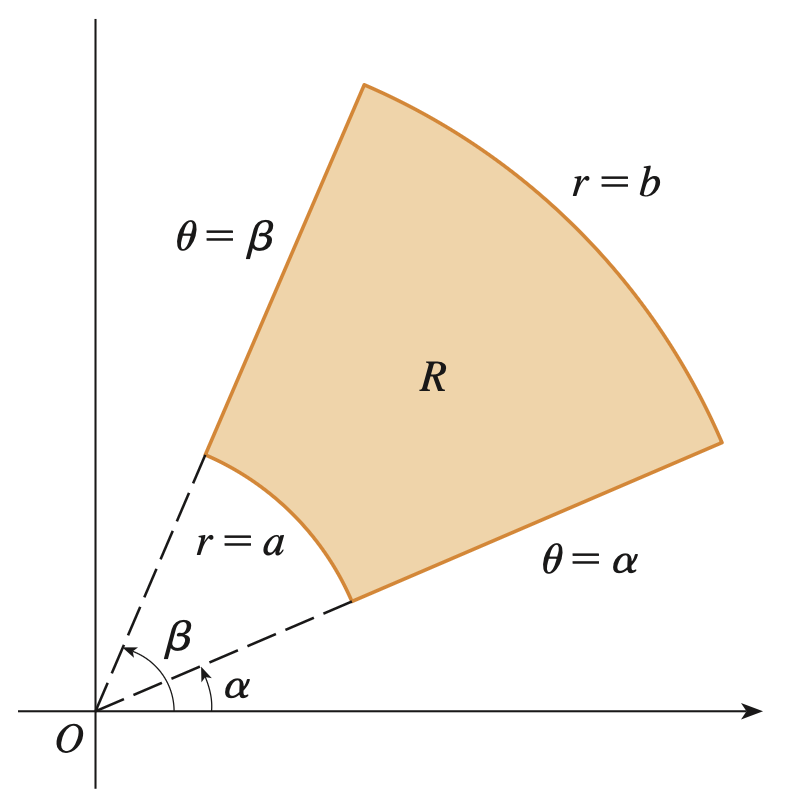
Recall the two variables in polar coordinates are \(r\) and \(\theta\text{,}\) where \(r\) is the distance from the origin and \(\theta\) is the angle between the positive x-axis and the ray from the origin to the point. If we let \(r\) and \(\theta\) to vary independently, we obtain a "polar rectangular region". But what does this region look like?
Figure 15.4.1. Polar Rectangular Region \(\c{R}\) where \(a\leq r \leq b\) and \(\alpha \leq \theta \leq \beta\)
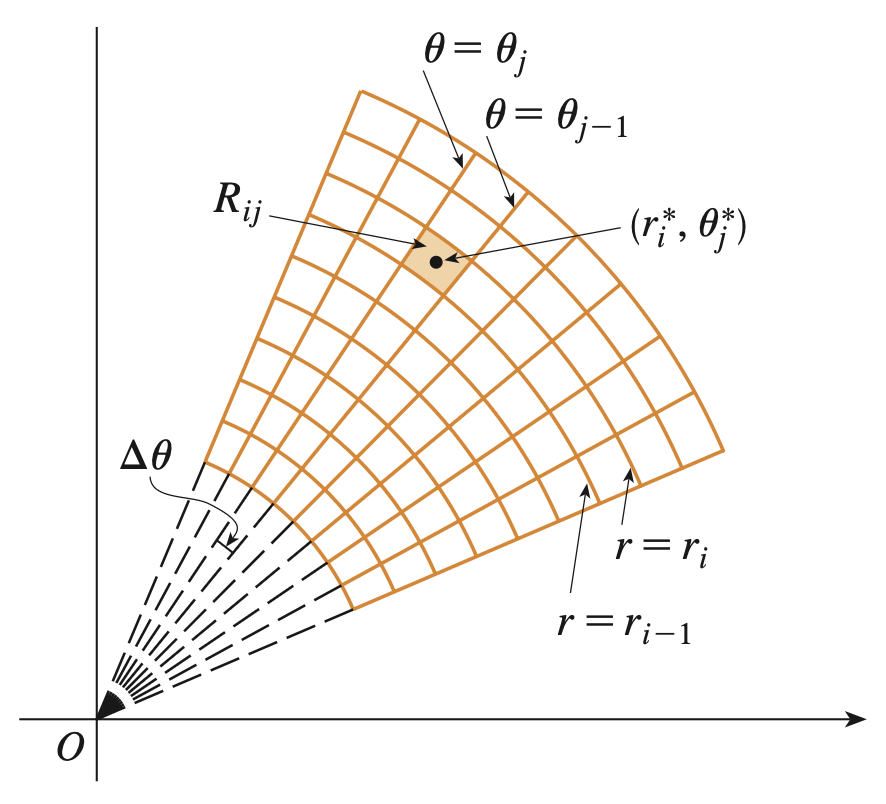
To integrate a function \(f\) over this polar rectangular region \(\c{R}\text{,}\) as you can imagine, we will split up this region into a bunch of smaller polar rectangular regions. Then we will find a sample point in each of these smaller regions and evaluate the function value at the sample point. Finally, we will multiply the function value by the area of the smaller polar rectangular region and add up all of these products together.
Figure 15.4.2. Partitioning \(\c{R}\) into smaller polar rectangular regions
That is, the volume of the solid under the surface defined by \(f(r,\theta)\) over the polar rectangular region \(\c{R}\) can be approximated by
\begin{equation*} V \approx \sum_{k = 1}^N f\lp r_k^*, \theta_k^* \rp \Delta A_k \end{equation*}
where \(\Delta A_k\) is the area of the \(k\)-th smaller polar rectangular region and \((r_k^*, \theta_k^*)\) is a sample point in the \(k\)-th smaller polar rectangular region. As you can imagine, we can define the double integral over the polar rectangular region as
\begin{equation*} \iint_\c{R} f(r,\theta) \, dA = \lim_{N\to \infty} \sum_{k = 1}^N f\lp r_k^*, \theta_k^* \rp \Delta A_k \end{equation*}
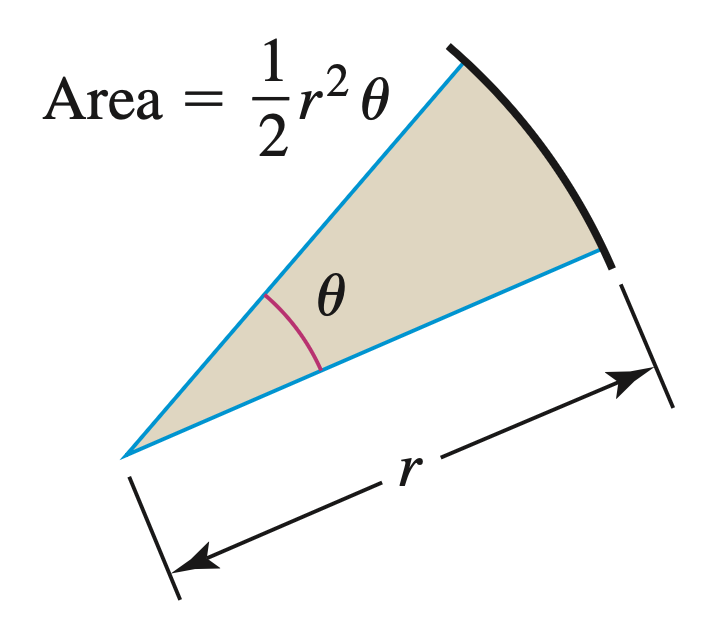
But how do we find the area of a polar rectangular region, \(\Delta A_k\text{?}\) Well we can think of the polar rectangular region as the difference between two sectors of a circle.
Figure 15.4.3. Area of a sector of a circle is \(\dfrac{1}{2} r^2 \theta\)
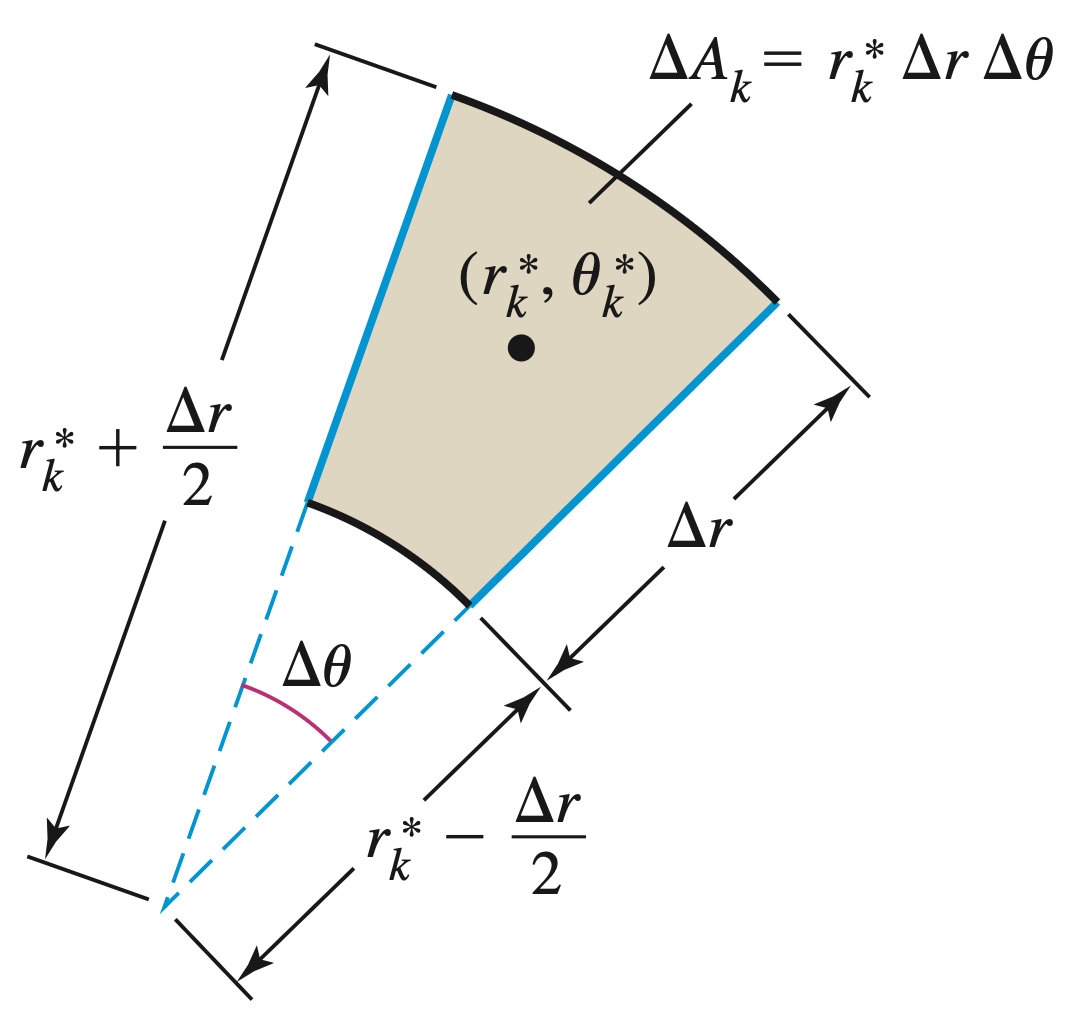
Before we derive an expression for \(\Delta A_k\text{,}\) we will pick the sample point to be in the exact middle of the smaller polar rectangular region, as shown in the figure below.
Figure 15.4.4. Sample point in the exact middle of the smaller polar rectangular region
Now we will derive an expression for \(\Delta A_k\text{!}\) Let’s say the inner radius of the \(k\)-th smaller polar rectangular region is \(r_1\) and the outer radius is \(r_2\text{.}\) Then we have
\begin{align*} \Delta A_k \amp= \frac{1}{2} r_2^2 \Delta \theta - \frac{1}{2} r_1^2 \Delta \theta \\ \amp= \frac{1}{2} \lp r_2^2 - r_1^2 \rp \Delta \theta \\ \amp= \frac{1}{2} \lp r_1 + r_2 \rp \lp r_2 - r_1 \rp \Delta \theta \\ \amp= \frac{1}{2} \lp r_1 + r_2 \rp \Delta r \Delta \theta \end{align*}
Okay cool... but this expression is still a bit complicated. What is \(\frac{1}{2} \lp r_1 + r_2 \rp\text{?}\)
That is why we chose the sample point to be in the exact middle of the smaller polar rectangular region! By doing so, \(r_k^*\) will be the midpoint between \(r_1\) and \(r_2\text{,}\) which means that
\begin{equation*} r_k^* = \frac{r_1 + r_2}{2} \end{equation*}
Therefore, we can simplify the expression for \(\Delta A_k\) to
\begin{equation*} \Delta A_k = r_k^* \Delta r \Delta \theta \end{equation*}
This implies that the area of the smaller polar rectangular region is radius times change in radius times change in angle. Hence, we can now express this double integral as an iterated integral, guaranteed by the Fubini’s theorem.

Example 15.4.6.

Find the volume of the solid bounded by the paraboloid \(z = 9 - x^2 - y^2\) and the \(xy\)-plane.
Hint.
You are more than welcome to use rectangular coordinates to solve this problem, but it is much easier to use polar coordinates.
Also, it doesn’t matter which coordinates you use, the first step is to sketch the region of integration to determine the limits of integration.
Also, to help you visualize, Richard coded the paraboloid for you.
Figure 15.4.7. The paraboloid \(z = 9 - x^2 - y^2\)
Solution.
First, we determine the region of integration, \(\c{D}\text{,}\) in the \(xy\)-plane. The solid is bounded below by the \(xy\)-plane, where \(z = 0\text{.}\) Setting \(z = 0\) in the equation of the paraboloid gives:
\begin{equation*} 0 = 9 - x^2 - y^2 \implies x^2 + y^2 = 9 \end{equation*}
This means our region \(\c{D}\) is a disk of radius 3 centered at the origin. In polar coordinates, this region is described by \(0 \leq r \leq 3\) and \(0 \leq \theta \leq 2\pi\text{.}\)
The height of the solid is given by the paraboloid \(f(x,y) = 9 - x^2 - y^2\text{.}\) Converting this to polar coordinates, we get \(f(r,\theta) = 9 - r^2\text{.}\) Now, we can set up and evaluate the double integral:
\begin{align*} V \amp= \iint_\c{D} \lp 9 - x^2 - y^2 \rp \, dA \\ \amp= \int_0^{2\pi} \int_0^3 \lp 9 - r^2 \rp r \, dr \, d\theta \\ \amp= \int_0^{2\pi} \int_0^3 \lp 9r - r^3 \rp \, dr \, d\theta \\ \amp= \int_0^{2\pi} \left[ \frac{9}{2}r^2 - \frac{1}{4}r^4 \right]_0^3 \, d\theta \\ \amp= \int_0^{2\pi} \lp \frac{81}{2} - \frac{81}{4} \rp \, d\theta \\ \amp= \int_0^{2\pi} \frac{81}{4} \, d\theta \\ \amp= \frac{81}{4} \lp 2\pi \rp = \frac{81\pi}{2} \end{align*}
But why bother spending all the effort to find a second formula that pretty much finds the same thing? As you observed in the example above, sometimes it is much easier to use polar coordinates to evaluate a double integral than to use rectangular coordinates. That is, we will need a formula to convert a double integral in rectangular coordinates to a double integral in polar coordinates. Recall the conversion formulas from a rectangular coordinate \((x,y)\) to a polar coordinate \((r,\theta)\) are
\begin{equation*} x = r\cos(\theta) \qquad \text{ and } \qquad y = r\sin(\theta) \end{equation*}
In addition to the fact that \(dA = r\, dr\, d\theta\) in polar coordinates, we have the following conversion formula
\begin{equation*} \iint_\c{D} f(x,y) \, dA = \int_\alpha^\beta \int_{r = r_1(\theta)}^{r_2(\theta)} f(r\cos(\theta), r\sin(\theta)) \, r\, dr\, d\theta \end{equation*}
Observe that this formula applies to a more general region \(\c{D}\) that is not necessarily a polar rectangular region. That is, \(r\) can be a function of \(\theta\text{.}\)

Example 15.4.8.

Evaluate the integral \(\ds \iint_\c{D} \frac{dA}{\sqrt{16 - x^2 - y^2}}\) where
\begin{equation*} \c{D} = \left\{(x,y)\in \R^2 \mid x^2 + y^2 \leq 4, \, x \geq 0, \, \text{ and } y \geq 0\right\} \end{equation*}
Solution.
The region \(\c{D}\) is bounded by \(x^2 + y^2 \leq 4\text{,}\) which is a circle of radius 2. The conditions \(x \geq 0\) and \(y \geq 0\) restrict this region to the first quadrant. Therefore, in polar coordinates, \(\c{D}\) is described by \(0 \leq r \leq 2\) and \(0 \leq \theta \leq \pi/2\text{.}\)
Converting the integrand to polar coordinates, we note that \(x^2 + y^2 = r^2\) and \(dA = r\, dr\, d\theta\text{.}\) Setting up the integral yields:
\begin{align*} \iint_\c{D} \frac{dA}{\sqrt{16 - x^2 - y^2}} \amp= \int_0^{\pi/2} \int_0^2 \frac{1}{\sqrt{16 - r^2}} r \, dr \, d\theta \end{align*}
We can evaluate the inner integral using a \(u\)-substitution. Let \(u = 16 - r^2\text{,}\) then \(du = -2r \, dr\text{,}\) which means \(r \, dr = -\frac{1}{2} du\text{.}\)
\begin{align*} \int \frac{r}{\sqrt{16 - r^2}} \, dr \amp= \int -\frac{1}{2\sqrt{u}} \, du = -\sqrt{u} = -\sqrt{16 - r^2} \end{align*}
Applying the limits of integration from \(r = 0\) to \(r = 2\text{:}\)
\begin{align*} \left[ -\sqrt{16 - r^2} \right]_0^2 \amp= -\sqrt{16 - 4} - \lp -\sqrt{16 - 0} \rp \\ \amp= -\sqrt{12} + 4 = 4 - 2\sqrt{3} \end{align*}
Finally, we evaluate the outer integral:
\begin{align*} \int_0^{\pi/2} \lp 4 - 2\sqrt{3} \rp \, d\theta \amp= \lp 4 - 2\sqrt{3} \rp \left[ \theta \right]_0^{\pi/2} = \frac{\pi}{2} \lp 4 - 2\sqrt{3} \rp = \pi \lp 2 - \sqrt{3} \rp \end{align*}

Subsection Integration in Cylindrical Coordinates

Let’s say you want to convert a triple integral in rectangular coordinates to some other coordinates. Then the polar coordinates won’t work because of the lack of a third variable.
We did learn about extending polar coordinates to include a third variable, called cylindrical coordinates, in SectionΒ 12.7. Briefly, the third variable in cylindrical coordinates is just the \(z\)-coordinate in rectangular coordinates.
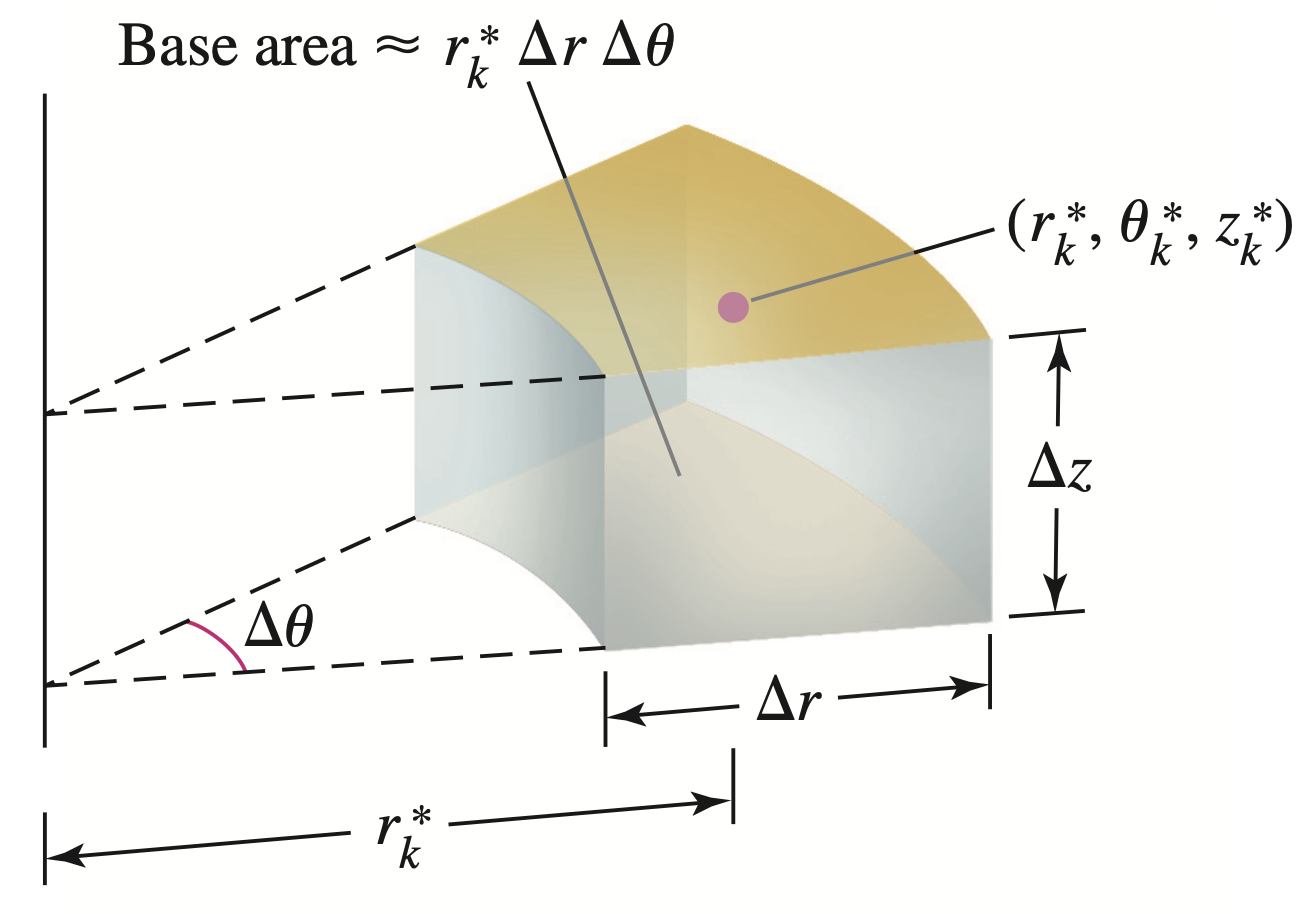
Figure 15.4.9. A cylindrical sub-box in cylindrical coordinates
For the volume of a cylindrical sub-box, we can think of it as the area of the base times the height. We spent all the effort earlier to find the area of the base in polar coordinates, which is \(r_k^*\Delta r \Delta \theta\text{.}\) The height of the cylindrical sub-box is just \(\Delta z\text{.}\) Therefore, the volume of a cylindrical sub-box is
\begin{equation*} r_k^* \Delta r \Delta \theta \Delta z \end{equation*}
This gives us a way to express a triple integral in cylindrical coordinates as an iterated integral, guaranteed, again, by the Fubini’s theorem.
Then we can convert a triple integral in rectangular coordinates to cylindrical coordinates by using the conversion formulas from a rectangular coordinate \((x,y,z)\) to a cylindrical coordinate \((r,\theta,z)\) covered in SectionΒ 12.7. Briefly, the conversion formulas are
\begin{equation*} x = r \cos \theta\, , \qquad y = r \sin \theta\, , \qquad z = z \end{equation*}
In addition to the fact that \(dV = r\, dz\, dr\, d\theta\) in cylindrical coordinates, we have the following conversion formula
\begin{equation*} \iiint_\c{W} f(x,y,z) \, dV = \int_\alpha^\beta \int_{r = r_1(\theta)}^{r_2(\theta)} \int_{z = z_1(r,\theta)}^{z_2(r,\theta)} f(r\cos \theta, r\sin \theta, z) \, r\, dz\, dr\, d\theta \end{equation*}

Example 15.4.11.

Evaluate the integral \(\ds \int_{-2}^2 \int_{-\sqrt{4 - y^2}}^\sqrt{4 - y^2} \int_\sqrt{x^2 + y^2}^2 xz \, dz\, dx\, dy\) by changing to cylindrical coordinates.
Hint. More like visualization...
Richard coded the region to help you see what the region looks like.
Figure 15.4.12. Region of integration bounded below by \(z = \sqrt{x^2 + y^2}\) and above by \(z = 2\)
Solution.
First, we determine the region of integration, \(\c{W}\text{,}\) from the given limits of integration in rectangular coordinates. The bounds are:
\begin{align*} -\sqrt{4 - y^2} \amp \leq x \leq \sqrt{4 - y^2} \\ -2 \amp \leq y \leq 2 \\ \sqrt{x^2 + y^2} \amp \leq z \leq 2 \end{align*}
The inequalities for \(x\) and \(y\) describe a disk of radius 2 centered at the origin in the \(xy\)-plane, which is \(x^2 + y^2 \leq 4\text{.}\) In cylindrical coordinates, this region translates to \(0 \leq r \leq 2\) and \(0 \leq \theta \leq 2\pi\text{.}\)
For the \(z\) bounds, we know that \(\sqrt{x^2 + y^2} = r\text{.}\) So, the solid is bounded below by the cone \(z = r\) and above by the plane \(z = 2\text{.}\) Thus, our bounds for \(z\) are \(r \leq z \leq 2\text{.}\)
Next, we convert the integrand \(f(x,y,z) = xz\) and the differential \(dz\, dx\, dy\) into cylindrical coordinates:
\begin{align*} xz \amp= \lp r\cos\theta \rp z = rz\cos\theta \\ dz\, dx\, dy \amp= r\, dz\, dr\, d\theta \end{align*}
Now we can set up and evaluate the triple integral:
\begin{align*} \int_{-2}^2 \int_{-\sqrt{4 - y^2}}^\sqrt{4 - y^2} \int_\sqrt{x^2 + y^2}^2 xz \, dz\, dx\, dy \amp= \int_0^{2\pi} \int_0^2 \int_r^2 \lp rz\cos\theta \rp r \, dz\, dr\, d\theta \\ \amp= \int_0^{2\pi} \int_0^2 \int_r^2 r^2 z \cos\theta \, dz\, dr\, d\theta \end{align*}
Evaluating the innermost integral with respect to \(z\text{:}\)
\begin{align*} \amp= \int_0^{2\pi} \int_0^2 \left[ \frac{1}{2} r^2 z^2 \cos\theta \right]_{z=r}^{z=2} \, dr\, d\theta \\ \amp= \int_0^{2\pi} \int_0^2 \lp \frac{1}{2} r^2 (2)^2 \cos\theta - \frac{1}{2} r^2 (r)^2 \cos\theta \rp \, dr\, d\theta \\ \amp= \int_0^{2\pi} \int_0^2 \lp 2r^2 - \frac{1}{2}r^4 \rp \cos\theta \, dr\, d\theta \end{align*}
Next, evaluating with respect to \(r\text{:}\)
\begin{align*} \amp= \int_0^{2\pi} \left[ \lp \frac{2}{3}r^3 - \frac{1}{10}r^5 \rp \cos\theta \right]_{r=0}^{r=2} \, d\theta \\ \amp= \int_0^{2\pi} \lp \frac{16}{3} - \frac{32}{10} \rp \cos\theta \, d\theta \\ \amp= \int_0^{2\pi} \frac{32}{15} \cos\theta \, d\theta \end{align*}
Finally, evaluating the outermost integral with respect to \(\theta\text{:}\)
\begin{align*} \amp= \left[ \frac{32}{15} \sin\theta \right]_0^{2\pi} \\ \amp= \frac{32}{15} \lp 0 - 0 \rp = 0 \end{align*}

Subsection Integration in Spherical Coordinates

Recall back in SectionΒ 12.7, there is another 3D coordinates system, called spherical coordinates. Then we can also express a triple integral in spherical coordinates as an iterated integral, guaranteed by the Fubini’s theorem.
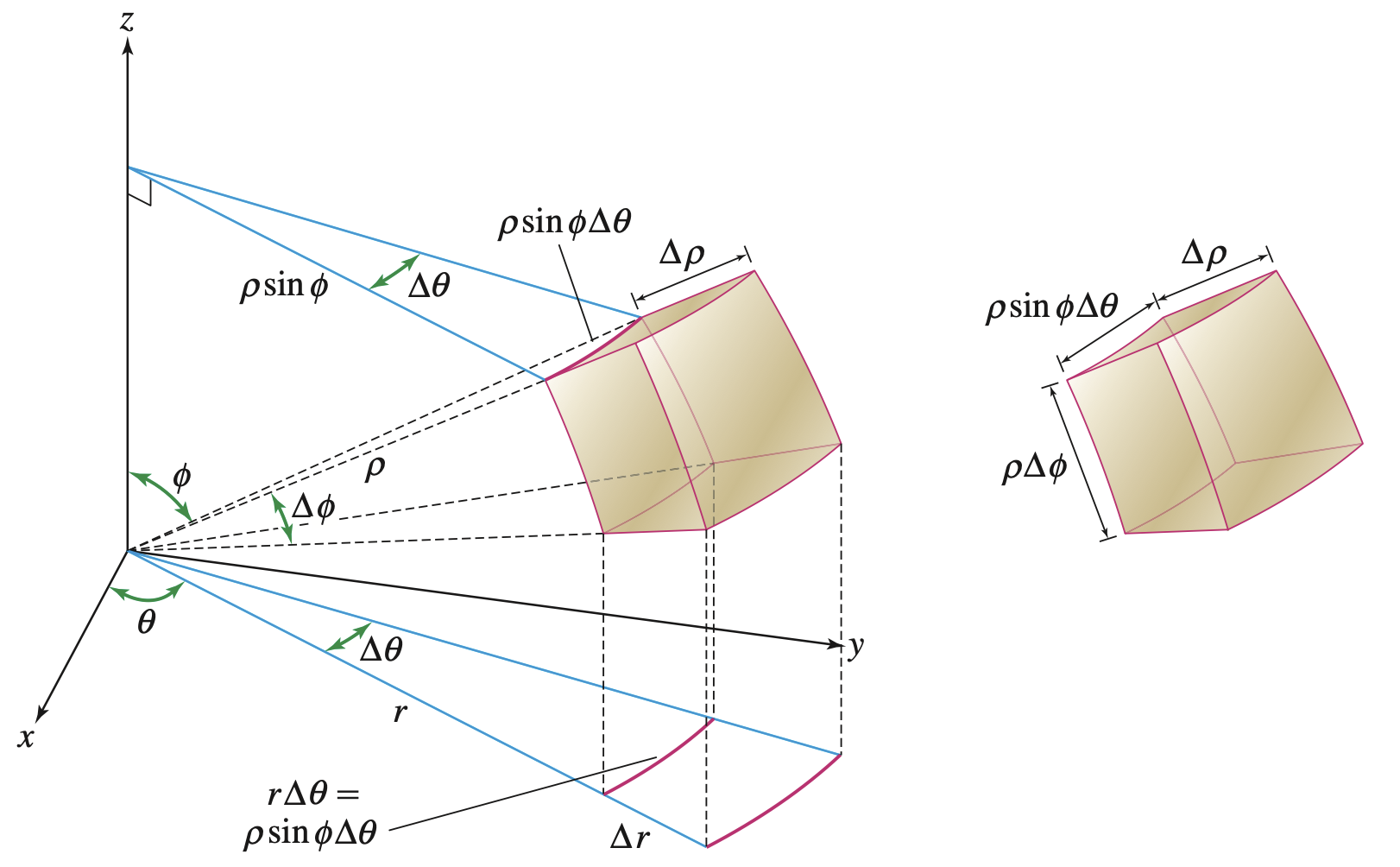
To do so, we will need to find the volume of a spherical sub-box in spherical coordinates. But what does a spherical sub-box look like?
Figure 15.4.13. A spherical sub-box in spherical coordinates
Imagine the spherical sub-box is getting smaller and smaller, then the spherical sub-box will look more and more like a rectangular box. Then we can find its volume by multiplying the length, width, and height. These three dimensions are \(\Delta \rho\text{,}\) \(\rho \Delta \phi\text{,}\) and \(\rho \sin \lp \phi \rp \Delta \theta\text{,}\) respectively. The diagram above should help you understand why these are the dimensions of the spherical sub-box.
Therefore, the volume of a spherical sub-box is
\begin{equation*} \Delta V = \Delta \rho \times \rho \Delta \phi \times \rho \sin \lp \phi \rp \Delta \theta = \rho^2\sin \lp \phi \rp \Delta \rho \Delta \phi \Delta \theta \end{equation*}
Now we can express a triple integral in spherical coordinates as an iterated integral, guaranteed, again, by the Fubini’s theorem.
Then we can convert a triple integral in rectangular coordinates to spherical coordinates by using the conversion formulas from a rectangular coordinate \((x,y,z)\) to a spherical coordinate \((\rho, \phi, \theta)\) covered in SectionΒ 12.7. Briefly, the conversion formulas are
\begin{equation*} x = \rho \sin \lp \phi \rp \cos \theta\, , \qquad y = \rho \sin \lp \phi \rp \sin \theta\, , \qquad z = \rho \cos \lp \phi \rp \end{equation*}
In addition to the fact that \(dV = \rho^2\sin(\phi) \, d\rho \, d\phi \, d\theta\) in spherical coordinates, we have the following conversion formula
\begin{equation*} \iiint_\c{W} f(x,y,z) dV = \int_{\theta_1}^{\theta_2} \int_{\phi_1}^{\phi_2} \int_{\rho_1(\phi, \theta)}^{\rho_2(\phi, \theta)} f(\rho\sin(\phi)\cos(\theta), \rho\sin(\phi)\sin(\theta), \rho\cos(\phi))\, \rho^2\sin(\phi) \, d\rho \, d\phi \, d\theta \end{equation*}

Example 15.4.15.

Evaluate the integral \(\ds \iiint_\c{W} e^{-\lp x^2 + y^2 + z^2 \rp^{3/2}}\, dV\text{,}\) where \(\c{W}\) is a unit ball.
Solution.
The region \(\c{W}\) is a unit ball, which means it consists of all points with a distance of 1 or less from the origin. In spherical coordinates, this is described by the bounds: \(0 \leq \rho \leq 1\text{,}\) \(0 \leq \phi \leq \pi\text{,}\) and \(0 \leq \theta \leq 2\pi\text{.}\)
We know that \(x^2 + y^2 + z^2 = \rho^2\text{.}\) Therefore, the exponent becomes \(-\lp \rho^2 \rp^{3/2} = -\rho^3\text{.}\) The volume differential is \(dV = \rho^2 \sin\lp\phi\rp \, d\rho \, d\phi \, d\theta\text{.}\)
Setting up the triple integral as an iterated integral, we evaluate from the inside out:
\begin{align*} \iiint_\c{W} e^{-\lp x^2 + y^2 + z^2 \rp^{3/2}}\, dV \amp= \int_0^{2\pi} \int_0^\pi \int_0^1 e^{-\rho^3} \rho^2 \sin\lp\phi\rp \, d\rho \, d\phi \, d\theta \end{align*}
First, we evaluate the innermost integral with respect to \(\rho\text{.}\) We can use \(u\)-substitution by letting \(u = -\rho^3\text{,}\) which means \(du = -3\rho^2 \, d\rho\text{,}\) or \(\rho^2 \, d\rho = -\frac{1}{3}du\text{:}\)
\begin{align*} \amp= \int_0^{2\pi} \int_0^\pi \left[ -\frac{1}{3} e^{-\rho^3} \sin\lp\phi\rp \right]_{\rho=0}^{\rho=1} \, d\phi \, d\theta \\ \amp= \int_0^{2\pi} \int_0^\pi \lp -\frac{1}{3} e^{-1} \sin\lp\phi\rp - \lp -\frac{1}{3} e^{0} \sin\lp\phi\rp \rp \rp \, d\phi \, d\theta \\ \amp= \int_0^{2\pi} \int_0^\pi \frac{1 - e^{-1}}{3} \sin\lp\phi\rp \, d\phi \, d\theta \end{align*}
Next, we evaluate the middle integral with respect to \(\phi\text{:}\)
\begin{align*} \amp= \int_0^{2\pi} \left[ -\frac{1 - e^{-1}}{3} \cos\lp\phi\rp \right]_{\phi=0}^{\phi=\pi} \, d\theta \\ \amp= \int_0^{2\pi} \lp -\frac{1 - e^{-1}}{3} \cos(\pi) - \lp -\frac{1 - e^{-1}}{3} \cos(0) \rp \rp \, d\theta \\ \amp= \int_0^{2\pi} \lp \frac{1 - e^{-1}}{3} + \frac{1 - e^{-1}}{3} \rp \, d\theta \\ \amp= \int_0^{2\pi} \frac{2\lp 1 - e^{-1} \rp}{3} \, d\theta \end{align*}
Finally, we evaluate the outermost integral with respect to \(\theta\text{:}\)
\begin{align*} \amp= \left[ \frac{2\lp 1 - e^{-1} \rp}{3} \theta \right]_0^{2\pi} \\ \amp= \frac{2\lp 1 - e^{-1} \rp}{3} (2\pi) \\ \amp= \frac{4\pi \lp 1 - e^{-1} \rp}{3} \end{align*}

Worksheet Assigned Problems for Section 15.4

The problems listed below are assigned to be included in your problem set portfolio. Note that a specific selection of these problems will also form the written homework assignments. I recommend working through all of them to ensure a solid grasp of the material. Reach out to Richard for help if you get stuck or have any questions.
The solutions will be posted after the written homework due dates. If you have any questions about your work, talk to Richard and he is happy to discuss the process with you.

15.4.3.

Sketch the region \(\c{D} = \left\{ (x,y) \in \R^2 \mid x \geq 0, \, y \geq 0 \, \text{and } x^2 + y^2 \leq 4 \right\}\) and integrate \(f(x,y) = xy\) over \(\c{D}\) using polar coordinates.
Solution.
The region \(\c{D}\) is bounded by \(x \geq 0\) (the right half-plane), \(y \geq 0\) (the upper half-plane), and \(x^2 + y^2 \leq 4\) (a disk of radius 2). This describes exactly the quarter-circle of radius 2 in the first quadrant.
In polar coordinates, this region is defined by the limits:
\begin{align*} 0 \amp \leq r \leq 2 \\ 0 \amp \leq \theta \leq \frac{\pi}{2} \end{align*}
We convert the integrand \(f(x,y) = xy\) using \(x = r\cos\theta\) and \(y = r\sin\theta\text{.}\) This gives \(f(r,\theta) = (r\cos\theta)(r\sin\theta) = r^2\cos\theta\sin\theta\text{.}\) Remembering to include the extra \(r\) from the differential \(dA = r\,dr\,d\theta\text{,}\) we set up the iterated integral:
\begin{align*} \iint_\c{D} xy \, dA \amp= \int_0^{\pi/2} \int_0^2 (r^2\cos\theta\sin\theta) r \, dr \, d\theta \\ \amp= \int_0^{\pi/2} \int_0^2 r^3\cos\theta\sin\theta \, dr \, d\theta \end{align*}
Evaluate the inner integral with respect to \(r\text{:}\)
\begin{align*} \int_0^2 r^3\cos\theta\sin\theta \, dr \amp= \left[ \frac{1}{4}r^4\cos\theta\sin\theta \right]_{r=0}^{r=2} \\ \amp= \frac{1}{4}(16)\cos\theta\sin\theta - 0 = 4\cos\theta\sin\theta \end{align*}
Substitute this into the outer integral and evaluate with respect to \(\theta\text{.}\) We can use the double angle identity \(2\sin\theta\cos\theta = \sin(2\theta)\) to rewrite \(4\cos\theta\sin\theta\) as \(2\sin(2\theta)\text{:}\)
\begin{align*} \int_0^{\pi/2} 2\sin(2\theta) \, d\theta \amp= \left[ -\cos(2\theta) \right]_0^{\pi/2} \\ \amp= -\cos\left(2\cdot\frac{\pi}{2}\right) - (-\cos(0)) \\ \amp= -\cos(\pi) + \cos(0) = -(-1) + 1 = 2 \end{align*}

15.4.13.

For the following integral, sketch the region of integration and evaluate by changing to polar coordinates.
\begin{equation*} \int_{-1}^2 \int_0^\sqrt{4 - x^2} \lp x^2 + y^2 \rp \, dy \, dx \end{equation*}
Solution.
Let’s analyze the given limits of integration:
\begin{align*} -1 \amp \leq x \leq 2 \\ 0 \amp \leq y \leq \sqrt{4 - x^2} \end{align*}
The \(y\)-bounds tell us the region lies in the upper half-plane (\(y \geq 0\)) and is bounded above by the semicircle \(y = \sqrt{4 - x^2}\text{,}\) which corresponds to a circle of radius 2. However, \(x\) only goes from \(-1\) to \(2\text{,}\) meaning we do not have the full upper half-circle (which would go from \(x = -2\) to \(x = 2\)).
In polar coordinates, the radius clearly goes from \(r = 0\) to \(r = 2\text{.}\) The angle \(\theta\) starts at the positive \(x\)-axis where \(x = 2\) (so \(\theta = 0\)). It sweeps counterclockwise until it hits the point on the circle where \(x = -1\text{.}\) Using \(x = r\cos\theta\text{,}\) we have \(-1 = 2\cos\theta \implies \cos\theta = -\frac{1}{2}\text{.}\) In the upper half-plane, this corresponds to the angle \(\theta = \frac{2\pi}{3}\text{.}\) Thus, our bounds are \(0 \leq r \leq 2\) and \(0 \leq \theta \leq \frac{2\pi}{3}\text{.}\)
Converting the integrand, we know \(x^2 + y^2 = r^2\text{.}\) Including the polar differential \(dA = r\,dr\,d\theta\text{,}\) the integral becomes:
\begin{gather*} \int_0^{2\pi/3} \int_0^2 (r^2) r \, dr \, d\theta = \int_0^{2\pi/3} \int_0^2 r^3 \, dr \, d\theta \end{gather*}
Evaluate the inner integral with respect to \(r\text{:}\)
\begin{align*} \int_0^2 r^3 \, dr \amp= \left[ \frac{1}{4}r^4 \right]_0^2 = \frac{1}{4}(16) - 0 = 4 \end{align*}
Substitute this into the outer integral and evaluate with respect to \(\theta\text{:}\)
\begin{align*} \int_0^{2\pi/3} 4 \, d\theta \amp= \Big[ 4\theta \Big]_0^{2\pi/3} = 4\left(\frac{2\pi}{3}\right) - 0 = \frac{8\pi}{3} \end{align*}

15.4.19.

Calculate the integral of \(f(x,y) = x - y\) over the region \(\c{D} = \left\{ (x,y) \in \R^2 \mid x^2 + y^2 \leq 1 \text{ and } x + y \geq1\right\}\) by changing to polar coordinates.
Solution.
The region \(\c{D}\) is bounded by the circle \(x^2 + y^2 = 1\) and the line \(x + y = 1\text{.}\) These two curves intersect at \((1,0)\) and \((0,1)\text{,}\) so the region lies entirely in the first quadrant, making our angular bounds \(0 \leq \theta \leq \frac{\pi}{2}\text{.}\)
For a fixed angle \(\theta\text{,}\) a ray from the origin enters the region at the line and exits at the circle.
  • Outer bound (circle): \(x^2 + y^2 = 1 \implies r = 1\)
  • Inner bound (line): \(x + y = 1 \implies r\cos\theta + r\sin\theta = 1 \implies r(\cos\theta + \sin\theta) = 1 \implies r = \frac{1}{\cos\theta + \sin\theta}\)
The integrand converts to \(x - y = r\cos\theta - r\sin\theta = r(\cos\theta - \sin\theta)\text{.}\) With \(dA = r\,dr\,d\theta\text{,}\) the integral is:
\begin{gather*} \int_0^{\pi/2} \int_{\frac{1}{\cos\theta + \sin\theta}}^1 \big(r(\cos\theta - \sin\theta)\big) r \, dr \, d\theta = \int_0^{\pi/2} \int_{\frac{1}{\cos\theta + \sin\theta}}^1 r^2(\cos\theta - \sin\theta) \, dr \, d\theta \end{gather*}
Evaluate the inner integral with respect to \(r\text{:}\)
\begin{align*} \int_{\frac{1}{\cos\theta + \sin\theta}}^1 r^2(\cos\theta - \sin\theta) \, dr \amp= \left[ \frac{1}{3}r^3(\cos\theta - \sin\theta) \right]_{r=\frac{1}{\cos\theta + \sin\theta}}^{r=1} \\ \amp= \frac{1}{3}(1)^3(\cos\theta - \sin\theta) - \frac{1}{3}\left(\frac{1}{\cos\theta + \sin\theta}\right)^3(\cos\theta - \sin\theta) \\ \amp= \frac{1}{3}(\cos\theta - \sin\theta) - \frac{1}{3}\frac{\cos\theta - \sin\theta}{(\cos\theta + \sin\theta)^3} \end{align*}
Substitute this into the outer integral:
\begin{gather*} \int_0^{\pi/2} \left( \frac{1}{3}(\cos\theta - \sin\theta) - \frac{1}{3}\frac{\cos\theta - \sin\theta}{(\cos\theta + \sin\theta)^3} \right) \, d\theta \end{gather*}
We can split this into two integrals and evaluate. For the first part:
\begin{align*} \int_0^{\pi/2} \frac{1}{3}(\cos\theta - \sin\theta) \, d\theta \amp= \frac{1}{3} \Big[ \sin\theta + \cos\theta \Big]_0^{\pi/2} \\ \amp= \frac{1}{3}\big(\sin(\pi/2) + \cos(\pi/2)\big) - \frac{1}{3}\big(\sin(0) + \cos(0)\big) \\ \amp= \frac{1}{3}(1 + 0) - \frac{1}{3}(0 + 1) = 0 \end{align*}
For the second part, let \(u = \cos\theta + \sin\theta\text{.}\) Then \(du = (-\sin\theta + \cos\theta)\,d\theta = (\cos\theta - \sin\theta)\,d\theta\text{.}\) Let’s look at the bounds: when \(\theta = 0\text{,}\) \(u = 1+0=1\text{.}\) When \(\theta = \pi/2\text{,}\) \(u = 0+1=1\text{.}\) Since the upper and lower limits of integration are the same (\(u\) goes from 1 to 1), the definite integral evaluates exactly to 0!
Therefore, the total integral is \(0 - 0 = 0\text{.}\) (This makes perfect sense geometrically, as the region is symmetric across the line \(y = x\text{,}\) but the function \(x - y\) has perfectly opposite values across that same line, causing everything to cancel out!).

15.4.23.

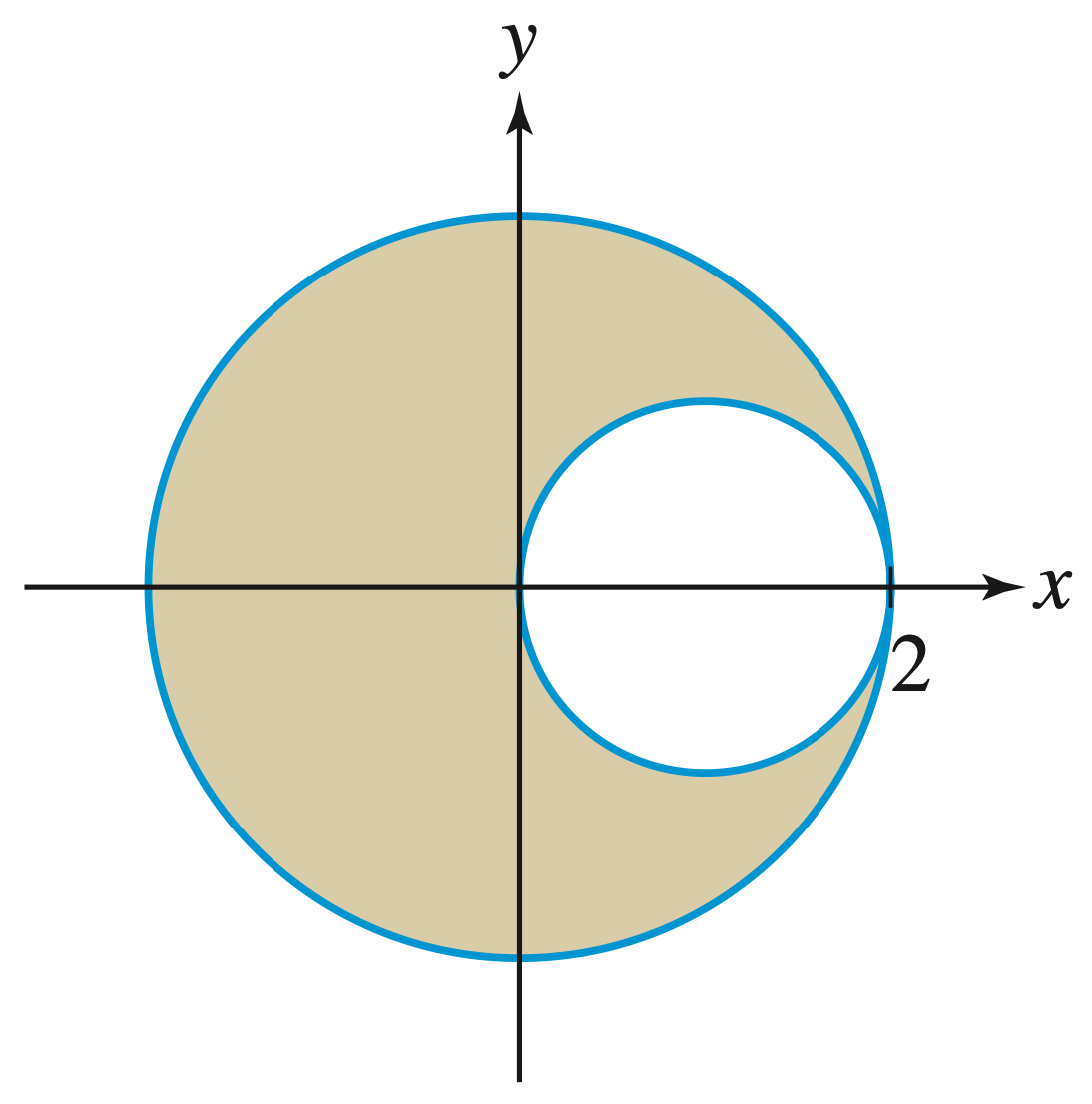
Evaluate \(\ds \iint_\c{D} \sqrt{x^2 + y^2} \, dA\text{,}\) where \(\c{D}\) is the domain in the following figure.
Hint.
Find the equation of the inner circle in polar coordinates and treat the right and left parts of the region separately.
Solution.
Looking at the figure, the domain \(\c{D}\) is bounded by the outer circle \(x^2 + y^2 = 4\) (which has a radius of 2), and it contains an empty "hole." The hole is a circle centered at \((1, 0)\) with a radius of 1.
Let’s find the polar equation for the inner boundary. The Cartesian equation is \((x - 1)^2 + y^2 = 1\text{.}\) Expanding this yields:
\begin{align*} x^2 - 2x + 1 + y^2 \amp= 1 \\ x^2 + y^2 \amp= 2x \end{align*}
Substituting our polar conversions (\(x^2 + y^2 = r^2\) and \(x = r\cos\theta\)):
\begin{align*} r^2 \amp= 2r\cos\theta \implies r = 2\cos\theta \end{align*}
Notice that the inner circle \(r = 2\cos\theta\) only exists in the right half-plane (where \(-\pi/2 \leq \theta \leq \pi/2\)). In the left half-plane (where \(\pi/2 \leq \theta \leq 3\pi/2\)), there is no hole, so the region goes all the way from the origin \(r = 0\) to the outer edge \(r = 2\text{.}\) Therefore, we must split our region into two parts: a left half and a right half.
The integrand is \(\sqrt{x^2+y^2} = r\text{.}\) With the polar differential \(dA = r\,dr\,d\theta\text{,}\) the function we are integrating becomes \(r \cdot r = r^2\text{.}\)
\begin{gather*} \iint_\c{D} \sqrt{x^2+y^2} \, dA = \int_{\pi/2}^{3\pi/2} \int_0^2 r^2 \, dr \, d\theta + \int_{-\pi/2}^{\pi/2} \int_{2\cos\theta}^2 r^2 \, dr \, d\theta \end{gather*}
Part 1: The Left Half
\begin{align*} \int_{\pi/2}^{3\pi/2} \int_0^2 r^2 \, dr \, d\theta \amp= \int_{\pi/2}^{3\pi/2} \left[ \frac{1}{3}r^3 \right]_0^2 \, d\theta \\ \amp= \int_{\pi/2}^{3\pi/2} \frac{8}{3} \, d\theta \\ \amp= \left[ \frac{8}{3}\theta \right]_{\pi/2}^{3\pi/2} = \frac{8}{3}\left(\frac{3\pi}{2}\right) - \frac{8}{3}\left(\frac{\pi}{2}\right) = \frac{8\pi}{3} \end{align*}
Part 2: The Right Half
\begin{align*} \int_{-\pi/2}^{\pi/2} \int_{2\cos\theta}^2 r^2 \, dr \, d\theta \amp= \int_{-\pi/2}^{\pi/2} \left[ \frac{1}{3}r^3 \right]_{2\cos\theta}^2 \, d\theta \\ \amp= \int_{-\pi/2}^{\pi/2} \left( \frac{8}{3} - \frac{8}{3}\cos^3\theta \right) \, d\theta \end{align*}
We separate this into two integrals:
\begin{gather*} \int_{-\pi/2}^{\pi/2} \frac{8}{3} \, d\theta - \frac{8}{3} \int_{-\pi/2}^{\pi/2} \cos^3\theta \, d\theta \end{gather*}
The first integral is simply \(\frac{8}{3}(\pi) = \frac{8\pi}{3}\text{.}\) For the second integral, we use the Pythagorean identity \(\cos^2\theta = 1 - \sin^2\theta\) to set up a \(u\)-substitution where \(u = \sin\theta\) and \(du = \cos\theta \, d\theta\text{.}\) When \(\theta = -\pi/2\text{,}\) \(u = -1\text{.}\) When \(\theta = \pi/2\text{,}\) \(u = 1\text{.}\)
\begin{align*} \int_{-\pi/2}^{\pi/2} \cos^2\theta \cos\theta \, d\theta \amp= \int_{-1}^1 (1 - u^2) \, du \\ \amp= \left[ u - \frac{1}{3}u^3 \right]_{-1}^1 \\ \amp= \left( 1 - \frac{1}{3} \right) - \left( -1 - \left(-\frac{1}{3}\right) \right) = \frac{2}{3} - \left(-\frac{2}{3}\right) = \frac{4}{3} \end{align*}
So the right half evaluates to \(\frac{8\pi}{3} - \frac{8}{3}\left(\frac{4}{3}\right) = \frac{8\pi}{3} - \frac{32}{9}\text{.}\)
Total Area Summing the left half and the right half:
\begin{align*} \iint_\c{D} \sqrt{x^2+y^2} \, dA \amp= \frac{8\pi}{3} + \left( \frac{8\pi}{3} - \frac{32}{9} \right) \\ \amp= \frac{16\pi}{3} - \frac{32}{9} \end{align*}
15.4.29.

Use cylindrical coordinates to evaluate \(\ds \iiint_\c{W} x \, dV\) where \(\c{W} = \left\{ (x,y,z) \in \R^3 \mid x^2 + y^2 \leq 16 , \, x \geq 0, \, y \geq 0, \, -3 \leq z \leq 3 \right\}\)
Solution.
The region \(\c{W}\) is bounded by the cylinder \(x^2 + y^2 = 16\) (radius 4) in the first quadrant (\(x \geq 0\text{,}\) \(y \geq 0\)), between the planes \(z = -3\) and \(z = 3\text{.}\)
In cylindrical coordinates, this region translates beautifully to constant bounds:
\begin{align*} 0 \amp \leq r \leq 4 \\ 0 \amp \leq \theta \leq \frac{\pi}{2} \\ -3 \amp \leq z \leq 3 \end{align*}
The integrand is \(x = r\cos\theta\text{.}\) With \(dV = r\,dz\,dr\,d\theta\text{,}\) the integral is:
\begin{align*} \iiint_\c{W} x \, dV \amp= \int_0^{\pi/2} \int_0^4 \int_{-3}^3 (r\cos\theta) r \, dz \, dr \, d\theta \\ \amp= \int_0^{\pi/2} \int_0^4 \int_{-3}^3 r^2\cos\theta \, dz \, dr \, d\theta \end{align*}
Evaluate the inner integral with respect to \(z\text{:}\)
\begin{align*} \int_{-3}^3 r^2\cos\theta \, dz \amp= \Big[ r^2z\cos\theta \Big]_{z=-3}^{z=3} \\ \amp= r^2(3)\cos\theta - r^2(-3)\cos\theta = 6r^2\cos\theta \end{align*}
Evaluate the middle integral with respect to \(r\text{:}\)
\begin{align*} \int_0^4 6r^2\cos\theta \, dr \amp= \left[ 2r^3\cos\theta \right]_0^4 \\ \amp= 2(64)\cos\theta - 0 = 128\cos\theta \end{align*}
Evaluate the outer integral with respect to \(\theta\text{:}\)
\begin{align*} \int_0^{\pi/2} 128\cos\theta \, d\theta \amp= \Big[ 128\sin\theta \Big]_0^{\pi/2} \\ \amp= 128\sin(\pi/2) - 128\sin(0) = 128(1) - 0 = 128 \end{align*}

15.4.35.

Express the triple integral in cylindrical coordinates.
\begin{equation*} \int_{x = -1}^1 \int_{y = 0}^\sqrt{1 - x^2} \int_{z = 0}^{x^2 + y^2} f(x,y,z) \, dz \, dy \, dx \end{equation*}
Solution.
We need to translate the rectangular bounds into cylindrical bounds. The given limits are:
\begin{align*} -1 \amp \leq x \leq 1 \\ 0 \amp \leq y \leq \sqrt{1 - x^2} \\ 0 \amp \leq z \leq x^2 + y^2 \end{align*}
The \(z\)-bounds are \(0 \leq z \leq x^2 + y^2\text{.}\) In cylindrical coordinates, \(x^2 + y^2 = r^2\text{,}\) so our new \(z\)-bounds are \(0 \leq z \leq r^2\text{.}\)
The \(x\) and \(y\) bounds describe the projection of the solid on the \(xy\)-plane. \(y\) ranges from \(0\) to the upper semicircle \(y = \sqrt{1 - x^2}\) (which is \(x^2 + y^2 = 1\)). \(x\) sweeps completely from \(-1\) to \(1\text{.}\) This outlines the top half of the unit disk. In cylindrical (polar) coordinates, this is \(0 \leq r \leq 1\) and \(0 \leq \theta \leq \pi\text{.}\)
Substituting \(x = r\cos\theta\) and \(y = r\sin\theta\) into the function, and adding the \(r\) for the volume differential \(dV = r\,dz\,dr\,d\theta\text{,}\) the integral becomes:
\begin{gather*} \int_0^\pi \int_0^1 \int_0^{r^2} f(r\cos\theta, r\sin\theta, z) r \, dz \, dr \, d\theta \end{gather*}

15.4.39.

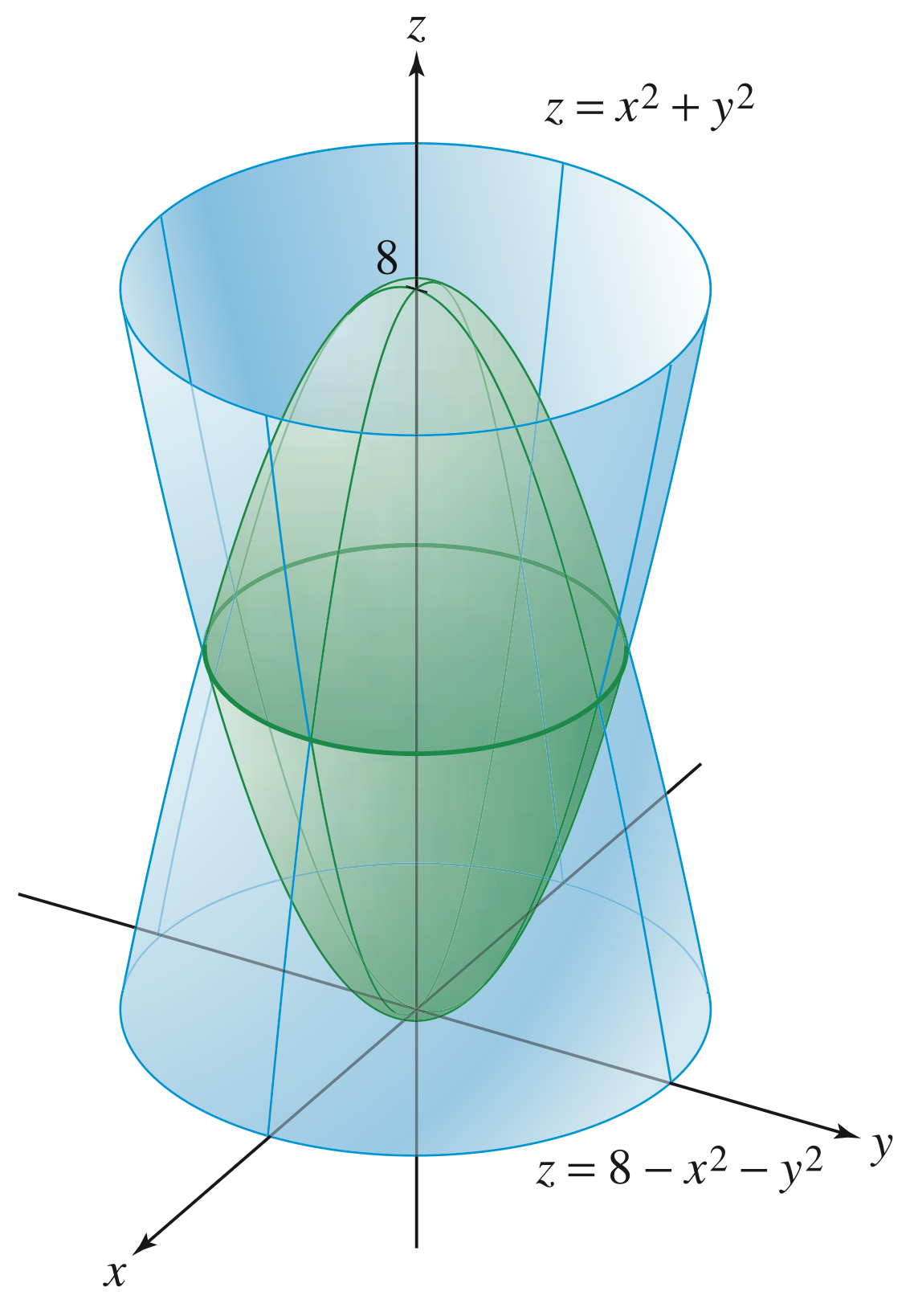
Find the volume of the region appearing between the two surfaces in the following figure.
Solution.
Looking at the figure, the green solid is bounded between two paraboloids. The top surface (which opens downward from \(z=8\)) is \(z = 8 - x^2 - y^2\text{.}\) The bottom surface (which opens upward from the origin) is \(z = x^2 + y^2\text{.}\) Because of the rotational symmetry, cylindrical coordinates are perfect here.
In cylindrical coordinates, the top surface is \(z = 8 - r^2\) and the bottom surface is \(z = r^2\text{.}\) To find the projection of the solid onto the \(xy\)-plane, we set the two \(z\)-equations equal to find their intersection curve:
\begin{align*} 8 - r^2 \amp= r^2 \\ 8 \amp= 2r^2 \implies r^2 = 4 \implies r = 2 \end{align*}
So the projection is a disk of radius 2. Our bounds are:
\begin{align*} 0 \amp\leq \theta \leq 2\pi \\ 0 \amp\leq r \leq 2 \\ r^2 \amp\leq z \leq 8 - r^2 \end{align*}
We set up the iterated integral. Since we are finding volume, the function is \(1\text{.}\) With \(dV = r \, dz \, dr \, d\theta\text{,}\) the integral is:
\begin{gather*} V = \int_0^{2\pi} \int_0^2 \int_{r^2}^{8-r^2} r \, dz \, dr \, d\theta \end{gather*}
Evaluate the inner integral with respect to \(z\text{:}\)
\begin{align*} \int_{r^2}^{8-r^2} r \, dz \amp= \Big[ rz \Big]_{z=r^2}^{z=8-r^2} \\ \amp= r(8 - r^2) - r(r^2) \\ \amp= 8r - 2r^3 \end{align*}
Evaluate the middle integral with respect to \(r\text{:}\)
\begin{align*} \int_0^2 (8r - 2r^3) \, dr \amp= \left[ 4r^2 - \frac{1}{2}r^4 \right]_0^2 \\ \amp= \left( 4(4) - \frac{1}{2}(16) \right) - 0 \\ \amp= 16 - 8 = 8 \end{align*}
Evaluate the outer integral with respect to \(\theta\text{:}\)
\begin{align*} \int_0^{2\pi} 8 \, d\theta \amp= \Big[ 8\theta \Big]_0^{2\pi} = 16\pi \end{align*}

15.4.49.

Use spherical coordinates to calculate
\begin{equation*} \iiint_\c{W} \sqrt{x^2 + y^2 + z^2}\, dV \end{equation*}
where \(\c{W} = \left\{ (x,y,z) \in \R^3 \mid x^2 + y^2 + z^2 \leq 2z \right\}\text{.}\)
Solution.
The region \(\c{W}\) is bounded by \(x^2 + y^2 + z^2 \leq 2z\text{.}\) Let’s convert this inequality into spherical coordinates. We know \(x^2 + y^2 + z^2 = \rho^2\) and \(z = \rho\cos\phi\text{.}\)
\begin{align*} \rho^2 \amp \leq 2\rho\cos\phi \\ \rho \amp \leq 2\cos\phi \end{align*}
Because \(\rho\) represents a positive distance, we must have \(\rho \geq 0\text{,}\) which means \(2\cos\phi \geq 0\text{.}\) This restricts \(\phi\) to the range \(0 \leq \phi \leq \frac{\pi}{2}\text{.}\) There are no restrictions on \(\theta\text{,}\) so it sweeps completely around from \(0\) to \(2\pi\text{.}\) (Geometrically, this region is a sphere of radius 1 sitting exactly on top of the origin, centered at \((0,0,1)\)).
The integrand is \(\sqrt{x^2 + y^2 + z^2} = \sqrt{\rho^2} = \rho\text{.}\) Including the spherical volume differential \(dV = \rho^2\sin\phi \, d\rho \, d\phi \, d\theta\text{,}\) the integral is:
\begin{align*} \iiint_\c{W} \sqrt{x^2 + y^2 + z^2} \, dV \amp= \int_0^{2\pi} \int_0^{\pi/2} \int_0^{2\cos\phi} (\rho) \rho^2\sin\phi \, d\rho \, d\phi \, d\theta \\ \amp= \int_0^{2\pi} \int_0^{\pi/2} \int_0^{2\cos\phi} \rho^3\sin\phi \, d\rho \, d\phi \, d\theta \end{align*}
Evaluate the inner integral with respect to \(\rho\text{:}\)
\begin{align*} \int_0^{2\cos\phi} \rho^3\sin\phi \, d\rho \amp= \left[ \frac{1}{4}\rho^4\sin\phi \right]_{\rho=0}^{\rho=2\cos\phi} \\ \amp= \frac{1}{4}(2\cos\phi)^4\sin\phi - 0 = 4\cos^4\phi\sin\phi \end{align*}
Evaluate the middle integral with respect to \(\phi\text{.}\) Let \(u = \cos\phi\text{,}\) then \(du = -\sin\phi \, d\phi\text{.}\) The bounds change from \(\cos(0)=1\) to \(\cos(\pi/2)=0\text{.}\)
\begin{align*} \int_0^{\pi/2} 4\cos^4\phi\sin\phi \, d\phi \amp= -4 \int_1^0 u^4 \, du = 4 \int_0^1 u^4 \, du \\ \amp= 4 \left[ \frac{1}{5}u^5 \right]_0^1 = \frac{4}{5} \end{align*}
Evaluate the outer integral with respect to \(\theta\text{:}\)
\begin{align*} \int_0^{2\pi} \frac{4}{5} \, d\theta \amp= \left[ \frac{4}{5}\theta \right]_0^{2\pi} = \frac{8\pi}{5} \end{align*}

15.4.53.

Calculate the integral of
\begin{equation*} f(x,y,z) = z\lp x^2 + y^2 + z^2 \rp^{-\frac{3}{2}} \end{equation*}
over the part of the ball \(x^2 + y^2 + z^2 \leq 16\) defined by \(z \geq 2\text{.}\)
Solution.
The region is the part of the ball \(x^2 + y^2 + z^2 \leq 16\) that lies above the plane \(z = 2\text{.}\) In spherical coordinates, the ball translates to \(\rho \leq 4\text{.}\) The plane translates to \(\rho\cos\phi = 2 \implies \rho = \frac{2}{\cos\phi} = 2\sec\phi\text{.}\)
To find the angle \(\phi\) where these two bounding surfaces intersect, we set them equal:
\begin{align*} 4 \amp= \frac{2}{\cos\phi} \implies \cos\phi = \frac{1}{2} \implies \phi = \frac{\pi}{3} \end{align*}
So, the angle \(\phi\) drops from the \(z\)-axis (\(\phi = 0\)) out to the intersection edge (\(\phi = \pi/3\)). For any fixed angle \(\phi\) in this range, a ray from the origin pierces into the solid through the flat plane (\(\rho = 2\sec\phi\)) and exits through the spherical dome (\(\rho = 4\)). \(\theta\) sweeps the full circle from \(0\) to \(2\pi\text{.}\)
The integrand is \(z(x^2 + y^2 + z^2)^{-3/2}\text{.}\) Substituting \(z = \rho\cos\phi\) and \(x^2 + y^2 + z^2 = \rho^2\text{,}\) the function becomes:
\begin{gather*} (\rho\cos\phi)(\rho^2)^{-3/2} = (\rho\cos\phi)(\rho^{-3}) = \rho^{-2}\cos\phi \end{gather*}
Including \(dV = \rho^2\sin\phi \, d\rho \, d\phi \, d\theta\text{,}\) the integral is:
\begin{align*} \int_0^{2\pi} \int_0^{\pi/3} \int_{2\sec\phi}^4 \big(\rho^{-2}\cos\phi\big) \big(\rho^2\sin\phi\big) \, d\rho \, d\phi \, d\theta \amp= \int_0^{2\pi} \int_0^{\pi/3} \int_{2\sec\phi}^4 \cos\phi\sin\phi \, d\rho \, d\phi \, d\theta \end{align*}
Evaluate the inner integral with respect to \(\rho\text{:}\)
\begin{align*} \int_{2\sec\phi}^4 \cos\phi\sin\phi \, d\rho \amp= \Big[ \rho\cos\phi\sin\phi \Big]_{\rho=2\sec\phi}^{\rho=4} \\ \amp= 4\cos\phi\sin\phi - (2\sec\phi)\cos\phi\sin\phi \\ \amp= 4\cos\phi\sin\phi - 2\left(\frac{1}{\cos\phi}\right)\cos\phi\sin\phi \\ \amp= 4\cos\phi\sin\phi - 2\sin\phi \end{align*}
We can rewrite \(4\cos\phi\sin\phi\) as \(2\sin(2\phi)\) using the double angle identity. This gives \(2\sin(2\phi) - 2\sin\phi\text{.}\)
Evaluate the middle integral with respect to \(\phi\text{:}\)
\begin{align*} \int_0^{\pi/3} \big(2\sin(2\phi) - 2\sin\phi\big) \, d\phi \amp= \Big[ -\cos(2\phi) + 2\cos\phi \Big]_0^{\pi/3} \\ \amp= \left( -\cos(2\pi/3) + 2\cos(\pi/3) \right) - \left( -\cos(0) + 2\cos(0) \right) \\ \amp= \left( -\left(-\frac{1}{2}\right) + 2\left(\frac{1}{2}\right) \right) - \left( -1 + 2(1) \right) \\ \amp= \left( \frac{1}{2} + 1 \right) - (1) = \frac{1}{2} \end{align*}
Evaluate the outer integral with respect to \(\theta\text{:}\)
\begin{align*} \int_0^{2\pi} \frac{1}{2} \, d\theta \amp= \left[ \frac{1}{2}\theta \right]_0^{2\pi} = \pi \end{align*}