Section 15.3 Triple Integrals

In our previous work, we expanded the idea of integration from intervals on a line to regions in a plane using double integrals. Now, we take this concept one step further into the third dimension. In this section, we introduce the triple integral, which allows us to integrate functions of three variables over solid regions in space.
Recall we defined the single integral back in MTH 252Z (or MTH 252) by partitioning the interval (in \(\R^1\)) into sub-intervals. We then defined the double integral in SectionΒ 15.1 by partitioning a region (in \(\R^2\)) into sub-rectangulars.
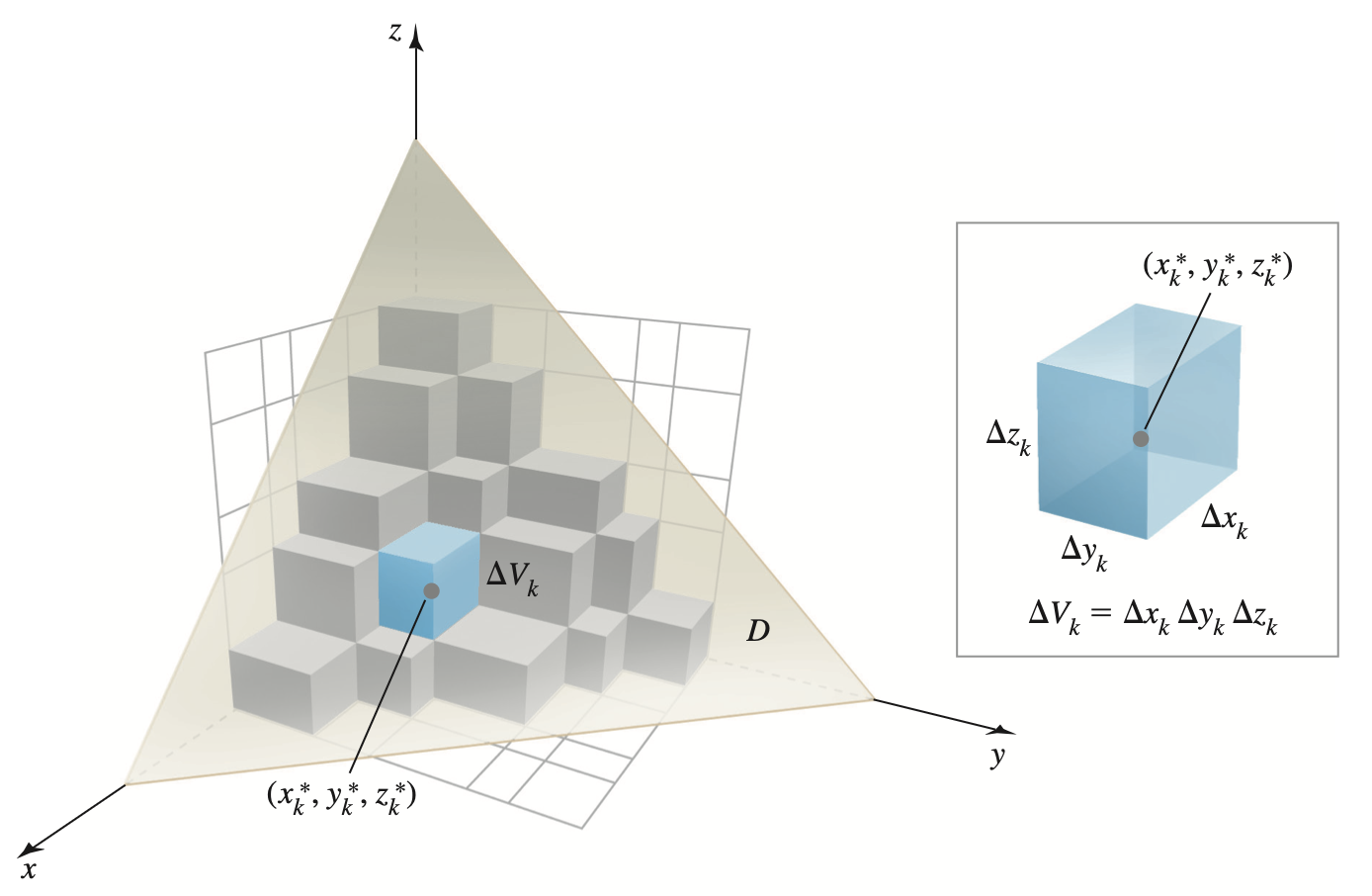
As the pattern continues, we will define the triple integrals by partitioning a solid (in \(\R^3\)) into sub-boxes. By summing up all the products of the function value at a sample point in each sub-box and the volume of each sub-box, we can define the triple integral as the limit of these sums as the maximum volume of the sub-boxes approaches zero.
Figure 15.3.1. A Solid in \(\R^3\) Partitioned into Sub-Boxes with Sample Points
Let’s follow the same process as before to define the triple integral! Say we have a three-variable function \(w = f(x,y,z)\text{.}\) The graph of this function really lives in \(\R^4\) that we cannot visualize...
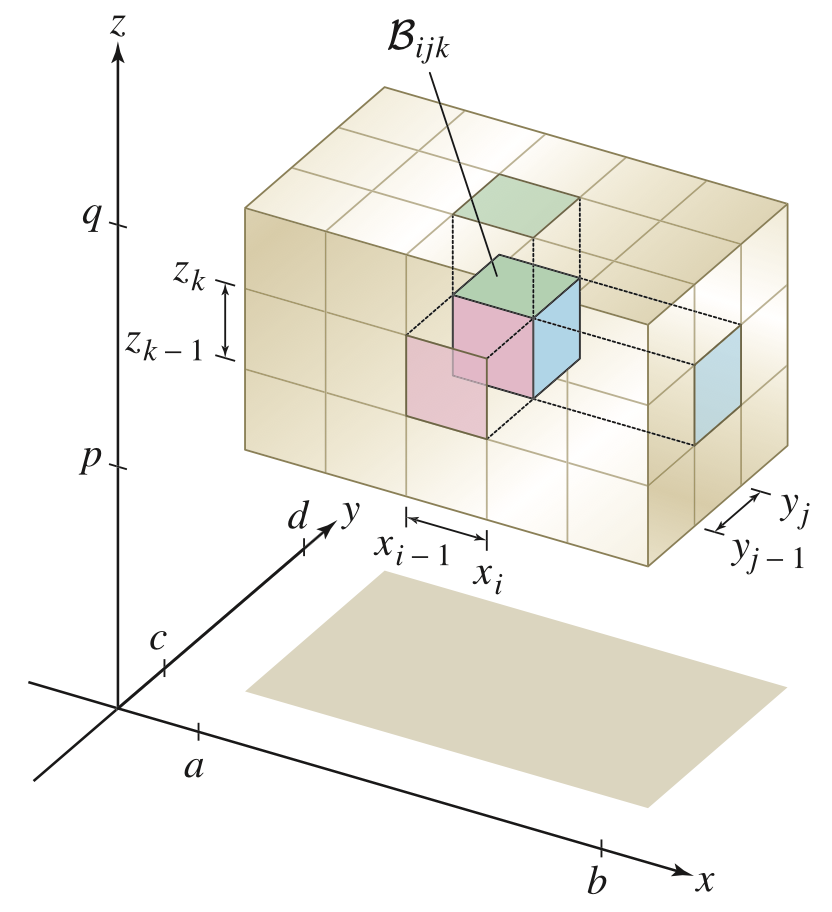
However, we can visualize the domain of this function in \(\R^3\text{.}\) Let’s say we want to integrate this function over a rectangular box \(\c{B}\text{:}\)
\begin{align*} \c{B} \amp= \left\{ (x,y,z) \mid a \leq x \leq b\, , \quad c \leq y \leq d\, , \quad p \leq z \leq q \right\} \\ \amp= [a,b] \times [c,d] \times [p,q] \end{align*}
We can partition this solid into a bunch of sub-boxes.
Figure 15.3.2. The box \(\c{B} = [a,b] \times [c,d] \times [p,q]\) partitioned into sub-boxes
For an sub-box, its volume is given by
\begin{equation*} \Delta V_{ijk} = \Delta x_i \times \Delta y_j \times \Delta z_k \end{equation*}
In addition, we can pick a sample point \((x_{ijk}^*, y_{ijk}^*, z_{ijk}^*)\) in each sub-box and evaluate the function at that point to get
\begin{equation*} f(x_{ijk}^*, y_{ijk}^*, z_{ijk}^*) \end{equation*}
Then we can obtain the Riemann sum by summing up the products of the function values at the sample points and the volumes of the sub-boxes:
\begin{equation*} S_{N,M,L} = \sum_{i=1}^N \sum_{j=1}^M \sum_{k=1}^L f(x_{ijk}^*, y_{ijk}^*, z_{ijk}^*) \Delta V_{ijk} \end{equation*}
As we use finer and finer partitions (i.e., as the maximum volume of the sub-boxes approaches zero), if the limit of the Riemann sums exists, we define this limit to be the triple integral of \(f\) over \(\c{B}\text{,}\) denoted by
\begin{equation*} \iiint_\c{B} f(x,y,z)\, dV = \lim_{N,M,L \to \infty} \sum_{i=1}^N \sum_{j=1}^M \sum_{k=1}^L f(x_{ijk}^*, y_{ijk}^*, z_{ijk}^*) \Delta V_{ijk} \end{equation*}
All the fun things you learned about the double integrals (e.g., Fubini’s Theorem) also hold for triple integrals! That is, we can evaluate a triple integral as an iterated integral in any order we want (as long as the function is continuous).

Example 15.3.4.

Evaluate the triple integral \(\ds \iiint_\c{B} xyz^2\, dV\text{,}\) where \(\c{B}\) is the rectangular box given by \(\c{B} = [0,1] \times [-1,2] \times [0,3]\text{.}\)
Solution.
Using Fubini’s Theorem, we can set this up as an iterated integral. Since all limits of integration are constants, the order of integration does not matter. Let’s integrate in the order \(dz\, dy\, dx\text{:}\)
\begin{align*} \iiint_\c{B} xyz^2\, dV \amp= \int_0^1 \int_{-1}^2 \int_0^3 xyz^2 \, dz\, dy\, dx \\ \amp= \int_0^1 \int_{-1}^2 \left[ xy \left(\frac{1}{3}z^3\right) \right]_{z=0}^{z=3} \, dy\, dx \\ \amp= \int_0^1 \int_{-1}^2 9xy \, dy\, dx \\ \amp= \int_0^1 \left[ 9x \left(\frac{1}{2}y^2\right) \right]_{y=-1}^{y=2} \, dx \\ \amp= \int_0^1 9x \left(2 - \frac{1}{2}\right) \, dx \\ \amp= \int_0^1 \frac{27}{2}x \, dx \\ \amp= \left[ \frac{27}{4}x^2 \right]_0^1 = \frac{27}{4} \end{align*}
The next step is to extend the definition of triple integrals to a more general region \(\c{W}\) in \(\R^3\) that is not necessarily a box. We can use the same trick as we did for double integrals in SectionΒ 15.2 to define the triple integral over a general region by using a box that contains the region. That is, we define the triple integral over a general region \(\c{W}\) the same way, and the region is specified by the limits of integration in the iterated integral.
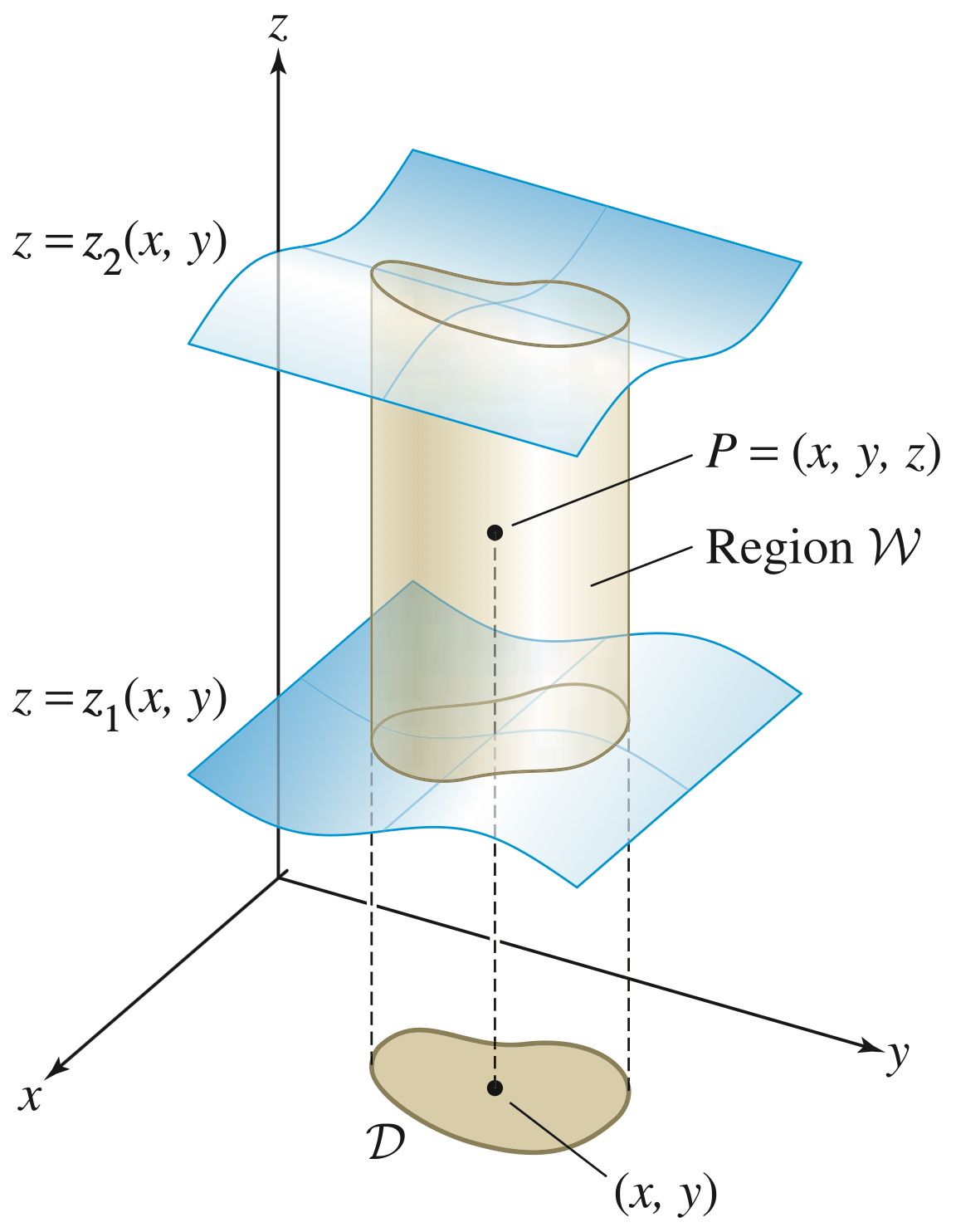
One way to describe the region \(\c{W}\) is through the region between two surfaces \(z_1(x,y)\) and \(z_2(x,y)\text{.}\) That is,
\begin{equation*} \c{W} = \left\{(x,y,z) \in \R^3 \mid (x,y) \in \c{D} \quad \text{ and } \quad z_1(x,y) \leq z \leq z_2(x,y)\right\} \end{equation*}
This is called a \(z-simple\) region. Furthermore, the domain \(\c{D}\) is the projection of \(\c{W}\) onto the \(xy\)-plane.
Figure 15.3.5. The point \(P = (x,y,z)\) in the \(z\)-simple region \(\c{W}\) if \((x,y) \in \c{D}\) and \(z_1(x,y) \leq z \leq z_2(x,y)\)
Then we can evaluate a triple integral over \(\c{W}\) using an iterated integral using the following theorem
The above theorem allows us to turn a triple integral to a double integral over a general region \(\c{D}\) after the innermost integral is evaluated. We learned how to evaluate a double integral over a general region in SectionΒ 15.2!

Example 15.3.7.

Evaluate the triple integral \(\ds \int_0^1 \int_0^\sqrt{1 - x^2} \int_0^{2-x} 4yz \, dz\, dy\, dx\)
Hint. More like a visualization...
The region of integration is
\begin{equation*} \c{W} = \left\{ (x,y,z)\in \R^3 \mid 0 \leq z \leq 2 - x\, , \quad 0 \leq y \leq \sqrt{1 - x^2}\, , \quad 0\leq x \leq 1 \right\} \end{equation*}
To help you visualize this region, Richard coded the graph of the region below:
Figure 15.3.8. The region \(\c{W}\)
Solution.
We evaluate the iterated integral by working from the inside out, starting with the innermost integral with respect to \(z\text{:}\)
\begin{align*} \int_0^1 \int_0^\sqrt{1 - x^2} \int_0^{2-x} 4yz \, dz\, dy\, dx \amp= \int_0^1 \int_0^\sqrt{1 - x^2} \left[ 2yz^2 \right]_{z=0}^{z=2-x} \, dy\, dx \\ \amp= \int_0^1 \int_0^\sqrt{1 - x^2} 2y(2-x)^2 \, dy\, dx \end{align*}
Next, we evaluate the middle integral with respect to \(y\text{:}\)
\begin{align*} \amp= \int_0^1 \left[ y^2(2-x)^2 \right]_{y=0}^{y=\sqrt{1-x^2}} \, dx \\ \amp= \int_0^1 (\sqrt{1-x^2})^2 (2-x)^2 \, dx \\ \amp= \int_0^1 (1-x^2)(4 - 4x + x^2) \, dx \end{align*}
Expanding the polynomial, we get:
\begin{align*} \amp= \int_0^1 (4 - 4x + x^2 - 4x^2 + 4x^3 - x^4) \, dx \\ \amp= \int_0^1 (-x^4 + 4x^3 - 3x^2 - 4x + 4) \, dx \end{align*}
Finally, we evaluate the outermost integral with respect to \(x\text{:}\)
\begin{align*} \amp= \left[ -\frac{1}{5}x^5 + x^4 - x^3 - 2x^2 + 4x \right]_0^1 \\ \amp= \left(-\frac{1}{5} + 1 - 1 - 2 + 4\right) - 0 \\ \amp= \frac{9}{5} \end{align*}

Worksheet Assigned Problems for Section 15.3

The problems listed below are assigned to be included in your problem set portfolio. Note that a specific selection of these problems will also form the written homework assignments. I recommend working through all of them to ensure a solid grasp of the material. Reach out to Richard for help if you get stuck or have any questions.
The solutions will be posted after the written homework due dates. If you have any questions about your work, talk to Richard and he is happy to discuss the process with you.

Exercise Group.

In the following exercises, evaluate \(\ds \iiint_\c{B} f(x,y,z)\, dV\) for the specified function \(f\) and box \(\c{B}\text{.}\)
15.3.3.
\(f(x,y,z) = xe^{y - 2z}\, ; \qquad 0 \leq x \leq 2\, , \quad 0 \leq y \leq 1\, , \quad 0 \leq z \leq 1\)
Solution.
We are evaluating \(\ds \iiint_\c{B} xe^{y-2z} \, dV\) over the rectangular box \(\c{B} = [0,2] \times [0,1] \times [0,1]\text{.}\) Since all limits of integration are constants, we can set up the iterated integral in the order \(dz\, dy\, dx\text{:}\)
\begin{gather*} \int_0^2 \int_0^1 \int_0^1 xe^{y-2z} \, dz \, dy \, dx \end{gather*}
Evaluate the inner integral with respect to \(z\text{:}\)
\begin{align*} \int_0^1 xe^{y-2z} \, dz \amp= \left[ -\frac{1}{2}xe^{y-2z} \right]_{z=0}^{z=1} \\ \amp= -\frac{1}{2}xe^{y-2} - \left(-\frac{1}{2}xe^{y-0}\right) \\ \amp= -\frac{1}{2}xe^{y-2} + \frac{1}{2}xe^y \\ \amp= \frac{1}{2}xe^y(1 - e^{-2}) \end{align*}
Substitute this into the middle integral and evaluate with respect to \(y\text{:}\)
\begin{align*} \int_0^1 \frac{1}{2}xe^y(1 - e^{-2}) \, dy \amp= \frac{1}{2}x(1 - e^{-2}) \int_0^1 e^y \, dy \\ \amp= \frac{1}{2}x(1 - e^{-2}) \Big[ e^y \Big]_0^1 \\ \amp= \frac{1}{2}x(1 - e^{-2})(e - 1) \end{align*}
Finally, substitute this into the outer integral and evaluate with respect to \(x\text{:}\)
\begin{align*} \int_0^2 \frac{1}{2}x(1 - e^{-2})(e - 1) \, dx \amp= \frac{1}{2}(1 - e^{-2})(e - 1) \int_0^2 x \, dx \\ \amp= \frac{1}{2}(1 - e^{-2})(e - 1) \left[ \frac{1}{2}x^2 \right]_0^2 \\ \amp= \frac{1}{2}(1 - e^{-2})(e - 1) (2 - 0) \\ \amp= (1 - e^{-2})(e - 1) \end{align*}
15.3.7.
\(f(x,y,z) = (x + z)^3\, ; \qquad [0,a] \times [0,b] \times [0,c]\)
Solution.
We are evaluating \(\ds \iiint_\c{B} (x+z)^3 \, dV\) over the rectangular box \(\c{B} = [0,a] \times [0,b] \times [0,c]\text{.}\) Let’s set up the iterated integral in the order \(dz\, dy\, dx\text{:}\)
\begin{gather*} \int_0^a \int_0^b \int_0^c (x+z)^3 \, dz \, dy \, dx \end{gather*}
Evaluate the inner integral with respect to \(z\text{:}\)
\begin{align*} \int_0^c (x+z)^3 \, dz \amp= \left[ \frac{1}{4}(x+z)^4 \right]_{z=0}^{z=c} \\ \amp= \frac{1}{4}(x+c)^4 - \frac{1}{4}(x+0)^4 \\ \amp= \frac{1}{4}\big((x+c)^4 - x^4\big) \end{align*}
Substitute this into the middle integral and evaluate with respect to \(y\text{:}\)
\begin{align*} \int_0^b \frac{1}{4}\big((x+c)^4 - x^4\big) \, dy \amp= \frac{1}{4}\big((x+c)^4 - x^4\big) \Big[ y \Big]_0^b \\ \amp= \frac{b}{4}\big((x+c)^4 - x^4\big) \end{align*}
Substitute this into the outer integral and evaluate with respect to \(x\text{:}\)
\begin{align*} \int_0^a \frac{b}{4}\big((x+c)^4 - x^4\big) \, dx \amp= \frac{b}{4} \left[ \frac{1}{5}(x+c)^5 - \frac{1}{5}x^5 \right]_0^a \\ \amp= \frac{b}{20} \Big( \big((a+c)^5 - a^5\big) - \big((0+c)^5 - 0^5\big) \Big) \\ \amp= \frac{b}{20} \big( (a+c)^5 - a^5 - c^5 \big) \end{align*}

Exercise Group.

In the following exercises, evaluate \(\ds \iiint_\c{W} f(x,y,z)\, dV\) for the function \(f\) and region \(\c{W}\) specified.
15.3.9.
\(f(x,y,z) = x + y\, ; \qquad \c{W}: \, y \leq z \leq x\, , \quad 0 \leq y \leq x\, , \quad 0 \leq x \leq 1\)
Solution.
The region \(\c{W}\) is already described perfectly for an iterated integral in the order \(dz\, dy\, dx\text{.}\)
\begin{align*} \iiint_\c{W} (x+y) \, dV \amp= \int_0^1 \int_0^x \int_y^x (x+y) \, dz \, dy \, dx \end{align*}
Evaluate the inner integral with respect to \(z\text{:}\)
\begin{align*} \int_y^x (x+y) \, dz \amp= \Big[ (x+y)z \Big]_{z=y}^{z=x} \\ \amp= (x+y)(x) - (x+y)(y) \\ \amp= (x+y)(x-y) = x^2 - y^2 \end{align*}
Substitute this into the middle integral and evaluate with respect to \(y\text{:}\)
\begin{align*} \int_0^x (x^2 - y^2) \, dy \amp= \left[ x^2y - \frac{1}{3}y^3 \right]_0^x \\ \amp= \left( x^3 - \frac{1}{3}x^3 \right) - (0) = \frac{2}{3}x^3 \end{align*}
Substitute this into the outer integral and evaluate with respect to \(x\text{:}\)
\begin{align*} \int_0^1 \frac{2}{3}x^3 \, dx \amp= \left[ \frac{2}{12}x^4 \right]_0^1 = \left[ \frac{1}{6}x^4 \right]_0^1 \\ \amp= \frac{1}{6}(1) - 0 = \frac{1}{6} \end{align*}
15.3.13.
\(f(x,y,z) = e^z\, ; \qquad \c{W}: \, x + y + z \leq 1\, , \quad x \geq 0\, , \quad y \geq 0\, , \quad z \geq 0\)
Solution.
The region \(\c{W}\) is the tetrahedron in the first octant bounded by the plane \(x + y + z = 1\) and the three coordinate planes. We can set this up as a \(z\)-simple region. The top surface is the plane \(z = 1 - x - y\text{,}\) and the bottom surface is the \(xy\)-plane (\(z = 0\)).
The projection of this solid onto the \(xy\)-plane is the triangle bounded by \(x = 0\text{,}\) \(y = 0\text{,}\) and the line \(x + y = 1\) (which comes from setting \(z = 0\)). For the outer limits, \(x\) goes from \(0\) to \(1\text{.}\) For a fixed \(x\text{,}\) \(y\) goes from \(0\) to \(1 - x\text{.}\)
Setting up the iterated integral:
\begin{align*} \iiint_\c{W} e^z \, dV \amp= \int_0^1 \int_0^{1-x} \int_0^{1-x-y} e^z \, dz \, dy \, dx \end{align*}
Evaluate the inner integral with respect to \(z\text{:}\)
\begin{align*} \int_0^{1-x-y} e^z \, dz \amp= \Big[ e^z \Big]_{z=0}^{z=1-x-y} \\ \amp= e^{1-x-y} - e^0 = e^{1-x-y} - 1 \end{align*}
Evaluate the middle integral with respect to \(y\text{:}\)
\begin{align*} \int_0^{1-x} (e^{1-x-y} - 1) \, dy \amp= \Big[ -e^{1-x-y} - y \Big]_{y=0}^{y=1-x} \\ \amp= \Big( -e^{1-x-(1-x)} - (1-x) \Big) - \Big( -e^{1-x-0} - 0 \Big) \\ \amp= \Big( -e^0 - 1 + x \Big) - \Big( -e^{1-x} \Big) \\ \amp= -1 - 1 + x + e^{1-x} = x - 2 + e^{1-x} \end{align*}
Finally, evaluate the outer integral with respect to \(x\text{:}\)
\begin{align*} \int_0^1 (x - 2 + e^{1-x}) \, dx \amp= \left[ \frac{1}{2}x^2 - 2x - e^{1-x} \right]_0^1 \\ \amp= \left( \frac{1}{2}(1)^2 - 2(1) - e^0 \right) - \left( 0 - 0 - e^1 \right) \\ \amp= \left( \frac{1}{2} - 2 - 1 \right) - (-e) \\ \amp= -\frac{5}{2} + e = e - \frac{5}{2} \end{align*}

15.3.17.

Integrate \(f(x,y,z) = x\) over the region in the first octant bounded above by \(z = 8 - 2x^2 - y^2\) and below by \(z = y^2\text{.}\)
Solution.
The region is bounded above by the paraboloid \(z = 8 - 2x^2 - y^2\) and below by the parabolic cylinder \(z = y^2\text{.}\) We are restricted to the first octant, which means \(x \geq 0, y \geq 0, z \geq 0\text{.}\)
To find the domain \(\c{D}\) in the \(xy\)-plane, we find the curve where the top and bottom surfaces intersect:
\begin{align*} 8 - 2x^2 - y^2 \amp= y^2 \\ 8 \amp= 2x^2 + 2y^2 \\ x^2 + y^2 \amp= 4 \end{align*}
Since we are in the first octant, \(\c{D}\) is the quarter-circle of radius 2 in the first quadrant. As a \(y\)-simple region, \(x\) goes from \(0\) to \(2\text{,}\) and \(y\) goes from \(0\) to \(\sqrt{4-x^2}\text{.}\)
Setting up the iterated integral:
\begin{align*} \iiint_\c{W} x \, dV \amp= \int_0^2 \int_0^{\sqrt{4-x^2}} \int_{y^2}^{8-2x^2-y^2} x \, dz \, dy \, dx \end{align*}
Evaluate the inner integral with respect to \(z\text{:}\)
\begin{align*} \int_{y^2}^{8-2x^2-y^2} x \, dz \amp= \Big[ xz \Big]_{z=y^2}^{z=8-2x^2-y^2} \\ \amp= x(8 - 2x^2 - y^2) - xy^2 \\ \amp= x(8 - 2x^2 - 2y^2) = 8x - 2x^3 - 2xy^2 \end{align*}
Substitute this into the middle integral and evaluate with respect to \(y\text{:}\)
\begin{align*} \int_0^{\sqrt{4-x^2}} (8x - 2x^3 - 2xy^2) \, dy \amp= \left[ (8x - 2x^3)y - \frac{2}{3}xy^3 \right]_0^{\sqrt{4-x^2}} \\ \amp= (8x - 2x^3)\sqrt{4-x^2} - \frac{2}{3}x(\sqrt{4-x^2})^3 - 0 \\ \amp= 2x(4 - x^2)\sqrt{4-x^2} - \frac{2}{3}x(4-x^2)^{3/2} \\ \amp= 2x(4 - x^2)^{3/2} - \frac{2}{3}x(4-x^2)^{3/2} \\ \amp= \frac{4}{3}x(4 - x^2)^{3/2} \end{align*}
Substitute this into the outer integral and evaluate with respect to \(x\) using a \(u\)-substitution. Let \(u = 4 - x^2\text{,}\) then \(du = -2x \, dx\text{.}\) When \(x=0, u=4\) and when \(x=2, u=0\text{.}\)
\begin{align*} \int_0^2 \frac{4}{3}x(4 - x^2)^{3/2} \, dx \amp= \int_4^0 \frac{4}{3} \left(-\frac{1}{2}\right) u^{3/2} \, du \\ \amp= -\frac{2}{3} \int_4^0 u^{3/2} \, du \\ \amp= \frac{2}{3} \int_0^4 u^{3/2} \, du \\ \amp= \frac{2}{3} \left[ \frac{2}{5}u^{5/2} \right]_0^4 \\ \amp= \frac{4}{15} \left( 4^{5/2} - 0 \right) \\ \amp= \frac{4}{15} (32) = \frac{128}{15} \end{align*}

15.3.21.

Find the volume of the solid in the first octant bounded between the planes \(x + y + z = 1\) and \(x + y + 2z = 1\text{.}\)
Solution.
We want to find the volume, which means our objective function is simply \(f(x,y,z) = 1\text{.}\) The region is bounded between the two planes \(x + y + z = 1\) and \(x + y + 2z = 1\) in the first octant (\(x \geq 0, y \geq 0, z \geq 0\)).
Solving both planes for \(z\text{:}\)
  • Plane 1: \(z = 1 - x - y\)
  • Plane 2: \(z = \frac{1}{2}(1 - x - y)\)
Since \(x\) and \(y\) are positive in the first octant, \((1 - x - y)\) is larger than \(\frac{1}{2}(1 - x - y)\text{.}\) Thus, Plane 1 is the "top" surface and Plane 2 is the "bottom" surface.
These two planes intersect exactly when \(z = 0\text{.}\) If we set \(z = 0\text{,}\) both equations yield the line \(x + y = 1\text{.}\) This line, along with the axes, forms the triangular domain \(\c{D}\) in the \(xy\)-plane. As a vertically simple region, \(x\) goes from \(0\) to \(1\text{,}\) and \(y\) goes from \(0\) to \(1 - x\text{.}\)
Setting up the integral for volume:
\begin{align*} V \amp= \int_0^1 \int_0^{1-x} \int_{\frac{1}{2}(1-x-y)}^{1-x-y} 1 \, dz \, dy \, dx \end{align*}
Evaluate the inner integral:
\begin{align*} \int_{\frac{1}{2}(1-x-y)}^{1-x-y} 1 \, dz \amp= \Big[ z \Big]_{\frac{1}{2}(1-x-y)}^{1-x-y} \\ \amp= (1 - x - y) - \frac{1}{2}(1 - x - y) = \frac{1}{2}(1 - x - y) \end{align*}
Evaluate the middle integral:
\begin{align*} \int_0^{1-x} \frac{1}{2}(1 - x - y) \, dy \amp= \frac{1}{2} \left[ y - xy - \frac{1}{2}y^2 \right]_0^{1-x} \\ \amp= \frac{1}{2} \left( (1-x) - x(1-x) - \frac{1}{2}(1-x)^2 \right) - 0 \\ \amp= \frac{1}{2} \left( (1-x) - x + x^2 - \frac{1}{2}(1 - 2x + x^2) \right) \\ \amp= \frac{1}{2} \left( 1 - 2x + x^2 - \frac{1}{2} + x - \frac{1}{2}x^2 \right) \\ \amp= \frac{1}{2} \left( \frac{1}{2}x^2 - x + \frac{1}{2} \right) = \frac{1}{4}(x^2 - 2x + 1) = \frac{1}{4}(x - 1)^2 \end{align*}
Evaluate the outer integral:
\begin{align*} \int_0^1 \frac{1}{4}(x - 1)^2 \, dx \amp= \left[ \frac{1}{12}(x - 1)^3 \right]_0^1 \\ \amp= \frac{1}{12}(0) - \frac{1}{12}(-1)^3 = \frac{1}{12} \end{align*}

15.3.25.

Describe the domain of integration of the following integral
\begin{equation*} \int_{-2}^2 \int_{-\sqrt{4 - z^2}}^{\sqrt{4 - z^2}} \int_1^{\sqrt{5 - x^2 - z^2}} f(x,y,z)\, dy \, dx \, dz \end{equation*}
Solution.
Let’s look at the given limits of integration carefully:
\begin{align*} -2 \amp\leq z \leq 2 \\ -\sqrt{4-z^2} \amp\leq x \leq \sqrt{4-z^2} \\ 1 \amp\leq y \leq \sqrt{5 - x^2 - z^2} \end{align*}
The inner limits tell us that \(y\) goes from the plane \(y = 1\) to the surface \(y = \sqrt{5 - x^2 - z^2}\text{.}\) If we square the top surface equation, we get \(y^2 = 5 - x^2 - z^2\text{,}\) or \(x^2 + y^2 + z^2 = 5\text{.}\) This is a sphere of radius \(\sqrt{5}\) centered at the origin. Since \(y\) is given by the positive square root, it is the "front" hemisphere. So, the region is bounded between the flat plane \(y = 1\) and the spherical cap \(x^2 + y^2 + z^2 = 5\text{.}\)
The middle limits describe how \(x\) behaves: it goes from the left half of a circle \(x = -\sqrt{4-z^2}\) to the right half \(x = \sqrt{4-z^2}\text{.}\) Squaring this gives \(x^2 = 4 - z^2\) or \(x^2 + z^2 = 4\text{.}\) This tells us the shadow (projection) of the solid onto the \(xz\)-plane is exactly a disk of radius 2 centered at the origin.
The outer limits confirm this, as \(z\) goes from \(-2\) to \(2\text{,}\) perfectly sweeping out that disk of radius 2.
Conclusion: The domain of integration is the solid chunk of the sphere \(x^2 + y^2 + z^2 \leq 5\) that is sliced off by the plane \(y = 1\) and lies in the direction of the positive \(y\)-axis (the "cap" of the sphere). Notice that if you plug \(y=1\) into the sphere equation, you get \(x^2 + 1 + z^2 = 5 \implies x^2 + z^2 = 4\text{,}\) which perfectly matches the projected disk on the \(xz\)-plane!

15.3.31.

Let \(\ds \c{W} = \left\{(x,y,z) \mid \sqrt{x^2 + y^2} \leq z \leq 1 \right\}\) (see the figure below). Express \(\ds \iiint_\c{W} f(x,y,z)\, dV\) as an iterated integral in the order \(dz\, dy\, dx\) (for an arbitrary function \(f\)).
Solution.
The region \(\c{W}\) is bounded below by the cone \(z = \sqrt{x^2 + y^2}\) and above by the flat plane \(z = 1\text{.}\) This describes a solid cone that opens upwards, with its tip at the origin and a flat circular top at height 1.
To express the integral in the order \(dz\, dy\, dx\text{,}\) we first need the bounds for \(z\text{.}\) From the problem description, \(z\) goes from the cone to the plane:
\begin{gather*} \sqrt{x^2 + y^2} \leq z \leq 1 \end{gather*}
Next, we find the projection \(\c{D}\) of this solid onto the \(xy\)-plane to get the bounds for \(y\) and \(x\text{.}\) The widest part of this solid is at the top where \(z = 1\text{.}\) Substituting \(z = 1\) into the cone equation gives:
\begin{gather*} 1 = \sqrt{x^2 + y^2} \implies x^2 + y^2 = 1 \end{gather*}
So the projection \(\c{D}\) is the unit disk \(x^2 + y^2 \leq 1\text{.}\)
To set up the \(dy\, dx\) outer integrals for a unit disk, \(x\) goes from \(-1\) to \(1\text{.}\) For a fixed \(x\text{,}\) \(y\) goes from the bottom semicircle to the top semicircle.
\begin{align*} -1 \amp\leq x \leq 1 \\ -\sqrt{1-x^2} \amp\leq y \leq \sqrt{1-x^2} \end{align*}
Putting it all together, the iterated integral is:
\begin{gather*} \iiint_\c{W} f(x,y,z) \, dV = \int_{-1}^1 \int_{-\sqrt{1-x^2}}^{\sqrt{1-x^2}} \int_{\sqrt{x^2+y^2}}^1 f(x,y,z) \, dz \, dy \, dx \end{gather*}

15.3.37.

Draw the region \(\c{W}\) bounded by the surfaces given by \(z = y^2\text{,}\) \(y = z^2\text{,}\) and the planes given by \(x = 0\text{,}\) \(x + y + z = 4\text{.}\) Then set up (but do not compute) a single triple integral that yields the volume of \(\c{W}\text{.}\)
Solution.
Let’s analyze the bounding surfaces to understand the region \(\c{W}\text{:}\)
  • \(z = y^2\text{:}\) A parabolic cylinder opening upward along the \(z\)-axis.
  • \(y = z^2\text{:}\) A parabolic cylinder opening forward along the \(y\)-axis.
  • \(x = 0\text{:}\) The \(yz\)-plane (a back wall).
  • \(x + y + z = 4 \implies x = 4 - y - z\text{:}\) A slanted plane acting as a front wall.
If we look closely at the first two surfaces, \(z = y^2\) and \(y = z^2\text{,}\) they intersect to form a tube-like region that extends infinitely along the \(x\)-axis. In the \(yz\)-plane, these two parabolas intersect at \((0,0)\) and \((1,1)\text{,}\) creating a small leaf-shaped region.
Because the tube runs along the \(x\)-axis, it makes sense to treat this as an \(x\)-simple region (integrating with respect to \(x\) first). The back wall is \(x = 0\) and the front wall is the slanted plane \(x = 4 - y - z\text{.}\)
The projection \(\c{D}\) onto the \(yz\)-plane is exactly that leaf-shaped region bounded by the two parabolas. Setting them up in a \(dz\, dy\) order: \(y\) ranges from 0 to 1. For a fixed \(y\text{,}\) \(z\) goes from the lower parabola \(z = y^2\) to the upper parabola (which we must solve for \(z\text{:}\) \(y = z^2 \implies z = \sqrt{y}\)).

Since we want the volume, the objective function is \(f(x,y,z) = 1\text{.}\) The triple integral setup is:
\begin{gather*} V = \int_0^1 \int_{y^2}^{\sqrt{y}} \int_0^{4-y-z} 1 \, dx \, dz \, dy \end{gather*}