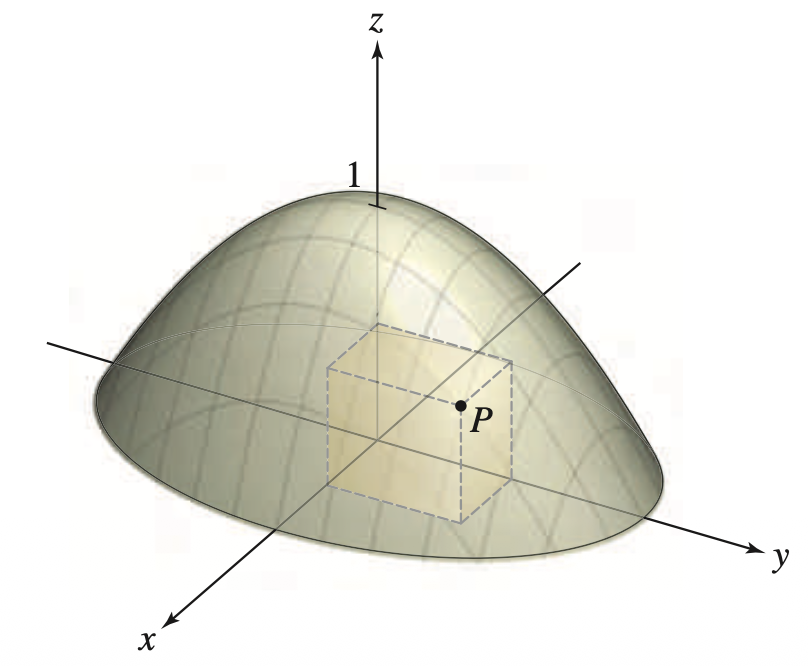
To maximize the volume of a rectangular box, start with the relation \(V = xyz\) and using the paraboloid equation we see
\begin{gather*}
z = 1 - \frac{x^2}{4} - \frac{y^2}{9} \quad \implies \quad V(x,y) = xy\left(1 - \frac{x^2}{4} - \frac{y^2}{9}\right)
\end{gather*}
Therefore we will consider
\begin{gather*}
V(x,y) = xy - \frac{1}{4}x^3y - \frac{1}{9}xy^3
\end{gather*}
First to find the critical points, we take the first-order partial derivatives and set them equal to zero, and solve:
\begin{gather*}
V_x(x,y) = y - \frac{3}{4}x^2y - \frac{1}{9}y^3, \quad V_y(x,y) = x - \frac{1}{4}x^3 - \frac{1}{3}xy^2
\end{gather*}
Using the equation \(V_y = 0\) we see
\begin{gather*}
x - \frac{1}{4}x^3 - \frac{1}{3}xy^2 = 0 \quad \implies \quad x = 0, \quad y^2 = 3 - \frac{3}{4}x^2 \quad \implies \quad y = \sqrt{3 - \frac{3}{4}x^2}
\end{gather*}
(Note here, we can ignore the value \(x = 0\text{,}\) since it produces a box having zero volume.)
Using this relation in the first equation, \(V_x = 0\text{,}\) we see:
\begin{gather*}
\sqrt{3 - \frac{3}{4}x^2} - \frac{3}{4}x^2\sqrt{3 - \frac{3}{4}x^2} - \frac{1}{9}\left(3 - \frac{3}{4}x^2\right)^{3/2} = 0
\end{gather*}
Factoring we see:
\begin{gather*}
\sqrt{3 - \frac{3}{4}x^2}\left[1 - \frac{3}{4}x^2 - \frac{1}{9}\left(3 - \frac{3}{4}x^2\right)\right] = 0
\end{gather*}
and thus
\begin{gather*}
3 - \frac{3}{4}x^2 = 0 \quad \implies \quad x^2 = 4 \quad \implies \quad x = \pm 2
\end{gather*}
or
\begin{gather*}
1 - \frac{3}{4}x^2 - \frac{1}{3} + \frac{1}{12}x^2 = 0 \quad \implies \quad \frac{2}{3} - \frac{2}{3}x^2 = 0 \quad \implies \quad x = \pm 1
\end{gather*}
Since the governing equation
\(f(x,y)\) is a paraboloid, that is symmetric about the
\(z\)-axis, we need only consider the point when
\(x = 2\) or
\(x = 1\text{.}\)
Therefore, since \(y = \sqrt{3 - \frac{3}{4}x^2}\) and \(z = 1 - \frac{1}{4}x^2 - \frac{1}{9}y^2\text{,}\) we have, if \(x = 2\)
\begin{gather*}
y = \sqrt{3 - \frac{3}{4} \cdot 4} = 0 \quad \implies \quad z = 1 - \frac{1}{4} \cdot 4 - \frac{1}{9} \cdot 0 = 0
\end{gather*}
This will give a box having zero volume - not a maximum volume at all.
Using \(x = 1\text{,}\) and \(y = \sqrt{3 - \frac{3}{4}x^2}\text{,}\) \(z = 1 - \frac{1}{4}x^2 - \frac{1}{9}y^2\text{,}\) we have
\begin{gather*}
y = \sqrt{3 - \frac{3}{4}} = \frac{3}{2}, \quad z = 1 - \frac{1}{4} \cdot 1^2 - \frac{1}{9} \cdot \frac{9}{4} = \frac{1}{2}
\end{gather*}
Therefore, the box having maximum volume has dimensions, \(x = 1\text{,}\) \(y = 3/2\text{,}\) and \(z = 1/2\) and maximum value for the volume:
\begin{gather*}
V = xyz = 1 \cdot \frac{3}{2} \cdot \frac{1}{2} = \frac{3}{4}
\end{gather*}