Section 14.6 Multivariable Calculus Chain Rules

In single-variable calculus, the Chain Rule tracks how a change in \(x\) ripples through a function. In multivariable calculus, an independent variable may influence a function through multiple "paths" simultaneously. This section introduces the General Chain Rule to account for these branching dependencies using tree diagrams and streamlines implicit differentiation using partial derivatives.

Subsection The (Fancy) Chain Rule

Back in MTH 251Z (or MTH 251), you learned the Chain Rule for single variable functions. The chain rule says that if \(y = f(u)\) and \(u = g(x)\text{,}\) then
\begin{equation*} \dfrac{d}{dx} f\lp g(x) \rp = f'\lp g(x) \rp f'(x) \end{equation*}
Alternatively, in Leibniz notation, we would write
\begin{equation*} \frac{dy}{dx} = \frac{dy}{du} \cdot \frac{du}{dx} \end{equation*}
Now let’s move on to the multivariable version of the Chain Rule. Let’s start with a simple case where we have \(z = f(x,y)\text{,}\) where \(x\) and \(y\) are both functions of \(t\text{.}\) In this case, the Chain Rule says
\begin{equation*} \frac{dz}{dt} = \frac{\partial f}{\partial x} \frac{dx}{dt} + \frac{\partial f}{\partial y} \frac{dy}{dt} \end{equation*}
Observe that the spirit of the Chain Rule stays the same. But we need to account for the fact that \(f\) depends on both \(x\) and \(y\text{,}\) and both of those variables depend on \(t\text{.}\) So we have two terms in the Chain Rule, one for the contribution of \(x\) and one for the contribution of \(y\text{.}\)

Example 14.6.1.

Let \(f(x,y) = x^2y + 3xy^4\text{,}\) where \(x = \sin(2t)\) and \(y = \cos(t)\text{.}\) Find \(\dfrac{df}{dt}\) at the point where \(t = 0\text{.}\)
Solution.
The Chain Rule gives
\begin{align*} \frac{df}{dt} \amp= \frac{\partial f}{\partial x} \frac{dx}{dt} + \frac{\partial f}{\partial y} \frac{dy}{dt} \\ \amp= \lp 2xy + 3y^4 \rp \lp 2\cos(2t) \rp + \lp x^2 + 12xy^3 \rp \lp -\sin(t) \rp \end{align*}
When t = 0, we have \(x = \sin(0) = 0\) and \(y = \cos(0) = 1\text{.}\) So we get
\begin{equation*} \frac{df}{dt}\bigg|_{t=0} = (0 + 3)(2 \cos(0)) + (0 + 0) (-\sin(0)) = 6 \end{equation*}

Note 14.6.2. But Richard... Why can’t we just replace everything with \(t\) and differentiate?

Well you for sure can! But one thing to keep in mind is that your function will likely be a lot more complicated after you replace everything with \(t\text{.}\)
For example, in the above example, if we replace \(x\) and \(y\) with their definitions, we get
\begin{equation*} f(t) = \sin^2(2t)\cos(t) + 3\sin(2t)\cos^4(t) \end{equation*}
Then a MTH 251Z (or MTH 251) student can differentiate this fine. But the work will be a lot more complicated as multiple rounds of the product rule and chain rule will be required.
Now let’s kick it up a notch and consider the case where \(z = f(x,y)\text{,}\) where \(x\) and \(y\) are both functions of \(s\) and \(t\text{.}\) That is, \(x = g(s,t)\) and \(y = h(s,t)\text{.}\) How should we take the derivative of \(f\text{?}\)
One thing to keep in mind is that \(f\) depends on \(s\) and \(t\) through both \(x\) and \(y\text{.}\) So we can only take the partial derivative by picking one of the variables, \(s\) or \(t\text{,}\) to differentiate with respect to.
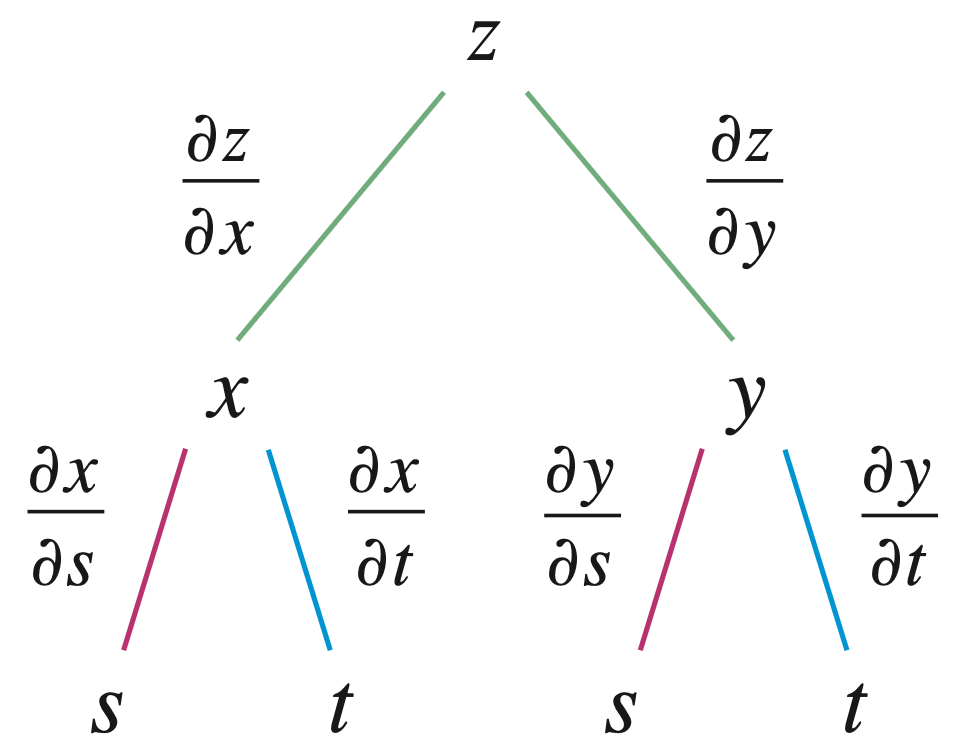
Let’s say we want to take the partial derivative of \(f\) with respect to \(s\text{.}\) Then we will need to account for all the contributions of \(s\) to \(f\text{.}\) One way to sort out the contributions is to use a tree diagram (see the diagram below).
Figure 14.6.3.
In this tree diagram, we can see that \(s\) contributes to \(f\) through both \(x\) and \(y\text{.}\) So we have two terms in the Chain Rule, as follows
\begin{equation*} \frac{\partial f}{\partial s} = \frac{\partial f}{\partial x}\frac{\partial x}{\partial s} + \frac{\partial f}{\partial y}\frac{\partial y}{\partial s} \end{equation*}
Similarly, if we want to take the partial derivative of \(f\) with respect to \(t\text{,}\) we get
\begin{equation*} \frac{\partial f}{\partial t} = \frac{\partial f}{\partial x}\frac{\partial x}{\partial t} + \frac{\partial f}{\partial y}\frac{\partial y}{\partial t} \end{equation*}
since \(t\) contributes to \(f\) through both \(x\) and \(y\) as well, as indicated in the tree diagram above.

Example 14.6.4.

Let \(f(x,y) = e^x\sin(y)\text{,}\) where \(x = st^2\) and \(y = s^2t\text{.}\) Find the first-order partial derivatives \(\dfrac{\partial f}{\partial s}\) and \(\dfrac{\partial f}{\partial t}\text{.}\)
Solution.
Applying the Chain Rule, we get
\begin{align*} \frac{\partial f}{\partial s} \amp= \frac{\partial f}{\partial x}\frac{\partial x}{\partial s} + \frac{\partial f}{\partial y}\frac{\partial y}{\partial s} \\ \amp= \lp e^x\sin(y) \rp \lp t^2 \rp + \lp e^x\cos(y) \rp \lp 2st \rp \\ \amp= t^2e^{st^2} \sin\lp s^2t \rp + 2ste^{st^2} \cos\lp s^2t \rp \end{align*}
and
\begin{align*} \frac{\partial f}{\partial t} \amp= \frac{\partial f}{\partial x}\frac{\partial x}{\partial t} + \frac{\partial f}{\partial y}\frac{\partial y}{\partial t} \\ \amp= \lp e^x\sin(y) \rp \lp 2st \rp + \lp e^x\cos(y) \rp \lp s^2 \rp \\ \amp= 2ste^{st^2} \sin\lp s^2t \rp + s^2e^{st^2} \cos\lp s^2t \rp \end{align*}
You may get the idea of the Chain Rule for more complicated cases by now. We will just need to account for all the contributions of the variable we are differentiating with respect to. Using a tree diagram can be helpful to sort out the contributions.

Example 14.6.6.

Let \(u = x^4y + y^2z^3\text{,}\) where \(x = rse^t\text{,}\) \(y = rs^2e^{-t}\text{,}\) and \(z = r^2s\sin(t)\text{.}\) Find the value of \(\dfrac{\partial u}{\partial s}\) when \(r = 2\text{,}\) \(s = 1\text{,}\) and \(t = 0\text{.}\)
Solution.
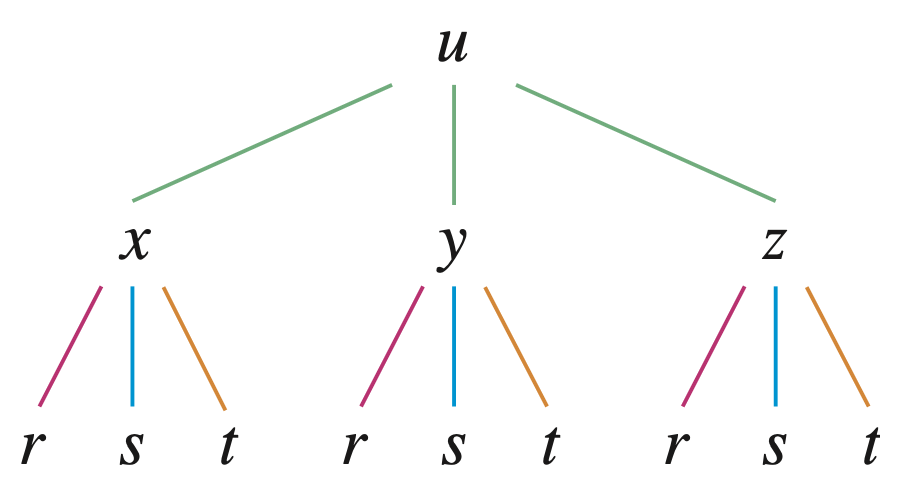
We can construct a tree diagram to keep track of the variables as follows.
Figure 14.6.7.
The diagram implies that
\begin{align*} \frac{\partial u}{\partial s} \amp= \frac{\partial u}{\partial x} \frac{\partial x}{\partial s} + \frac{\partial u}{\partial y} \frac{\partial y}{\partial s} + \frac{\partial u}{\partial z} \frac{\partial z}{\partial s} \\ \amp= \lp 4x^3y \rp \lp re^t \rp + \lp x^4 + 2yz^3 \rp \lp 2rse^{-t} \rp + \lp 3y^2z^2 \rp \lp r^2\sin(t) \rp \end{align*}
When \(r = 2\text{,}\) \(s = 1\text{,}\) and \(t = 0\text{,}\) we have
\begin{equation*} \frac{\partial u}{\partial s} = (64)(2) + (16)(4) + (0)(0) = 192 \end{equation*}

Subsection (Fancy) Implicit Differentiation

Back in MTH 251Z (or MTH 251), you learned a fancy way of taking derivatives of an equation, which is called implicit differentiation. The whole idea of implicit differentiation is to take the derivative of both sides of the equation and sort out all the little derivatives pieces using the Chain Rule.
Let’s start by looking at an example to remind ourselves how implicit differentiation works.

Example 14.6.8.

Find \(y'\) if \(x^3 + y^3 = 6xy\)
Hint.
This is a standard implicit differentiation problem in MTH 251Z (or MTH 251). But we are in big-boy calculus now, so let’s try using multivariable calculus tools to solve this problem.
Richard will help you with the setup! Let’s define a function \(F(x,y) = x^3 + y^3 - 6xy\text{.}\) Then the equation \(x^3 + y^3 = 6xy\) can be rewritten as \(F(x,y) = 0\text{.}\)
If we take the derivative of both sides of the equation \(F(x,y) = 0\text{,}\) we get
\begin{equation*} \dfrac{\partial F}{\partial x} \cdot \dfrac{dx}{dx} + \dfrac{\partial F}{\partial y} \cdot \dfrac{dy}{dx} = 0 \end{equation*}
Well the question asks us to find \(y'\text{...}\) So where is it?
Solution.
Let’s follow Richard’s setup and define \(F(x,y) = x^3 + y^3 - 6xy\text{.}\) Then we have
\begin{equation*} x^3 + y^3 - 6xy = 0 \end{equation*}
Now we take the derivative of both sides of the equation using the Chain Rule. We obtain
\begin{equation*} \dfrac{\partial F}{\partial x} \cdot \dfrac{dx}{dx} + \dfrac{\partial F}{\partial y} \cdot \dfrac{dy}{dx} = 0 \end{equation*}
where \(\dfrac{dx}{dx} = 1\) and \(\dfrac{dy}{dx} = y'\text{.}\) Then we can solve for \(y'\) to get
\begin{equation*} y' = \frac{dy}{dx} = -\frac{\frac{\partial F}{\partial x}}{\frac{\partial F}{\partial y}} = -\frac{F_x}{F_y} \end{equation*}
Since \(F_x = 3x^2 - 6y\) and \(F_y = 3y^2 - 6x\text{,}\) we get
\begin{equation*} y' = -\frac{3x^2 - 6y}{3y^2 - 6x} = -\frac{x^2 - 2y}{y^2 - 2x} \end{equation*}
The above example demonstrates the (fancy) implicit differentiation in multivariable calculus. The key idea is to define a function \(F\) such that the equation we want to differentiate can be rewritten as \(F(x,y,z) = 0\text{.}\) Then we can take the derivative of both sides of the equation using the Chain Rule and isolate the desired derivative.
Now let’s say we have an equation \(F(x,y,z) = 0\text{,}\) where \(z\) is implicitly defined as a function of \(x\) and \(y\text{.}\) Then we can take the derivative of both sides of the equation using the Chain Rule to get
\begin{equation*} \frac{\partial F}{\partial x} \cdot \frac{\partial x}{\partial x} + \frac{\partial F}{\partial y} \cdot \frac{\partial y}{\partial x} + \frac{\partial F}{\partial z} \cdot \frac{\partial z}{\partial x} = 0 \end{equation*}
Obviously, \(\dfrac{\partial x}{\partial x} = 1\text{.}\) Also, sine \(x\) and \(y\) are both independent variables, then \(\dfrac{\partial y}{\partial x} = 0\text{.}\) So we can simplify the above equation to get
\begin{equation*} \frac{\partial F}{\partial x} + \frac{\partial F}{\partial z} \cdot \frac{\partial z}{\partial x} = 0 \end{equation*}
Assuming \(\dfrac{\partial F}{\partial z} \neq 0\text{,}\) we can solve for \(\dfrac{\partial z}{\partial x}\) to get
\begin{equation*} \frac{\partial z}{\partial x} = -\frac{F_x}{F_z} \qquad \text{ and } \qquad \frac{\partial z}{\partial y} = -\frac{F_y}{F_z} \end{equation*}
Then we can use the above formula to calculate the partial derivatives of \(z\) with respect to \(x\) and \(y\text{.}\)
You may have doubts about why we can assume \(z = f(x,y)\) can be obtained from the equation \(F(x,y,z) = 0\) (if this condition is not satisfied, then we can’t argue that \(\frac{\partial y}{\partial x} = 0\text{...}\) since \(x\) and \(y\) may not be independent of each other). Well there is a fancy math theorem called the Implicit Function Theorem that gives us the conditions under which we can obtain \(z = f(x,y)\) from the equation \(F(x,y,z) = 0\text{.}\) But we won’t be able to prove it in this class (we don’t even know what a Jacobian matrix is yet).
Feel free to look up the Implicit Function Theorem if you are interested. But you can just assume the conditions of the Implicit Function Theorem are satisfied for the problems in this class. In short, the Implicit Function Theorem says that if \(F\) is defined within a sphere containing \((a,b,c)\text{,}\) where \(F(a,b,c) = 0\text{,}\) \(F_z(a,b,c) \neq 0\text{,}\) and \(F_x\text{,}\) \(F_y\text{,}\) and \(F_z\) are all continuous inside the sphere, then the equation \(F(x,y,z) = 0\) defines \(z\) as a function of \(x\) and \(y\) near the point \((a,b,c)\) and this function is differentiable.

Example 14.6.9.

Find \(\dfrac{\partial z}{\partial x}\) and \(\dfrac{\partial z}{\partial y}\) if \(x^3 + y^3 + z^3 + 6xyz = 1\text{.}\)
Solution.
Let \(F(x,y,z) = x^3 + y^3 + z^3 + 6xyz - 1\text{.}\) Then we obtain
\begin{align*} \frac{\partial z}{\partial x} \amp= - \frac{F_x}{F_z} = - \frac{3x^2 + 6yz}{3z^2 + 6xy} = - \frac{x^2 + 2yz}{z^2 + 2xy} \\ \frac{\partial z}{\partial y} \amp= - \frac{F_y}{F_z} = - \frac{3y^2 + 6xz}{3z^2 + 6xy} = - \frac{y^2 + 2xz}{z^2 + 2xy} \end{align*}

Worksheet Assigned Problems for Section 14.6

The problems listed below are assigned to be included in your problem set portfolio. Note that a specific selection of these problems will also form the written homework assignments. I recommend working through all of them to ensure a solid grasp of the material. Reach out to Richard for help if you get stuck or have any questions.
The solutions will be posted after the written homework due dates. If you have any questions about your work, talk to Richard and he is happy to discuss the process with you.

14.6.1.

Let \(f(x,y,z) = x^2y^3 + z^4\) and \(x = s^2\text{,}\) \(y = st^2\text{,}\) and \(z = s^2t\text{.}\)
  1. Calculate the primary derivatives \(\dfrac{\partial f}{\partial x}\text{,}\) \(\dfrac{\partial f}{\partial y}\text{,}\) and \(\dfrac{\partial f}{\partial z}\text{.}\)
  2. Calculate \(\dfrac{\partial x}{\partial s}\text{,}\) \(\dfrac{\partial y}{\partial s}\text{,}\) and \(\dfrac{\partial z}{\partial s}\text{.}\)
  3. Compute \(\dfrac{\partial f}{\partial s}\) using the Chain Rule:
    \begin{equation*} \frac{\partial f}{\partial s} = \frac{\partial f}{\partial x}\frac{\partial x}{\partial s} + \frac{\partial f}{\partial y}\frac{\partial y}{\partial s} + \frac{\partial f}{\partial z}\frac{\partial z}{\partial s} \end{equation*}
Solution.
  1. \begin{align*} \frac{\partial f}{\partial x} \amp= 2xy^3 \\ \frac{\partial f}{\partial y} \amp= 3x^2y^2 \\ \frac{\partial f}{\partial z} \amp= 4z^3 \end{align*}
  2. \begin{align*} \frac{\partial x}{\partial s} \amp= 2s \\ \frac{\partial y}{\partial s} \amp= t^2 \\ \frac{\partial z}{\partial s} \amp= 2st \end{align*}
  3. Using the Chain Rule formula:
    \begin{align*} \frac{\partial f}{\partial s} \amp= (2xy^3)(2s) + (3x^2y^2)(t^2) + (4z^3)(2st) \end{align*}
    Now we substitute \(x = s^2\text{,}\) \(y = st^2\text{,}\) and \(z = s^2t\) back into the equation:
    \begin{align*} \frac{\partial f}{\partial s} \amp= 2(s^2)(st^2)^3(2s) + 3(s^2)^2(st^2)^2(t^2) + 4(s^2t)^3(2st) \\ \amp= 2(s^2)(s^3t^6)(2s) + 3(s^4)(s^2t^4)(t^2) + 4(s^6t^3)(2st) \\ \amp= 4s^6t^6 + 3s^6t^6 + 8s^7t^4 \\ \amp= 7s^6t^6 + 8s^7t^4 \end{align*}

Exercise Group.

In the following exercises, use the Chain Rule to calculate the partial derivatives, Express the answer in terms of the independent variables.
14.6.7.
\(\dfrac{\partial F}{\partial y}\text{;}\) \(F(u,v) = e^{u + v}\text{,}\) \(u = x^2\text{,}\) \(v = xy\text{.}\)
Solution.
Using the Chain Rule:
\begin{equation*} \frac{\partial F}{\partial y} = \frac{\partial F}{\partial u} \frac{\partial u}{\partial y} + \frac{\partial F}{\partial v} \frac{\partial v}{\partial y} \end{equation*}
First, calculate the partial derivatives:
\begin{align*} \frac{\partial F}{\partial u} \amp= e^{u+v} \amp \frac{\partial u}{\partial y} \amp= 0 \\ \frac{\partial F}{\partial v} \amp= e^{u+v} \amp \frac{\partial v}{\partial y} \amp= x \end{align*}
Substitute these into the Chain Rule:
\begin{align*} \frac{\partial F}{\partial y} \amp= (e^{u+v})(0) + (e^{u+v})(x) \\ \amp= x e^{u+v} \end{align*}
Finally, substitute \(u = x^2\) and \(v = xy\) back into the equation:
\begin{equation*} \frac{\partial F}{\partial y} = x e^{x^2 + xy} \end{equation*}
14.6.9.
\(\dfrac{\partial h}{\partial t_2}\text{;}\) \(f(x,y) = \dfrac{x}{y}\text{,}\) \(x = t_1t_2\text{,}\) \(y = t_1^2t_2\text{.}\)
Solution.
Note that \(h\) represents the composite function \(h(t_1, t_2) = f(x(t_1, t_2), y(t_1, t_2))\text{.}\) Using the Chain Rule:
\begin{equation*} \frac{\partial h}{\partial t_2} = \frac{\partial f}{\partial x} \frac{\partial x}{\partial t_2} + \frac{\partial f}{\partial y} \frac{\partial y}{\partial t_2} \end{equation*}
Calculate the necessary partial derivatives:
\begin{align*} \frac{\partial f}{\partial x} \amp= \frac{1}{y} \amp \frac{\partial x}{\partial t_2} \amp= t_1 \\ \frac{\partial f}{\partial y} \amp= -\frac{x}{y^2} \amp \frac{\partial y}{\partial t_2} \amp= t_1^2 \end{align*}
Substitute these into the Chain Rule:
\begin{align*} \frac{\partial h}{\partial t_2} \amp= \left(\frac{1}{y}\right)(t_1) + \left(-\frac{x}{y^2}\right)(t_1^2) \\ \amp= \frac{t_1}{y} - \frac{xt_1^2}{y^2} \end{align*}
Finally, substitute \(x = t_1t_2\) and \(y = t_1^2t_2\text{:}\)
\begin{align*} \frac{\partial h}{\partial t_2} \amp= \frac{t_1}{t_1^2t_2} - \frac{(t_1t_2)t_1^2}{(t_1^2t_2)^2} \\ \amp= \frac{1}{t_1t_2} - \frac{t_1^3t_2}{t_1^4t_2^2} \\ \amp= \frac{1}{t_1t_2} - \frac{1}{t_1t_2} = 0 \end{align*}
(Alternatively, substituting \(x\) and \(y\) into \(f\) first gives \(f(x,y) = \frac{t_1t_2}{t_1^2t_2} = \frac{1}{t_1}\text{.}\) Since this expression only depends on \(t_1\text{,}\) its derivative with respect to \(t_2\) is trivially \(0\text{!}\))

14.6.13.

Use the Chain Rule to evaluate the partial derivative \(\dfrac{\partial g}{\partial \theta}\) at the point \((r, \theta) = \lp 2\sqrt{2}, \dfrac{\pi}{4} \rp\text{,}\) where
\begin{equation*} g(x,y) = \frac{1}{x + y^2}\, , \qquad x = r\cos(\theta) \quad \text{ and } \quad y = r\sin(\theta) \end{equation*}
Solution.
First, let’s find the values of \(x\) and \(y\) at the given point:
\begin{align*} x \amp= 2\sqrt{2}\cos\lp\frac{\pi}{4}\rp = 2\sqrt{2} \lp\frac{\sqrt{2}}{2}\rp = 2 \\ y \amp= 2\sqrt{2}\sin\lp\frac{\pi}{4}\rp = 2\sqrt{2} \lp\frac{\sqrt{2}}{2}\rp = 2 \end{align*}
The Chain Rule states:
\begin{equation*} \frac{\partial g}{\partial \theta} = \frac{\partial g}{\partial x} \frac{\partial x}{\partial \theta} + \frac{\partial g}{\partial y} \frac{\partial y}{\partial \theta} \end{equation*}
Let’s calculate each of these partial derivatives:
\begin{align*} \frac{\partial g}{\partial x} \amp= -(x+y^2)^{-2} = -\frac{1}{(x+y^2)^2} \\ \frac{\partial g}{\partial y} \amp= -2y(x+y^2)^{-2} = -\frac{2y}{(x+y^2)^2} \\ \frac{\partial x}{\partial \theta} \amp= -r\sin(\theta) \\ \frac{\partial y}{\partial \theta} \amp= r\cos(\theta) \end{align*}
Now, evaluate these derivatives at our specific point (\(x=2, y=2, r=2\sqrt{2}, \theta=\frac{\pi}{4}\)):
\begin{align*} \frac{\partial g}{\partial x} \amp= -\frac{1}{(2 + 2^2)^2} = -\frac{1}{36} \\ \frac{\partial g}{\partial y} \amp= -\frac{2(2)}{(2 + 2^2)^2} = -\frac{4}{36} = -\frac{1}{9} \\ \frac{\partial x}{\partial \theta} \amp= -2\sqrt{2}\sin\lp\frac{\pi}{4}\rp = -2 \\ \frac{\partial y}{\partial \theta} \amp= 2\sqrt{2}\cos\lp\frac{\pi}{4}\rp = 2 \end{align*}
Substitute these values back into the Chain Rule:
\begin{align*} \frac{\partial g}{\partial \theta} \amp= \lp-\frac{1}{36}\rp(-2) + \lp-\frac{1}{9}\rp(2) \\ \amp= \frac{2}{36} - \frac{2}{9} = \frac{1}{18} - \frac{4}{18} = -\frac{3}{18} = -\frac{1}{6} \end{align*}

14.6.19.

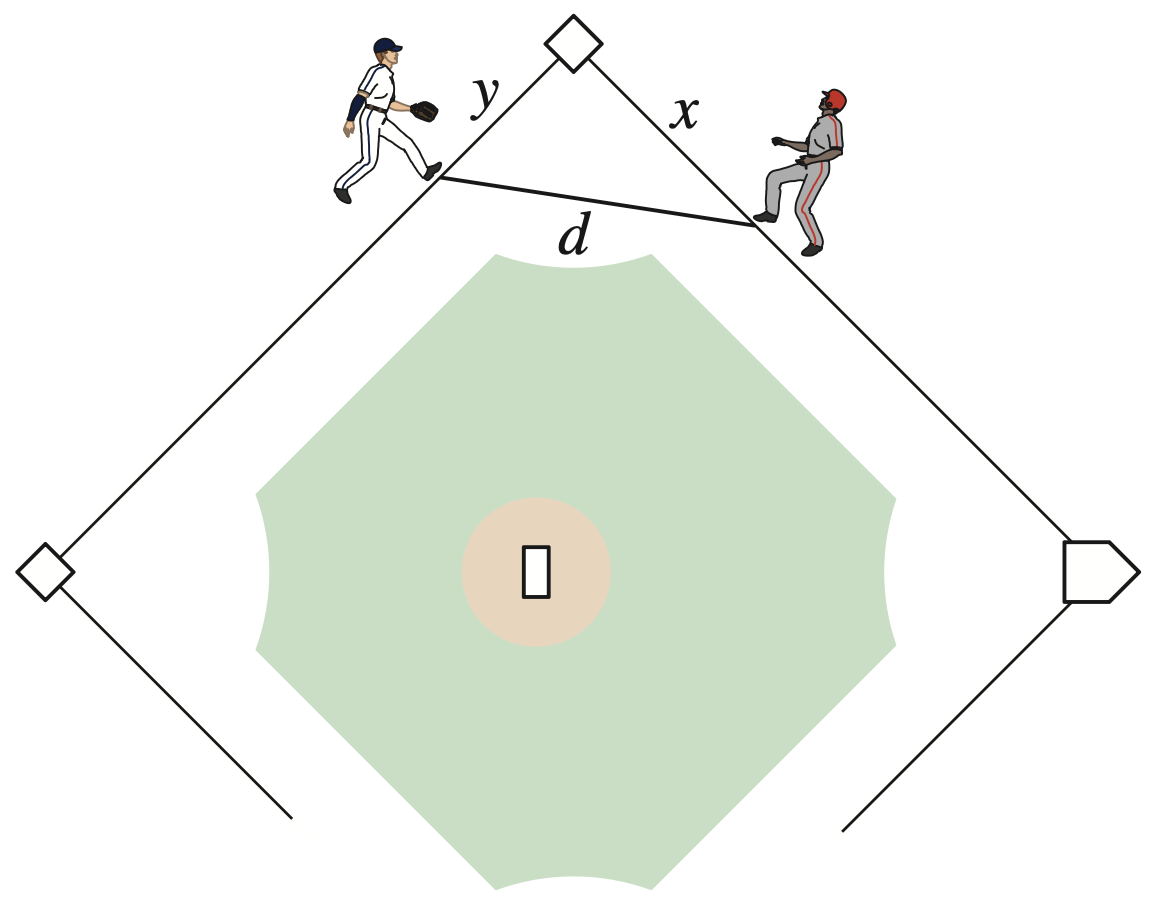
A baseball player hits the ball and then runs down the first base line at 20 ft/s. The first baseman fields the ball and then runs toward first base along the second base line at 18 ft/s as shown in the figure below.
Figure 14.6.10.
Determine how fast the distance between the two players is changing at a moment when the hitter is 8 ft from first base and the first baseman is 6 ft from first base.
Solution.
As in the figure, let \(x(t)\) be the distance of the runner from first base at time \(t\text{,}\) and \(y(t)\) the distance of the fielder from first base at time \(t\text{.}\) With first base at the origin, fix signs so that both speeds are positive and the distances from the base are negative. Then the distance between the two players is \(D(t) = \sqrt{x(t)^2 + y(t)^2}\text{.}\) Using the Chain Rule, the rate of change of distance with respect to time is
\begin{equation*} \frac{dD}{dt} = \frac{dD}{dx} \cdot \frac{dx}{dt} + \frac{dD}{dy} \cdot \frac{dy}{dt}. \end{equation*}
We are given that \(\frac{dx}{dt} = 20\) and \(\frac{dy}{dt} = 18\text{.}\) Further,
\begin{align*} \frac{dD}{dx} \amp= \frac{1}{2}(x^2 + y^2)^{-1/2} \cdot 2x = \frac{x}{\sqrt{x^2 + y^2}}, \\ \frac{dD}{dy} \amp= \frac{1}{2}(x^2 + y^2)^{-1/2} \cdot 2y = \frac{y}{\sqrt{x^2 + y^2}} \end{align*}
so that for the given values of \(x\) and \(y\)
\begin{align*} \left. \frac{dD}{dx} \right|_{(x,y)=(-8,-6)} \amp= -\frac{8}{\sqrt{8^2 + 6^2}} = -\frac{4}{5} \\ \left. \frac{dD}{dy} \right|_{(x,y)=(-8,-6)} \amp= -\frac{6}{\sqrt{8^2 + 6^2}} = -\frac{3}{5}. \end{align*}
\begin{equation*} \frac{dD}{dt} = -\frac{4}{5} \cdot 20 - \frac{3}{5} \cdot 18 = -\frac{134}{5} = -26.8 \text{ ft/sec}. \end{equation*}
The distance between the players is decreasing at a rate of \(26.8 \text{ ft/sec}\text{.}\)

14.6.21.

Two spacecraft are following paths in space given by \(\v{r}_1 = \la \sin(t), t, t^2 \ra\) and \(\v{r}_2(t) = \la \cos(t), 1-t, t^3 \ra\text{.}\) If the temperature for points in space is given by \(T(x,y,z) = x^2y(1-z)\text{,}\) use the Chain Rule to determine the rate of change of the difference \(D\) in the temperatures the two spacecraft experience at time \(t = \pi\text{.}\)
Solution.
The difference in temperatures is \(D(t) = T(\v{r}_1(t)) - T(\v{r}_2(t))\text{.}\) The rate of change is \(D'(t) = \frac{d}{dt}T(\v{r}_1(t)) - \frac{d}{dt}T(\v{r}_2(t))\text{.}\) By the Chain Rule, \(\frac{d}{dt}T(\v{r}(t)) = \nabla T(\v{r}(t)) \cdot \v{r}'(t)\text{.}\)
First, calculate the gradient of \(T\text{:}\)
\begin{equation*} \nabla T = \la 2xy(1-z), x^2(1-z), -x^2y \ra \end{equation*}
Spacecraft 1: Evaluate path and velocity at \(t = \pi\text{:}\)
\begin{align*} \v{r}_1(\pi) \amp= \la \sin(\pi), \pi, \pi^2 \ra = \la 0, \pi, \pi^2 \ra \\ \v{r}_1'(t) \amp= \la \cos(t), 1, 2t \ra \implies \v{r}_1'(\pi) = \la -1, 1, 2\pi \ra \end{align*}
Evaluate gradient at \(\v{r}_1(\pi)\text{:}\)
\begin{equation*} \nabla T(0, \pi, \pi^2) = \la 2(0)(\pi)(1-\pi^2), (0)^2(1-\pi^2), -(0)^2(\pi) \ra = \la 0, 0, 0 \ra \end{equation*}
Rate of change for spacecraft 1:
\begin{equation*} \frac{d}{dt}T(\v{r}_1(\pi)) = \la 0, 0, 0 \ra \cdot \la -1, 1, 2\pi \ra = 0 \end{equation*}
Spacecraft 2: Evaluate path and velocity at \(t = \pi\text{:}\)
\begin{align*} \v{r}_2(\pi) \amp= \la \cos(\pi), 1-\pi, \pi^3 \ra = \la -1, 1-\pi, \pi^3 \ra \\ \v{r}_2'(t) \amp= \la -\sin(t), -1, 3t^2 \ra \implies \v{r}_2'(\pi) = \la 0, -1, 3\pi^2 \ra \end{align*}
Evaluate gradient at \(\v{r}_2(\pi)\text{:}\)
\begin{align*} \nabla T(-1, 1-\pi, \pi^3) \amp= \la 2(-1)(1-\pi)(1-\pi^3), (-1)^2(1-\pi^3), -(-1)^2(1-\pi) \ra \\ \amp= \la -2(1-\pi)(1-\pi^3), 1-\pi^3, -(1-\pi) \ra \\ \amp= \la 2(\pi-1)(1-\pi^3), 1-\pi^3, \pi-1 \ra \end{align*}
Rate of change for spacecraft 2:
\begin{align*} \frac{d}{dt}T(\v{r}_2(\pi)) \amp= \la 2(\pi-1)(1-\pi^3), 1-\pi^3, \pi-1 \ra \cdot \la 0, -1, 3\pi^2 \ra \\ \amp= 0 - (1-\pi^3) + 3\pi^2(\pi-1) \\ \amp= \pi^3 - 1 + 3\pi^3 - 3\pi^2 = 4\pi^3 - 3\pi^2 - 1 \end{align*}
Finally, calculate the rate of change of the difference:
\begin{align*} D'(\pi) \amp= \frac{d}{dt}T(\v{r}_1(\pi)) - \frac{d}{dt}T(\v{r}_2(\pi)) \\ \amp= 0 - (4\pi^3 - 3\pi^2 - 1) \\ \amp= -4\pi^3 + 3\pi^2 + 1 \end{align*}
14.6.27.

Suppose that \(z\) is defined implicitly as a function of \(x\) and \(y\) by equation \(F(x,y,z) = xz^2 + y^2z + xy - 1 = 0\text{.}\)
  1. Calculate \(F_x\text{,}\) \(F_y\text{,}\) and \(F_z\text{.}\)
  2. Use () to calculate \(\dfrac{\partial z}{\partial x}\) and \(\dfrac{\partial z}{\partial y}\text{.}\)
Solution.
  1. \begin{align*} F_x \amp= z^2 + y \\ F_y \amp= 2yz + x \\ F_z \amp= 2xz + y^2 \end{align*}
  2. Using the implicit differentiation formulas:
    \begin{align*} \frac{\partial z}{\partial x} \amp= -\frac{F_x}{F_z} = -\frac{z^2 + y}{2xz + y^2} \\ \frac{\partial z}{\partial y} \amp= -\frac{F_y}{F_z} = -\frac{2yz + x}{2xz + y^2} \end{align*}

14.6.31.

Calculate the partial derivative \(\dfrac{\partial z}{\partial y}\) of the equation \(e^{xy} + \sin(xz) + y = 0\) using implicit differentiation.
Solution.
Let \(F(x,y,z) = e^{xy} + \sin(xz) + y\text{.}\) By the implicit differentiation formula, \(\frac{\partial z}{\partial y} = -\frac{F_y}{F_z}\text{.}\)
First, calculate the necessary partial derivatives:
\begin{align*} F_y \amp= \frac{\partial}{\partial y}(e^{xy} + \sin(xz) + y) = xe^{xy} + 0 + 1 = xe^{xy} + 1 \\ F_z \amp= \frac{\partial}{\partial z}(e^{xy} + \sin(xz) + y) = 0 + \cos(xz) \cdot x + 0 = x\cos(xz) \end{align*}
Substitute into the formula:
\begin{equation*} \frac{\partial z}{\partial y} = -\frac{xe^{xy} + 1}{x\cos(xz)} \end{equation*}