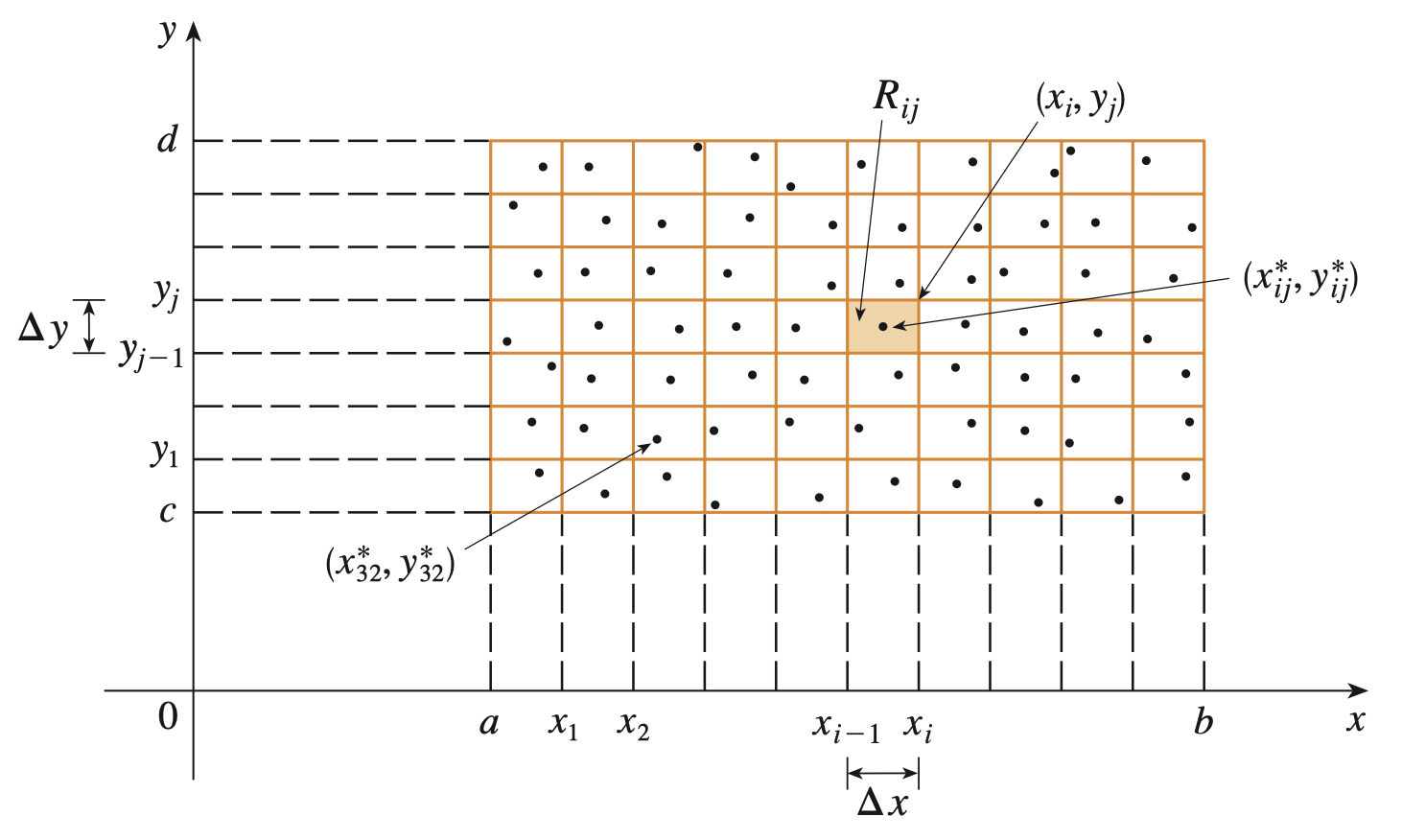
Each subrectangle is a square of side
\(0.25\text{,}\) hence the area of each subrectangle is
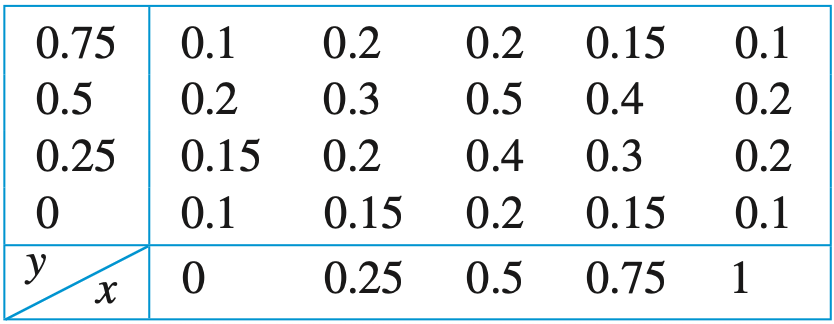
\(\Delta A = 0.25^2 = 0.0625\text{.}\) By the given data, the lower-left vertex sample points are:
\begin{align*}
f(P_{11}) \amp= f(0, 0) \amp f(P_{12}) \amp= f(0, 0.25) \amp f(P_{13}) \amp= f(0, 0.50) \\
f(P_{21}) \amp= f(0.25, 0) \amp f(P_{22}) \amp= f(0.25, 0.25) \amp f(P_{23}) \amp= f(0.25, 0.50) \\
f(P_{31}) \amp= f(0.50, 0) \amp f(P_{32}) \amp= f(0.50, 0.25) \amp f(P_{33}) \amp= f(0.50, 0.50) \\
f(P_{41}) \amp= f(0.75, 0) \amp f(P_{42}) \amp= f(0.75, 0.25) \amp f(P_{43}) \amp= f(0.75, 0.50)
\end{align*}
The Riemann sum
\(S_{4,3}\) that corresponds to these lower-left vertex sample points is the following sum:
\begin{align*}
S_{4,3} \amp= \sum_{i=1}^4 \sum_{j=1}^3 f(P_{ij}) \Delta A \\
\amp= 0.0625(0.1 + 0.15 + 0.2 + 0.15 + 0.2 + 0.3 + 0.2 + 0.4 + 0.5 + 0.15 + 0.3 + 0.4) \\
\amp\approx 0.190625
\end{align*}
Now by the given data, the upper-right vertex sample points are:
\begin{align*}
f(P_{11}) \amp= f(0.25, 0.25) \amp f(P_{12}) \amp= f(0.25, 0.50) \amp f(P_{13}) \amp= f(0.25, 0.75) \\
f(P_{21}) \amp= f(0.50, 0.25) \amp f(P_{22}) \amp= f(0.50, 0.50) \amp f(P_{23}) \amp= f(0.50, 0.75) \\
f(P_{31}) \amp= f(0.75, 0.25) \amp f(P_{32}) \amp= f(0.75, 0.50) \amp f(P_{33}) \amp= f(0.75, 0.75) \\
f(P_{41}) \amp= f(1, 0.25) \amp f(P_{42}) \amp= f(1, 0.50) \amp f(P_{43}) \amp= f(1, 0.75)
\end{align*}
The Riemann sum
\(S'_{4,3}\) that corresponds to these upper-right vertex sample points is the following sum:
\begin{align*}
S'_{4,3} \amp= \sum_{i=1}^4 \sum_{j=1}^3 f(P_{ij}) \Delta A \\
\amp= 0.0625(0.2 + 0.3 + 0.2 + 0.4 + 0.5 + 0.2 + 0.3 + 0.4 + 0.15 + 0.2 + 0.2 + 0.1) \\
\amp\approx 0.196875
\end{align*}
Taking the average of the two Riemann sums we have:
\begin{align*}
\text{volume} \amp\approx \frac{S_{4,3} + S'_{4,3}}{2} = \frac{0.190625 + 0.196875}{2} = 0.19375
\end{align*}