Worksheet Assigned Problems for Section 12.4

The problems listed below are assigned to be included in your problem set portfolio. Note that a specific selection of these problems will also form the written homework assignments. I recommend working through all of them to ensure a solid grasp of the material. Reach out to Richard for help if you get stuck or have any questions.
The solutions will be posted after the written homework due dates. If you have any questions about your work, talk to Richard and he is happy to discuss the process with you.

12.4.11.

Calculate \(\v{v} \times \v{w}\text{,}\) where \(\v{v} = \la \frac{2}{3}, 1, \frac{1}{2} \ra\) and \(\v{w} = \la 4, -6, 3 \ra\text{.}\)
Solution.
We have
\begin{align*} \v{v} \times \v{w} \amp= \begin{vmatrix} \v{i} \amp \v{j} \amp \v{k} \\ \frac{2}{3} \amp 1 \amp \frac{1}{2} \\ 4 \amp -6 \amp 3 \end{vmatrix}\\ \amp= \v{i}\begin{vmatrix} 1 \amp \frac{1}{2} \\ -6 \amp 3 \end{vmatrix} - \v{j}\begin{vmatrix} \frac{2}{3} \amp \frac{1}{2} \\ 4 \amp 3 \end{vmatrix} + \v{k}\begin{vmatrix} \frac{2}{3} \amp 1 \\ 4 \amp -6 \end{vmatrix}\\ \amp= (3 + 3)\v{i} - (2 - 2)\v{j} + (-4 - 4)\v{k}\\ \amp= 6\v{i} + 0\v{j} -8\v{k}\\ \amp= \la 6,0,-8 \ra \end{align*}

12.4.17.

Calculate the cross product \(\lp \v{i} - 3\v{j} + 2\v{k} \rp \times \lp \v{j} - \v{k} \rp\)
Solution.
Using the distributive law, we obtain
\begin{align*} \lp \v{i} - 3\v{j} + 2\v{k} \rp \times \lp \v{j} - \v{k} \rp \amp= \v{i} \times \v{j} + 2\v{k} \times \v{j} - \v{i} \times \v{k} - (-3\v{j} \times \v{k}) \\ \amp= \v{k} + 2(-\v{i}) - (-\v{j}) - (-3\v{i}) \\ \amp= \v{k} - 2\v{i} + \v{j} + 3\v{i} \\ \amp= \v{i} + \v{j} + \v{k} \end{align*}

12.4.21.

Calculate the cross product \(\v{w} \times \lp \v{u} + \v{v} \rp\text{,}\) assuming that
\begin{equation*} \v{u} \times \v{v} = \la 1,1,0 \ra, \qquad \v{u} \times \v{w} = \la 0,3,1 \ra, \qquad \v{v} \times \v{w} = \la 2,-1,1 \ra \end{equation*}
Solution.
Using the properties of the cross product, we obtain
\begin{align*} \v{w} \times \lp \v{u} + \v{v} \rp \amp= \v{w} \times \v{u} + \v{w} \times \v{v} \\ \amp= -\v{u} \times \v{w} - \v{v} \times \v{w} \\ \amp= -\la 0,3,1 \ra - \la 2,-1,1 \ra \\ \amp= \la 0,-3,-1 \ra - \la 2,-1,1 \ra \\ \amp= \la -2,-2,-2 \ra \end{align*}

12.4.37.

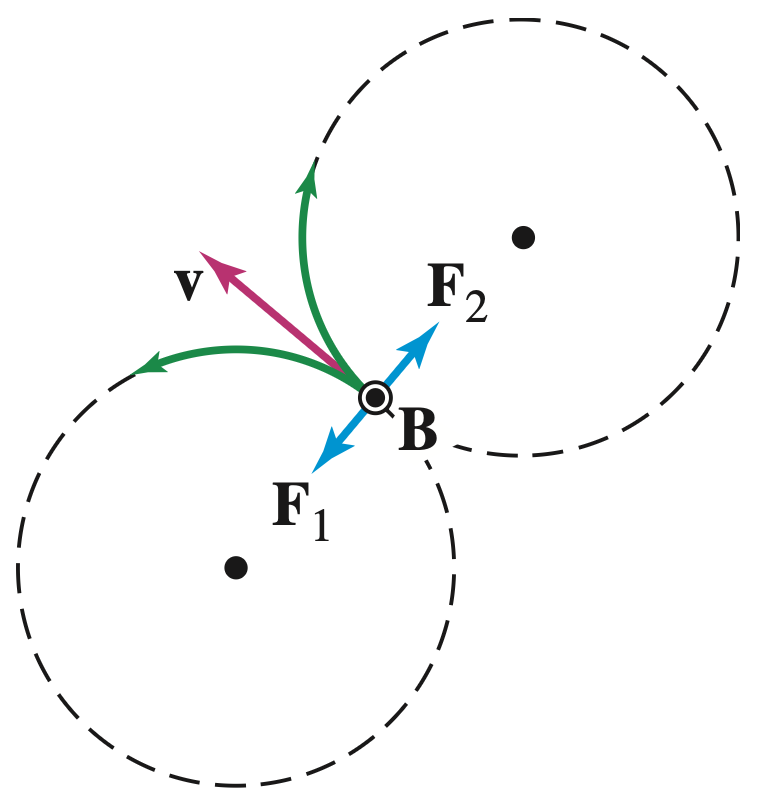
A force \(\v{F}\) (in newtons) on an electron moving at velocity \(\v{v}\) meters per second in a uniform magnetic field \(\v{B}\) (in teslas) is given by \(\v{F} = q\lp \v{v} \times \v{B} \rp\text{,}\) where \(q = -1.6 \times 10^{-19}\) coulombs is the charge on the electron. Assume an electron moves with velocity \(\v{v}\) in the plane and \(\v{B}\) is a uniform magnetic field pointing directly out of the page. Which of the two vectors, \(\v{F}_1\) or \(\v{F}_2\text{,}\) in the following figure represents the force on the electron? Remember that \(q\) is negative.
Figure 12.4.29. The magnetic field vector \(\v{B}\) points directly out of the page.
Solution.
Since the magnetic field \(\v{B}\) points directly out the page (toward us), the right-hand rule implies that the cross product \(\v{v} \times \v{B}\) is in the direction of \(\v{F}_2\text{.}\)

12.4.41.

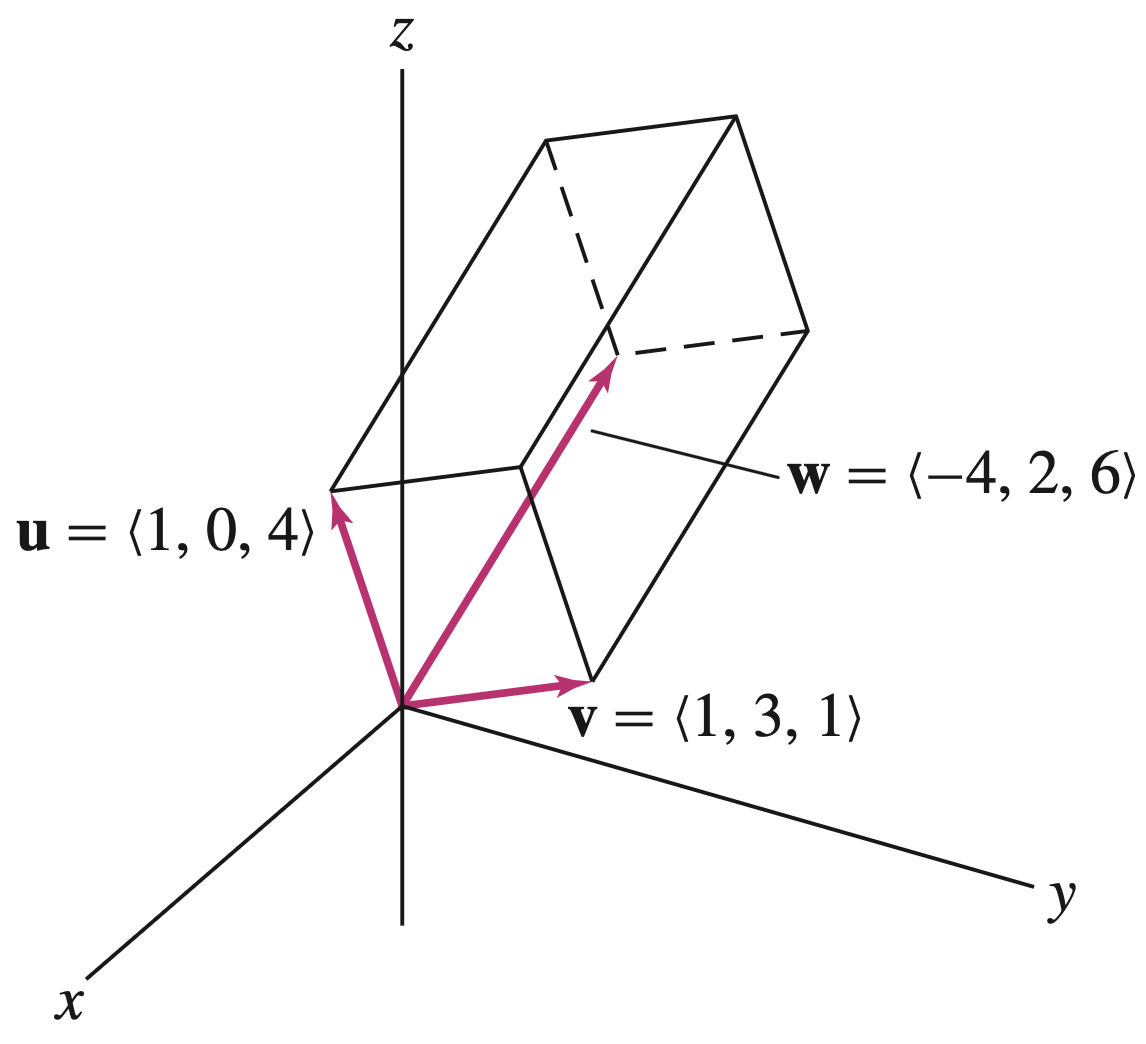
Find the area of the parallelogram spanned by \(\v{v}\) and \(\v{w}\) in the following figure.
Figure 12.4.30.
Solution.
The area of the parallelogram equals the length of the cross product of the two vectors \(\v{v} = \la 1,3,1 \ra\) and \(\v{w} = \la -4,2,6 \ra\text{.}\) We calculate the cross product as follows:
\begin{align*} \v{v} \times \v{w} \amp= \begin{vmatrix} \v{i} \amp \v{j} \amp \v{k} \\ 1 \amp 3 \amp 1 \\ -4 \amp 2 \amp 6 \end{vmatrix} \\ \amp= (18 - 2)\v{i} - (6 + 4)\v{j} + (2 + 12)\v{k} \\ \amp= 16\v{i} - 10\v{j} + 14\v{k} \end{align*}
The length of this vector \(16\v{i} - 10\v{j} + 14\v{k}\) is
\begin{equation*} \sqrt{16^2 + (-10)^2 + 14^2} = 2\sqrt{138} \approx 23.49 \text{ units}^2 \end{equation*}
Hence, the area of the parallelogram is approximately \(23.49 \text{ units}^2\text{.}\)

12.4.47.

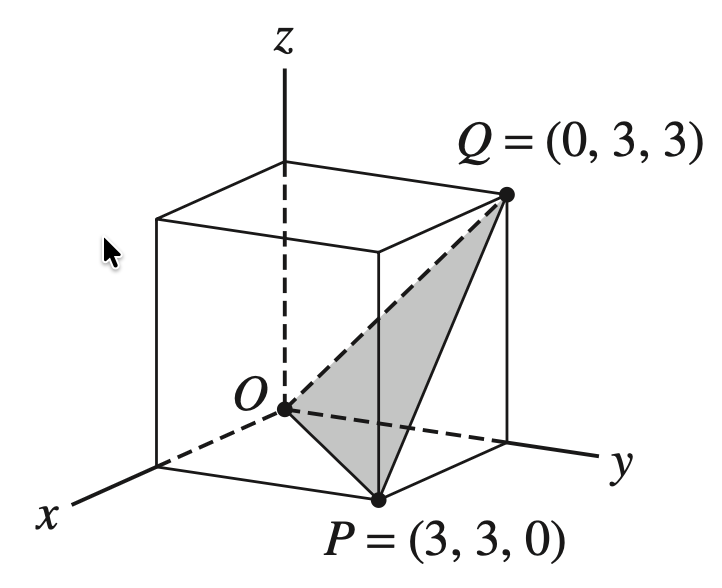
Sketch the triangle with vertices at the origin \(O\text{,}\) \(P = (3,3,0)\text{,}\) and \(Q = (0,3,3)\text{,}\) and compute its area using cross product.
Solution.
The triangle \(OPQ\) is shown in the following figure.
Figure 12.4.31.
The area \(S\) of the triangle is half of the area of the parallelogram spanned by the vectors \(\overrightarrow{OP} = \la 3,3,0 \ra\) and \(\overrightarrow{OQ} = \la 0,3,3 \ra\text{.}\) Thus,
\begin{equation*} S = \frac{1}{2} \|\overrightarrow{OP} \times \overrightarrow{OQ}\| \end{equation*}
We compute the cross product:
\begin{align*} \overrightarrow{OP} \times \overrightarrow{OQ} \amp= \begin{vmatrix} \v{i} \amp \v{j} \amp \v{k} \\ 3 \amp 3 \amp 0 \\ 0 \amp 3 \amp 3 \end{vmatrix} \\ \amp= \begin{vmatrix} 3 \amp 0 \\ 3 \amp 3 \end{vmatrix} \v{i} - \begin{vmatrix} 3 \amp 0 \\ 0 \amp 3 \end{vmatrix} \v{j} + \begin{vmatrix} 3 \amp 3 \\ 0 \amp 3 \end{vmatrix} \v{k} \\ \amp= 9\v{i} - 9\v{j} + 9\v{k}\\ \amp= 9\la 1, -1, 1 \ra \end{align*}
Substituting into the area formula, we obtain
\begin{align*} S \amp= \frac{1}{2} \|9 \la 1,-1,1 \ra \| \\ \amp= \frac{9}{2} \|\la 1,-1,1 \ra \| \\ \amp= \frac{9}{2} \sqrt{1^2 + (-1)^2 + 1^2} \\ \amp= \frac{9\sqrt{3}}{2} \\ \amp\approx 7.8 \end{align*}
The area of the triangle is \(S = \dfrac{9\sqrt{3}}{2} \approx 7.8\text{.}\)

12.4.51.

Check that the four points \(P = (2,4,4)\text{,}\) \(Q = (3,1,6)\text{,}\) \(R = (2,8,0)\text{,}\) and \(S = (7,2,1)\) all lie in a plane. Then use vectors to find the area of the quadrilateral they define.
Solution.
The points \(P\text{,}\) \(Q\text{,}\) and \(R\) determine a plane with normal vector \(\v{n}\text{.}\) \(S\) lies in that plane if \(\overrightarrow{PS}\) is perpendicular to \(\v{n}\text{.}\) To find \(\v{n}\text{,}\) we compute
\begin{align*} \overrightarrow{PQ} \times \overrightarrow{PR} \amp \la 1,-3,2 \ra \times \la 0,4,-4 \ra \\ \amp= \begin{vmatrix} \v{i} \amp \v{j} \amp \v{k} \\ 1 \amp -3 \amp 2 \\ 0 \amp 4 \amp -4 \end{vmatrix} \\ \amp= \begin{vmatrix} -3 \amp 2 \\ 4 \amp -4 \end{vmatrix} \v{i} - \begin{vmatrix} 1 \amp 2 \\ 0 \amp -4 \end{vmatrix} \v{j} + \begin{vmatrix} 1 \amp -3 \\ 0 \amp 4 \end{vmatrix} \v{k}\\ \amp= 4\v{i} + 4\v{j} + 4\v{k} \end{align*}
Since
\begin{equation*} \la 4,4,4 \ra \cdot \overrightarrow{PS} = \la 4,4,4 \ra \cdot \la 5,-2,-3 \ra = 0 \end{equation*}
the normal vector is also orthogonal to \(\overrightarrow{PS}\text{,}\) so that the vector \(\overrightarrow{PS}\text{,}\) and therefore the point \(S\text{,}\) also lies in the plane. So all four points lie in a plane.
To find the area of the quadrilateral of which they are the vectices, divide the quadrilateral into the two triangles \(\triangle PQR\) and \(\triangle SQR\text{.}\) The area of each of these triangles is given by half the magnitude of the cross product of two of its sides. First, we must compute various vectors:
\begin{align*} \overrightarrow{PQ} \amp= \la 3-2, 1-4, 6-4 \ra = \la 1,-3,2 \ra\\ \overrightarrow{PR} \amp= \la 2-2, 8-4, 0-4 \ra = \la 0,4,-4 \ra\\ \overrightarrow{SQ} \amp= \la 3-7, 1-2, 6-1 \ra = \la -4,-1,5 \ra\\ \overrightarrow{SR} \amp= \la 2-7, 8-2, 0-1 \ra = \la -5,6,-1 \ra \end{align*}
To find the area of \(\triangle PQR\text{,}\) we must compute \(\overrightarrow{PQ} \times \overrightarrow{PR}\text{;}\) to find the area of \(\triangle SQR\text{,}\) we must compute \(\overrightarrow{SQ} \times \overrightarrow{SR}\text{.}\)
\begin{align*} \overrightarrow{PQ} \times \overrightarrow{PR} \amp= \begin{vmatrix} \v{i} \amp \v{j} \amp \v{k} \\ 1 \amp -3 \amp 2 \\ 0 \amp 4 \amp -4 \end{vmatrix} = 4\v{i} + 4\v{j} + 4\v{k}\\ \overrightarrow{SQ} \times \overrightarrow{SR} \amp= \begin{vmatrix} \v{i} \amp \v{j} \amp \v{k} \\ -4 \amp -1 \amp 5 \\ -5 \amp 6 \amp -1 \end{vmatrix} = -29\v{i} - 29\v{j} - 29\v{k} \end{align*}
The area of the quadrilateral, \(\c{S}\text{,}\) is given by
\begin{align*} \c{S} \amp= \frac{1}{2} \| 4\v{i} + 4\v{j} + 4\v{k} \| + \frac{1}{2} \| -29\v{i} - 29\v{j} - 29\v{k} \| \\ \amp= \frac{1}{2} \lp 4\sqrt{3} + 29 \sqrt{3} \rp \\ \amp= \frac{33\sqrt{3}}{2} \\ \amp\approx 28.58 \end{align*}
12.4.55.

Prove the identity using the formula for the cross product.
\begin{equation*} (\v{u} + \v{v}) \times \v{w} = \v{u} \times \v{w} + \v{v} \times \v{w} \end{equation*}
Solution.
We let \(\mathbf{u} = \la a_1, a_2, a_3 \ra\text{,}\) \(\mathbf{v} = \la b_1, b_2, b_3 \ra\) and \(\mathbf{w} = \la c_1, c_2, c_3 \ra\text{.}\) Computing the left-hand side gives
\begin{align*} (\mathbf{u} + \mathbf{v}) \times \mathbf{w} \amp = \la a_1 + b_1, a_2 + b_2, a_3 + b_3 \ra \times \la c_1, c_2, c_3 \ra\\ \amp = \begin{vmatrix} \mathbf{i} \amp \mathbf{j} \amp \mathbf{k} \\ a_1 + b_1 \amp a_2 + b_2 \amp a_3 + b_3 \\ c_1 \amp c_2 \amp c_3 \end{vmatrix}\\ \amp = \begin{vmatrix} a_2 + b_2 \amp a_3 + b_3 \\ c_2 \amp c_3 \end{vmatrix} \mathbf{i} - \begin{vmatrix} a_1 + b_1 \amp a_3 + b_3 \\ c_1 \amp c_3 \end{vmatrix} \mathbf{j} + \begin{vmatrix} a_1 + b_1 \amp a_2 + b_2 \\ c_1 \amp c_2 \end{vmatrix} \mathbf{k}\\ \amp = (c_3(a_2 + b_2) - c_2(a_3 + b_3)) \mathbf{i} - (c_3 (a_1 + b_1) - c_1 (a_3 + b_3)) \mathbf{j} + (c_2(a_1 + b_1) - c_1(a_2 + b_2)) \mathbf{k} \end{align*}
We now compute the right-hand-side of the equality:
\begin{align*} \mathbf{u} \times \mathbf{w} + \mathbf{v} \times \mathbf{w} \amp = \begin{vmatrix} \mathbf{i} \amp \mathbf{j} \amp \mathbf{k} \\ a_1 \amp a_2 \amp a_3 \\ c_1 \amp c_2 \amp c_3 \end{vmatrix} + \begin{vmatrix} \mathbf{i} \amp \mathbf{j} \amp \mathbf{k} \\ b_1 \amp b_2 \amp b_3 \\ c_1 \amp c_2 \amp c_3 \end{vmatrix}\\ \amp = \left| \begin{matrix} a_2 \amp a_3 \\ c_2 \amp c_3 \end{matrix} \right| \mathbf{i} - \left| \begin{matrix} a_1 \amp a_3 \\ c_1 \amp c_3 \end{matrix} \right| \mathbf{j} + \left| \begin{matrix} a_1 \amp a_2 \\ c_1 \amp c_2 \end{matrix} \right| \mathbf{k} + \left| \begin{matrix} b_2 \amp b_3 \\ c_2 \amp c_3 \end{matrix} \right| \mathbf{i} - \left| \begin{matrix} b_1 \amp b_3 \\ c_1 \amp c_3 \end{matrix} \right| \mathbf{j} + \left| \begin{matrix} b_1 \amp b_2 \\ c_1 \amp c_2 \end{matrix} \right| \mathbf{k}\\ \amp = (a_2c_3 - a_3c_2)\mathbf{i} - (a_1c_3 - a_3c_1)\mathbf{j} + (a_1c_2 - a_2c_1)\mathbf{k}\\ \amp \qquad + (b_2c_3 - b_3c_2)\mathbf{i} - (b_1c_3 - b_3c_1)\mathbf{j} + (b_1c_2 - b_2c_1)\mathbf{k}\\ \amp = (a_2c_3 - a_3c_2 + b_2c_3 - b_3c_2)\mathbf{i} - (a_1c_3 - a_3c_1 + b_1c_3 - b_3c_1)\mathbf{j} + (a_1c_2 - a_2c_1 + b_1c_2 - b_2c_1)\mathbf{k}\\ \amp = (c_3(a_2 + b_2) - c_2(a_3 + b_3)) \mathbf{i} - (c_3(a_1 + b_1) - c_1(a_3 + b_3)) \mathbf{j} + (c_2(a_1 + b_1) - c_1(a_2 + b_2)) \mathbf{k} \end{align*}
The results are the same. Hence,
\begin{equation*} (\mathbf{u} + \mathbf{v}) \times \mathbf{w} = \mathbf{u} \times \mathbf{w} + \mathbf{v} \times \mathbf{w}. \end{equation*}

12.4.67.

The torque about the origin \(O\) due to a force \(\v{F}\) acting on an object with position vector \(\v{r}\) is the vector quantity \(\boldsymbol{\tau} = \v{r} \times \v{F}\text{.}\) If several forces \(\v{F}_j\) act at psitions \(\v{r}_j\text{,}\) then the net torque (units: N-m or lb-ft) is the sum
\begin{equation*} \boldsymbol{\tau} = \sum \v{r}_j \times \v{F}_j \end{equation*}
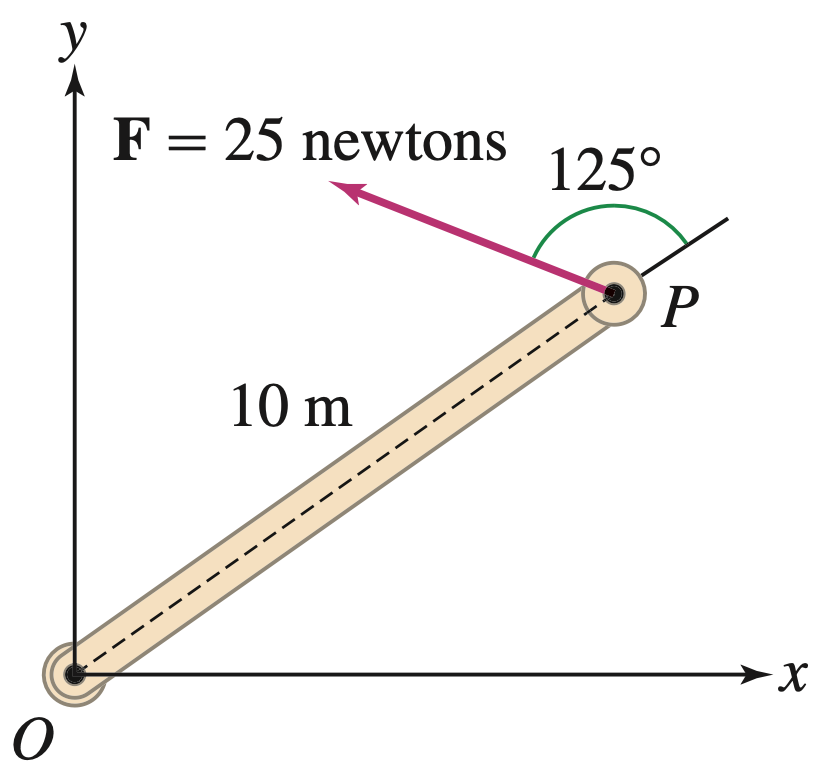
Calculate the net torque \(\boldsymbol{\tau}\) about \(O\) acting at the point \(P\) on the mechanical arm in the following figure, assuming that a 25-newton force acts as indicated.
Figure 12.4.32.
Solution.
We denote by \(O\) and \(P\) the points shown in the figure and compute the position vector \(\v{r} = \overrightarrow{OP}\) and the force vector \(\v{F}\text{.}\)
Denoting by \(\theta\) the angle between the arm and the \(x\)-axis we have
\begin{equation*} \v{r} = \overrightarrow{OP} = 10 (\cos \theta \v{i} + \sin \theta \v{j}) \end{equation*}
The angle between the force vector \(\v{F}\) and the \(x\)-axis is \((\theta + 125^\circ)\text{,}\) hence,
\begin{equation*} \v{F} = 25 (\cos (\theta + 125^\circ) \v{i} + \sin (\theta + 125^\circ) \v{j}) \end{equation*}
The torque \(\boldsymbol{\tau}\) about \(O\) acting at the point \(P\) is the cross product \(\boldsymbol{\tau} = \v{r} \times \v{F}\text{.}\) We compute it using the cross products of the unit vectors \(\v{i}\) and \(\v{j}\text{:}\)
\begin{align*} \boldsymbol{\tau} = \v{r} \times \v{F} \amp = 10 (\cos \theta \v{i} + \sin \theta \v{j}) \times 25 (\cos (\theta + 125^\circ) \v{i} + \sin (\theta + 125^\circ) \v{j})\\ \amp = 250 (\cos \theta \v{i} + \sin \theta \v{j}) \times (\cos (\theta + 125^\circ) \v{i} + \sin (\theta + 125^\circ) \v{j})\\ \amp = 250 (\cos \theta \sin (\theta + 125^\circ) \v{k} + \sin \theta \cos (\theta + 125^\circ) (-\v{k}))\\ \amp = 250 (\sin (\theta + 125^\circ) \cos \theta - \sin \theta \cos (\theta + 125^\circ)) \v{k} \end{align*}
We now use the identity \(\sin \alpha \cos \beta - \sin \beta \cos \alpha = \sin(\alpha - \beta)\) to obtain
\begin{equation*} \boldsymbol{\tau} = 250 \sin (\theta + 125^\circ - \theta) \v{k} = 250 \sin 125^\circ \v{k} \approx 204.79 \v{k} \end{equation*}