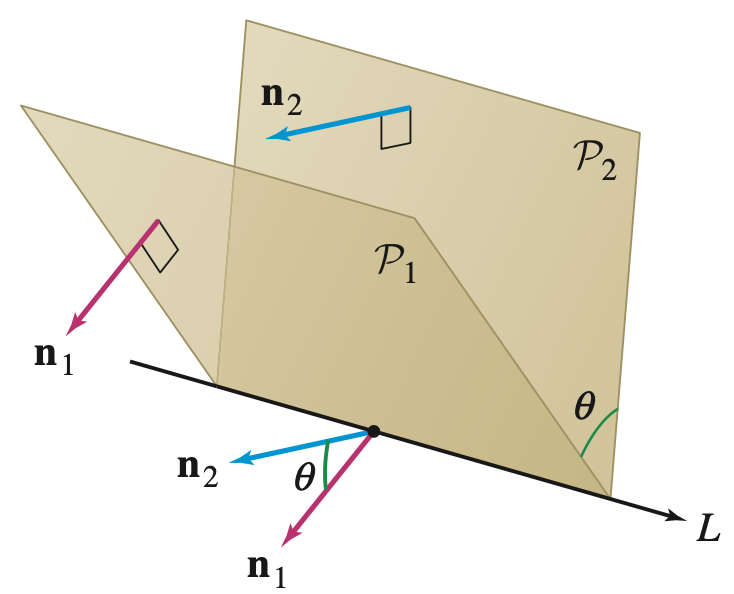
We use the vector form of the equation of the plane.
\begin{equation*}
\v{n}\cdot\la x,y,z\ra=d
\end{equation*}
To find the normal vector to the plane, \(\v{n}\text{,}\) we first compute the vectors \(\overrightarrow{PQ}\) and \(\overrightarrow{PR}\) that lie in the plane, and then find the cross product of these vectors. This gives
\begin{align*}
\overrightarrow{PQ} \amp =\la0,1,1\ra-\la1,0,0\ra=\la-1,1,1\ra\\
\overrightarrow{PR} \amp =\la2,0,1\ra-\la1,0,0\ra=\la1,0,1\ra
\end{align*}
\begin{align*}
\v{n}=\overrightarrow{PQ}\times\overrightarrow{PR} \amp= \begin{vmatrix}\v{i}\amp \v{j}\amp \v{k}\\ -1\amp 1\amp 1\\ 1\amp 0\amp 1\end{vmatrix} \\
\amp=\begin{vmatrix}1\amp 1\\ 0\amp 1\end{vmatrix}\v{i}-\begin{vmatrix}-1\amp 1\\ 1\amp 1\end{vmatrix}\v{j}+\begin{vmatrix}-1\amp 1\\ 1\amp 0\end{vmatrix}\v{k} \\
\amp=\v{i}+2\v{j}-\v{k} \\
\amp=\la1,2,-1\ra
\end{align*}
We now choose any one of the three points in the plane, say \(P=(1,0,0),\) and compute \(d\text{.}\)
\begin{equation*}
d=\v{n}\cdot\overrightarrow{OP}=\la1,2,-1\ra\cdot\la1,0,0\ra=1\cdot1+2\cdot0+(-1)\cdot0=1
\end{equation*}
Putting it all together, the equation of the plane is
\begin{align*}
\la1,2,-1\ra\cdot\la x,y,z\ra \amp= 1\\
x+2y-z \amp= 1
\end{align*}