Worksheet Assigned Problems for Section 13.2

The problems listed below are assigned to be included in your problem set portfolio. Note that a specific selection of these problems will also form the written homework assignments. I recommend working through all of them to ensure a solid grasp of the material. Reach out to Richard for help if you get stuck or have any questions.
The solutions will be posted after the written homework due dates. If you have any questions about your work, talk to Richard and he is happy to discuss the process with you.

13.2.3.

Evaluate the limit \(\displaystyle \lim_{t\to 0} e^{2t}\v{i} + \ln(t+1)\v{j} + 4\v{k}\)
Solution.
Computing the limit of each component, we obtain
\begin{align*} \lim_{t\to 0} \lp e^{2t}\v{i} + \ln(t+1)\v{j} + 4\v{k} \rp \amp= \lp \lim_{t\to 0} e^{2t} \rp \v{i} + \lp \lim_{t\to 0} \ln(t+1) \rp \v{j} + \lp \lim_{t\to 0} 4 \rp \v{k} \\ \amp= e^0\v{i} + \ln(1)\v{j} + 4\v{k} \\ \amp= \v{i} + 4\v{k} \end{align*}

13.2.9.

Compute the derivative of \(\v{r}(s) = \la e^{1-s}, 1-s, \ln(1-s) \ra\text{.}\)
Solution.
Using componentwise differentiation, we have
\begin{align*} \frac{d\v{r}}{ds} \amp= \la \frac{d}{ds}e^{1-s}, \frac{d}{ds}(1-s), \frac{d}{ds}\ln(1-s) \ra \\ \amp= \la -e^{1-s}, -1, -\frac{1}{1-s} \ra \end{align*}

13.2.15.

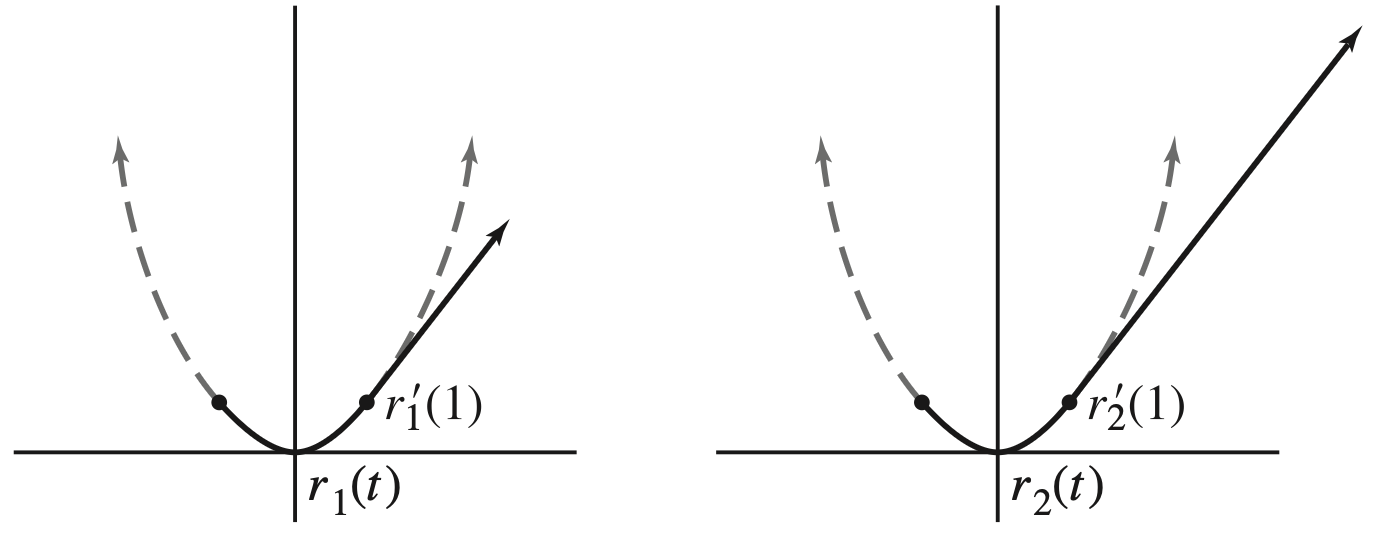
Sketch the curve parametrized by \(\v{r}_1(t) = \la t,t^2 \ra\) together with its tangent vector at \(t = 1\text{.}\) Then do the same for \(\v{r}_2(t) = \la t^3, t^6 \ra\)
Solution.
Note that \(\v{r}'(t) = \la 1,2t \ra\) and so \(\v{r}'(1) = \la 1,2 \ra\text{.}\) The graph of \(\v{r}_1(t)\) satisfies \(y = x^2\text{.}\)
Likewise, \(\v{r}_2'(t) = \la 3t^2,6t^5 \ra\) and so \(\v{r}_2'(1) = \la 3,6 \ra\text{.}\) The graph of \(\v{r}_2(t)\) also satisfies \(y = x^2\text{.}\)
Both graphs and tangent vectors are given below.
Figure 13.2.20.

13.2.17.

Determine the value of \(t\) between \(0\) and \(2\pi\) such that the tangent vector to the clycloid \(\v{r}(t) = \la t - \sin(t), 1 - \cos(t) \ra\) is parallel to \(\la \sqrt{3}, 1 \ra\text{.}\)
Solution.
We first find the tangent vector \(\v{r}'(t)\text{:}\)
\begin{equation*} \v{r}'(t) = \frac{d}{dt}\la t - \sin(t), 1 - \cos(t) \ra = \la 1 - \cos(t), \sin(t) \ra \end{equation*}
For this vector to be parallel to \(\v{v} = \la \sqrt{3}, 1 \ra\text{,}\) the ratio of their \(y\) and \(x\) components (the slope) must be equal.
\begin{equation*} \frac{\sin(t)}{1 - \cos(t)} = \frac{1}{\sqrt{3}} \end{equation*}
We can simplify the left side using half-angle identities: \(\sin(t) = 2\sin(t/2)\cos(t/2)\) and \(1-\cos(t) = 2\sin^2(t/2)\text{.}\)
\begin{align*} \frac{2\sin(t/2)\cos(t/2)}{2\sin^2(t/2)} \amp= \frac{1}{\sqrt{3}} \\ \cot(t/2) \amp= \frac{1}{\sqrt{3}} \\ \tan(t/2) \amp= \sqrt{3} \end{align*}
Since \(t\) is between \(0\) and \(2\pi\text{,}\) we have \(0 \lt t/2 \lt \pi\text{.}\) The only solution for the tangent function in this range is:
\begin{equation*} t/2 = \frac{\pi}{3} \implies t = \frac{2\pi}{3} \end{equation*}
Thus, the tangent vector is parallel to \(\la \sqrt{3}, 1 \ra\) when \(t = \frac{2\pi}{3}\text{.}\)

Exercise Group.

In the following exercises, evaluate the derivative by using the appropriate Product Rule, where
\begin{equation*} \v{r}_1(t) = \la t^2, t^3, t \ra \, , \qquad \v{r}_2(t) = \la e^{3t}, e^{2t}, e^t \ra \end{equation*}
13.2.19.
\(\dfrac{d}{dt} \lp \v{r}_1(t) \cdot \v{r}_2(t) \rp\)
Solution.
\begin{align*} \dfrac{d}{dt} \lp \v{r}_1(t) \cdot \v{r}_2(t) \rp \amp= \v{r}_1'(t) \cdot \v{r}_2(t) + \v{r}_1(t) \cdot \v{r}_2'(t) \\ \amp= \la 2t, 3t^2, 1 \ra \cdot \la e^{3t}, e^{2t}, e^t \ra + \la t^2, t^3, t \ra \cdot \la 3e^{3t}, 2e^{2t}, e^t \ra \\ \amp= 2te^{3t} + 3t^2e^{2t} + e^t + 3t^2e^{3t} + 2t^3e^{2t} + te^t \\ \amp= \lp 3t^2 + 2t \rp e^{3t} + \lp 2t^3 + 3t^2 \rp e^{2t} + (t+1)e^t \end{align*}
13.2.21.
\(\dfrac{d}{dt} \lp \v{r}_1(t) \times \v{r}_2(t) \rp\)
Solution.
\begin{align*} \dfrac{d}{dt} \lp \v{r}_1(t) \times \v{r}_2(t) \rp \amp= \v{r}_1'(t) \times \v{r}_2(t) + \v{r}_1(t) \times \v{r}_2'(t) \\ \amp= \la 2t, 3t^2, 1 \ra \times \la e^{3t}, e^{2t}, e^t \ra + \la t^2, t^3, t \ra \times \la 3e^{3t}, 2e^{2t}, e^t \ra \\ \amp= \begin{vmatrix} \v{i} \amp \v{j} \amp \v{k} \\ 2t \amp 3t^2 \amp 1 \\ e^{3t} \amp e^{2t} \amp e^t \end{vmatrix} + \begin{vmatrix} \v{i} \amp \v{j} \amp \v{k} \\ t^2 \amp t^3 \amp t \\ 3e^{3t} \amp 2e^{2t} \amp e^t \end{vmatrix} \\ \amp= \lp 3t^2e^t - e^{2t} \rp \v{i} + \lp e^{3t} - 2te^t \rp \v{j} + \lp 2te^{2t} - 3t^2e^{3t} \rp \v{k} \\ \amp \qquad + \lp t^3e^t - 2te^{2t} \rp \v{i} + \lp 3t^2e^{3t} - t^2e^t \rp \v{j} + \lp 2t e^{2t} - 3t^3 e^{3t} \rp \v{k} \\ \amp= \left[ \lp 3t^2 + t^3\rp e^t - \lp 1 + 2t \rp e^{2t} \right] \v{i} + \left[ \lp 1 + 3t\rp e^{3t} - \lp 2t + t^2 \rp e^t \right] \v{j} \\ \amp \qquad + \left[ \lp 2t + 2t^2 \rp e^{2t} - \lp 3t^2 + 3t^3 \rp e^{3t} \right] \v{k} \end{align*}

13.2.27.

Evaluate \(\dfrac{d}{dt}\v{r}\lp g(t) \rp\) using the Chain Rule, where
\begin{equation*} \v{r}(t) = \la e^t, e^{2t}, 4 \ra \, , \qquad g(t) = 4t + 9 \end{equation*}
Solution.
We first differentiate the two functions.
\begin{align*} \v{r}'(t) \amp= \frac{d}{dt} \la e^t, e^{2t}, 4 \ra = \la e^t, 2e^{2t}, 0 \ra \\ g'(t) \amp= \frac{d}{dt} (4t + 9) = 4 \end{align*}
Using the Chain Rule, we have
\begin{align*} \frac{d}{dt}\v{r}\lp g(t) \rp \amp= \v{r}'(g(t)) \cdot g'(t) \\ \amp= \v{r}'(4t + 9) \cdot 4 \\ \amp= \la e^{4t+9}, 2e^{2(4t+9)}, 0 \ra \cdot 4 \\ \amp= \la 4e^{4t+9}, 8e^{8t+18}, 0 \ra \end{align*}

13.2.33.

Find a parametrization of the tangent line of \(\v{r}(t) = \la 1-t^2, 5t, 2t^3 \ra\) at the point \(t = 2\text{.}\)
Solution.
The tangent line is parametrized by
\begin{equation*} \ell(t) = \v{r}(2) + t\v{r}'(2) \end{equation*}
We compute the vectors in the above parametrization
\begin{align*} \v{r}(2) \amp= \la 1-2^2, 5\cdot 2, 2\cdot 2^3 \ra = \la -3, 10, 16 \ra \\ \v{r}'(t)\amp= \frac{d}{dt} \la 1-t^2, 5t, 2t^3 \ra = \la -2t, 5, 6t^2 \ra \quad \implies \quad \v{r}'(2) = \la -4, 5, 24 \ra \end{align*}
Substituting them back into the parametrization, we have
\begin{equation*} \ell(t) = \la -3,10,16 \ra + t \la -4,5,24 \ra = \la -3-4t, 10+5t, 16+24t \ra \end{equation*}

13.2.45.

Evaluate the integral \(\displaystyle \int_0^\pi \la -\sin(t), 6t, 2t+\cos(2t) \ra\, dt\)
Solution.
We integrate the vector-valued function componentwise:
\begin{align*} \int_0^\pi \la -\sin(t), 6t, 2t+\cos(2t) \ra\, dt \amp= \la \int_0^\pi -\sin(t)\, dt, \int_0^\pi 6t\, dt, \int_0^\pi (2t+\cos(2t))\, dt \ra \end{align*}
We evaluate each integral separately:
\begin{align*} \int_0^\pi -\sin(t)\, dt \amp= \left[ \cos(t) \right]_0^\pi = \cos(\pi) - \cos(0) = -1 - 1 = -2 \\ \int_0^\pi 6t\, dt \amp= \left[ 3t^2 \right]_0^\pi = 3\pi^2 - 0 = 3\pi^2 \\ \int_0^\pi (2t+\cos(2t))\, dt \amp= \left[ t^2 + \frac{1}{2}\sin(2t) \right]_0^\pi \\ \amp= \left( \pi^2 + \frac{1}{2}\sin(2\pi) \right) - \left( 0^2 + \frac{1}{2}\sin(0) \right) \\ \amp= \pi^2 \end{align*}
Combining these components, the value of the vector integral is:
\begin{equation*} \la -2, 3\pi^2, \pi^2 \ra \end{equation*}

13.2.55.

Find both the general solution of the differential equation and the solution with the given initial condition.
\begin{equation*} \v{r}''(t) = \la 0,2,0 \ra \, , \qquad \v{r}(3) = \la 1,1,0 \ra \, , \qquad \v{r}'(3) = \la 0,0,1 \ra \end{equation*}
Solution.
To find the general solution we first find \(\v{r}'(t)\) by integrating \(\v{r}''(t)\text{.}\)
\begin{equation*} \v{r}'(t) = \int \v{r}''(t)\, dt = \int \la 0,2,0 \ra \, dt = \la 0,2t,0 \ra + \v{c}_1 \end{equation*}
We now integrate \(\v{r}'(t)\) to find the general solution \(\v{r}(t)\text{.}\)
\begin{equation*} \v{r}(t) = \int \v{r}'(t)\, dt = \int \lp \la 0,2t,0 \ra + \v{c}_1 \rp\, dt = \la 0,t^2,0 \ra + \v{c}_1 t + \v{c}_2 \end{equation*}
We substitute the initial conditions to find the particular solution. This gives
\begin{align*} \v{r}'(3) \amp= \la 0,6,0 \ra + \v{c}_1 = \la 0,0,1 \ra \quad \implies \quad \v{c}_1 = \la 0,-6,1 \ra \\ \v{r}(3) \amp= \la 0,9,0 \ra + \v{c}_1 \cdot 3 + \v{c}_2 = \la 1,1,0 \ra \\ \amp\quad\, \, \la 0,9,0 \ra + \la 0,-18,3 \ra + \v{c}_2 = \la 1,1,0 \ra \\ \amp\implies \quad \v{c}_2 = \la 1,10,-3 \ra \end{align*}
Combining everything, we obtain the following solution
\begin{align*} \v{r}(t) \amp= \la 0,t^2,0 \ra + t \la 0,-6,1 \ra + \la 1,10,-3 \ra \\ \amp= \la 1, t^2-6t+10, t-3 \ra \end{align*}