
Worksheet Assigned Problems for Section 14.6

The problems listed below are assigned to be included in your problem set portfolio. Note that a specific selection of these problems will also form the written homework assignments. I recommend working through all of them to ensure a solid grasp of the material. Reach out to Richard for help if you get stuck or have any questions.
The solutions will be posted after the written homework due dates. If you have any questions about your work, talk to Richard and he is happy to discuss the process with you.

14.6.1.

Let \(f(x,y,z) = x^2y^3 + z^4\) and \(x = s^2\text{,}\) \(y = st^2\text{,}\) and \(z = s^2t\text{.}\)
  1. Calculate the primary derivatives \(\dfrac{\partial f}{\partial x}\text{,}\) \(\dfrac{\partial f}{\partial y}\text{,}\) and \(\dfrac{\partial f}{\partial z}\text{.}\)
  2. Calculate \(\dfrac{\partial x}{\partial s}\text{,}\) \(\dfrac{\partial y}{\partial s}\text{,}\) and \(\dfrac{\partial z}{\partial s}\text{.}\)
  3. Compute \(\dfrac{\partial f}{\partial s}\) using the Chain Rule:
    \begin{equation*} \frac{\partial f}{\partial s} = \frac{\partial f}{\partial x}\frac{\partial x}{\partial s} + \frac{\partial f}{\partial y}\frac{\partial y}{\partial s} + \frac{\partial f}{\partial z}\frac{\partial z}{\partial s} \end{equation*}
Solution.
  1. \begin{align*} \frac{\partial f}{\partial x} \amp= 2xy^3 \\ \frac{\partial f}{\partial y} \amp= 3x^2y^2 \\ \frac{\partial f}{\partial z} \amp= 4z^3 \end{align*}
  2. \begin{align*} \frac{\partial x}{\partial s} \amp= 2s \\ \frac{\partial y}{\partial s} \amp= t^2 \\ \frac{\partial z}{\partial s} \amp= 2st \end{align*}
  3. Using the Chain Rule formula:
    \begin{align*} \frac{\partial f}{\partial s} \amp= (2xy^3)(2s) + (3x^2y^2)(t^2) + (4z^3)(2st) \end{align*}
    Now we substitute \(x = s^2\text{,}\) \(y = st^2\text{,}\) and \(z = s^2t\) back into the equation:
    \begin{align*} \frac{\partial f}{\partial s} \amp= 2(s^2)(st^2)^3(2s) + 3(s^2)^2(st^2)^2(t^2) + 4(s^2t)^3(2st) \\ \amp= 2(s^2)(s^3t^6)(2s) + 3(s^4)(s^2t^4)(t^2) + 4(s^6t^3)(2st) \\ \amp= 4s^6t^6 + 3s^6t^6 + 8s^7t^4 \\ \amp= 7s^6t^6 + 8s^7t^4 \end{align*}

Exercise Group.

In the following exercises, use the Chain Rule to calculate the partial derivatives, Express the answer in terms of the independent variables.
14.6.7.
\(\dfrac{\partial F}{\partial y}\text{;}\) \(F(u,v) = e^{u + v}\text{,}\) \(u = x^2\text{,}\) \(v = xy\text{.}\)
Solution.
Using the Chain Rule:
\begin{equation*} \frac{\partial F}{\partial y} = \frac{\partial F}{\partial u} \frac{\partial u}{\partial y} + \frac{\partial F}{\partial v} \frac{\partial v}{\partial y} \end{equation*}
First, calculate the partial derivatives:
\begin{align*} \frac{\partial F}{\partial u} \amp= e^{u+v} \amp \frac{\partial u}{\partial y} \amp= 0 \\ \frac{\partial F}{\partial v} \amp= e^{u+v} \amp \frac{\partial v}{\partial y} \amp= x \end{align*}
Substitute these into the Chain Rule:
\begin{align*} \frac{\partial F}{\partial y} \amp= (e^{u+v})(0) + (e^{u+v})(x) \\ \amp= x e^{u+v} \end{align*}
Finally, substitute \(u = x^2\) and \(v = xy\) back into the equation:
\begin{equation*} \frac{\partial F}{\partial y} = x e^{x^2 + xy} \end{equation*}
14.6.9.
\(\dfrac{\partial h}{\partial t_2}\text{;}\) \(f(x,y) = \dfrac{x}{y}\text{,}\) \(x = t_1t_2\text{,}\) \(y = t_1^2t_2\text{.}\)
Solution.
Note that \(h\) represents the composite function \(h(t_1, t_2) = f(x(t_1, t_2), y(t_1, t_2))\text{.}\) Using the Chain Rule:
\begin{equation*} \frac{\partial h}{\partial t_2} = \frac{\partial f}{\partial x} \frac{\partial x}{\partial t_2} + \frac{\partial f}{\partial y} \frac{\partial y}{\partial t_2} \end{equation*}
Calculate the necessary partial derivatives:
\begin{align*} \frac{\partial f}{\partial x} \amp= \frac{1}{y} \amp \frac{\partial x}{\partial t_2} \amp= t_1 \\ \frac{\partial f}{\partial y} \amp= -\frac{x}{y^2} \amp \frac{\partial y}{\partial t_2} \amp= t_1^2 \end{align*}
Substitute these into the Chain Rule:
\begin{align*} \frac{\partial h}{\partial t_2} \amp= \left(\frac{1}{y}\right)(t_1) + \left(-\frac{x}{y^2}\right)(t_1^2) \\ \amp= \frac{t_1}{y} - \frac{xt_1^2}{y^2} \end{align*}
Finally, substitute \(x = t_1t_2\) and \(y = t_1^2t_2\text{:}\)
\begin{align*} \frac{\partial h}{\partial t_2} \amp= \frac{t_1}{t_1^2t_2} - \frac{(t_1t_2)t_1^2}{(t_1^2t_2)^2} \\ \amp= \frac{1}{t_1t_2} - \frac{t_1^3t_2}{t_1^4t_2^2} \\ \amp= \frac{1}{t_1t_2} - \frac{1}{t_1t_2} = 0 \end{align*}
(Alternatively, substituting \(x\) and \(y\) into \(f\) first gives \(f(x,y) = \frac{t_1t_2}{t_1^2t_2} = \frac{1}{t_1}\text{.}\) Since this expression only depends on \(t_1\text{,}\) its derivative with respect to \(t_2\) is trivially \(0\text{!}\))

14.6.13.

Use the Chain Rule to evaluate the partial derivative \(\dfrac{\partial g}{\partial \theta}\) at the point \((r, \theta) = \lp 2\sqrt{2}, \dfrac{\pi}{4} \rp\text{,}\) where
\begin{equation*} g(x,y) = \frac{1}{x + y^2}\, , \qquad x = r\cos(\theta) \quad \text{ and } \quad y = r\sin(\theta) \end{equation*}
Solution.
First, let’s find the values of \(x\) and \(y\) at the given point:
\begin{align*} x \amp= 2\sqrt{2}\cos\lp\frac{\pi}{4}\rp = 2\sqrt{2} \lp\frac{\sqrt{2}}{2}\rp = 2 \\ y \amp= 2\sqrt{2}\sin\lp\frac{\pi}{4}\rp = 2\sqrt{2} \lp\frac{\sqrt{2}}{2}\rp = 2 \end{align*}
The Chain Rule states:
\begin{equation*} \frac{\partial g}{\partial \theta} = \frac{\partial g}{\partial x} \frac{\partial x}{\partial \theta} + \frac{\partial g}{\partial y} \frac{\partial y}{\partial \theta} \end{equation*}
Let’s calculate each of these partial derivatives:
\begin{align*} \frac{\partial g}{\partial x} \amp= -(x+y^2)^{-2} = -\frac{1}{(x+y^2)^2} \\ \frac{\partial g}{\partial y} \amp= -2y(x+y^2)^{-2} = -\frac{2y}{(x+y^2)^2} \\ \frac{\partial x}{\partial \theta} \amp= -r\sin(\theta) \\ \frac{\partial y}{\partial \theta} \amp= r\cos(\theta) \end{align*}
Now, evaluate these derivatives at our specific point (\(x=2, y=2, r=2\sqrt{2}, \theta=\frac{\pi}{4}\)):
\begin{align*} \frac{\partial g}{\partial x} \amp= -\frac{1}{(2 + 2^2)^2} = -\frac{1}{36} \\ \frac{\partial g}{\partial y} \amp= -\frac{2(2)}{(2 + 2^2)^2} = -\frac{4}{36} = -\frac{1}{9} \\ \frac{\partial x}{\partial \theta} \amp= -2\sqrt{2}\sin\lp\frac{\pi}{4}\rp = -2 \\ \frac{\partial y}{\partial \theta} \amp= 2\sqrt{2}\cos\lp\frac{\pi}{4}\rp = 2 \end{align*}
Substitute these values back into the Chain Rule:
\begin{align*} \frac{\partial g}{\partial \theta} \amp= \lp-\frac{1}{36}\rp(-2) + \lp-\frac{1}{9}\rp(2) \\ \amp= \frac{2}{36} - \frac{2}{9} = \frac{1}{18} - \frac{4}{18} = -\frac{3}{18} = -\frac{1}{6} \end{align*}

14.6.19.

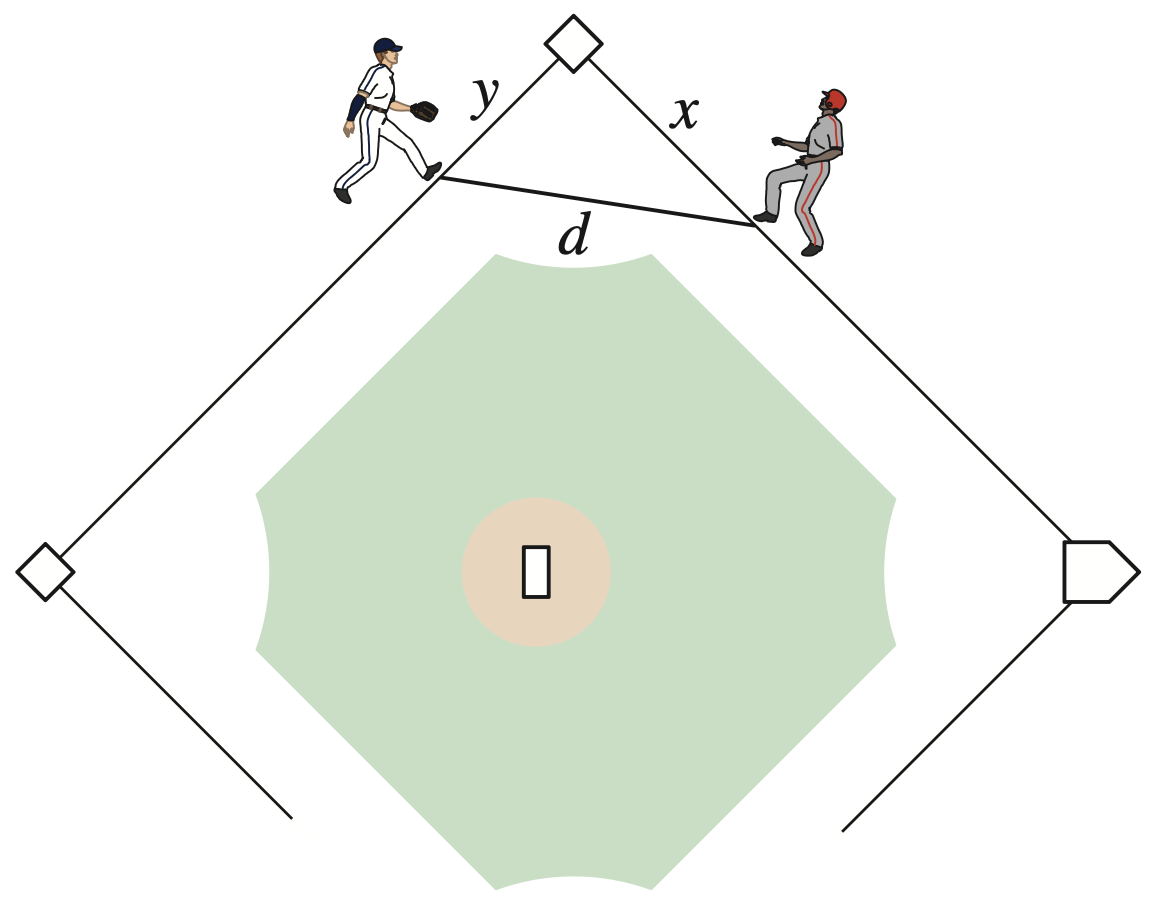
A baseball player hits the ball and then runs down the first base line at 20 ft/s. The first baseman fields the ball and then runs toward first base along the second base line at 18 ft/s as shown in the figure below.
Figure 14.6.10.
Determine how fast the distance between the two players is changing at a moment when the hitter is 8 ft from first base and the first baseman is 6 ft from first base.
Solution.
As in the figure, let \(x(t)\) be the distance of the runner from first base at time \(t\text{,}\) and \(y(t)\) the distance of the fielder from first base at time \(t\text{.}\) With first base at the origin, fix signs so that both speeds are positive and the distances from the base are negative. Then the distance between the two players is \(D(t) = \sqrt{x(t)^2 + y(t)^2}\text{.}\) Using the Chain Rule, the rate of change of distance with respect to time is
\begin{equation*} \frac{dD}{dt} = \frac{dD}{dx} \cdot \frac{dx}{dt} + \frac{dD}{dy} \cdot \frac{dy}{dt}. \end{equation*}
We are given that \(\frac{dx}{dt} = 20\) and \(\frac{dy}{dt} = 18\text{.}\) Further,
\begin{align*} \frac{dD}{dx} \amp= \frac{1}{2}(x^2 + y^2)^{-1/2} \cdot 2x = \frac{x}{\sqrt{x^2 + y^2}}, \\ \frac{dD}{dy} \amp= \frac{1}{2}(x^2 + y^2)^{-1/2} \cdot 2y = \frac{y}{\sqrt{x^2 + y^2}} \end{align*}
so that for the given values of \(x\) and \(y\)
\begin{align*} \left. \frac{dD}{dx} \right|_{(x,y)=(-8,-6)} \amp= -\frac{8}{\sqrt{8^2 + 6^2}} = -\frac{4}{5} \\ \left. \frac{dD}{dy} \right|_{(x,y)=(-8,-6)} \amp= -\frac{6}{\sqrt{8^2 + 6^2}} = -\frac{3}{5}. \end{align*}
\begin{equation*} \frac{dD}{dt} = -\frac{4}{5} \cdot 20 - \frac{3}{5} \cdot 18 = -\frac{134}{5} = -26.8 \text{ ft/sec}. \end{equation*}
The distance between the players is decreasing at a rate of \(26.8 \text{ ft/sec}\text{.}\)

14.6.21.

Two spacecraft are following paths in space given by \(\v{r}_1 = \la \sin(t), t, t^2 \ra\) and \(\v{r}_2(t) = \la \cos(t), 1-t, t^3 \ra\text{.}\) If the temperature for points in space is given by \(T(x,y,z) = x^2y(1-z)\text{,}\) use the Chain Rule to determine the rate of change of the difference \(D\) in the temperatures the two spacecraft experience at time \(t = \pi\text{.}\)
Solution.
The difference in temperatures is \(D(t) = T(\v{r}_1(t)) - T(\v{r}_2(t))\text{.}\) The rate of change is \(D'(t) = \frac{d}{dt}T(\v{r}_1(t)) - \frac{d}{dt}T(\v{r}_2(t))\text{.}\) By the Chain Rule, \(\frac{d}{dt}T(\v{r}(t)) = \nabla T(\v{r}(t)) \cdot \v{r}'(t)\text{.}\)
First, calculate the gradient of \(T\text{:}\)
\begin{equation*} \nabla T = \la 2xy(1-z), x^2(1-z), -x^2y \ra \end{equation*}
Spacecraft 1: Evaluate path and velocity at \(t = \pi\text{:}\)
\begin{align*} \v{r}_1(\pi) \amp= \la \sin(\pi), \pi, \pi^2 \ra = \la 0, \pi, \pi^2 \ra \\ \v{r}_1'(t) \amp= \la \cos(t), 1, 2t \ra \implies \v{r}_1'(\pi) = \la -1, 1, 2\pi \ra \end{align*}
Evaluate gradient at \(\v{r}_1(\pi)\text{:}\)
\begin{equation*} \nabla T(0, \pi, \pi^2) = \la 2(0)(\pi)(1-\pi^2), (0)^2(1-\pi^2), -(0)^2(\pi) \ra = \la 0, 0, 0 \ra \end{equation*}
Rate of change for spacecraft 1:
\begin{equation*} \frac{d}{dt}T(\v{r}_1(\pi)) = \la 0, 0, 0 \ra \cdot \la -1, 1, 2\pi \ra = 0 \end{equation*}
Spacecraft 2: Evaluate path and velocity at \(t = \pi\text{:}\)
\begin{align*} \v{r}_2(\pi) \amp= \la \cos(\pi), 1-\pi, \pi^3 \ra = \la -1, 1-\pi, \pi^3 \ra \\ \v{r}_2'(t) \amp= \la -\sin(t), -1, 3t^2 \ra \implies \v{r}_2'(\pi) = \la 0, -1, 3\pi^2 \ra \end{align*}
Evaluate gradient at \(\v{r}_2(\pi)\text{:}\)
\begin{align*} \nabla T(-1, 1-\pi, \pi^3) \amp= \la 2(-1)(1-\pi)(1-\pi^3), (-1)^2(1-\pi^3), -(-1)^2(1-\pi) \ra \\ \amp= \la -2(1-\pi)(1-\pi^3), 1-\pi^3, -(1-\pi) \ra \\ \amp= \la 2(\pi-1)(1-\pi^3), 1-\pi^3, \pi-1 \ra \end{align*}
Rate of change for spacecraft 2:
\begin{align*} \frac{d}{dt}T(\v{r}_2(\pi)) \amp= \la 2(\pi-1)(1-\pi^3), 1-\pi^3, \pi-1 \ra \cdot \la 0, -1, 3\pi^2 \ra \\ \amp= 0 - (1-\pi^3) + 3\pi^2(\pi-1) \\ \amp= \pi^3 - 1 + 3\pi^3 - 3\pi^2 = 4\pi^3 - 3\pi^2 - 1 \end{align*}
Finally, calculate the rate of change of the difference:
\begin{align*} D'(\pi) \amp= \frac{d}{dt}T(\v{r}_1(\pi)) - \frac{d}{dt}T(\v{r}_2(\pi)) \\ \amp= 0 - (4\pi^3 - 3\pi^2 - 1) \\ \amp= -4\pi^3 + 3\pi^2 + 1 \end{align*}

14.6.27.

Suppose that \(z\) is defined implicitly as a function of \(x\) and \(y\) by equation \(F(x,y,z) = xz^2 + y^2z + xy - 1 = 0\text{.}\)
  1. Calculate \(F_x\text{,}\) \(F_y\text{,}\) and \(F_z\text{.}\)
  2. Use () to calculate \(\dfrac{\partial z}{\partial x}\) and \(\dfrac{\partial z}{\partial y}\text{.}\)
Solution.
  1. \begin{align*} F_x \amp= z^2 + y \\ F_y \amp= 2yz + x \\ F_z \amp= 2xz + y^2 \end{align*}
  2. Using the implicit differentiation formulas:
    \begin{align*} \frac{\partial z}{\partial x} \amp= -\frac{F_x}{F_z} = -\frac{z^2 + y}{2xz + y^2} \\ \frac{\partial z}{\partial y} \amp= -\frac{F_y}{F_z} = -\frac{2yz + x}{2xz + y^2} \end{align*}

14.6.31.

Calculate the partial derivative \(\dfrac{\partial z}{\partial y}\) of the equation \(e^{xy} + \sin(xz) + y = 0\) using implicit differentiation.
Solution.
Let \(F(x,y,z) = e^{xy} + \sin(xz) + y\text{.}\) By the implicit differentiation formula, \(\frac{\partial z}{\partial y} = -\frac{F_y}{F_z}\text{.}\)
First, calculate the necessary partial derivatives:
\begin{align*} F_y \amp= \frac{\partial}{\partial y}(e^{xy} + \sin(xz) + y) = xe^{xy} + 0 + 1 = xe^{xy} + 1 \\ F_z \amp= \frac{\partial}{\partial z}(e^{xy} + \sin(xz) + y) = 0 + \cos(xz) \cdot x + 0 = x\cos(xz) \end{align*}
Substitute into the formula:
\begin{equation*} \frac{\partial z}{\partial y} = -\frac{xe^{xy} + 1}{x\cos(xz)} \end{equation*}
