14.7.3.
Find the critical points of
\begin{equation*}
f(x,y) = 8y^4 + x^2 + xy - 3y^2 - y^3
\end{equation*}
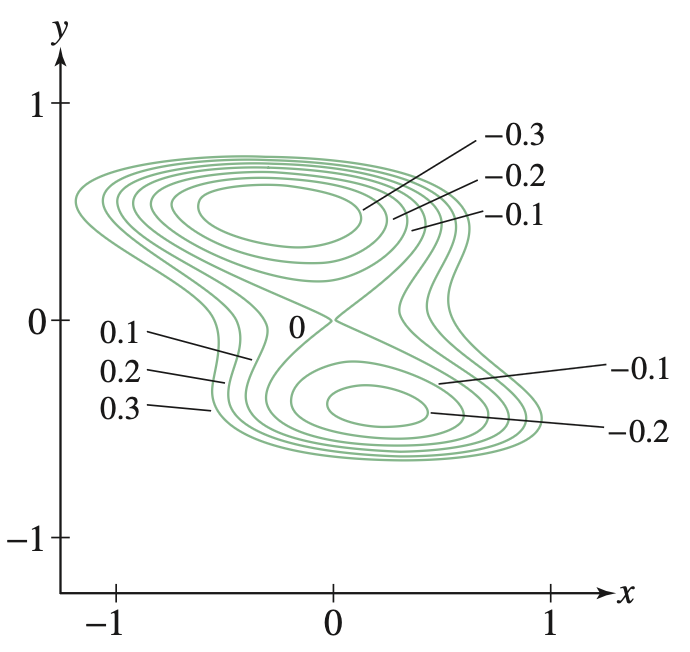
Use the contour map below to determine their nature (local minimum, local maximum, or saddle point).
Solution.
First, we find the partial derivatives and set them to zero:
\begin{align*}
f_x \amp= 2x + y = 0 \implies y = -2x \implies x = -\frac{y}{2} \\
f_y \amp= 32y^3 + x - 6y - 3y^2 = 0
\end{align*}
Substituting \(x = -\frac{y}{2}\) into the second equation:
\begin{align*}
32y^3 - \frac{y}{2} - 6y - 3y^2 \amp= 0 \\
32y^3 - 3y^2 - \frac{13}{2}y \amp= 0 \\
y(64y^2 - 6y - 13) \amp= 0
\end{align*}
This gives \(y = 0\) or \(64y^2 - 6y - 13 = 0\text{.}\) Using the quadratic formula, we find \(y = \frac{6 \pm \sqrt{36 - 4(64)(-13)}}{128} = \frac{6 \pm 58}{128}\text{.}\) Thus, the \(y\)-values are \(0\text{,}\) \(\frac{1}{2}\text{,}\) and \(-\frac{13}{32}\text{.}\)
Using \(x = -\frac{y}{2}\text{,}\) our three critical points are \((0,0)\text{,}\) \(\left(-\frac{1}{4}, \frac{1}{2}\right)\text{,}\) and \(\left(\frac{13}{64}, -\frac{13}{32}\right)\text{.}\)
Now, instead of using the Second Partial Derivative Test, we can just look at the provided contour map to classify these points:
-
At the origin \((0,0)\text{,}\) we see the level curve for \(z = 0\) crossing itself in an "X" shape. The function increases if we move along the \(x\)-axis (towards \(0.1, 0.2\)), but decreases if we move along the \(y\)-axis (towards \(-0.1, -0.2\)). This is the hallmark of a saddle point.
-
At \(\left(-\frac{1}{4}, \frac{1}{2}\right) = (-0.25, 0.5)\text{,}\) we see concentric closed loops with values decreasing inward (from \(0\) down to \(-0.3\)). This "valley" indicates a local minimum.
-
At \(\left(\frac{13}{64}, -\frac{13}{32}\right) \approx (0.2, -0.4)\text{,}\) we see another set of concentric closed loops with values decreasing inward (from \(0\) down to \(-0.2\)). This second "valley" is also a local minimum.