15.4.3.
Sketch the region \(\c{D} = \left\{ (x,y) \in \R^2 \mid x \geq 0, \, y \geq 0 \, \text{and } x^2 + y^2 \leq 4 \right\}\) and integrate \(f(x,y) = xy\) over \(\c{D}\) using polar coordinates.
Solution.
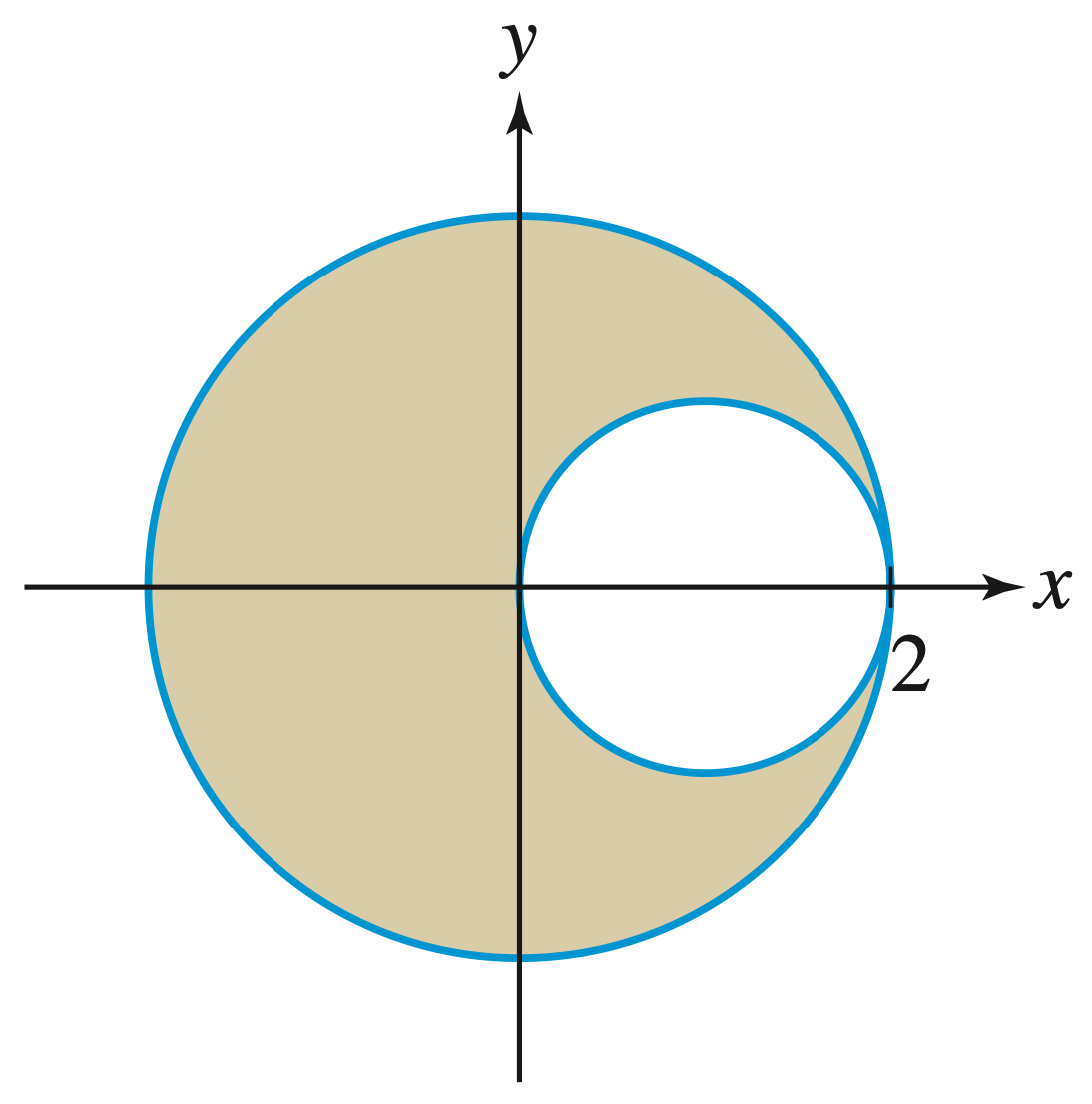
The region \(\c{D}\) is bounded by \(x \geq 0\) (the right half-plane), \(y \geq 0\) (the upper half-plane), and \(x^2 + y^2 \leq 4\) (a disk of radius 2). This describes exactly the quarter-circle of radius 2 in the first quadrant.
In polar coordinates, this region is defined by the limits:
\begin{align*}
0 \amp \leq r \leq 2 \\
0 \amp \leq \theta \leq \frac{\pi}{2}
\end{align*}
We convert the integrand \(f(x,y) = xy\) using \(x = r\cos\theta\) and \(y = r\sin\theta\text{.}\) This gives \(f(r,\theta) = (r\cos\theta)(r\sin\theta) = r^2\cos\theta\sin\theta\text{.}\) Remembering to include the extra \(r\) from the differential \(dA = r\,dr\,d\theta\text{,}\) we set up the iterated integral:
\begin{align*}
\iint_\c{D} xy \, dA \amp= \int_0^{\pi/2} \int_0^2 (r^2\cos\theta\sin\theta) r \, dr \, d\theta \\
\amp= \int_0^{\pi/2} \int_0^2 r^3\cos\theta\sin\theta \, dr \, d\theta
\end{align*}
Evaluate the inner integral with respect to \(r\text{:}\)
\begin{align*}
\int_0^2 r^3\cos\theta\sin\theta \, dr \amp= \left[ \frac{1}{4}r^4\cos\theta\sin\theta \right]_{r=0}^{r=2} \\
\amp= \frac{1}{4}(16)\cos\theta\sin\theta - 0 = 4\cos\theta\sin\theta
\end{align*}
Substitute this into the outer integral and evaluate with respect to \(\theta\text{.}\) We can use the double angle identity \(2\sin\theta\cos\theta = \sin(2\theta)\) to rewrite \(4\cos\theta\sin\theta\) as \(2\sin(2\theta)\text{:}\)
\begin{align*}
\int_0^{\pi/2} 2\sin(2\theta) \, d\theta \amp= \left[ -\cos(2\theta) \right]_0^{\pi/2} \\
\amp= -\cos\left(2\cdot\frac{\pi}{2}\right) - (-\cos(0)) \\
\amp= -\cos(\pi) + \cos(0) = -(-1) + 1 = 2
\end{align*}