Worksheet Assigned Problems for Section 12.1

The problems listed below are assigned to be included in your problem set portfolio. Note that a specific selection of these problems will also form the written homework assignments. I recommend working through all of them to ensure a solid grasp of the material. Reach out to Richard for help if you get stuck or have any questions.
The solutions will be posted after the written homework due dates. If you have any questions about your work, talk to Richard and he is happy to discuss the process with you.

12.1.5.

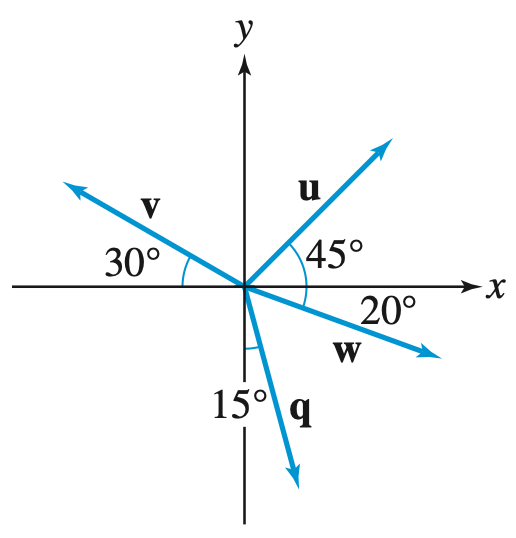
Find the components of the unit vector \(\v{u}\) in the figure below.
Figure 12.1.28.
Solution.
Since \(\v{u}\) makes an angle of \(45^\circ\) with the positive \(x\)-axis, its components are
\begin{equation*} \|\v{u}\| \la \cos\lp 45^\circ\rp, \sin\lp 45^\circ\rp \ra = \|\v{u}\| \la \frac{\sqrt{2}}{2}, \frac{\sqrt{2}}{2}\ra \end{equation*}

12.1.11.

Find the components of \(\overrightarrow{PQ}\text{,}\) where \(P=(1,-7)\) and \(Q=(0,17)\text{.}\)
Solution.
Using the definition of components of a vector, we have
\begin{equation*} \overrightarrow{PQ} = \la 0 - 1, 17 - (-7) \ra = \la -1, 24 \ra \end{equation*}

12.1.19.

Calculate \(\la 2e, 1 - 2\pi\ra - \la 2e - \pi, 8 - 2\pi\ra\text{.}\)
Solution.
Using vector algebra, we obtain
\begin{align*} \la 2e, 1 - 2\pi\ra - \la 2e - \pi, 8 - 2\pi\ra \amp= \la 2e - (2e - \pi), (1 - 2\pi) - (8 - 2\pi) \ra \\ \amp= \la \pi, -7 \ra \end{align*}

12.1.23.

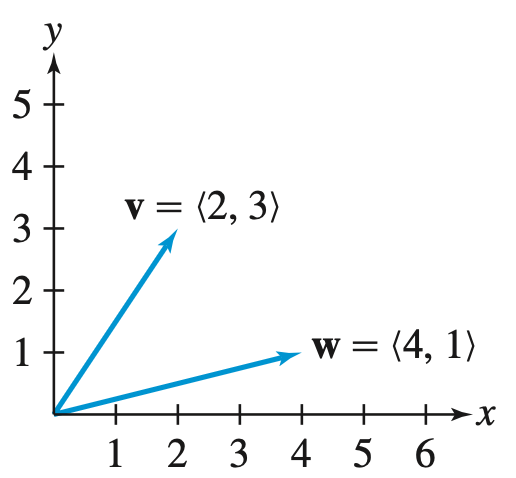
Sketch \(2\v{v}\text{,}\) \(-\v{w}\text{,}\) \(\v{v} + \v{w}\text{,}\) and \(2\v{v} - \v{w}\) in the following figure.
Figure 12.1.29.
Solution.
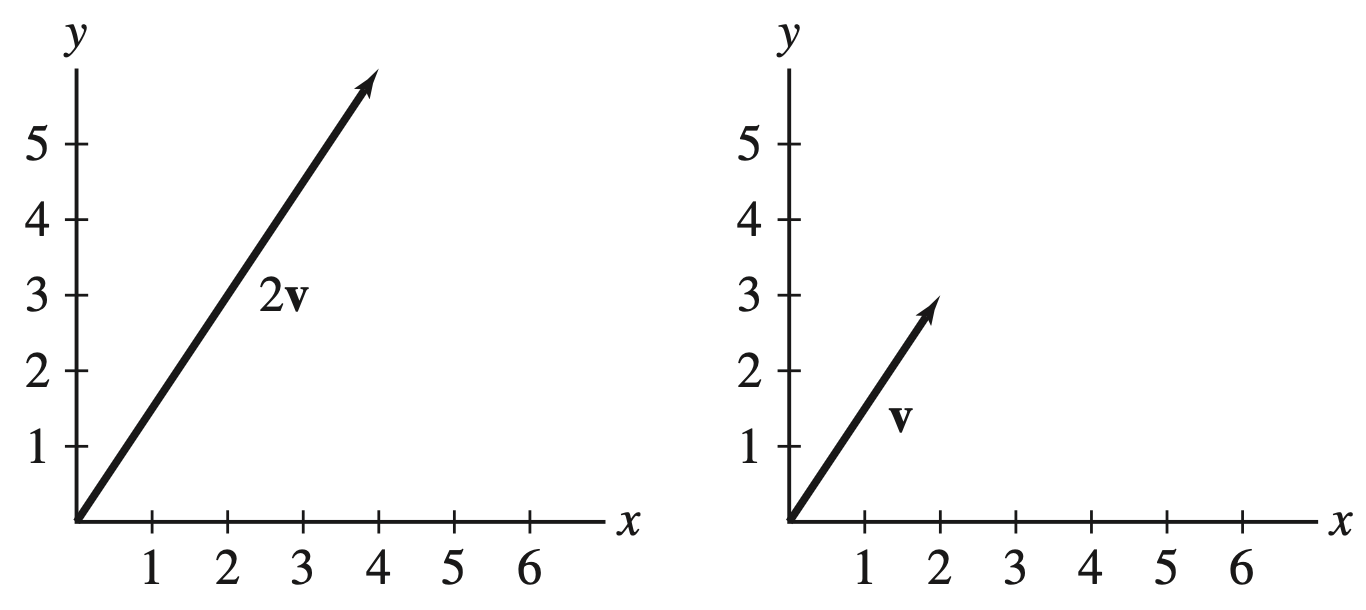
The scalar multiple \(2\v{v}\) points in the same direction as \(\v{v}\) and its length is twice the length of \(\v{v}\text{.}\) It is the vector \(2\v{v} = \la 4, 6 \ra\text{.}\)
Figure 12.1.30. The sketch of \(\v{v}\) and \(2\v{v}\text{.}\)
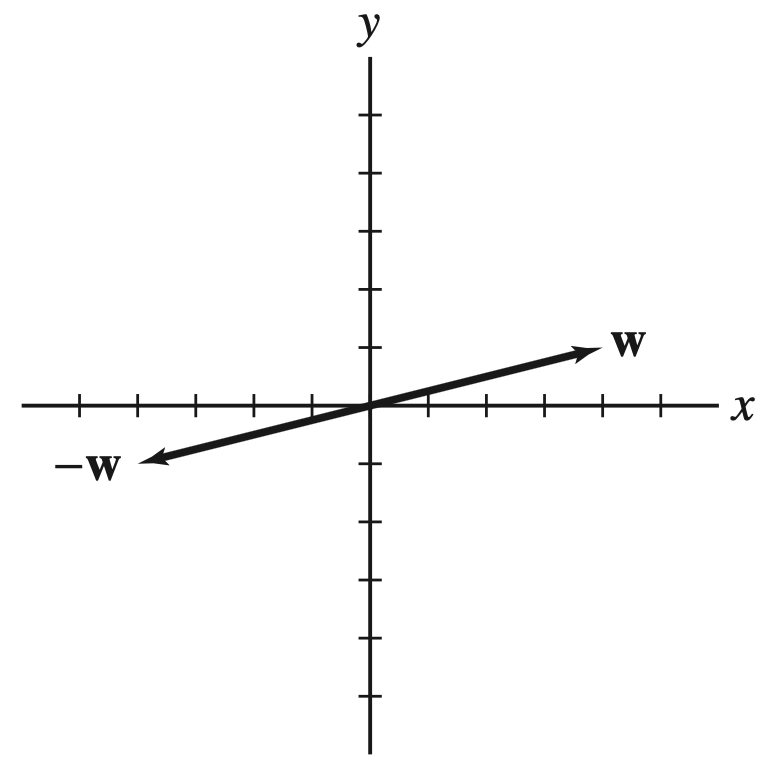
\(-\v{w}\) has the same length as \(\v{w}\) but points to the opposite direction. It is the vector \(-\v{w} = \la -4, -1 \ra\text{.}\)
Figure 12.1.31. The sketch of \(\v{w}\) and \(-\v{w}\text{.}\)
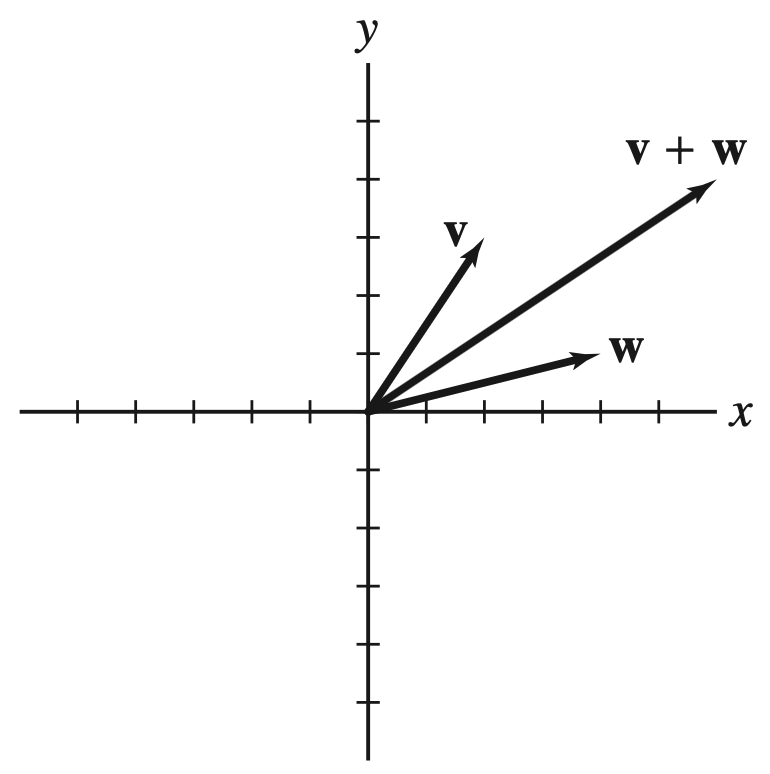
The vector sum \(\v{v} + \v{w}\) is the vector:
\begin{equation*} \v{v} + \v{w} = \la 2, 3 \ra + \la 4, 1 \ra = \la 6, 4 \ra \end{equation*}
The vector is shown in the following figure:
Figure 12.1.32. The sketch of \(\v{v}\text{,}\) \(\v{w}\text{,}\) and \(\v{v} + \v{w}\text{.}\)
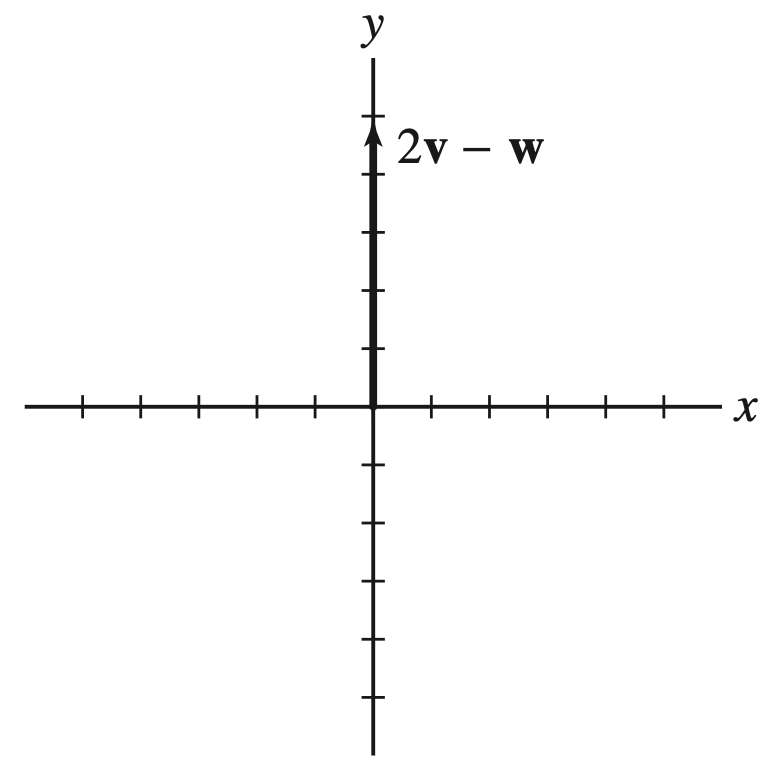
The vector \(2\v{v} - \v{w}\) is the vector:
\begin{equation*} 2\v{v} - \v{w} = 2\la 2, 3 \ra - \la 4, 1 \ra = \la 4, 6 \ra - \la 4, 1 \ra = \la 0, 5 \ra \end{equation*}
It is shown next:
Figure 12.1.33. The sketch of \(\v{v}\text{,}\) \(\v{w}\text{,}\) and \(2\v{v} - \v{w}\text{.}\)

12.1.25.

Sketch \(\v{v} = \langle 0,2\rangle\text{,}\) \(\v{w} = \langle -2, 4\rangle\text{,}\) \(3\v{v} + \v{w}\text{,}\) and \(2\v{v} - 2\v{w}\text{.}\)
Solution.
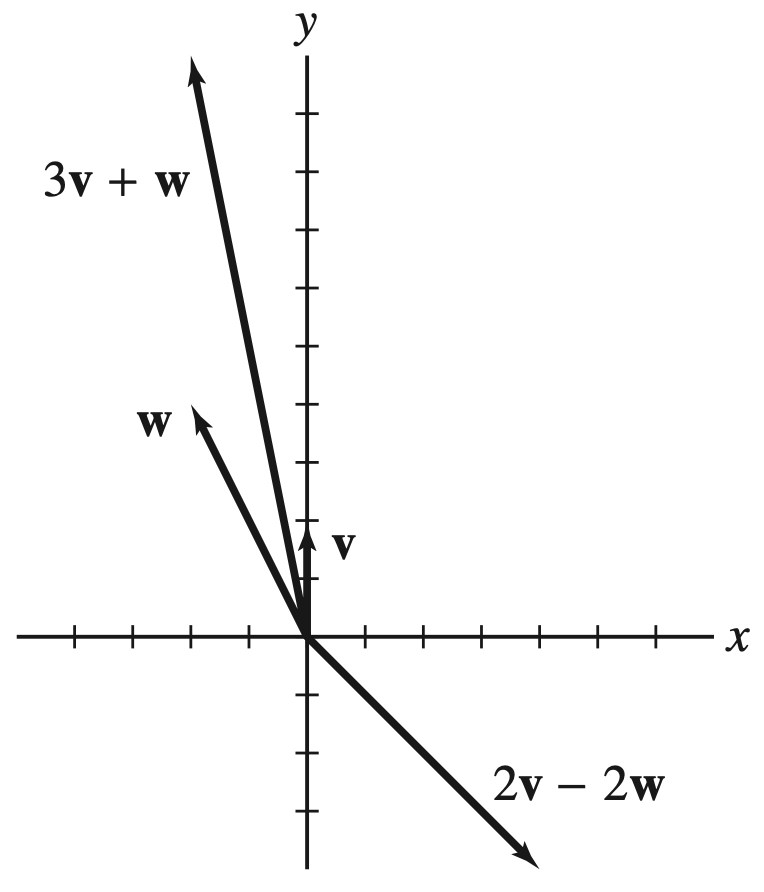
We compute the vectors and then sketch them:
\begin{equation*} 3\v{v} + \v{w} = 3\la 0, 2 \ra + \la -2, 4 \ra = \la 0, 6 \ra + \la -2, 4 \ra = \la -2, 10 \ra \end{equation*}
\begin{equation*} 2\v{v} - 2\v{w} = 2\la 0, 2 \ra - 2\la -2, 4 \ra = \la 0, 4 \ra - \la -4, 8 \ra = \la 4, -4 \ra \end{equation*}
Figure 12.1.34. The sketch of \(\v{v}, \v{w}, 3\v{v} + \v{w},\) and \(2\v{v} - 2\v{w}\text{.}\)

12.1.35.

Are \(\overrightarrow{AB}\) and \(\overrightarrow{PQ}\) parallel if \(A=(1,1)\text{,}\) \(B=(3,4)\text{,}\) \(P=(1,1)\text{,}\) and \(Q=(7,10)\text{?}\) And if so, do they point in the same direction?
Solution.
We compute the vectors \(\overrightarrow{AB}\) and \(\overrightarrow{PQ}\text{:}\)
\begin{equation*} \overrightarrow{AB} = \la 3 - 1, 4 - 1 \ra = \la 2, 3 \ra \end{equation*}
\begin{equation*} \overrightarrow{PQ} = \la 7 - 1, 10 - 1 \ra = \la 6, 9 \ra \end{equation*}
Since \(\overrightarrow{AB} = \dfrac{1}{3} \la 6, 9 \ra\text{,}\) the vectors are parallel and point in the same direction.

Exercise Group.

In the following exercises, find the given vector.
12.1.43.
Unit vector \(\v{e_v}\text{,}\) where \(\v{v} = \langle 3, 4 \rangle\text{.}\)
Solution.
We find the length of \(\v{v} = \la 3, 4 \ra\text{:}\)
\begin{equation*} \|\v{v}\| = \sqrt{3^2 + 4^2} = 5 \end{equation*}
Then the unit vector in the direction of \(\v{v}\) is
\begin{equation*} \v{e_v} = \frac{1}{5} \la 3, 4 \ra = \la \frac{3}{5}, \frac{4}{5} \ra \end{equation*}
12.1.45.
Vector of length \(4\) in the direction of \(\v{u} = \langle -1, -1 \rangle\text{.}\)
Solution.
We first find the unit vector in the direction of \(\v{u}\text{:}\)
\begin{equation*} \v{e_u} = \frac{1}{\|\v{u}\|} \v{u} = \frac{1}{\sqrt{(-1)^2 + (-1)^2}} \la -1, -1 \ra = \la -\frac{1}{\sqrt{2}}, -\frac{1}{\sqrt{2}} \ra \end{equation*}
We now multiply \(\v{e_u}\) by \(4\) to obtain the desired vector:
\begin{equation*} 4\v{e_u} = 4 \la -\frac{1}{\sqrt{2}}, -\frac{1}{\sqrt{2}} \ra = \la -\frac{4}{\sqrt{2}}, -\frac{4}{\sqrt{2}} \ra = \la -2\sqrt{2}, -2\sqrt{2} \ra \end{equation*}
12.1.49.
Unit vector \(\v{e}\) making an angle of \(\dfrac{4\pi}{7}\) with the \(x\)-axis.
Solution.
The unit vector \(\v{e}\) is the following vector:
\begin{equation*} \v{e} = \la \cos\lp \frac{4\pi}{7}\rp, \sin\lp \frac{4\pi}{7}\rp \ra = \la -0.22, 0.97\ra \end{equation*}

12.1.61.

Calculate the linear combination \(\lp 3\v{i} + \v{j} \rp - 6\v{j} + 2\lp \v{j} - 4\v{i} \rp\)
Solution.
\begin{align*} \lp 3\v{i} + \v{j} \rp - 6\v{j} + 2\lp \v{j} - 4\v{i} \rp \amp= \lp 3\la 1, 0\ra + \la 0, 1\ra \rp - 6\la 0, 1\ra + 2\lp \la 0, 1\ra - 4\la 1, 0\ra \rp \\ \amp= \lp \la 3, 0\ra + \la 0, 1\ra \rp - \la 0, 6\ra + 2\lp \la 0, 1\ra - \la 4, 0\ra \rp \\ \amp= \la 3, 0\ra + \la 0, 1\ra - \la 0, 6\ra + \la 0, 2\ra - \la 8, 0\ra \\ \amp= \la 3 + 0 - 0 + 0 - 8, 0 + 1 - 6 + 2 - 0 \ra \\ \amp= \la -5, -3 \ra \end{align*}

12.1.65.

Express \(\v{u}\) as a linear combination \(\v{u} = r\v{v} + s\v{w}\text{,}\) where
\begin{equation*} \v{u} = \langle 3, -1 \rangle; \qquad\qquad \v{v} = \langle 2, 1 \rangle \quad \text{and} \quad \v{w} = \langle 1, 3 \rangle. \end{equation*}
Then sketch \(\mathbf{u}, \mathbf{v},\mathbf{w}\text{,}\) and the parallelogram formed by \(r\v{v}\) and \(s\v{w}\text{.}\)
Solution.
We have
\begin{equation*} \v{u} = \la 3, -1 \ra = r\v{v} + s\v{w} = r\la 2, 1 \ra + s\la 1, 3 \ra \end{equation*}
which becomes the system of equations
\begin{equation*} \begin{cases} 3 = 2r + s \\ -1 = r + 3s \end{cases} \end{equation*}
Solving the above system of equations, we obtain \(r = 2\) and \(s = -1\text{.}\)
Hence, the linear combination is
\begin{equation*} \v{u} = \la 3, -1 \ra = 2\la 2, 1\ra - 1\la 1, 3 \ra \end{equation*}
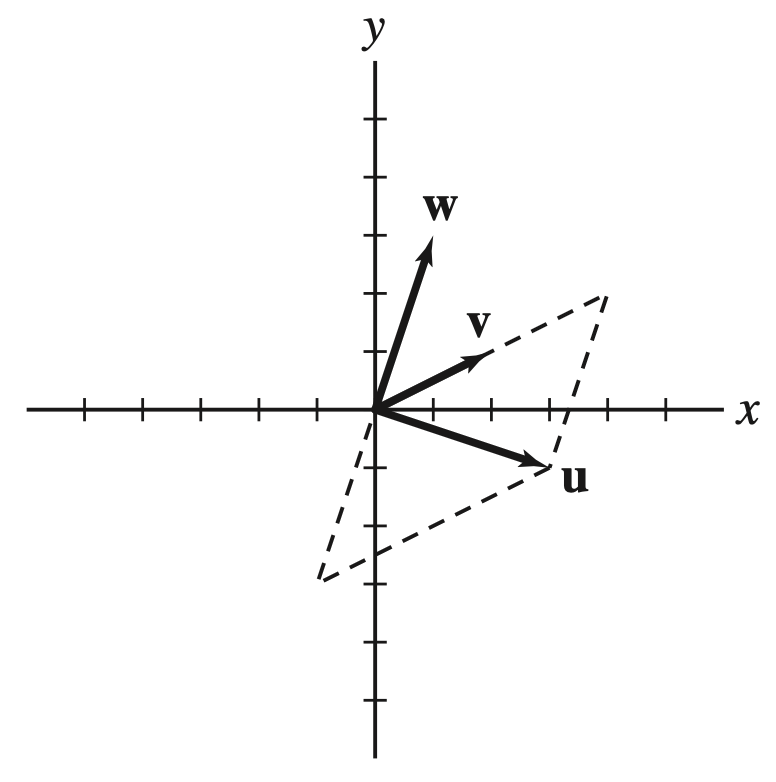
The sketch is shown below.
Figure 12.1.35. The sketch of \(\v{u}, \v{v}, \v{w}\) and the parallelogram formed by \(r\v{v}\) and \(s\v{w}\text{.}\)

12.1.67.

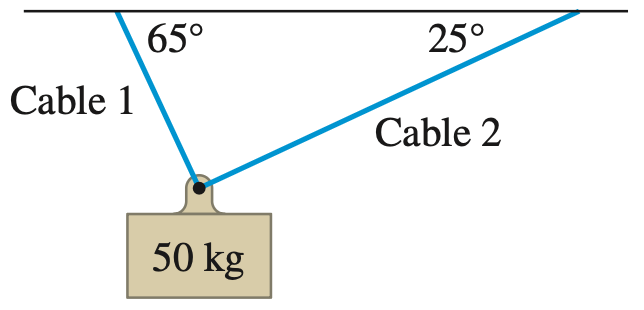
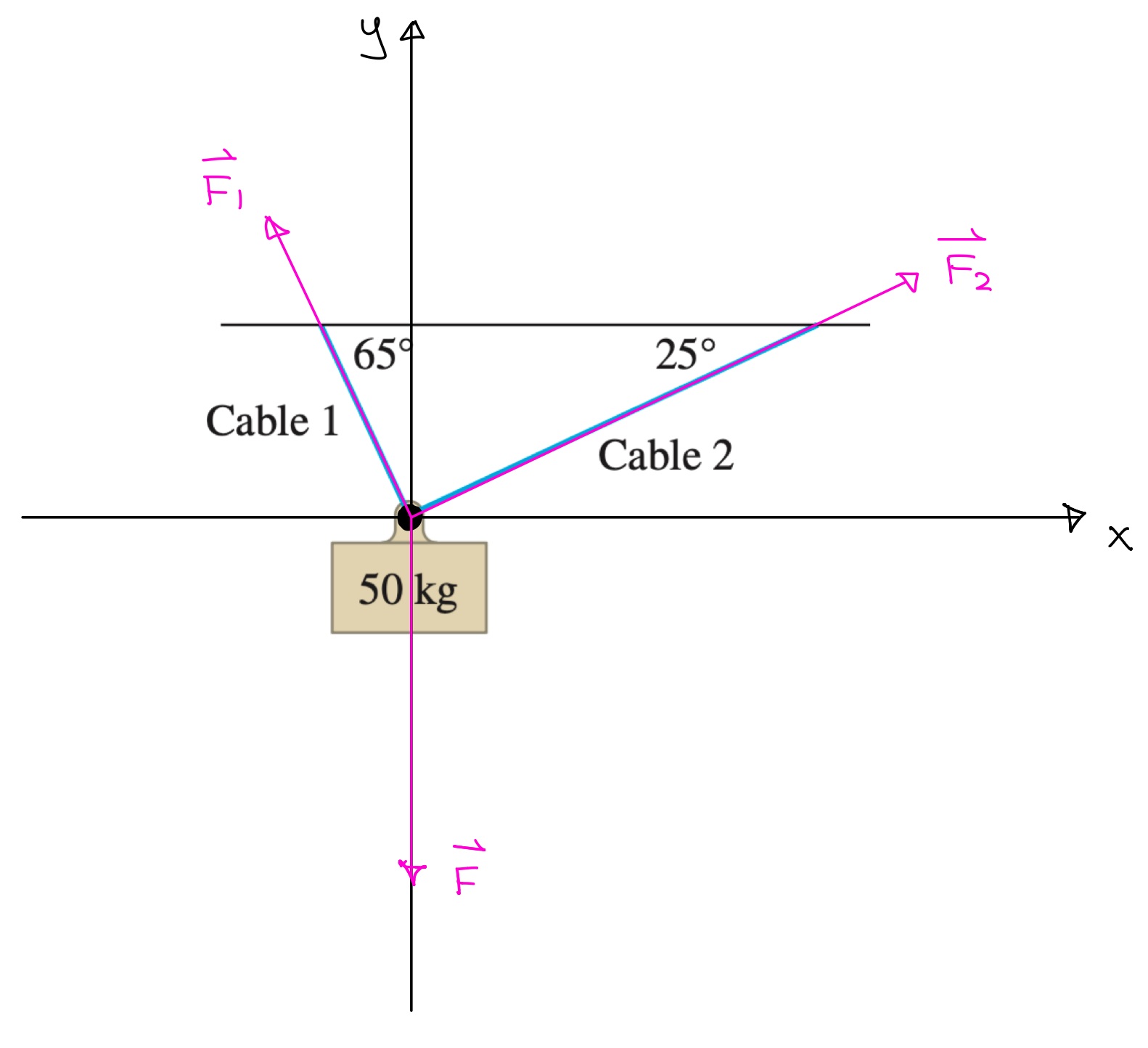
Calculate the magnitude of the force on cables 1 and 2 shown in the figure below.
Figure 12.1.36.
Solution.
The three forces acting on the point \(P\) are:
  • The force \(\v{F}\) of magnitude \(50\) lb that acts vertically downward.
  • The forces \(\v{F}_1\) and \(\v{F}_2\) that act through cables 1 and 2 respectively.
The diagram below shows the vectors representing these forces.
Figure 12.1.37.
Since the point \(P\) is not in motion, we have
\begin{equation*} \v{F}_1 + \v{F}_2 + \v{F} = \v{0} \end{equation*}
We compute the forces. Let \(\|\v{F}_1\| = f_1\) and \(\|\v{F}_2\| = f_2\text{.}\) We have
\begin{align*} \v{F}_1 \amp= f_1 \la \cos(115^\circ), \sin(115^\circ) \ra = f_1 \la -0.423, 0.906 \ra \\ \v{F}_2 \amp= f_2 \la \cos(25^\circ), \sin(25^\circ) \ra = f_2 \la 0.906, 0.423 \ra \\ \v{F} \amp= \la 0, -50 \ra \end{align*}
Substituting the forces into the equation gives
\begin{align*} f_1 \la -0.423, 0.906 \ra + f_2 \la 0.906, 0.423 \ra + \la 0, -50 \ra \amp= \v{0}\\ \la -0.423 f_1 + 0.906 f_2, 0.906 f_1 + 0.423 f_2 - 50 \ra \amp= \la 0, 0 \ra \end{align*}
We equate corresponding components and get
\begin{equation*} \begin{cases} -0.423 f_1 + 0.906 f_2 = 0 \\ 0.906 f_1 + 0.423 f_2 - 50 = 0 \end{cases} \end{equation*}
Solving the above system of equations, we obtain \(f_1 = 45.29\) and \(f_2 = 21.16\text{.}\)
We conclude that the magnitude of the force on cable 1 is \(f_1 = 45.29\) lb and the magnitude of the force on cable 2 is \(f_2 = 21.16\) lb.