Worksheet Assigned Problems for Section 12.2

The problems listed below are assigned to be included in your problem set portfolio. Note that a specific selection of these problems will also form the written homework assignments. I recommend working through all of them to ensure a solid grasp of the material. Reach out to Richard for help if you get stuck or have any questions.
The solutions will be posted after the written homework due dates. If you have any questions about your work, talk to Richard and he is happy to discuss the process with you.

12.2.5.

Find the components of the vector \(\overrightarrow{PQ}\text{,}\) where \(P = (1,0,1)\) and \(Q = (2,1,0)\)
Solution.
By the definition of the vector components we have
\begin{equation*} \overrightarrow{PQ} = \la 2 - 1, 1 - 0, 0 - 1 \ra = \la 1, 1, -1 \ra \end{equation*}

12.2.13.

Let \(\v{v} = \la 4,8,12 \ra\text{.}\) Which of the following vectors is parallel to \(\v{v}\text{?}\) Which point in the same direction?
  1. \(\displaystyle \la 2,4,6 \ra\)
  2. \(\displaystyle \la -1,-2,3 \ra\)
  3. \(\displaystyle \la -7,-14,-21 \ra\)
  4. \(\displaystyle \la 6,10,14 \ra\)
Solution.
A vector is parallel to \(\v{v}\) if it is a scalar multiple of \(\v{v}\text{.}\) It points in the same direction if the multiplying scalar is positive. Using these properties we obtain the following answers:
  1. \(\la 2,4,6 \ra = \dfrac{1}{2}\v{v}\text{.}\) The vectors are parallel and point in the same direction.
  2. \(\la -1,-2,3 \ra\) is not a scalar multiple of \(\v{v}\text{,}\) hence these vectors are not parallel.
  3. \(\la -7,-14,-21 \ra = -\dfrac{7}{4}\v{v}\text{.}\) The vectors are parallel but point in opposite directions.
  4. \(\la 6,10,14 \ra\) is not a scalar multiple of \(\v{v}\text{.}\) hence these vectors are not parallel.

12.2.25.

Determine whether or not the two vectors \(\v{u} = \la 4,2,-6 \ra\) and \(\v{v} = \la 2,-1,3 \ra\) are parallel.
Solution.
Since the first component of \(\v{u}\) is twice the first component of \(\v{v}\text{,}\) if the two vectors are to be parallel, the second component of \(\v{u}\) must be twice the second component of \(\v{v}\text{.}\) But it is not; it is \(-2\) times the second component of \(\v{v}\text{.}\) Thus the two vectors are not parallel.

12.2.32.

Sketch the following vectors, and find their components and lengths:
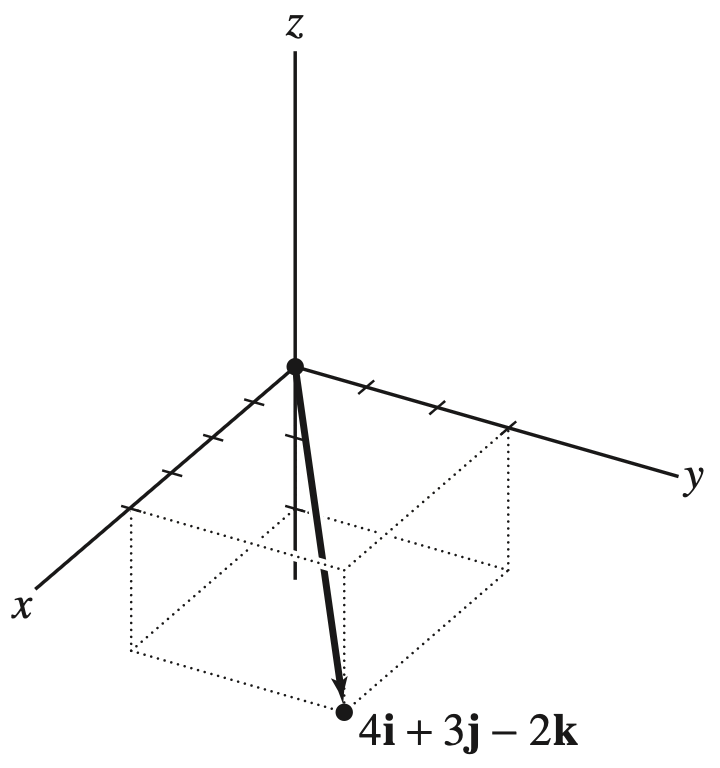
  1. \(\displaystyle 4\v{i} + 3\v{j} - 2\v{k}\)
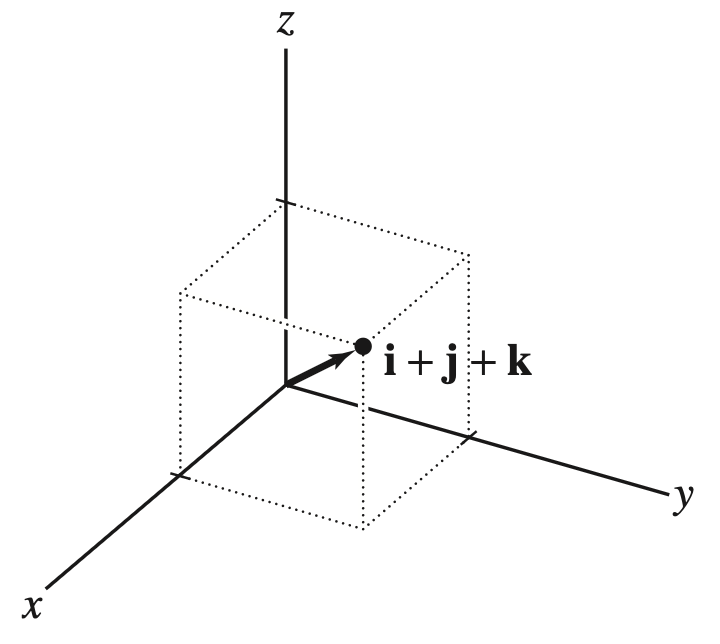
  2. \(\displaystyle \v{i} + \v{j} + \v{k}\)
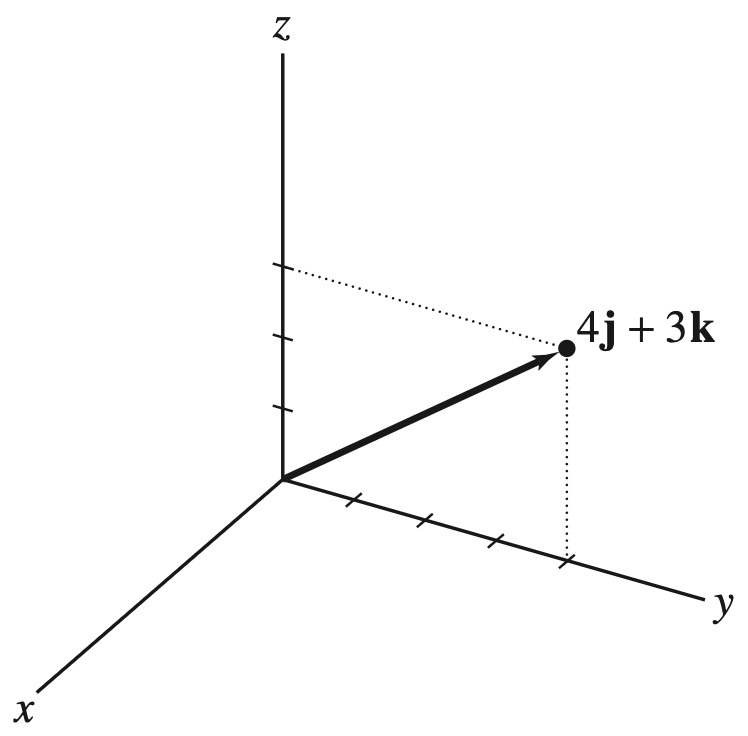
  3. \(\displaystyle 4\v{j} + 3\v{k}\)
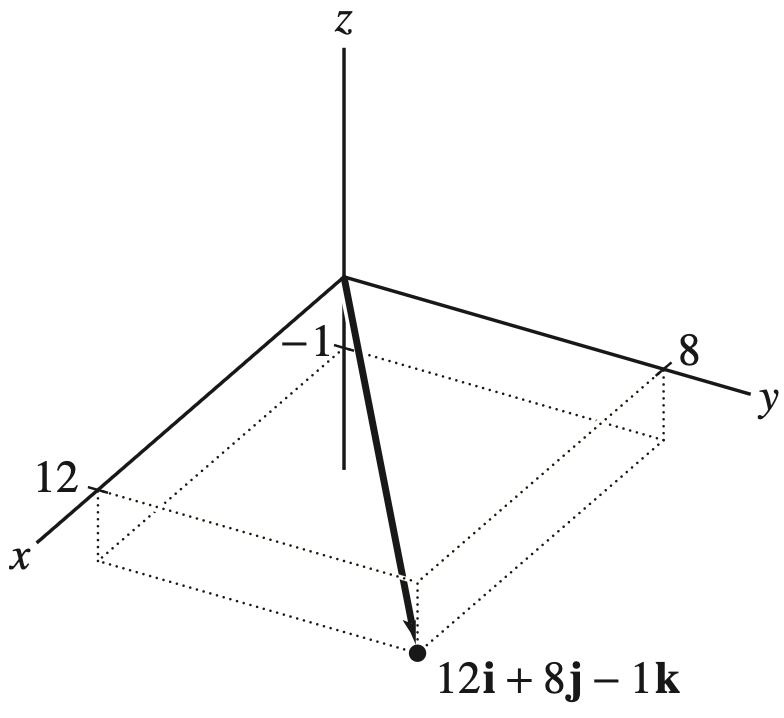
  4. \(\displaystyle 12\v{i} + 8\v{j} - \v{k}\)
Solution.
By the definition of the standard basis vectors in \(\R^3\) and the definition of vector length, we obtain the following answers:
  1. \(4\v{i} + 3\v{j} - 2\v{k} = \la 4,3,-2 \ra\)
    \(\|4\v{i} + 3\v{j} - 2\v{k}\| = \sqrt{4^2 + 3^2 + (-2)^2} = \sqrt{16 + 9 + 4} = \sqrt{29}\)
    Figure 12.2.34. Sketch of \(4\v{i} + 3\v{j} - 2\v{k}\)
  2. \(\v{i} + \v{j} + \v{k} = \la 1,1,1 \ra\)
    \(\|\v{i} + \v{j} + \v{k}\| = \sqrt{1^2 + 1^2 + 1^2} = \sqrt{3}\)
    Figure 12.2.35. Sketch of \(\v{i} + \v{j} + \v{k}\)
  3. \(4\v{j} + 3\v{k} = \la 0,4,3 \ra\)
    \(\|4\v{j} + 3\v{k}\| = \sqrt{0^2 + 4^2 + 3^2} = \sqrt{16 + 9} = 5\)
    Figure 12.2.36. Sketch of \(4\v{j} + 3\v{k}\)
  4. \(12\v{i} + 8\v{j} - \v{k} = \la 12,8,-1 \ra\)
    \(\|12\v{i} + 8\v{j} - \v{k}\| = \sqrt{12^2 + 8^2 + (-1)^2} = \sqrt{144 + 64 + 1} = \sqrt{209}\)
    Figure 12.2.37. Sketch of \(12\v{i} + 8\v{j} - \v{k}\)

Exercise Group.

In the following exercises, describe the surface.
12.2.33.
\(x^2 + y^2 + (z - 2)^2 = 4\text{,}\) with \(z\geq 2\)
Solution.
The equation \(x^2 + y^2 + (z - 2)^2 = 4\) describes a sphere of radius \(2\) centered at \((0,0,2)\text{.}\) The inequality \(z \geq 2\) restricts the surface to the upper hemisphere (the top half of the sphere).
The surface is shown in the figure below.
Figure 12.2.38. Upper semi-sphere with radius \(2\) and centered at \((0,0,2)\)
12.2.35.
\(x^2 + y^2 = 7\text{,}\) with \(|z| \leq 7\)
Solution.
The equation \(x^2 + y^2 = 7\) describes a cylinder of radius \(\sqrt{7}\) centered on the \(z\)-axis. The inequality \(|z| \leq 7\) restricts the cylinder to the finite portion between the planes \(z = -7\) and \(z = 7\text{.}\)
The surface is shown in the figure below.
Figure 12.2.39. Cylinder with \(r=\sqrt{7}\) between \(z=-7\) and \(z=7\)

Exercise Group.

In the following exercises, give an equation for the indicated surface.
12.2.39.
The sphere centered at \((6,-3,11)\) passing through \((0,1,-4)\)
Solution.
The radius of the sphere is the distance between the center \(C=(6,-3,11)\) and the point on the surface \(P=(0,1,-4)\text{:}\)
\begin{equation*} r^2 = (6-0)^2 + (-3-1)^2 + (11-(-4))^2 = 36 + 16 + 225 = 277 \end{equation*}
Thus, the equation of the sphere is
\begin{equation*} (x-6)^2 + (y+3)^2 + (z-11)^2 = 277 \end{equation*}
12.2.41.
The cylinder passing through the origin with the vertical line through \((1,-1,0)\) as its central axis.
Solution.
The vertical line through \((1,-1,0)\) corresponds to the axis \(x=1\text{,}\) \(y=-1\text{.}\) Since the cylinder passes through the origin \((0,0,0)\text{,}\) the radius is the distance from the axis to the origin:
\begin{equation*} r = \sqrt{(1-0)^2 + (-1-0)^2} = \sqrt{2} \end{equation*}
Therefore, the equation of the cylinder is
\begin{equation*} (x-1)^2 + (y+1)^2 = 2 \end{equation*}

Exercise Group.

In the following exercises, find a vector parametrization for the line with the given description.
12.2.43.
Passes through \(P = (1,2,-8)\text{,}\) direction vector \(\v{v} = \la 2,1,3 \ra\)
Solution.
A vector parametrization of the line is
\begin{equation*} \v{r}(t) = \la 1,2,-8 \ra + t \la 2,1,3 \ra = \la 1 + 2t, 2 + t, -8 + 3t \ra \end{equation*}
12.2.45.
Passes through \(P = (4,0,8)\text{,}\) direction vector \(\v{v} = 7\v{i} + 4\v{k}\)
Solution.
Since \(\v{v} = 7\v{i} + 4\v{k} = \la 7,0,4 \ra\text{,}\) we obtain the following parametrization:
\begin{equation*} \v{r}(t) = \overrightarrow{PQ} + t\v{v} = \la 4,0,8 \ra + t \la 7,0,4 \ra = \la 4 + 7t, 0, 8 + 4t \ra \end{equation*}

12.2.57.

Show that \(\v{r}_1(t)\) and \(\v{r}_2(t)\) define the same line, where
\begin{equation*} \v{r}_1(t) = \la 3,-1,4 \ra + t \la 8,12,-6 \ra \end{equation*}
\begin{equation*} \v{r}_2(t) = \la 11,11,-2 \ra + t \la 4,6,-3 \ra \end{equation*}
Hint.
Show that \(\v{r}_2(t)\) passes through \((3,-1,4)\) and that the direction vectors for \(\v{r}_1(t)\) and \(\v{r}_2(t)\) are parallel.
Solution.
We observe first that the direction vectors of \(\v{r}_1(t)\) and \(\v{r}_2(t)\) are multiples of each other:
\begin{equation*} \la 8,12,-6 \ra = 2\la 4,6,-3 \ra \end{equation*}
Therefore, \(\v{r}_1(t)\) and \(\v{r}_2(t)\) are parallel. To show they coincide, it suffices to prove that they share a point in common, so we verify that \(\v{r}_1(0) = \la 3,-1,4 \ra\) lies on \(\v{r}_2(t)\) by solving for \(t\text{:}\)
\begin{align*} \la 3,-1,4 \ra \amp= \la 11,11,-2 \ra + t \la 4,6,-3 \ra \\ \la 3,-1,4 \ra - \la 11,11,-2 \ra \amp= t \la 4,6,-3 \ra \\ \la -8,-12,6 \ra \amp= t \la 4,6,-3 \ra \end{align*}
This equation is satisfied for \(t = -2\text{,}\) so \(\v{r}_1\) and \(\v{r}_2\) coincide.

12.2.59.

Find two different vector parametrizations of the line through \(P = (5,5,2)\) with direction vector \(\v{v} = \la 0,-2,1 \ra\text{.}\)
Solution.
Two different parametrizations are
\begin{align*} \v{r}_1(t) \amp= \la 5,5,2 \ra + t \la 0,-2,1 \ra \\ \v{r}_2(t) \amp= \la 5,5,2 \ra + t \la 0,-20,10 \ra \end{align*}

12.2.63.

Determine whether the lines \(\v{r}_1(t) = \la 0,1,1 \ra + t \la 1,1,2 \ra\) and \(\v{r}_2(s) = \la 2,0,3 \ra + s \la 1,4,4 \ra\) intersect, and if so, find the point of intersection.
Solution.
The lines intersect if there exist parameter values \(t\) and \(s\) such that
\begin{align*} \la 0,1,1 \ra + t \la 1,1,2 \ra \amp= \la 2,0,3 \ra + s \la 1,4,4 \ra \\ \la t,1+t,1+2t \ra \amp= \la 2+s,4s,3+4s \ra \end{align*}
Equating corresponding components, we get
\begin{equation*} \begin{cases} t = 2 + s \\ 1 + t = 4s \\ 1 + 2t = 3 + 4s \end{cases} \end{equation*}
Substituting \(t\) from the first equation into the second equation we get
\begin{equation*} \begin{cases} 1 + 2 + s = 4s \\ 3s = 3 \end{cases} \qquad \implies \qquad s = 1, t = 2 + s = 3 \end{equation*}
We now check whether \(s = 1\) and \(t = 3\) satisfy the third equation:
\begin{align*} 1 + 2\cdot 3 \amp= 3 + 4\cdot 1 \\ 7 \amp= 7 \end{align*}
We conclude that \(s = 1\text{,}\) \(t = 3\) is the solution to the equation, hence the two lines intersect.
To find the point of intersection we substitute \(s = 1\) in the right-hand side of the equation to obtain
\begin{equation*} \la 2+1,4\cdot 1,3+4\cdot 1 \ra = \la 3,4,7 \ra \end{equation*}
The point of intersection is the terminal point of this vector, that is, \(\lp 3,4,7 \rp\)