Worksheet Assigned Problems for Section 12.3

The problems listed below are assigned to be included in your problem set portfolio. Note that a specific selection of these problems will also form the written homework assignments. I recommend working through all of them to ensure a solid grasp of the material. Reach out to Richard for help if you get stuck or have any questions.
The solutions will be posted after the written homework due dates. If you have any questions about your work, talk to Richard and he is happy to discuss the process with you.

12.3.11.

Compute the dot product \(\lp \v{i} + \v{j} + \v{k} \rp \cdot \lp 3\v{i} + 2\v{j} - 5\v{k} \rp\)
Solution.
We use properties of the dot product to obtain
\begin{align*} \lp \v{i} + \v{j} + \v{k} \rp \cdot \lp 3\v{i} + 2\v{j} - 5\v{k} \rp \amp= 3\v{i}\cdot \v{i} + 2\v{i} \cdot \v{j} - 5\v{i} \cdot \v{k} + 3\v{j} \cdot \v{i} + 2\v{j} \cdot \v{j} - 5\v{j} \cdot \v{k} + 3\v{k} \cdot \v{i} + 2\v{k} \cdot \v{j} - 5\v{k} \cdot \v{k} \\ \amp= 3\|\v{i}\|^2 + 2\|\v{j}\|^2 - 5\|\v{k}\|^2 \\ \amp= 3\cdot 1 + 2\cdot 1 - 5\cdot 1 \\ \amp= 0 \end{align*}

12.3.13.

Determine whether the two vectors \(\la 1,1,1 \ra\) and \(\la 1,-2,-2 \ra\) are orthogonal and, if not, whether the angle between them is acute or obtuse.
Solution.
We compute the dot product of the two vectors:
\begin{equation*} \la 1,1,1 \ra \cdot \la 1,-2,-2 \ra = 1\cdot 1 + 1\cdot (-2) + 1\cdot (-2) = 1 - 2 - 2 = -3 \end{equation*}
Since the dot product is negative, the angle between the vectors is obtuse.

12.3.25.

Find the angle bewteen the vectors \(\la 1,1,1 \ra\) and \(\la 1,0,1 \ra\text{.}\)
Solution.
We denote \(\v{v} = \la 1,1,1 \ra\) and \(\v{w} = \la 1,0,1 \ra\text{.}\) To use the formula for the cosine of the angle \(\theta\) between two vectors we need to compute the following values:
\begin{align*} \|\v{v}\| \amp= \sqrt{1^2 + 1^2 + 1^2} = \sqrt{3} \\ \|\v{w}\| \amp= \sqrt{1^2 + 0^2 + 1^2} = \sqrt{2} \\ \v{v} \cdot \v{w} \amp= 1\cdot 1 + 1\cdot 0 + 1\cdot 1 = 2 \end{align*}
Hence,
\begin{equation*} \cos(\theta) = \frac{\v{v}\cdot \v{w}}{\|\v{v}\|\|\v{w}\|} = \frac{2}{\sqrt{3}\cdot \sqrt{2}} = \frac{2}{\sqrt{6}} = \frac{\sqrt{6}}{3} \end{equation*}
and so,
\begin{equation*} \theta = \cos^{-1}\lp \frac{\sqrt{6}}{3} \rp \approx 0.615 \end{equation*}

12.3.37.

Simplify the expression \(\lp \v{v} - \v{w} \rp \cdot \v{v} + \v{v} \cdot \v{w}\)
Solution.
By properties of the dot product we obtain
\begin{align*} \lp \v{v} - \v{w} \rp \cdot \v{v} + \v{v} \cdot \v{w} \amp= \v{v} \cdot \v{v} - \v{w} \cdot \v{v} + \v{v} \cdot \v{w} \\ \amp= \|\v{v}\|^2 - \v{w} \cdot \v{v} + \v{v} \cdot \v{w} \\ \amp= \|\v{v}\|^2 \end{align*}

12.3.43.

Use the properties of the dot product to evaluate the expression \(2\v{u} \cdot \lp 3\v{u} - \v{v} \rp\text{,}\) assuming that \(\v{u} \cdot \v{v} = 2\text{,}\) \(\|\v{u}\| = 1\text{,}\) and \(\|\v{v}\| = 3\text{.}\)
Solution.
By properties of the dot product we obtain
\begin{align*} 2\v{u} \cdot \lp 3\v{u} - \v{v} \rp \amp= (2\v{u}) \cdot (3\v{u}) - (2\v{u}) \cdot \v{v} \\ \amp= 6 (\v{u}\cdot \v{u}) - 2 (\v{u} \cdot \v{v}) \\ \amp= 6 \|\v{u}\|^2 - 2 (\v{u} \cdot \v{v}) \\ \amp= 6\cdot 1^2 - 2 \cdot 2 \\ \amp= 2 \end{align*}

12.3.48.

Assume that \(\|\v{v}\| = 2\text{,}\) \(\|\v{w}\| = 3\text{,}\) and the angle between \(\v{v}\) and \(\v{w}\) is \(120^\circ\text{.}\) Determine
  1. \(\displaystyle \v{v} \cdot \v{w}\)
  2. \(\displaystyle \|2\v{v} + \v{w}\|\)
  3. \(\displaystyle \|2\v{v} - 3\v{w}\|\)
Solution.
  1. We use the relation between the dot product and the angle between two vectors to write
    \begin{equation*} \v{v} \cdot \v{w} = \|\v{v}\|\|\v{w}\| \cos(120^\circ) = 2 \cdot 3 \cdot \lp -\frac{1}{2} \rp = -3 \end{equation*}
  2. By the relation of the dot product with length and by properties of the dot product we have
    \begin{align*} \|2\v{v} + \v{w}\|^2 \amp= (2\v{v} + \v{w}) \cdot (2\v{v} + \v{w}) \\ \amp= 4(\v{v} \cdot \v) + 4(\v{v} \cdot \v{w}) + (\v{w} \cdot \v{w}) \\ \amp= 4\|\v{v}\|^2 + 4(\v{v} \cdot \v{w}) + \|\v{w}\|^2 \end{align*}
    We now substitute \(\v{v}\cdot \v{w} = -3\) from part a) and the given information, obtaining
    \begin{align*} \|2\v{v} + \v{w}\|^2 \amp= 4\cdot 2^2 + 4\cdot (-3) + 3^2 = 13 \\ \implies \qquad \|2\v{v} + \v{w}\| \amp= \sqrt{13} \approx 3.61 \end{align*}
  3. We express the length in terms of a dot product and use properties of the dot product. This gives
    \begin{align*} \|2\v{v} - 3\v{w}\|^2 \amp= (2\v{v} - 3\v{w}) \cdot (2\v{v} - 3\v{w}) \\ \amp= 4\v{v} \cdot \v{v} - 6\v{v} \cdot \v{w} - 6\v{w} \cdot \v{v} + 9\v{w} \cdot \v{w} \\ \amp= 4\|\v{v}\|^2 - 12\v{v} \cdot \v{w} + 9\|\v{w}\|^2 \end{align*}
    Substituting \(\v{v}\cdot \v{w} = -3\) from part a) and the given values yields
    \begin{align*} \|2\v{v} - 3\v{w}\|^2 \amp= 4\cdot 2^2 - 12\cdot (-3) + 9\cdot 3^2 = 133 \\ \implies \qquad \|2\v{v} - 3\v{w}\| \amp= \sqrt{133} \approx 11.53 \end{align*}

12.3.57.

Find the projection of \(\v{u}\) along \(\v{v}\text{,}\) where \(\v{u} = \la -1,2,0 \ra\) and \(\v{v} = \la 2,0,1 \ra\text{.}\)
Solution.
The projection of \(\v{u}\) along \(\v{v}\) is the following vector:
\begin{equation*} \v{u}_{\parallel \v{v}} = \lp \frac{\v{u} \cdot \v{v}}{\v{v} \cdot \v{v}} \rp \v{v} \end{equation*}
We compute the values in this expression:
\begin{align*} \v{u} \cdot \v{v} \amp= \la -1,2,0 \ra \cdot \la 2,0,1 \ra = -1 \cdot 2 + 2 \cdot 0 + 0 \cdot 1 = -2 \\ \v{v} \cdot \v{v} \amp= \|\v{v}\|^2 = 2^2 + 0^2 + 1^2 = 5 \end{align*}
Hence,
\begin{equation*} \v{u}_{\parallel \v{v}} = \frac{-2}{5} \la 2,0,1 \ra = \la -\frac{4}{5},0,-\frac{2}{5} \ra \end{equation*}

12.3.69.

Find the decomposition \(\v{a} = \v{a}_{\parallel \v{b}} + \v{a}_{\perp \v{b}}\) with respect to \(\v{b}\text{,}\) where \(\v{a} = \la 4,-1,0 \ra\) and \(\v{b} = \la 0,1,1 \ra\text{.}\)
Solution.
We first compute \(\v{a} \cdot \v{b}\) and \(\v{b} \cdot \v{b}\) to find the projection of \(\v{a}\) along \(\v{b}\text{:}\)
\begin{align*} \v{a} \cdot \v{b} \amp= \la 4,-1,0 \ra \cdot \la 0,1,1 \ra = 4\cdot 0 + (-1)\cdot 1 + 0\cdot 1 = -1 \\ \v{b} \cdot \v{b} \amp= \|\v{b}\|^2 = 0^2 + 1^2 + 1^2 = 2 \end{align*}
Hence,
\begin{equation*} \v{a}_{\parallel \v{b}} = \lp \frac{\v{a} \cdot \v{b}}{\v{b} \cdot \v{b}} \rp \v{b} = \frac{-1}{2} \la 0,1,1 \ra = \la 0,-\frac{1}{2}, -\frac{1}{2} \ra \end{equation*}
We now find the vector \(\v{a}_{\perp \v{b}}\) orthogonal to \(\v{b}\) by computing the difference:
\begin{equation*} \v{a} - \v{a}_{\perp \v{b}} = \la 4,-1,0 \ra - \la 0,-\frac{1}{2},-\frac{1}{2} \ra = \la 4,-\frac{1}{2},\frac{1}{2} \ra \end{equation*}
Thus, we have
\begin{equation*} \v{a} = \v{a}_{\parallel \v{b}} + \v{a}_{\perp \v{b}} = \la 0,-\frac{1}{2}, -\frac{1}{2} \ra + \la 4,-\frac{1}{2},\frac{1}{2} \ra \end{equation*}

12.3.75.

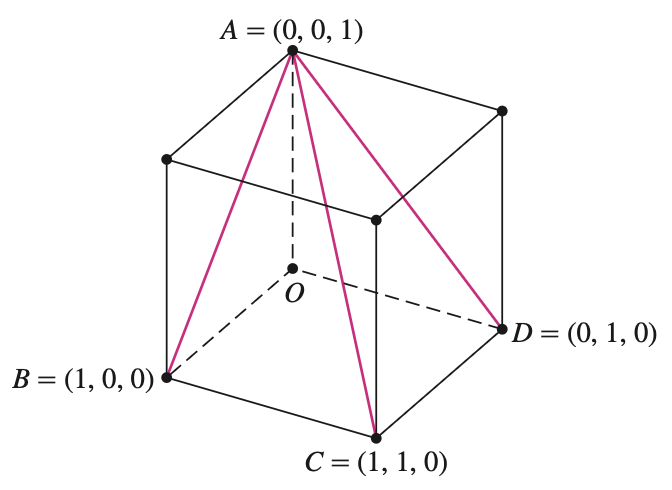
Find the angle between \(\overline{AB}\) and \(\overline{AC}\) in the following figure.
Figure 12.3.37. Unit cube in \(\R^3\)
Solution.
The cosine of the angle \(\alpha\) between the vectors \(\overline{AB}\) and \(\overline{AC}\) is
\begin{equation*} \cos (\alpha) = \frac{\overrightarrow{AB} \cdot \overrightarrow{AC}}{\|\overrightarrow{AB}\| \|\overrightarrow{AC}\|} \end{equation*}
We compute the vectors \(\overrightarrow{AB}\) and \(\overrightarrow{AC}\) and then calculate their dot product and lengths. We get
\begin{align*} \overrightarrow{AB} \amp= \la 1-0, 0-0, 0-1 \ra = \la 1,0,-1 \ra \\ \overrightarrow{AC} \amp= \la 1-0, 1-0, 0-1 \ra = \la 1,1,-1 \ra \\ \overrightarrow{AB} \cdot \overrightarrow{AC} \amp= \la 1,0,-1 \ra \cdot \la 1,1,-1 \ra = 1\cdot 1 + 0\cdot 1 + (-1)\cdot (-1) = 2 \\ \|\overrightarrow{AB}\| \amp= \sqrt{1^2 + 0^2 + (-1)^2} = \sqrt{2} \\ \|\overrightarrow{AC}\| \amp= \sqrt{1^2 + 1^2 + (-1)^2} = \sqrt{3} \end{align*}
Substituting these values into the formula for the cosine of the angle and solving for \(0 \le \alpha \le \pi\) gives
\begin{equation*} \cos(\alpha) = \frac{2}{\sqrt{2} \cdot \sqrt{3}} \approx 0.816 \qquad \implies \qquad \alpha \approx 0.615 \end{equation*}

12.3.85.

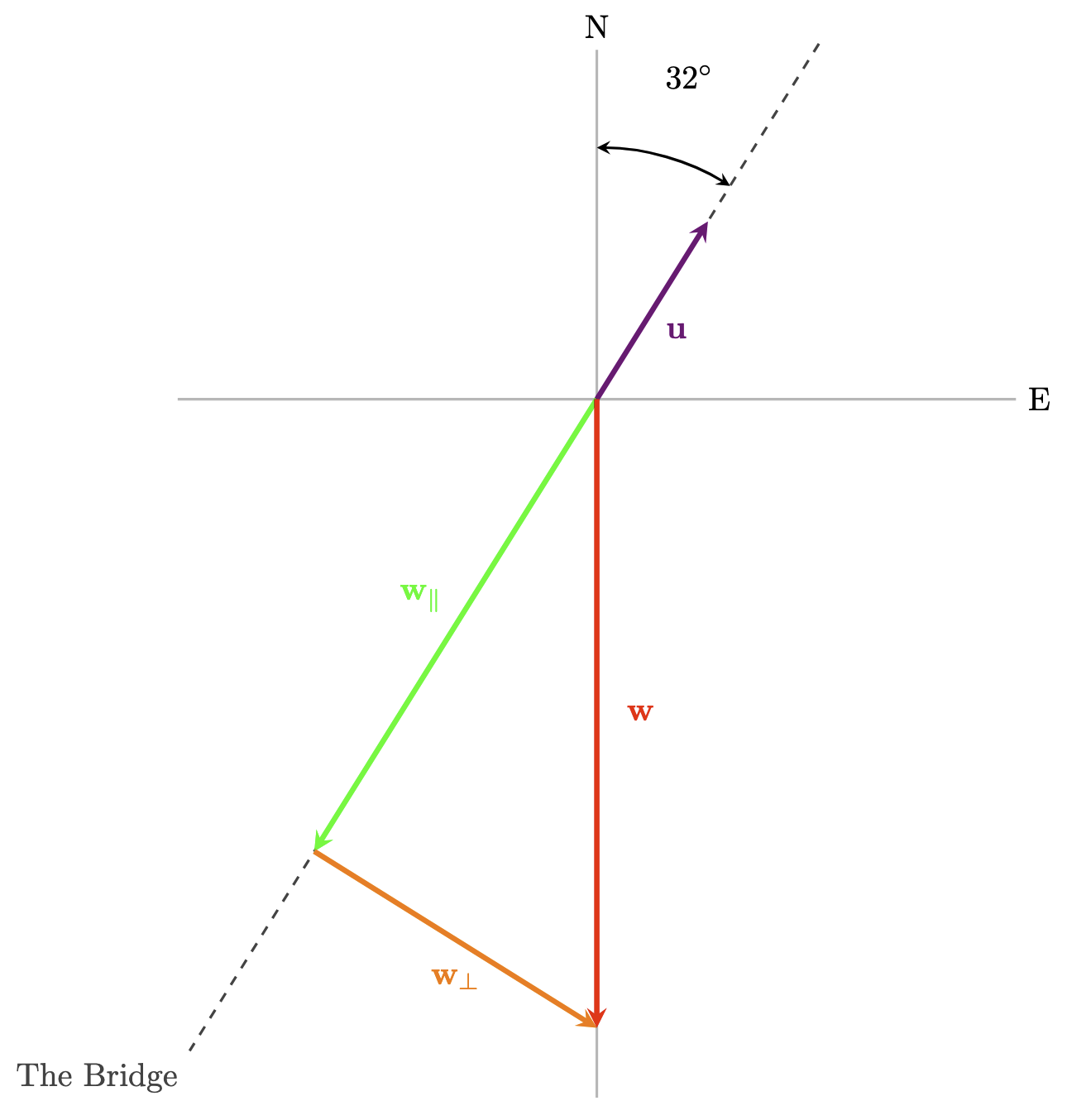
Suppose a 45 km/h wind \(\v{w}\) is blowing out of the north toward a bridge oriented \(32^\circ\) east of north. Express the corresponding wind vector as a sum of vectors, one parallel to the bridge and one perpendicular to it. Also, compute the magnitude of the perpendicular term to determine the speed of the part of the wind blowing directly at the bridge.
Hint.
Richard drew a pretty diagram based on his interpretation of this problem (by saying drawing, what he really meant is coding using TikZ...). Your goal is to find the two components of the vector \(\v{w}\text{,}\) one parallel to \(\v{u}\) and one orthogonal to \(\v{u}\text{.}\)
Figure 12.3.38. Wind vector decomposition
Solution.
We set up a coordinate system where North is the direction of the positive \(y\)-axis and East is the positive \(x\)-axis. Since the wind is blowing out of the North, it heads South, so \(\v{w} = \la 0, -45 \ra\text{.}\)
Figure 12.3.39. Wind vector decomposition
The bridge is oriented \(32^\circ\) East of North. We can define a unit vector \(\v{u}\) along the bridge direction using trigonometry: the \(x\)-component is \(\sin(58^\circ)\) and the \(y\)-component is \(\cos(58^\circ)\text{.}\)
\begin{equation*} \v{u} = \la \cos(58^\circ), \sin(58^\circ) \ra \end{equation*}
We first find \(\v{w}_\parallel\text{,}\) the vector parallel to the bridge by computing the projection of \(\v{w}\) along \(\v{u}\text{:}\)
\begin{align*} \v{w}_{\parallel} \amp= \text{proj}_{\v{u}} \v{w} = \lp \frac{\v{w} \cdot \v{u}}{\v{u} \cdot \v{u}} \rp \v{u} \\ \amp= \lp \la 0, -45 \ra \cdot \la \cos(58^\circ), \sin(58^\circ) \ra \rp \v{u} \\ \amp= -45\sin(58^\circ) \la \cos(58^\circ), \sin(58^\circ) \ra \\ \amp\approx \la -20.22, -32.36 \ra \end{align*}
Next, we find \(\v{w}_\perp\text{,}\) the vector perpendicular to the bridge by computing the difference \(\v{w}_{\perp} = \v{w} - \v{w}_{\parallel}\text{:}\)
\begin{equation*} \v{w}_{\perp} = \la 0, -45 \ra - \la -20.22, -32.36 \ra = \la 20.22, -12.64 \ra \end{equation*}
Thus, the decomposition is
\begin{equation*} \v{w} = \la -20.22, -32.36 \ra + \la 20.22, -12.64 \ra \end{equation*}
To find the speed of the wind blowing directly at the bridge, we compute the magnitude of the perpendicular component:
\begin{equation*} \|\v{w}_{\perp}\| \approx \sqrt{(20.22)^2 + (-12.64)^2} \approx 23.85 \text{ km/h} \end{equation*}

12.3.87.

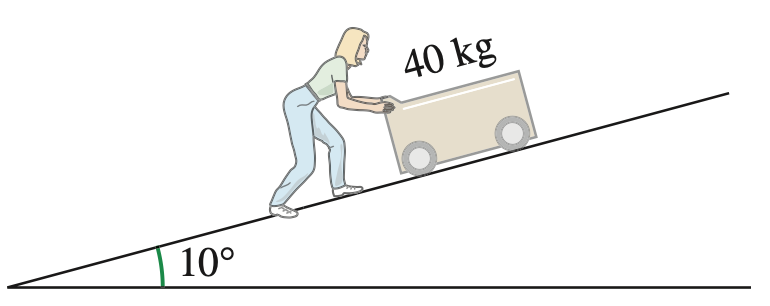
Calculate the force (in newtons) required to push a 40-kg wagon up a \(10^\circ\) incline.
Figure 12.3.40.
Solution.
Gravity exerts a force \(\v{F}_g\) of magnitude \(40g\) newtons where \(g = 9.8\text{.}\) The magnitude of the force required to push the wagon equals the component of the force \(\v{F}_g\) along the ramp. Resolving \(\v{F}_g\) into a sum \(\v{F}_g = \v{F}_\parallel + \v{F}_\perp\text{,}\) where \(\v{F}_\parallel\) is the force along the ramp and \(\v{F}_\perp\) is the force orthogonal to the ramp, we need to find the magnitude of \(\v{F}_\parallel\text{.}\)
Figure 12.3.41.
The angle between \(\v{F}_g\) and the ramp is \(90^\circ - 10^\circ = 80^\circ\text{.}\) Hence,
\begin{equation*} \v{F}_\parallel = \|\v{F}_g\| \cos(80^\circ) = 40 \cdot 9.8 \cdot \cos(80^\circ) \approx 68.07 \text{ N} \end{equation*}
Therefore the minimum force required to push the wagon is \(68.07\) N.
Actually, this is the force required to keep the wagon from sliding down the hill; any slight amount greater than this force will serve to push it up the hill.
12.3.91.

Prove that \(\|\v{v} + \v{w}\|^2 - \|\v{v} - \v{w}\|^2 = 4\v{v} \cdot \v{w}\text{.}\)
Solution.
We expand the left-hand side using the property \(\|\v{u}\|^2 = \v{u} \cdot \v{u}\) and the distributive property of the dot product.
First, we expand the term \(\|\v{v} + \v{w}\|^2\text{:}\)
\begin{align*} \|\v{v} + \v{w}\|^2 \amp= (\v{v} + \v{w}) \cdot (\v{v} + \v{w}) \\ \amp= \v{v} \cdot \v{v} + \v{v} \cdot \v{w} + \v{w} \cdot \v{v} + \v{w} \cdot \v{w} \\ \amp= \|\v{v}\|^2 + 2(\v{v} \cdot \v{w}) + \|\v{w}\|^2 \end{align*}
Next, we expand the term \(\|\v{v} - \v{w}\|^2\text{:}\)
\begin{align*} \|\v{v} - \v{w}\|^2 \amp= (\v{v} - \v{w}) \cdot (\v{v} - \v{w}) \\ \amp= \v{v} \cdot \v{v} - \v{v} \cdot \v{w} - \v{w} \cdot \v{v} + \v{w} \cdot \v{w} \\ \amp= \|\v{v}\|^2 - 2(\v{v} \cdot \v{w}) + \|\v{w}\|^2 \end{align*}
Finally, we subtract the second expression from the first:
\begin{align*} \|\v{v} + \v{w}\|^2 - \|\v{v} - \v{w}\|^2 \amp= \lp \|\v{v}\|^2 + 2(\v{v} \cdot \v{w}) + \|\v{w}\|^2 \rp - \lp \|\v{v}\|^2 - 2(\v{v} \cdot \v{w}) + \|\v{w}\|^2 \rp \\ \amp= \|\v{v}\|^2 + 2(\v{v} \cdot \v{w}) + \|\v{w}\|^2 - \|\v{v}\|^2 + 2(\v{v} \cdot \v{w}) - \|\v{w}\|^2 \\ \amp= 4\v{v} \cdot \v{w} \end{align*}