Worksheet Assigned Problems for Section 12.6

The problems listed below are assigned to be included in your problem set portfolio. Note that a specific selection of these problems will also form the written homework assignments. I recommend working through all of them to ensure a solid grasp of the material. Reach out to Richard for help if you get stuck or have any questions.
The solutions will be posted after the written homework due dates. If you have any questions about your work, talk to Richard and he is happy to discuss the process with you.

Exercise Group.

In the following exercises, state whether the given equation defines an ellipsoid or hyperboloid, and if a hyperboloid, whether it is of one or two sheets.
12.6.3.
\(x^2 + 3y^2 + 9z^2 = 1\)
Solution.
We rewrite the equation as follows:
\begin{equation*} \lp \dfrac{x}{1} \rp^2 + \lp \dfrac{y}{\frac{1}{\sqrt{3}}} \rp^2 + \lp \dfrac{z^2}{\frac{1}{3}} \rp^2 = 1 \end{equation*}
This equation defines an ellipse.
12.6.7.
\(x^2 + y^2 = 4 - 4z^2\)
Solution.
We rewrite the equation as follows:
\begin{equation*} \lp \dfrac{x}{2} \rp^2 + \lp \dfrac{y}{2} \rp^2 + \lp \dfrac{z}{1} \rp^2 = 1 \end{equation*}
This equation defines an ellipse.

Exercise Group.

In the following exercises, state whether the given equation defines an elliptic paraboloid, a hyperbolic paraboloid, or an elliptic cone.
12.6.13.
\(3x^2 - 7y^2 = z\)
Solution.
Rewriting the equation as
\begin{equation*} z = \lp \frac{x}{\frac{1}{\sqrt{3}}} \rp^2 - \lp \frac{y}{\frac{1}{\sqrt{7}}} \rp^2 \end{equation*}
We identify it as the equation of a hyperbolic paraboloid.

Exercise Group.

In the following exercises, state the type of the quadric surface and describe the trace obtained by intersecting with the given plane.
12.6.17.
\(x^2 + \lp \dfrac{y}{4} \rp^2 + z^2 = 1\text{,}\) \(\qquad y = 0\)
Solution.
The equation \(x^2 + \lp \frac{y}{4} \rp^2 + z^2 = 1\) defines an ellipsoid. The \(xz\)-trace is obtained by substituting \(y = 0\) in the equation of the ellipsoid. This gives the equation
\begin{equation*} x^2 + z^2 = 1 \end{equation*}
which defines a circle in the \(xz\)-plane.
12.6.19.
\(x^2 + \lp \dfrac{y}{4} \rp^2 + z^2 = 1\text{,}\) \(\qquad z = \dfrac{1}{4}\)
Solution.
The quadric surface is an ellipsoid, since its equation has the form \(\lp \frac{x}{a} \rp^2 + \lp \frac{y}{b} \rp^2 + \lp \frac{z}{c} \rp^2 = 1\) for \(a = 1\text{,}\) \(b = 4\text{,}\) and \(c = 1\text{.}\) To find the trace obtained by intersecting the ellipsoid with the plane \(z = \frac{1}{4}\text{,}\) we set \(z = \frac{1}{4}\) in the equation of the ellipsoid. This gives
\begin{align*} x^2 + \lp \frac{y}{4} \rp^2 + \lp \frac{1}{4} \rp^2 = 1 \\ x^2 + \frac{y^2}{16} \amp= \frac{15}{16} \end{align*}
To get the standard form we divide by \(\frac{15}{16}\) to obtain
\begin{align*} \frac{x^2}{\frac{15}{16}} + \frac{y^2}{\frac{16\cdot 15}{16}} \amp= 1 \\ \implies \qquad \lp \frac{x}{\frac{\sqrt{15}}{4}} \rp^2 + \lp \frac{y}{\sqrt{15}} \rp^2 \amp= 1 \end{align*}
We conclude that the trace is an ellipse on the \(xy\)-\plane with the equation above.

12.6.25.

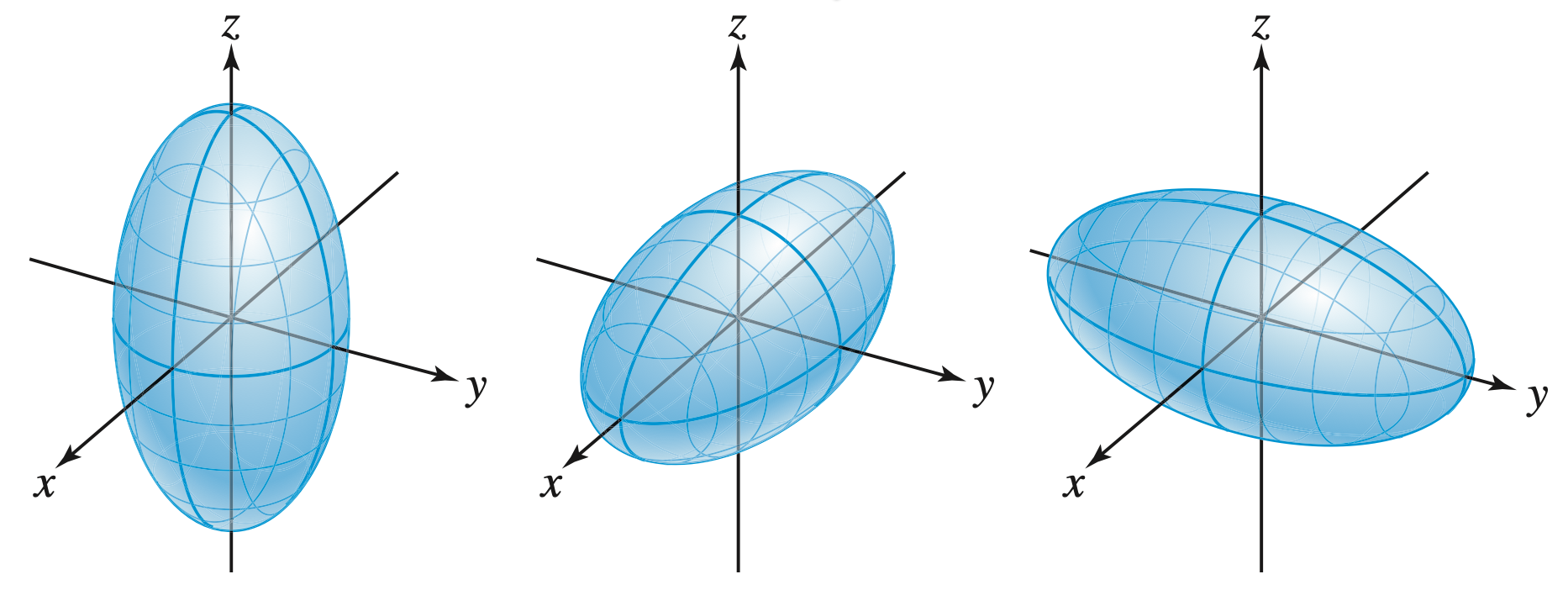
Match each of the ellipsoids in the figure below with the correct equation.
  1. \(\displaystyle x^2 + 4y^2 + 4z^2 = 16\)
  2. \(\displaystyle 4x^2 + y^2 + 4z^2 = 16\)
  3. \(\displaystyle 4x^2 + 4y^2 + z^2 = 16\)
Figure 12.6.24.
Solution.
  1. We rewrite the equation in the form
    \begin{equation*} \lp \frac{x}{4} \rp^2 + \lp \frac{y}{2} \rp^2 + \lp \frac{z}{2} \rp^2 = 1 \end{equation*}
    The ellipsoid intersets the \(x\text{,}\) \(y\text{,}\) and \(z\) axes at the points \((\pm 4,0,0)\text{,}\) \((0,\pm 2, 0)\text{,}\) and \((0,0,\pm 2)\text{,}\) hence (B) is the corresponding figure.
  2. We rewrite the equation in the form
    \begin{equation*} \lp \frac{x}{2} \rp^2 + \lp \frac{y}{4} \rp^2 + \lp \frac{z}{2} \rp^2 = 1 \end{equation*}
    The \(x\text{,}\) \(y\text{,}\) and \(z\) intercepts are \((\pm 2,0,0)\text{,}\) \((0,\pm 4, 0)\text{,}\) and \((0,0,\pm 2)\) respectively, hence (A) is the correct figure.
  3. We rewrite the equation in the form
    \begin{equation*} \lp \frac{x}{2} \rp^2 + \lp \frac{y}{2} \rp^2 + \lp \frac{z}{4} \rp^2 = 1 \end{equation*}
    The \(x\text{,}\) \(y\text{,}\) and \(z\) intercepts are \((\pm 2,0,0)\text{,}\) \((0,\pm 2, 0)\text{,}\) and \((0,0,\pm 4)\) respectively, hence theh corresponding figure is (C).

Exercise Group.

In the following exercises, sketch the given surface.
12.6.29.
\(x^2 + y^2 - z^2 = 1\)
Solution.
The equation defines a hyperboloid of one sheet. The trace on the plane \(z = z_0\) is the circle
\begin{equation*} x^2 + y^2 = 1 + z_0^2 \end{equation*}
The trace on the plane \(y = y_0\) is the hyperbola
\begin{equation*} x^2 - z^2 = 1 - y_0^2 \end{equation*}
and the trace on the plane \(x = x_0\) is the hyperbola
\begin{equation*} y^2 - z^2 = 1 - x_0^2 \end{equation*}
We obtain the surface shown below.
Figure 12.6.25. The hyperboloid with equation \(x^2 + y^2 - z^2 = 1\text{.}\)
12.6.33.
\(z^2 = \lp \dfrac{x}{4} \rp^2 + \lp \dfrac{y}{8} \rp^2\)
Solution.
The equation defines an elliptic cone. The trace on the plane \(z = z_0\) is the ellipse
\begin{equation*} \lp \frac{x}{4} \rp^2 + \lp \frac{y}{8} \rp^2 = z_0^2 \end{equation*}
The trace on the plane \(y = 0\) is the hyperbola
\begin{equation*} z^2 - \lp \frac{x}{4} \rp^2 = 0 \qquad \implies \qquad z = \pm \frac{x}{4} \end{equation*}
and the trace on the plane \(x = 0\) is the hyperbola
\begin{equation*} z^2 - \lp \frac{y}{8} \rp^2 = \lp \frac{x_0}{4} \rp^2 \qquad \implies \qquad z = \pm \frac{y}{8} \end{equation*}
The sketch of the surface is shown below.
Figure 12.6.26. The elliptic cone \(z^2 = \lp \dfrac{x}{4} \rp^2 + \lp \dfrac{y}{8} \rp^2\text{.}\)

12.6.45.

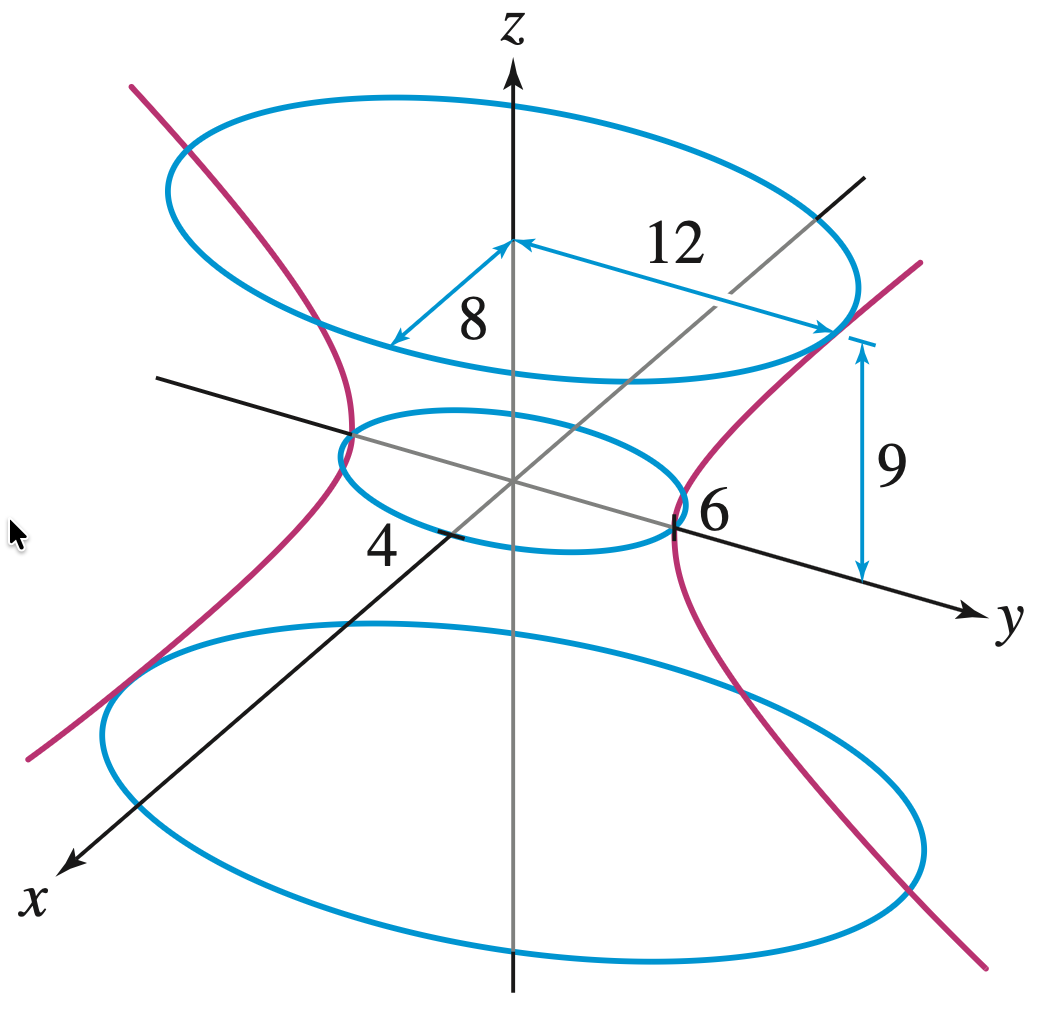
Find the equation of the hyperboloid shown in the following figure.
Figure 12.6.28.
Solution.
The hyperboloid in the figure is of one sheet and the intersections with the planes \(z = z_0\) are ellipses. Hence, the equation of the hyperboloid has the form
\begin{equation*} \lp \frac{x}{a} \rp^2 + \lp \frac{y}{b} \rp^2 - \lp \frac{z}{c} \rp^2 = 1 \end{equation*}
Substituting \(z = 0\text{,}\) we get
\begin{equation*} \lp \frac{x}{a} \rp^2 + \lp \frac{y}{b} \rp^2 = 1 \end{equation*}
By the given information this ellipse has \(x\) and \(y\) intercepts at the points \((\pm 2, 0, 0)\) and \((0, \pm 3, 0)\text{,}\) hence \(a = 4\) and \(b = 6\text{.}\)
Substituting in the equation of the hyperbolod, we get
\begin{equation*} \lp \frac{x}{4} \rp^2 + \lp \frac{y}{6} \rp^2 - \lp \frac{z}{c} \rp^2 = 1 \end{equation*}
Substituting \(z = 9\text{,}\) we get
\begin{align*} \frac{x}{16} + \frac{y}{36} - \frac{9^2}{c^2} \amp= 1 \\ \frac{x^2}{16} + \frac{y^2}{36} \amp= 1 + \frac{81}{c^2} = \frac{c^2 + 81}{c^2} \\ \frac{c^2x^2}{16\lp 81 + c^2 \rp} + \frac{c^2y^2}{36\lp 81 + c^2 \rp} \amp= 1 \\ \lp \frac{x}{\frac{4}{c}\sqrt{81 + c^2}} \rp^2 + \lp \frac{y}{\frac{6}{c}\sqrt{81 + c^2}} \rp^2 \amp= 1 \end{align*}
By the given information the following must hold.
\begin{equation*} \frac{4}{c} \sqrt{81 + c^2} = 8 \qquad \text{and} \qquad \frac{6}{c}\sqrt{81 + c^2} = 12 \end{equation*}
which implies that
\begin{equation*} \frac{\sqrt{81 + c^2}}{c} = 2 \qquad \implies \qquad 81 + c^2 = 4c^2 \qquad \implies \qquad 3c^2 = 81 \end{equation*}
Thus, \(c = 3\sqrt{3}\text{,}\) and by substituting back we obtain the following equation
\begin{equation*} \lp \frac{x}{4} \rp^2 + \lp \frac{y}{6} \rp^2 - \lp \frac{z}{3\sqrt{3}} \rp^2 = 1 \end{equation*}