Worksheet Assigned Problems for Section 14.1

The problems listed below are assigned to be included in your problem set portfolio. Note that a specific selection of these problems will also form the written homework assignments. I recommend working through all of them to ensure a solid grasp of the material. Reach out to Richard for help if you get stuck or have any questions.
The solutions will be posted after the written homework due dates. If you have any questions about your work, talk to Richard and he is happy to discuss the process with you.

14.1.3.

Evaluate the function \(h(x,y) = \dfrac{\sqrt{x - y^2}}{x - y}\) at the given points \((20,2)\text{,}\) \((1,-2)\text{,}\) and \((1,1)\) (or indicate that the function is undefined there).
Solution.
For \((20,2)\text{:}\)
\begin{equation*} h(20,2) = \frac{\sqrt{20 - 2^2}}{20 - 2} = \frac{\sqrt{16}}{18} = \frac{4}{18} = \frac{2}{9} \end{equation*}
For \((1,-2)\text{:}\)
\begin{equation*} h(1,-2) = \frac{\sqrt{1 - (-2)^2}}{1 - (-2)} = \frac{\sqrt{1 - 4}}{3} = \frac{\sqrt{-3}}{3} \end{equation*}
The function is undefined at \((1,-2)\) because the term under the square root is negative.
For \((1,1)\text{:}\)
\begin{equation*} h(1,1) = \frac{\sqrt{1 - 1^2}}{1 - 1} = \frac{0}{0} \end{equation*}
The function is undefined at \((1,1)\) due to division by zero.
14.1.9.

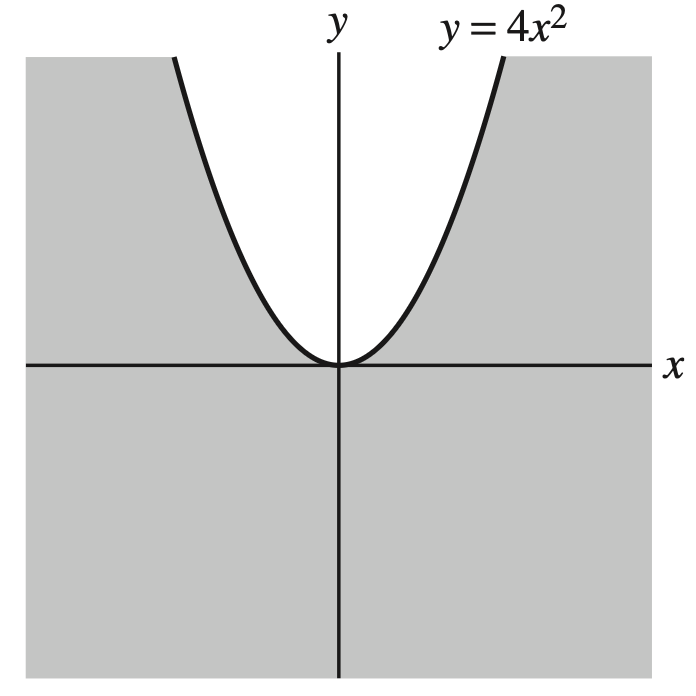
Sketch the domain of the function \(f(x,y) = \ln \lp 4x^2 - y \rp\text{.}\)
Solution.
The function is defined if \(4x^2 - y \gt 0\text{.}\) That is, \(y \lt 4x^2\text{.}\) The domain is the region in the \(xy\)-plane that is below the parabola \(y = 4x^2\text{.}\)
Figure 14.1.10.

14.1.17.

Describe the domain and range of the function \(P(r,s,t) = \sqrt{16 - r^2s^2t^2}\text{.}\)
Solution.
The domain is the subset of \(\R^3\) where \(r^2s^2t^2 \lt 16\text{,}\) or \(|rst| \lt 4\text{.}\) The range is \(\left\{ w \mid 0 \leq w \leq 4 \right\}\) since the values of \(P\) clearly range from \(\sqrt{16 - 16} = 0\) to \(\sqrt{16 - 0} = 4\text{.}\)

14.1.19.

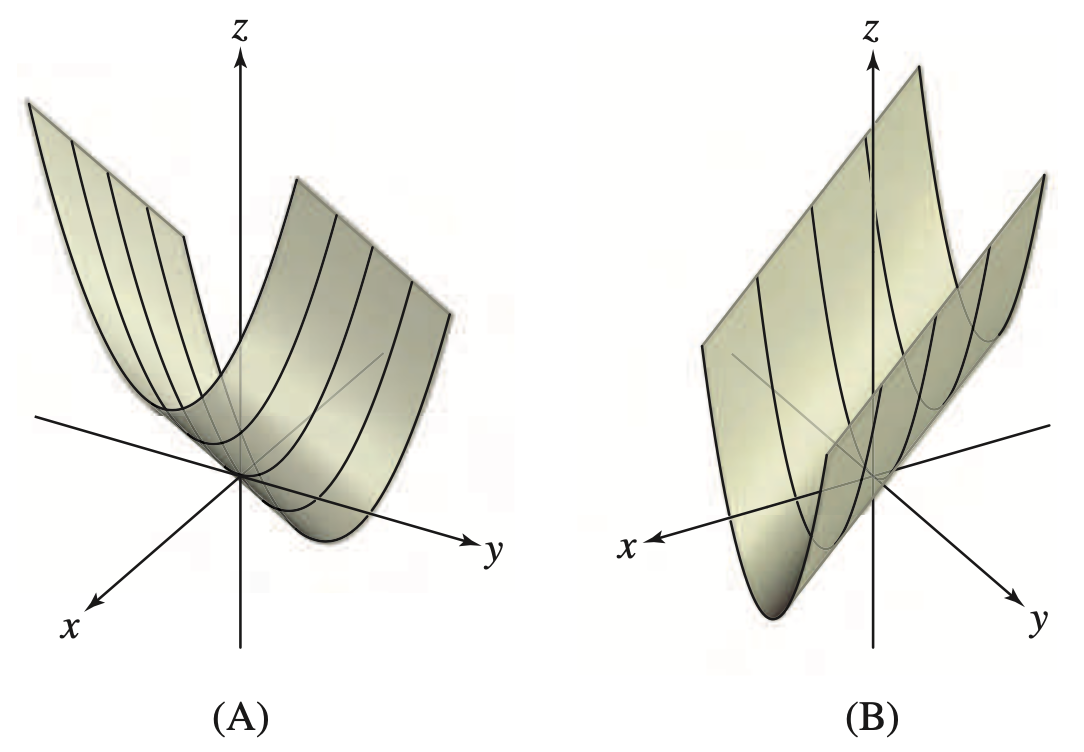
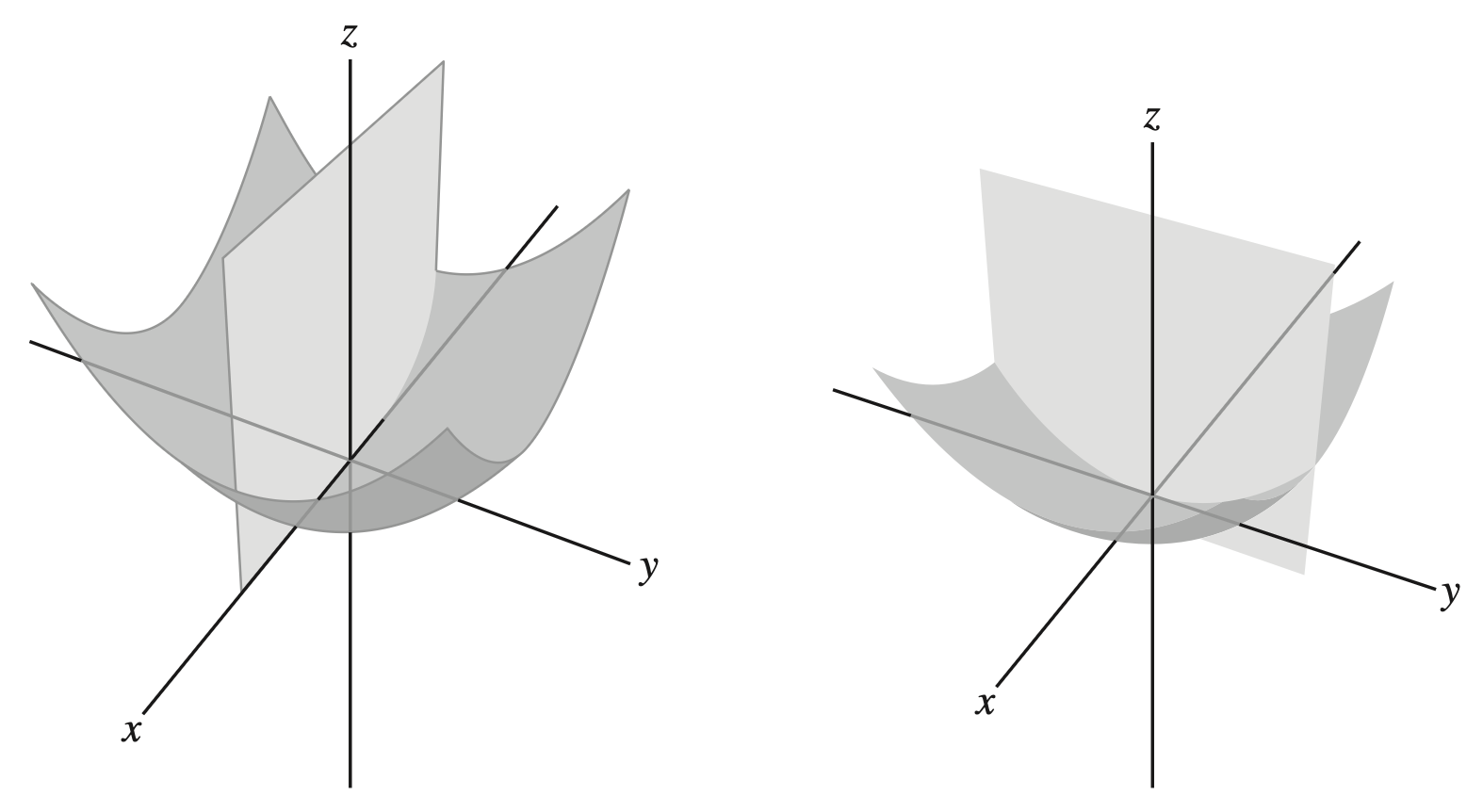
Match graphs (A) and (B) in the figure below with the functions
  1. \(\displaystyle f(x,y) = -x + y^2\)
  2. \(\displaystyle g(x,y) = x + y^2\)
Figure 14.1.11.
Solution.
  1. The vertical trace for \(f(x,y) = -x + y^2\) in the \(xz\)-plane (\(y = 0\)) is \(z = -x\text{.}\) This matches the graph shown in (B).
  2. The vertical trace for \(f(x,y) = x + y^2\) in the \(xz\)-plane (\(y = 0\)) is \(z = x\text{.}\) This matches the graph shown in (A).

14.1.21.

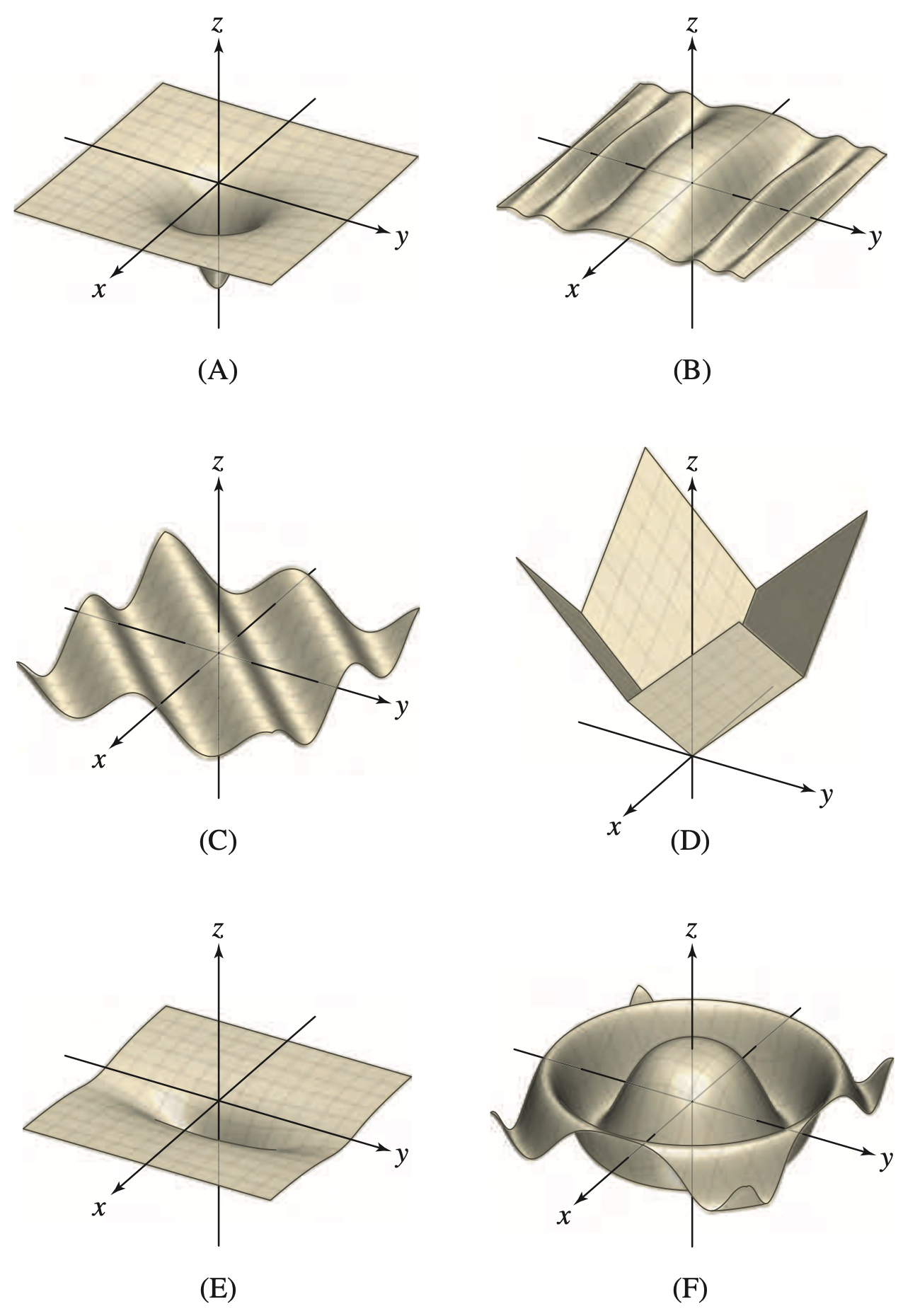
Match the functions (a)-(f) with their graphs (A)-(F) in the figure below.
  1. \(\displaystyle f(x,y) = |x| + |y|\)
  2. \(\displaystyle f(x,y) = \cos(x - y)\)
  3. \(\displaystyle f(x,y) = \dfrac{-1}{1 + 9x^2 + y^2}\)
  4. \(\displaystyle f(x,y) = \cos\lp y^2 \rp e^{-0.1\lp x^2 + y^2 \rp}\)
  5. \(\displaystyle f(x,y) = \frac{-1}{1 + 9x^2 + 9y^2}\)
  6. \(\displaystyle f(x,y) = \cos\lp x^2 + y^2 \rp e^{-0.1\lp x^2 + y^2 \rp}\)
Figure 14.1.12.
Solution.
  1. \(f(x,y) = |x| + |y|\text{.}\) The level curves are \(|x| + |y| = c\text{,}\) \(y = c - |x|\text{,}\) or \(y = -c + |x|\text{.}\) The graph (D) corresponds to the function with these level curves.
  2. \(f(x,y) = \cos(x - y)\text{.}\) The vertical trace in the plane \(x = c\) is the curve \(z = \cos(c - y)\) in the plane \(x = c\text{.}\) These traces correspond to the graph (C).
  3. \(f(x,y) = \dfrac{-1}{1 + 9x^2 + y^2}\text{.}\) The level curves of this function is
    \begin{equation*} \frac{-1}{1 + 9x^2 + y^2} = c \qquad \implies \qquad 9x^2 + y^2 = -1 - \frac{1}{c} \end{equation*}
    For suitable values of \(c\text{,}\) the level curves of the function are ellipses. The graph (E) corresponds to the function with these level curves.
  4. \(f(x,y) = \cos\lp y^2 \rp e^{-0.1\lp x^2 + y^2 \rp}\text{.}\) The value of \(|z|\) is decreasing to \(0\) as \(x\) or \(y\) are decreasing, hence the possible graphs are (B) and (F). Function (f) matches with graph (F), so function (d) must match with graph (B).
  5. \(f(x,y) = \dfrac{-1}{1 + 9x^2 + 9y^2}\text{.}\) The level curves of this function is
    \begin{equation*} \frac{-1}{1 + 9x^2 + 9y^2} = c \qquad \implies \qquad x^2 + y^2 = - \frac{1 + c}{9c} \end{equation*}
    For suitable values of \(c\text{,}\) the level curves of the function are circles. The graph (A) corresponds to the function with these level curves.
  6. \(f(x,y) = \cos\lp x^2 + y^2 \rp e^{-0.1\lp x^2 + y^2 \rp}\text{.}\) The value of \(|z|\) is decreasing to \(0\) as \(x\) or \(y\) are decreasing, hence the possible graphs are (B) and (F).
    Furthermore, \(z\) is a constant whenever \(x^2 + y^2\) is a constant. That is, \(z\) is constant whenever \((x,y)\) varies on a circle. Hence, graph (F) corresponds to this function.

14.1.25.

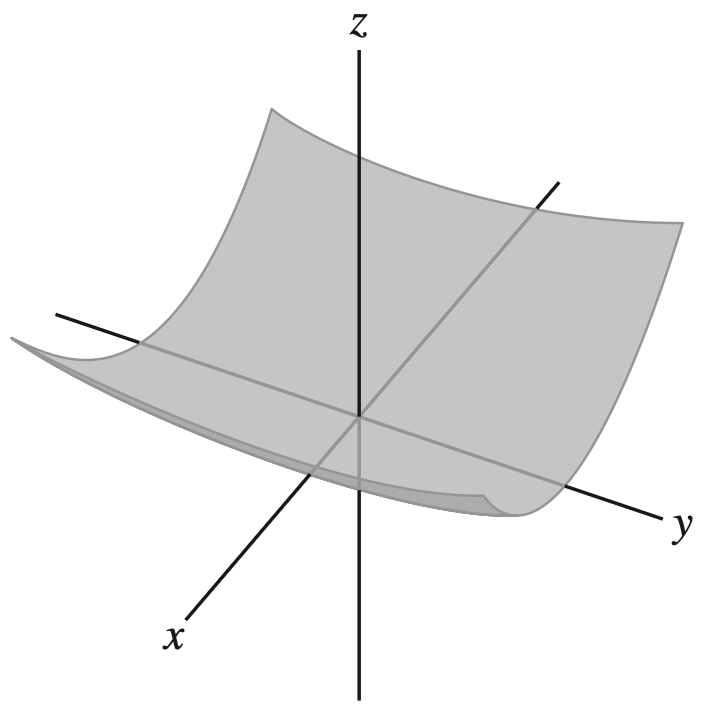
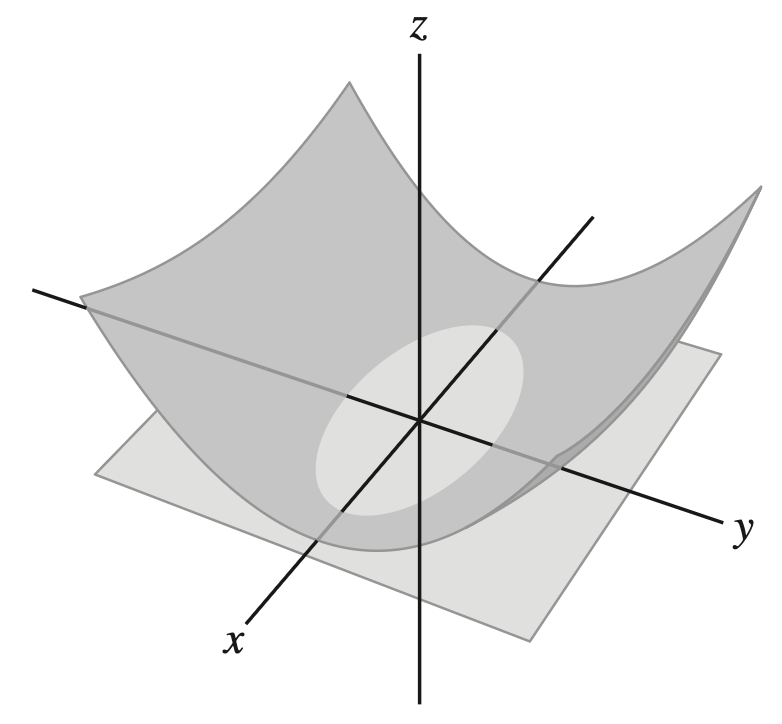
Sketch the graph of \(f(x,y) = x^2 + 4y^2\) and draw several vertical and horizontal traces.
Solution.
The graph of the function is shown below.
Figure 14.1.13.
The horizontal traces at height \(c\) is the curve \(x^2 + 4y^2 = c\text{,}\) where \(c \geq 0\) (if \(c = 0\text{,}\) it is the origin). The horizontal traces are ellipses for \(c \gt 0\text{.}\)
Figure 14.1.14.
The vertical traces in the plane \(x = a\) is the parabola \(z = a^2 + 4y^2\text{,}\) and the vertical trace in the plane \(y = a\) is the parabola \(z = x^2 + 4a^2\text{.}\)
Figure 14.1.15.

14.1.33.

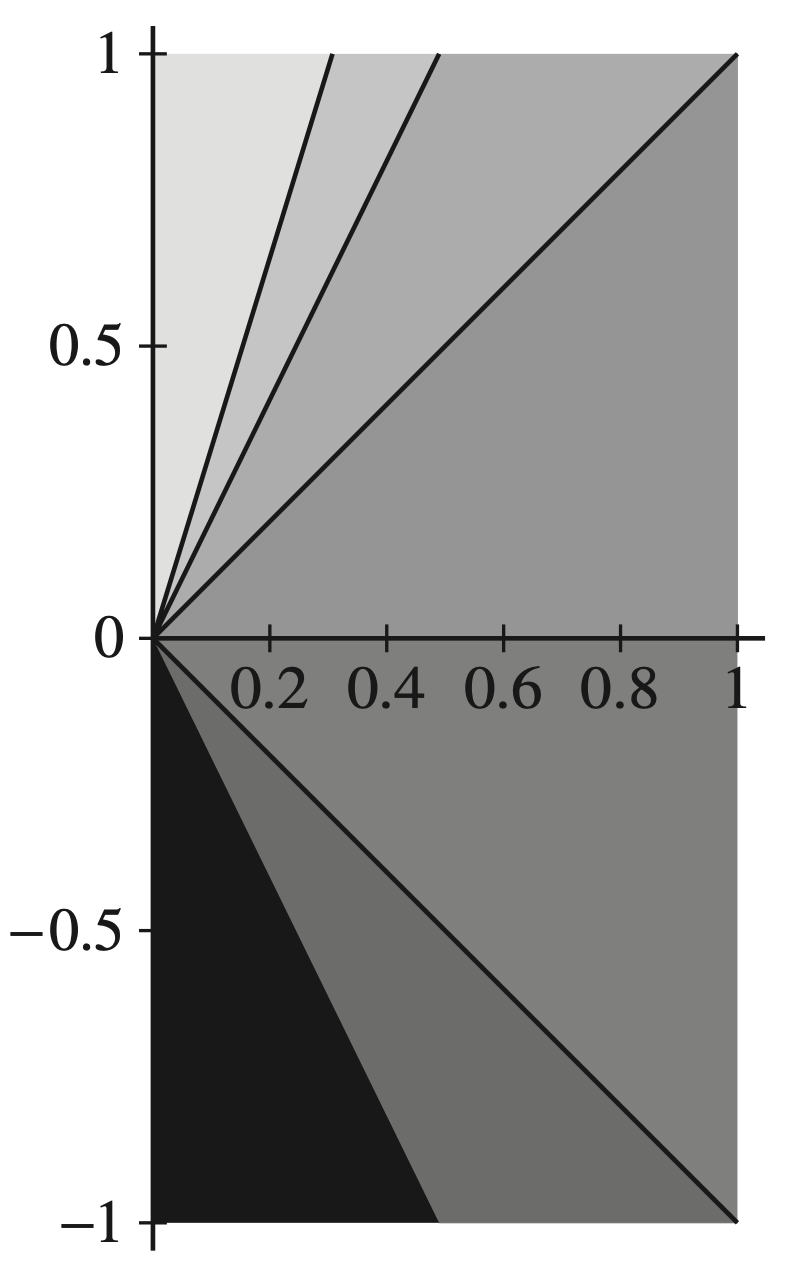
Draw a contour map of \(f(x,y) = \dfrac{y}{x}\) with an appropriate contour interval, showing at least six level curves.
Solution.
The level curves are defined by \(\frac{y}{x} = k\text{,}\) which implies \(y = kx\text{.}\) These are straight lines passing through the origin with slope \(k\) (excluding the origin itself, where the function is undefined).
Examples of level curves:
\begin{gather*} k = 0 \qquad \implies \qquad y = 0 \text{ (x-axis)} \\ k = 1 \qquad \implies \qquad y = x \\ k = -1 \qquad \implies \qquad y = -x \\ k = 2 \qquad \implies \qquad y = 2x \\ k = -2 \qquad \implies \qquad y = -2x \\ k = \frac{1}{2} \qquad \implies \qquad y = \frac{1}{2}x \end{gather*}
The contour map consists of a family of lines intersecting at the origin, shown in the figure below.
Figure 14.1.16.

14.1.47.

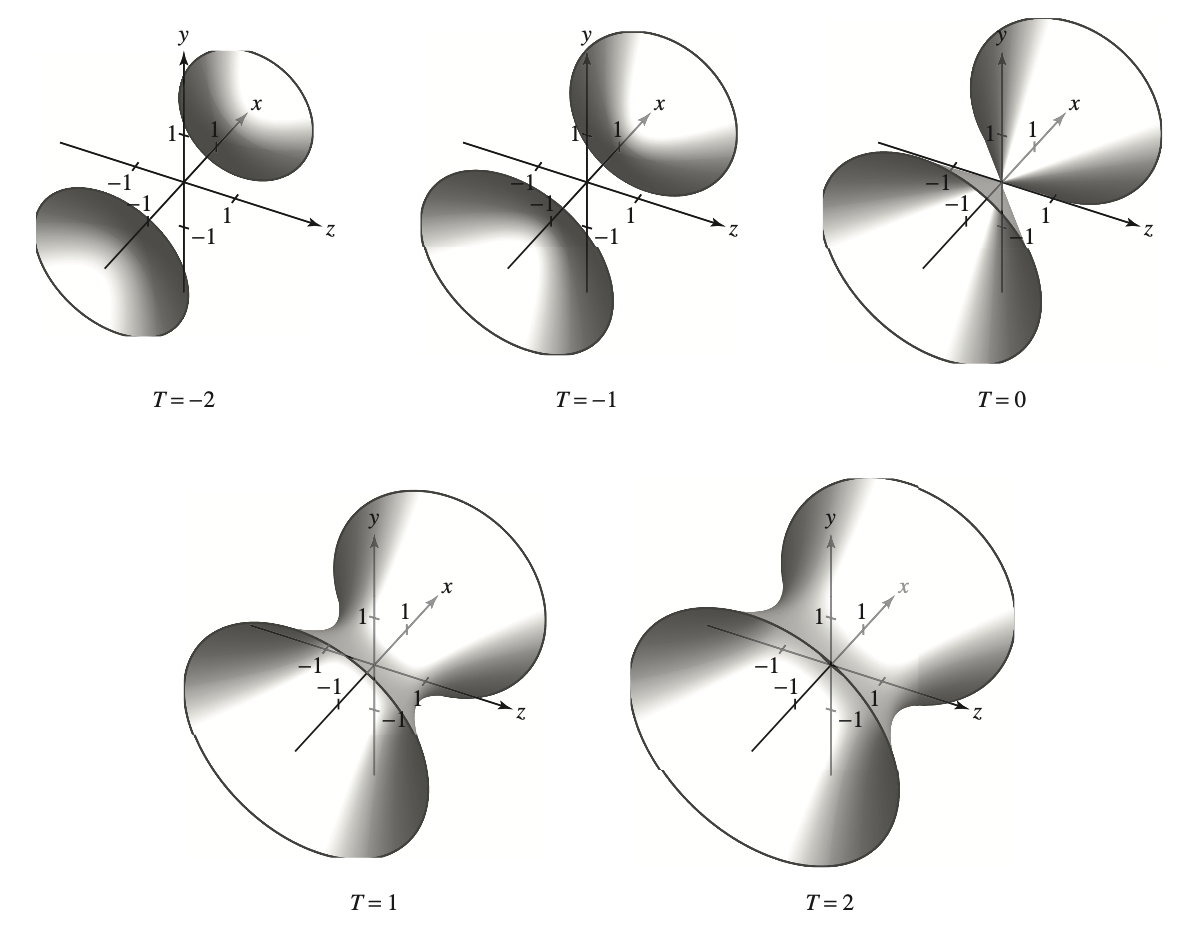
Let \(T(x,y,z) = x^2 - y^2 + z^2\) denote the temperature at each point in space. Draw level surfaces (also called isotherms) corresponding to the fixed temperatures \(T = 0,1,2,-1,-2\text{.}\)
Solution.
Each level surface of \(T\) is of the form \(x^2 - y^2 + z^2 = a\) for some constant \(a\text{,}\) so the level surfaces for \(a \gt 0\) are hyperboloids of one sheet;
For \(a \lt 0\text{,}\) they are hyperboloids of two sheets;
And for \(a = 0\) it is a elliptic cone.
Note that all of these surfaces are oriented along the \(y\)-axis.
Figure 14.1.18.

14.1.57.

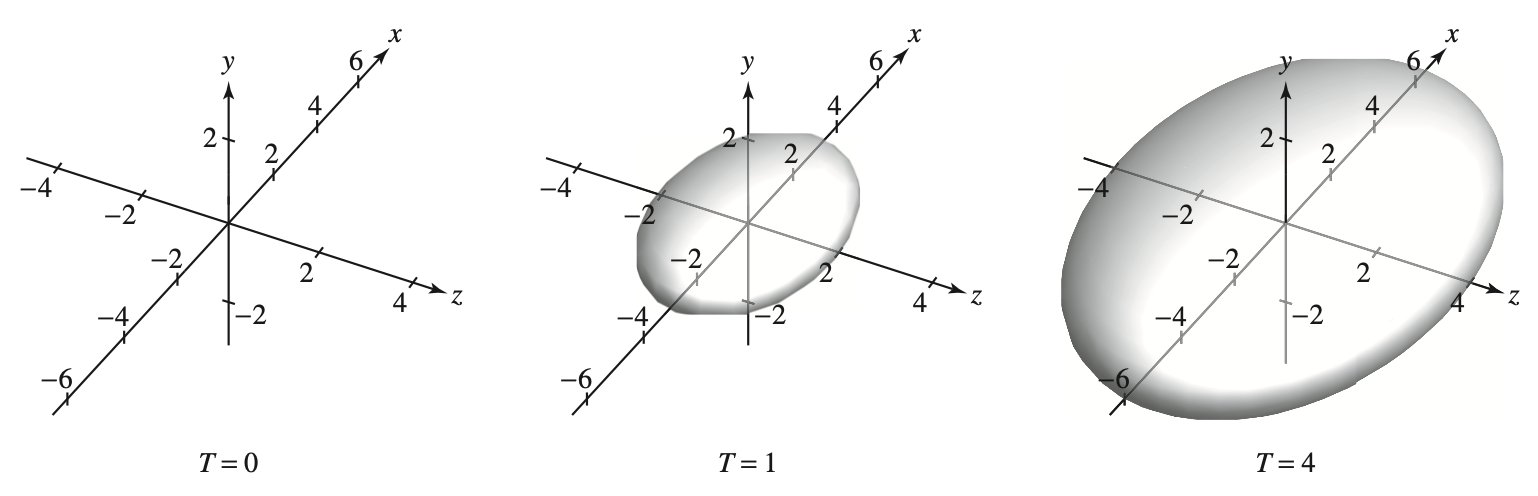
Let temperature in 3-space be given by
\begin{equation*} T(x,y,z) = \frac{x^2}{4} + \frac{y^2}{9} + z^2 \end{equation*}
Draw isotherms corresponding to temperatures \(T = 0, 1, 2\text{.}\)
Solution.
Each level surface of \(T\) is of the form
\begin{equation*} \frac{x^2}{4} + \frac{y^2}{9} + z^2 = a \end{equation*}
for some constant \(a\text{,}\) so the level surfaces are ellipsoids for positive values of \(a\text{,}\) empty for negative values of \(a\text{,}\) and consist of the origin if \(a = 0\text{.}\) Plots of the various surfaces are shown below.
Figure 14.1.19.