
Worksheet Assigned Problems for Section 15.2

The problems listed below are assigned to be included in your problem set portfolio. Note that a specific selection of these problems will also form the written homework assignments. I recommend working through all of them to ensure a solid grasp of the material. Reach out to Richard for help if you get stuck or have any questions.
The solutions will be posted after the written homework due dates. If you have any questions about your work, talk to Richard and he is happy to discuss the process with you.

15.2.3.

Express the domain \(\c{D}\) in the following figure as both a vertically simple region and a horizontally simple region, and evaluate the integral of \(f(x,y) = xy\) over \(\c{D}\) as an iterated integral in two ways.
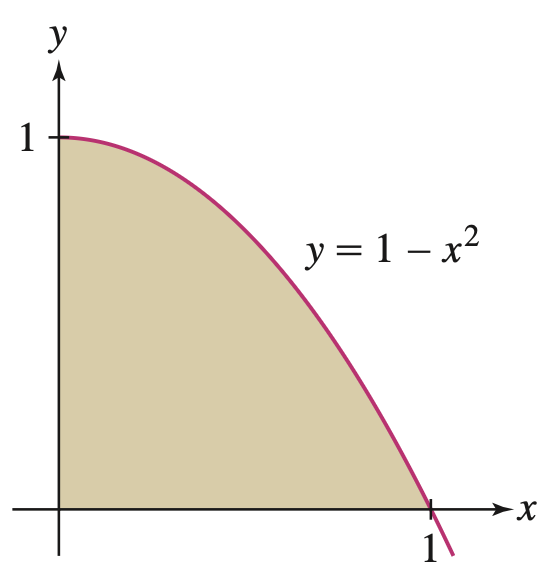
Figure 15.2.16.
Solution.
Vertically Simple: To express the domain as a vertically simple region, we bound \(x\) between two constants, and \(y\) between two functions of \(x\text{.}\) Looking at the figure, \(x\) ranges from \(0\) to \(1\text{.}\) For a given \(x\) in this interval, \(y\) goes from the \(x\)-axis (\(y = 0\)) up to the curve \(y = 1 - x^2\text{.}\)
\begin{align*} \iint_\c{D} xy \, dA \amp = \int_0^1 \int_0^{1-x^2} xy \, dy \, dx \end{align*}
Evaluating the inner integral with respect to \(y\text{:}\)
\begin{align*} \int_0^{1-x^2} xy \, dy \amp = \left[ \frac{1}{2}xy^2 \right]_{y=0}^{y=1-x^2} \\ \amp = \frac{1}{2}x(1 - x^2)^2 = \frac{1}{2}x(1 - 2x^2 + x^4) = \frac{1}{2}x - x^3 + \frac{1}{2}x^5 \end{align*}
Evaluating the outer integral with respect to \(x\text{:}\)
\begin{align*} \int_0^1 \left( \frac{1}{2}x - x^3 + \frac{1}{2}x^5 \right) \, dx \amp = \left[ \frac{1}{4}x^2 - \frac{1}{4}x^4 + \frac{1}{12}x^6 \right]_0^1 \\ \amp = \frac{1}{4} - \frac{1}{4} + \frac{1}{12} = \frac{1}{12} \end{align*}
Horizontally Simple: To express it as a horizontally simple region, we bound \(y\) between two constants, and \(x\) between two functions of \(y\text{.}\) First, we solve the curve equation for \(x\text{:}\) \(y = 1 - x^2 \implies x^2 = 1 - y\text{.}\) Since we are in the first quadrant, \(x = \sqrt{1 - y}\text{.}\) \(y\) ranges from \(0\) to \(1\text{.}\) For a given \(y\text{,}\) \(x\) goes from the \(y\)-axis (\(x = 0\)) out to the curve \(x = \sqrt{1 - y}\text{.}\)
\begin{align*} \iint_\c{D} xy \, dA \amp = \int_0^1 \int_0^{\sqrt{1-y}} xy \, dx \, dy \end{align*}
Evaluating the inner integral with respect to \(x\text{:}\)
\begin{align*} \int_0^{\sqrt{1-y}} xy \, dx \amp = \left[ \frac{1}{2}x^2y \right]_{x=0}^{x=\sqrt{1-y}} \\ \amp = \frac{1}{2}(\sqrt{1-y})^2 y = \frac{1}{2}(1 - y)y = \frac{1}{2}y - \frac{1}{2}y^2 \end{align*}
Evaluating the outer integral with respect to \(y\text{:}\)
\begin{align*} \int_0^1 \left( \frac{1}{2}y - \frac{1}{2}y^2 \right) \, dy \amp = \left[ \frac{1}{4}y^2 - \frac{1}{6}y^3 \right]_0^1 \\ \amp = \frac{1}{4} - \frac{1}{6} = \frac{3}{12} - \frac{2}{12} = \frac{1}{12} \end{align*}
As expected by Fubini’s Theorem, both orders of integration yield the exact same result: \(\frac{1}{12}\text{.}\)
15.2.9.

Integrate \(f(x,y) = x\) over the region bounded by \(y = x^2\) and \(y = x + 2\text{.}\)
Solution.
First, we find the intersection points of the two curves to determine the limits of integration. Setting them equal:
\begin{align*} x^2 \amp = x + 2 \\ x^2 - x - 2 \amp = 0 \\ (x - 2)(x + 1) \amp = 0 \implies x = 2, \text{ or } x = -1 \end{align*}
So, \(x\) ranges from \(-1\) to \(2\text{.}\) On this interval, the line \(y = x + 2\) is above the parabola \(y = x^2\text{.}\) This forms a vertically simple region.
We set up the iterated integral:
\begin{align*} \iint_\c{D} x \, dA \amp = \int_{-1}^2 \int_{x^2}^{x+2} x \, dy \, dx \end{align*}
Evaluate the inner integral with respect to \(y\text{:}\)
\begin{align*} \int_{x^2}^{x+2} x \, dy \amp = \Big[ xy \Big]_{y=x^2}^{y=x+2} \\ \amp = x(x + 2) - x(x^2) = x^2 + 2x - x^3 \end{align*}
Evaluate the outer integral with respect to \(x\text{:}\)
\begin{align*} \int_{-1}^2 (x^2 + 2x - x^3) \, dx \amp = \left[ \frac{1}{3}x^3 + x^2 - \frac{1}{4}x^4 \right]_{-1}^2 \\ \amp = \left( \frac{8}{3} + 4 - \frac{16}{4} \right) - \left( -\frac{1}{3} + 1 - \frac{1}{4} \right) \\ \amp = \left( \frac{8}{3} + 4 - 4 \right) - \left( \frac{2}{3} - \frac{1}{4} \right) \\ \amp = \frac{8}{3} - \frac{5}{12} = \frac{32 - 5}{12} = \frac{27}{12} = \frac{9}{4} \end{align*}

15.2.13.

Calculate the double integral of \(f(x,y) = x + y\) over the domain \(\c{D} = \left\{(x,y) \mid x^2 + y^2 \leq 4, \, y \geq 0 \right\}\text{.}\)
Solution.
The domain \(\c{D}\) is the top half of a circle of radius 2, centered at the origin. As a vertically simple region, \(x\) ranges from \(-2\) to \(2\text{,}\) and \(y\) goes from the \(x\)-axis (\(y = 0\)) up to the upper semicircle (\(y = \sqrt{4 - x^2}\)).
Setting up the integral:
\begin{align*} \iint_\c{D} (x + y) \, dA \amp = \int_{-2}^2 \int_0^{\sqrt{4-x^2}} (x + y) \, dy \, dx \end{align*}
Evaluate the inner integral:
\begin{align*} \int_0^{\sqrt{4-x^2}} (x + y) \, dy \amp = \left[ xy + \frac{1}{2}y^2 \right]_0^{\sqrt{4-x^2}} \\ \amp = x\sqrt{4 - x^2} + \frac{1}{2}(4 - x^2) - 0 \end{align*}
Now evaluate the outer integral:
\begin{gather*} \int_{-2}^2 \left( x\sqrt{4 - x^2} + \frac{4 - x^2}{2} \right) \, dx \end{gather*}
Notice that \(x\sqrt{4 - x^2}\) is an odd function over a symmetric interval \([-2, 2]\text{,}\) so its integral is exactly 0! We only need to integrate the second part, which is an even function:
\begin{align*} \int_{-2}^2 \frac{4 - x^2}{2} \, dx \amp = 2 \int_0^2 \left( 2 - \frac{1}{2}x^2 \right) \, dx \\ \amp = 2 \left[ 2x - \frac{1}{6}x^3 \right]_0^2 \\ \amp = 2 \left( 4 - \frac{8}{6} \right) = 2 \left( \frac{24 - 8}{6} \right) = 2 \left( \frac{16}{6} \right) = \frac{16}{3} \end{align*}

Exercise Group.

In the following exercises, compute the double integral of \(f(x,y)\) over the domain \(\c{D}\) indicated.
15.2.19.
\(f(x,y) = x\, ; \qquad 0 \leq x \leq 1, \, 1 \leq y \leq e^{x^2}\)
Solution.
The domain is already set up perfectly as a vertically simple region.
\begin{gather*} \int_0^1 \int_1^{e^{x^2}} x \, dy \, dx \end{gather*}
Evaluate the inner integral:
\begin{align*} \int_1^{e^{x^2}} x \, dy \amp = \Big[ xy \Big]_{y=1}^{y=e^{x^2}} = x\left(e^{x^2} - 1\right) \end{align*}
Evaluate the outer integral using \(u\)-substitution. Let \(u = x^2\text{,}\) then \(du = 2x \, dx\text{,}\) so \(\frac{1}{2}du = x \, dx\text{.}\) The bounds remain 0 to 1.
\begin{align*} \int_0^1 x\left(e^{x^2} - 1\right) \, dx \amp = \frac{1}{2} \int_0^1 (e^u - 1) \, du \\ \amp = \frac{1}{2} \Big[ e^u - u \Big]_0^1 \\ \amp = \frac{1}{2} \big( (e^1 - 1) - (e^0 - 0) \big) \\ \amp = \frac{1}{2} (e - 1 - 1) = \frac{e - 2}{2} \end{align*}
15.2.23.
\(f(x,y) = e^{x + y} \, \qquad \text{bounded by } y = x - 1, \, y = 12 - x, \, \text{for } 2 \leq y \leq 4\text{.}\)
Solution.
The region is bounded by \(y = x - 1\) and \(y = 12 - x\) between \(y = 2\) and \(y = 4\text{.}\) Because the \(y\)-bounds are constants, this is naturally a horizontally simple region! We should express \(x\) in terms of \(y\text{:}\)
  • \(y = x - 1 \implies x = y + 1\) (Left boundary)
  • \(y = 12 - x \implies x = 12 - y\) (Right boundary)
Setting up the integral:
\begin{gather*} \int_2^4 \int_{y+1}^{12-y} e^{x+y} \, dx \, dy \end{gather*}
Evaluate the inner integral with respect to \(x\text{:}\)
\begin{align*} \int_{y+1}^{12-y} e^{x+y} \, dx \amp = \Big[ e^{x+y} \Big]_{x=y+1}^{x=12-y} \\ \amp = e^{(12-y)+y} - e^{(y+1)+y} \\ \amp = e^{12} - e^{2y+1} \end{align*}
Evaluate the outer integral with respect to \(y\text{:}\)
\begin{align*} \int_2^4 (e^{12} - e^{2y+1}) \, dy \amp = \left[ ye^{12} - \frac{1}{2}e^{2y+1} \right]_2^4 \\ \amp = \left( 4e^{12} - \frac{1}{2}e^{9} \right) - \left( 2e^{12} - \frac{1}{2}e^{5} \right) \\ \amp = 2e^{12} - \frac{1}{2}e^{9} + \frac{1}{2}e^{5} \end{align*}

15.2.27.

Consider the double integral \(\ds \int_4^9 \int_2^{\sqrt{y}} f(x,y) \, dx \, dy\text{.}\) Sketch the domain of integration and express as an iterated integral in the opposite order.
Solution.
The current bounds describe a horizontally simple region:
\begin{align*} 4 \amp \leq y \leq 9 \\ 2 \amp \leq x \leq \sqrt{y} \end{align*}
The region is bounded on the right by the parabola \(x = \sqrt{y}\) (or \(y = x^2\)), on the left by the vertical line \(x = 2\text{,}\) and on the top and bottom by \(y = 9\) and \(y = 4\text{.}\)
If we change this to a vertically simple region (reversing the order of integration to \(dy\, dx\)), we need to find the constant bounds for \(x\text{.}\) The smallest \(x\) is given by the left boundary \(x = 2\text{.}\) The largest \(x\) occurs where \(y = 9\) hits \(x = \sqrt{y}\text{,}\) which is \(x = \sqrt{9} = 3\text{.}\) So, \(2 \leq x \leq 3\text{.}\)
For a fixed \(x\) in this interval, \(y\) goes from the parabola \(y = x^2\) at the bottom, up to the horizontal line \(y = 9\) at the top. The reversed integral is:
\begin{gather*} \int_2^3 \int_{x^2}^9 f(x,y) \, dy \, dx \end{gather*}

15.2.31.

Compute the integral of \(f(x,y) = \lp \ln(y) \rp^{-1}\) over the domain \(\c{D}\) bounded by \(y = e^x\) and \(y = e^{\sqrt{x}}\text{.}\)
Hint.
Choose the order of integration that enables you to evaluate the integral.
Solution.
We are given \(f(x,y) = \frac{1}{\ln(y)}\) and boundaries \(y = e^x\) and \(y = e^{\sqrt{x}}\text{.}\) Notice that for \(0 \lt x \lt 1\text{,}\) \(\sqrt{x} \gt x\text{,}\) so \(e^{\sqrt{x}}\) is the top boundary. They intersect at \(x = 0\) (where \(y=1\)) and \(x = 1\) (where \(y=e\)).
If we set this up as a vertically simple region (\(dy \, dx\)), we would have to integrate \(\frac{1}{\ln(y)}\) with respect to \(y\text{,}\) which does not have an elementary antiderivative. So, we must set it up as a horizontally simple region (\(dx \, dy\))!
Solving the boundaries for \(x\text{:}\)
  • \(y = e^x \implies x = \ln(y)\) (This is the right boundary)
  • \(y = e^{\sqrt{x}} \implies \sqrt{x} = \ln(y) \implies x = (\ln(y))^2\) (This is the left boundary)
Our \(y\) bounds are constants from \(y = 1\) to \(y = e\text{.}\)
Setting up and evaluating the new integral:
\begin{align*} \int_1^e \int_{(\ln(y))^2}^{\ln(y)} \frac{1}{\ln(y)} \, dx \, dy \amp = \int_1^e \left[ \frac{x}{\ln(y)} \right]_{x=(\ln(y))^2}^{x=\ln(y)} \, dy \\ \amp = \int_1^e \left( \frac{\ln(y)}{\ln(y)} - \frac{(\ln(y))^2}{\ln(y)} \right) \, dy \\ \amp = \int_1^e (1 - \ln(y)) \, dy \end{align*}
Using Integration by Parts for \(\ln(y)\) (recall \(\int \ln(y) dy = y\ln(y) - y\)):
\begin{align*} \int_1^e (1 - \ln(y)) \, dy \amp = \Big[ y - (y\ln(y) - y) \Big]_1^e \\ \amp = \Big[ 2y - y\ln(y) \Big]_1^e \\ \amp = (2e - e\ln(e)) - (2(1) - 1\ln(1)) \\ \amp = (2e - e) - (2 - 0) = e - 2 \end{align*}

15.2.35.

Consider the double integral \(\ds \int_0^1 \int_{y = x}^1 xe^{y^3} \, dy \, dx\text{.}\) Sketch the domain of integration. Then change the order of integration and evaluate. Explain the simplification achieved by changing the order.
Solution.
The current bounds are:
\begin{align*} 0 \amp \leq x \leq 1 \\ x \amp \leq y \leq 1 \end{align*}
This represents a triangle bounded by \(y = x\text{,}\) \(y = 1\text{,}\) and the \(y\)-axis (\(x = 0\)).
Integrating \(xe^{y^3}\) with respect to \(y\) first is impossible because \(e^{y^3}\) lacks the \(y^2\) term needed for a \(u\)-substitution.
Changing the order of integration to \(dx\, dy\text{,}\) we view it as a horizontally simple region. The \(y\)-values range from \(0\) to \(1\text{.}\) For a fixed \(y\text{,}\) the \(x\)-values go from the \(y\)-axis (\(x = 0\)) to the line \(x = y\text{.}\)
\begin{gather*} \int_0^1 \int_0^y xe^{y^3} \, dx \, dy \end{gather*}
Evaluate the inner integral:
\begin{align*} \int_0^y xe^{y^3} \, dx \amp = \left[ \frac{1}{2}x^2e^{y^3} \right]_{x=0}^{x=y} = \frac{1}{2}y^2e^{y^3} \end{align*}
Now, the outer integral is perfectly set up for \(u\)-substitution! Let \(u = y^3\text{,}\) then \(du = 3y^2 \, dy\text{,}\) so \(\frac{1}{6}du = \frac{1}{2}y^2 \, dy\text{.}\)
\begin{align*} \int_0^1 \frac{1}{2}y^2e^{y^3} \, dy \amp = \frac{1}{6} \int_0^1 e^u \, du \\ \amp = \frac{1}{6} \Big[ e^u \Big]_0^1 = \frac{e - 1}{6} \end{align*}
Explanation: By integrating with respect to \(x\) first, we naturally generated the \(y^2\) term required to successfully perform \(u\)-substitution on the \(e^{y^3}\) term in the outer integral.

15.2.41.

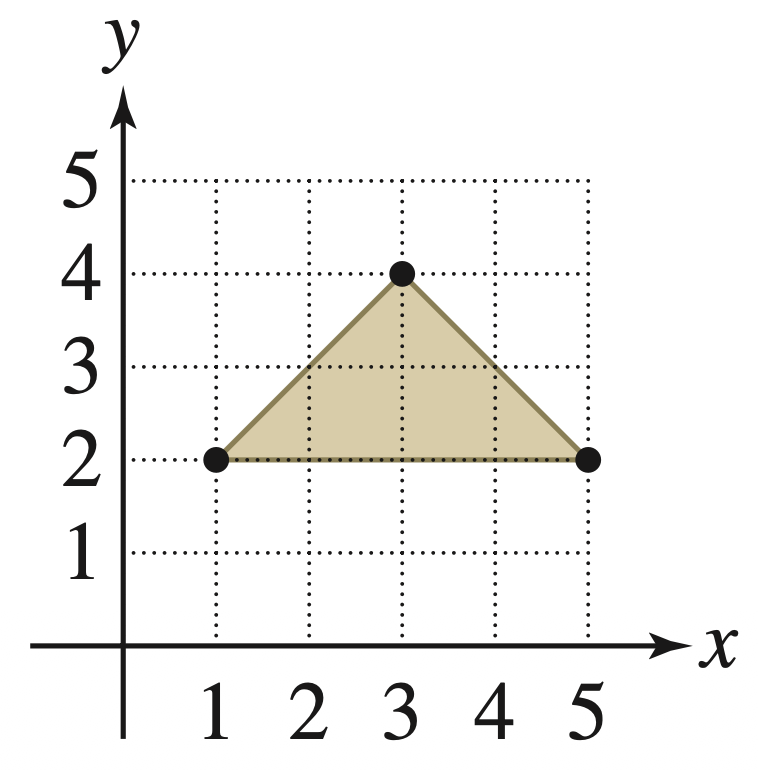
Calculate the double integral of \(f(x,y) = \dfrac{x}{y^2}\) over the triangle indicated in the following figure.
Figure 15.2.17.
Solution.
To integrate over the given triangle, we first need to determine the equations of the lines forming its boundaries. Looking at the figure, the vertices of the triangle are \((1,2)\text{,}\) \((5,2)\text{,}\) and \((3,4)\text{.}\)
Notice that if we treat this as a vertically simple region, the top boundary changes at \(x = 3\text{,}\) meaning we would have to split the integral into two pieces. However, treating it as a horizontally simple region is much easier because the left and right boundaries are consistent from the bottom (\(y=2\)) to the top (\(y=4\)).
Let’s find the equations for the left and right boundaries in terms of \(y\text{:}\)
  • Left boundary (line through \((1,2)\) and \((3,4)\)): Slope \(m = \frac{4-2}{3-1} = 1\text{.}\) Point-slope form gives \(y - 2 = 1(x - 1) \implies y = x + 1\text{.}\) Solving for \(x\text{,}\) we get \(x = y - 1\text{.}\)
  • Right boundary (line through \((5,2)\) and \((3,4)\)): Slope \(m = \frac{4-2}{3-5} = -1\text{.}\) Point-slope form gives \(y - 2 = -1(x - 5) \implies y = -x + 7\text{.}\) Solving for \(x\text{,}\) we get \(x = 7 - y\text{.}\)
Setting this up as a horizontally simple region, \(y\) goes from \(2\) to \(4\text{,}\) and \(x\) goes from \(y - 1\) to \(7 - y\text{:}\)
\begin{align*} \iint_\c{D} \frac{x}{y^2} \, dA \amp = \int_2^4 \int_{y-1}^{7-y} x y^{-2} \, dx \, dy \end{align*}
Evaluate the inner integral with respect to \(x\) (treating \(y^{-2}\) as a constant):
\begin{align*} \int_{y-1}^{7-y} x y^{-2} \, dx \amp = y^{-2} \left[ \frac{1}{2}x^2 \right]_{x=y-1}^{x=7-y} \\ \amp = \frac{1}{2y^2} \Big( (7 - y)^2 - (y - 1)^2 \Big) \\ \amp = \frac{1}{2y^2} \Big( (49 - 14y + y^2) - (y^2 - 2y + 1) \Big) \\ \amp = \frac{1}{2y^2} (48 - 12y) = \frac{24}{y^2} - \frac{6}{y} \end{align*}
Evaluate the outer integral with respect to \(y\text{:}\)
\begin{align*} \int_2^4 \left( 24y^{-2} - 6y^{-1} \right) \, dy \amp = \Big[ -24y^{-1} - 6\ln|y| \Big]_2^4 \\ \amp = \left( -\frac{24}{4} - 6\ln(4) \right) - \left( -\frac{24}{2} - 6\ln(2) \right) \\ \amp = (-6 - 6\ln(4)) - (-12 - 6\ln(2)) \\ \amp = 6 - 6\ln(4) + 6\ln(2) \end{align*}
We can simplify the natural logarithms. Since \(\ln(4) = \ln(2^2) = 2\ln(2)\text{:}\)
\begin{align*} 6 - 6(2\ln(2)) + 6\ln(2) \amp = 6 - 12\ln(2) + 6\ln(2) \\ \amp = 6 - 6\ln(2) \end{align*}
\(\text{Final Answer: } 6 - 6\ln(2)\text{.}\)

15.2.47.

Find the volume of the region bounded by \(z = 16 - y\text{,}\) \(z = y\text{,}\) \(y = x^2\text{,}\) and \(y = 8 - x^2\text{.}\)
Solution.
The volume is the double integral of the "top surface" minus the "bottom surface" over the region \(\c{D}\text{.}\) The top surface is \(z = 16 - y\) and the bottom surface is \(z = y\text{.}\) Thus, the height of our solid is \(h(x,y) = (16 - y) - y = 16 - 2y\text{.}\)
The region \(\c{D}\) on the \(xy\)-plane is bounded by \(y = x^2\) and \(y = 8 - x^2\text{.}\) We find their intersection to get our \(x\)-bounds:
\begin{align*} x^2 \amp = 8 - x^2 \\ 2x^2 \amp = 8 \implies x^2 = 4 \implies x = \pm 2 \end{align*}
So, \(x\) goes from \(-2\) to \(2\text{.}\) The parabola \(y = 8 - x^2\) opens downward and is above \(y = x^2\) on this interval.
Setting up the integral:
\begin{align*} V \amp = \int_{-2}^2 \int_{x^2}^{8-x^2} (16 - 2y) \, dy \, dx \end{align*}
Evaluate the inner integral:
\begin{align*} \int_{x^2}^{8-x^2} (16 - 2y) \, dy \amp = \Big[ 16y - y^2 \Big]_{y=x^2}^{y=8-x^2} \\ \amp = \Big( 16(8 - x^2) - (8 - x^2)^2 \Big) - \Big( 16(x^2) - (x^2)^2 \Big) \\ \amp = \Big( 128 - 16x^2 - (64 - 16x^2 + x^4) \Big) - \Big( 16x^2 - x^4 \Big) \\ \amp = (64 - x^4) - (16x^2 - x^4) \\ \amp = 64 - 16x^2 \end{align*}
Evaluate the outer integral:
\begin{align*} \int_{-2}^2 (64 - 16x^2) \, dx \amp = \left[ 64x - \frac{16}{3}x^3 \right]_{-2}^2 \\ \amp = \left( 128 - \frac{128}{3} \right) - \left( -128 + \frac{128}{3} \right) \\ \amp = 256 - \frac{256}{3} = \frac{768 - 256}{3} = \frac{512}{3} \end{align*}

15.2.53.

Calculate the average value of \(f(x,y) = e^{x + y}\) on the square domain \([0,1] \times [0,1]\text{.}\)
Solution.
The average value of a function over a region is given by \(\frac{1}{\text{Area of } \c{D}} \iint_\c{D} f(x,y) \, dA\text{.}\) The area of the square domain \(\c{D} = [0,1] \times [0,1]\) is simply \(1 \cdot 1 = 1\text{.}\)
Now we evaluate the double integral using an iterated integral. Let’s integrate with respect to \(y\) first:
\begin{align*} \iint_\c{D} e^{x+y} \, dA \amp = \int_0^1 \int_0^1 e^{x+y} \, dy \, dx \end{align*}
Evaluate the inner integral with respect to \(y\) (treating \(x\) as a constant):
\begin{align*} \int_0^1 e^{x+y} \, dy \amp = \Big[ e^{x+y} \Big]_{y=0}^{y=1} \\ \amp = e^{x+1} - e^{x+0} \\ \amp = e^{x+1} - e^x \end{align*}
Substitute this back into the outer integral and integrate with respect to \(x\text{:}\)
\begin{align*} \int_0^1 (e^{x+1} - e^x) \, dx \amp = \Big[ e^{x+1} - e^x \Big]_0^1 \\ \amp = (e^{1+1} - e^1) - (e^{0+1} - e^0) \\ \amp = (e^2 - e) - (e - 1) \\ \amp = e^2 - 2e + 1 \end{align*}
Notice that \(e^2 - 2e + 1\) can be factored into a perfect square, \((e - 1)^2\text{.}\) Since the area of the region is 1, the average value is exactly \((e - 1)^2\text{.}\)

15.2.55.

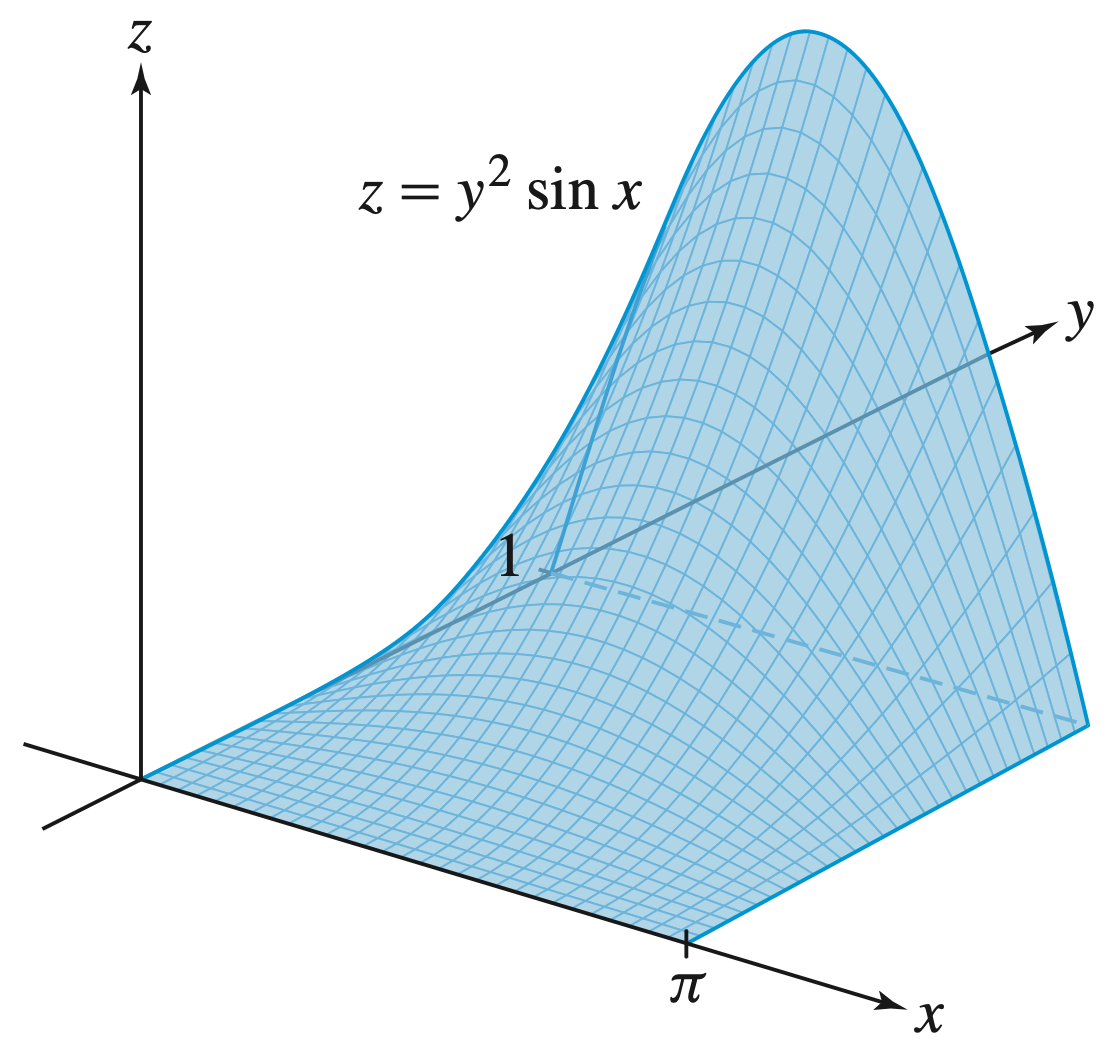
Find the average height of the "ceiling" in the figure below defined by \(z = y^2\sin(x)\) for \(0 \leq x \leq \pi\) and \(0 \leq y \leq 1\text{.}\)
Figure 15.2.18.
Solution.
First, we find the area of the rectangular domain \(\c{D} = [0,\pi] \times [0,1]\text{:}\)
\begin{gather*} \text{Area} = (\pi - 0)(1 - 0) = \pi \end{gather*}
Next, we evaluate the double integral of the height function \(z = y^2\sin(x)\) over this domain. Let’s set it up to integrate with respect to \(y\) first:
\begin{align*} \iint_\c{D} y^2\sin(x) \, dA \amp = \int_0^\pi \int_0^1 y^2\sin(x) \, dy \, dx \end{align*}
Evaluate the inner integral with respect to \(y\) (treating \(x\) as a constant):
\begin{align*} \int_0^1 y^2\sin(x) \, dy \amp = \left[ \frac{1}{3}y^3\sin(x) \right]_{y=0}^{y=1} \\ \amp = \frac{1}{3}(1)^3\sin(x) - \frac{1}{3}(0)^3\sin(x) \\ \amp = \frac{1}{3}\sin(x) \end{align*}
Substitute this back into the outer integral and integrate with respect to \(x\text{:}\)
\begin{align*} \int_0^\pi \frac{1}{3}\sin(x) \, dx \amp = \left[ -\frac{1}{3}\cos(x) \right]_0^\pi \\ \amp = -\frac{1}{3}\cos(\pi) - \left(-\frac{1}{3}\cos(0)\right) \\ \amp = -\frac{1}{3}(-1) + \frac{1}{3}(1) \\ \amp = \frac{1}{3} + \frac{1}{3} = \frac{2}{3} \end{align*}
The total volume under the ceiling is \(\frac{2}{3}\text{.}\) Finally, divide the volume by the area to find the average height:
\begin{gather*} \text{Average height} = \frac{\text{Volume}}{\text{Area}} = \frac{2/3}{\pi} = \frac{2}{3\pi} \end{gather*}

